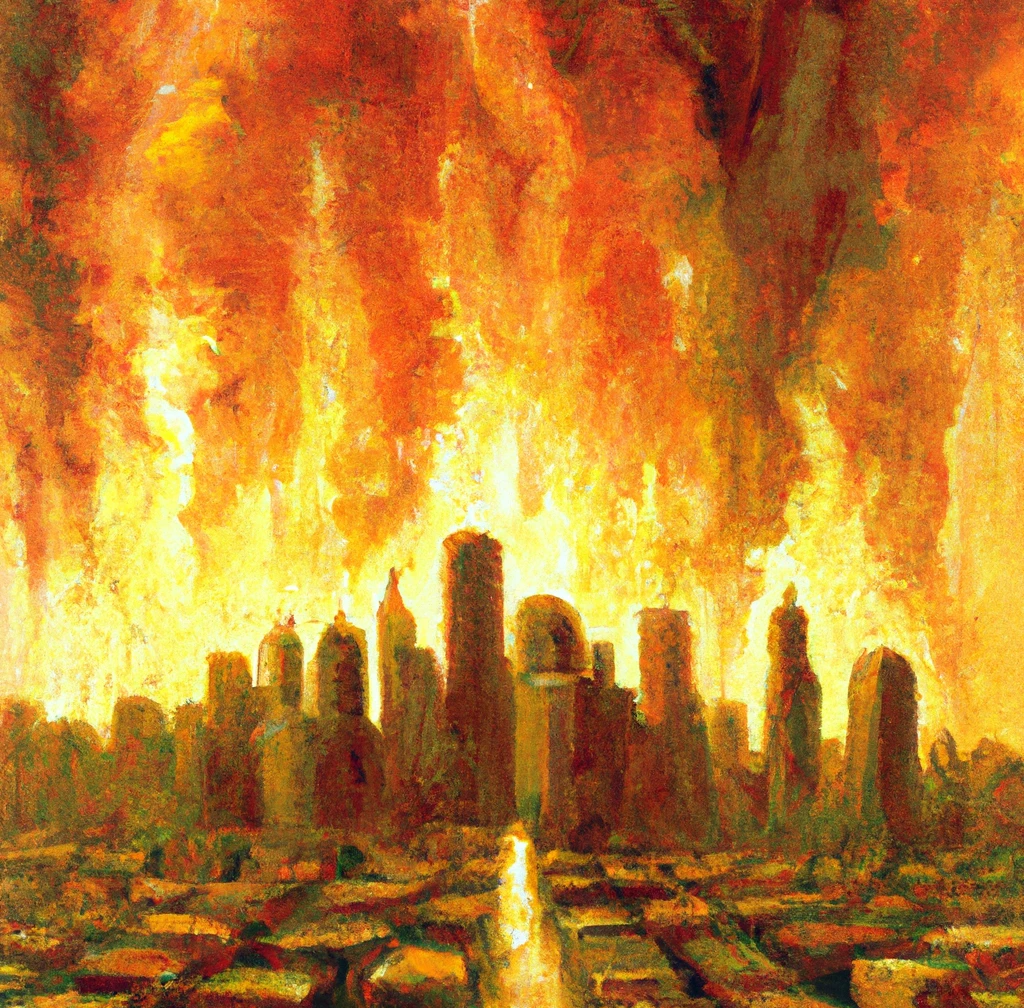
I have already reviewed the account of the Lord’s destruction of Sodom and Gomorrah in my standard scripture study, but the story has been on my mind lately and I wanted to address a few points about it in greater detail. All the verses I will be discussing can be found in Genesis 18-19.
God’s “Haggle”)
What first prompted my thoughts on this story was hearing a celebrity give it as evidence of God’s capriciousness, an example of Him being so petty and heartless that He would bargain and haggle over the lives of His children before destroying them. This is, of course, in reference to Abraham petitioning the Lord if He would spare the city for fifty souls, then forty-five, then forty, etc.
And Abraham drew near, and said, Wilt thou also destroy the righteous with the wicked?
 Peradventure there be fifty righteous within the city: wilt thou also destroy and not spare the place for the fifty righteous that are therein?
So, let me first point out that these accusations are obvious falsehoods, completely misrepresenting the story as it is written. God did not haggle or bargain over how many people it would take for Him to spare the city and He never changed His position on the matter. Abraham’s position changed, but not God’s.
The first thing to note is that God never brought numbers into the matter. He simply expressed His judgment, which was to destroy the city, no numbers attached whatsoever, and it was only Abraham who brought up the idea of sparing the city if a particular number of righteous people lived there.
Abraham wanted to know whether God would have spared the city for 50 righteous, and God assures that He would have… but there just aren’t 50. Abraham wanted to know if God would have spared the city for 45 righteous, and once again God indeed would have… but there just aren’t 45. And so on and so on, until Abraham reaches his own personal limit for mercy: 10 righteous souls to spare the city.
That Abraham presses the matter no further than 10 seems to suggest that he, himself, could not condone sparing the city for any less righteous than that. Even he felt it was justified to lose nine or eight righteous, if it meant that such a terrible evil could be blotted from the earth. And, once again, God shows that His mercy extends as far as Abraham could ever hope for. God, too, would have spared the city for 10 righteous…but there just aren’t 10.
When I read the account in Genesis 18, it is not about God and Abraham haggling, it is about Abraham not yet fully trusting God, and him exploring the limits of God’s mercy until he is convinced that God’s judgment is worthy of his trust. God had pronounced judgment, but Abraham wasn’t able to trust that judgment until he was convinced that God came to that determination by due prudence and fairness, and God indulged Abraham’s tests because He wanted to earn Abraham’s trust.
Thus, there is no haggling going on in this story and no changing of God’s mind. God was simply allowing Abraham to double-check His calculations so that Abraham could begin to learn to trust the Lord’s decisions.
God’s Mercy
And, as it turns out, not only was God as prudent and merciful towards Sodom and Gomorrah as Abraham, He was even more so. For after there were not even 10 righteous in the city Abraham would have surrendered any good souls to their destruction, but God would not. God shows us in this story that He cares for even the individual righteous soul, the 1 over the 99. Thus, while He was determined to destroy the city, first He sendt two angels to draw Lot and his family out of the midst of it.
In the records we have, Abraham never beseeched the Lord for the life of his nephew, Lot, even though he knew that Lot lived in the path of destruction. Abraham seems to have been ready to let his own kin die as a justified sacrifice for this destruction of evil. It was only because God was more good than Abraham that Lot and his family were spared.
A Lesson for Abraham)
Abraham’s willingness to sacrifice the righteous for the greater good returns again later in his story. When God commanded Abraham to sacrifice Isaac, we do not see a moment of hesitation in Abraham’s response. He forthrightly makes preparation, goes to the place of sacrifice, binds his son, and raises the knife to take the lad’s life. Abraham knew that his son was good, but as with Sodom and Gomorrah, he was willing to sacrifice that good to fulfill the demands of the Lord. But then, as with Sodom and Gomorrah, God intervened to save the good and provide another way.
I wonder whether Abraham being commanded to sacrifice Isaac was, in part, a way for God to teach Abraham a lesson that He had tried to teach with Sodom and Gomorrah, but which hadn’t fully clicked yet. I wonder whether Abraham was too quick to believe in the God that would sacrifice good to destroy evil. I wonder if God temporarily assumed that role when He commanded Abraham to sacrifice Isaac, so that He could then dispel that illusion from Abraham once-and-for-all. I wonder if one of God’s lessons to Abraham in that moment was “Stop seeing me as the God of sacrifice, the God of taking, the God of destroying evil. See me as the God of saving, the God that brings back, the God of redemption!”
This is, of course, pure speculation. I don’t claim to know that this was the subtext to Abraham’s trial, or even if it’s likely. It is simply something that I wonder about. At the very least, it does stand out to me that we have no account of Abraham pleading for Lot’s life nor Isaac’s, and yet God saved them both. Whatever else those facts mean, surely they mean that these stories show God’s mercy, not wrath. They show His care, not indifference. They show His compassion, not brutishness. They show that God is a God who can be trusted when He declares His judgment because He has already analyzed the situation more than we ever could, and He cares for the innocent more than we ever would.
 Spiritual Wanderings