Basis for Judgment: Summary

I’ve spent the last week-and-a-half exploring this concept of why we believe the things that we do, and which justifications for our moral alignment are reasonable and which ones are not. Today I’ll wrap things up by reviewing all of the things that I’ve covered.

Our Basis for Right and Wrong)

After contemplating the different foundations people set their judgment of right and wrong upon, I concluded that there were three main bases. A person judges what is right and wrong based on what God has said, or what society has said, or what he, himself has said.

I observed that people in our society have adopted a principle that they must listen to their own heart, determining their own right and wrong to live by. I also noted that usually what we think comes from our own self, has actually come from the society we live in. We tend to absorb the ideas we are surrounded by osmosis and then have those ideas come out of us word-for-word the same as we heard in the public square. Thus, most people end up basing their morals on what society has said, but they think they have based it upon themselves.

But neither individual whim or society’s favor are reliable bases for determining what is right or wrong. Both of them have too much variance and transformation to reflect any sort of objective, universal truth. What is “right” in society today was wrong yesterday, and likely will be wrong again in the future. A cursory glance at history shows us that it’s not as if society only improves, either. Sometimes it gets better, but sometimes it gets worse. Things have been brighter since the dark ages, but things were also brighter before them. Who is to say whether society today is at a local maxima or minima? We might think we know, but some future generation somewhere will surely disagree.

Sooner or later, any who believes that truth is defined by the individual or the society and pursues that logic to its end must come to the only possible conclusion: there actually is no absolute truth, no ideal, no sacred or unchanging standard by which our actions can be judged. Morality is transient and subjective, and any attempt to censure another person as being “wrong” is both hypocritical and vain.

The Proper Basis)

The only logical and consistent basis for moral judgment is God. Only a being that exists outside of the individual or society, one that is constant through all ages, one that is greater than the created world could lay down a law and a morality and a truth that would be consistent and objectively right.

Of course, the identity and exact opinion of that God would still be up for debate, but at least we would accept that truth could only come from some sort of theology. Of course, it would be important to acknowledge that whatever god was the true God, our knowledge of His universal law must transcend from heaven itself. It cannot simply be the idea of some man that this is what God must want, God Himself needs to have dictated it to some persons, and those persons need to have written it down as directed. Again, if such a thing were to occur, it would still be a matter of opinion as to which sacred book actually represents the mind of God, but at least we would accept that the truth could only be read out of the scripture He had given us.

And then, once we felt that we had identified that true scripture, from that true God, describing that universal truth that we are all beholden to, then all competing ideas and philosophies would have to be discarded. Never mind if your loved ones thought you were crazy, or your friends reviled you, or society persecuted you, or the great enemy destroyed you. Because, as we have established, none of those other voices have any foundation to stand upon as they oppose you. Let them think, say, and do what they will, their logic and methods are self-defeating, and all of them will crumble in time.

You, however, will have made yourself an acolyte of genuine truth, and having laid hold of it, you will be united with the only thing that is permanent, the only thing that can stay with you through all of life, and even into the world that lies beyond. Whether you be a Christian, a Jew, a Muslim, a Hindu, or any other believer of divinely-inspired words, hold to that inspired truth above all others, and your existence will surely work out better for you than chasing the ever-changing goalposts of society’s latest fad.


Basis for Judgment: The Foundation

We All Discriminate)

I’ve seen a trend where people are incredulous that those who hold traditional, Christian values could follow and believe the principles that were common in our society until just recently. “How could you believe that outdated doctrine? It’s sexist, it’s homophobic, it’s discriminatory, it’s shaming!”

But people who say such things seem to be oblivious to the fact that we all consider one social behavior or another to be reprehensible. If we list out every controversial behavior, we will all find many things that we discriminate against. Child marriage, eating disorders, slavery, incestuous relationships, bestiality, animal sacrifice, cannibalism, the use of hallucinogenic drugs, polygamy, asceticism, and many, many more. Are there not at least some of these practices that you are staunchly opposed to?

Thus, to some extent, we all discriminate and judge between what is right and what is wrong. The only question, then, is on what basis do we judge the way that we do?

The Religious Basis for Judgment)

For the traditionally religious, the answer is simple. Our basis for moral judgment is that God is our creator. He made us according to a fashion and order that is consistent with His own principles of right and wrong, and He educates as to what morality we must live by to fulfill our design and purpose.

And, if these assertions are true, then what coherent argument could be brought against those who strive to live by the principles given by that creator God? Frankly, it wouldn’t matter what God asked of us, simply the fact that He did ask it would be justification to follow it. Our understanding isn’t necessary, compliance with the modern trends of the world isn’t necessary, and a public vote of approval isn’t necessary. As I have heard others state, if God were to tell me that the way for me to fulfill my design and purpose in life was to stand on my head from this moment on, then that would be what I needed to do. As a creation, living in a greater universe that I do not perfectly understand, I have no basis to disagree. What He says I must follow.

So if God pronounces certain behaviors evil, and other behaviors good, and asks me to live by these principles and testify of them, then that is what I need to do. No matter of social rejection should dissuade me, for society did not fashion my innermost being, nor know the core purpose for which I was made.

The World’s Basis for Judgment)

But what basis does modern society have for the things it condones and the things it condemns? What justification does it have for judging certain behaviors as worthy and others as unacceptable? If we have rejected the belief that we are creations of God, living according to His revealed precepts, then our basis for judgment must be derived from either the individual or the society.

If it is derived from the individual, then there can be no universal truth, for no one believes all the same things as another person. Every conviction that you hold, somewhere there is another person that feels just the opposite, and their “truth” would be just as valid as yours. Or, if you deem their disagreement to not be valid, then there must be something greater that your “truth” is anchored in that theirs is not, in which case what would that be? This line of logic quickly falls apart.

Correct judgment must be based in society then. Whatever the current society has decided is right, then for today that must be what is right. Truth is therefore a matter of popular vote, and no one who lives against the popular consensus can be right. Activists who seek to change society are in the wrong, until they are able to convince a majority of the people to agree with them, and then they are right.

Past generations must have been right in their time, but they have no vote today, so today we judge them to have been wrong. In the past, homosexual marriage was considered reprehensible, but today we are ready to accept it, so now the past generations were wrong in their views. So, too, we will be in the wrong once a future generation votes against the values that we hold today. Thus, if the future societies are willing to accept pedophilia, self-mutilation, or the killing of undesirables, then they will be right to do so, and we will then be wrong to have ever stood against such things.

Are you willing to accept this view? If not, what outer principle can you point to that would still make these behaviors and lifestyles wrong, and would condemn an entire future society that feels otherwise?

A Sandy Foundation)

If we reject the notion that God is our creator, that we are made according to a particular design, and that the principles or right and wrong come from a universal truth which is interwoven through our beings, then what better foundation could we tie our principles to? What universal anchor does the man who denies he is a creation of God have for decrying any of the practices he considers abominable?

None. Once we let go of the fundamental truths of who we are and what we have come from, then all morality is transient. Our principles are not set in stone, but in sand, an obscure outlier in the greater scheme of things.

Christ saw this very conundrum two thousand years ago. We will finish today with his famous illustration in Matthew 7:

24 Therefore whosoever heareth these sayings of mine, and doeth them, I will liken him unto a wise man, which built his house upon a rock:

25 And the rain descended, and the floods came, and the winds blew, and beat upon that house; and it fell not: for it was founded upon a rock.

26 And every one that heareth these sayings of mine, and doeth them not, shall be likened unto a foolish man, which built his house upon the sand:

27 And the rain descended, and the floods came, and the winds blew, and beat upon that house; and it fell: and great was the fall of it.

Basis for Judgment: A Creation of God

I finished yesterday’s post by pointing out that if man tries to make himself the final power and authority in the universe—which would be to make himself god—then he must supplant his connection to actual divinity. If he would exalt himself, he must pave a ceiling between himself and heaven.

The Inner Voice)

But let’s look back even further than yesterday’s post. I mentioned at the start of this series that our society has developed a strong emphasis on everyone needing to “listen to their own heart,” and be “true to themselves.” Once I might have agreed with this notion wholeheartedly, but the words inside of these phrases have gradually changed their meaning. We used to mean that people needed to listen to the conscience as their heart, that they needed to be true to their divine selves. But today we’ve taken away the notion of an external voice that whispers within us, and now when we tell people to look inward, they think we mean narcissistic navel-gazing.

The fact is, there have always been two voices inside of us: the divine influence and the selfish desire. “Listen to your heart” was only useful advice when it pointed towards the first of those two inner voices. It becomes a great misguidance when attributed to the second. This misguidance is pernicious in that it so closely resembles what actually would have been good advice.

Spiritual Without God)

This subtle shift can perhaps be seen most clearly in society’s shift away from organized religion. “I’m spiritual, not religious,” we hear parroted over and over, but what does that really mean? From what I see, it appears to mean that the person still has a sense that she has a spiritual element, but she does not accept that she is a creation of God.

Yet each of us is a creation of God. This is the fundamental belief that we have lost, and that is very concerning, for it is the fundamental belief. The most fundamental, core principle of our identity must be where we are from. If we are from God, then it absolutely behooves us to understand who God is, what He is like, and what He created us for. And if He has told us these things, and if His voice is one of the influences that lives inside of us, then we must assume that following His instructions would bring us, His creations, the greatest fulfillment and purpose that we are capable of. If we truly are from God, then there can be no coherent argument to abandon Him just because society has decided something else.

To say that you are spiritual, but not religious, to say that you believe in the divine self, but not the divine creator, is to appreciate the beauty of the tree while cutting it off at the roots. It is to lay hold of something that is true and good, but to sever it from its sustenance, and before long it will wither and lose what originally attracted us to it. We can live without the belief that we are a creation of God, and we can even convince ourselves that it is so, but none of that will change our soul from still needing Him.

Basis for Judgment: Assuming the Divine

Yesterday I started to speak about the difference between humanity and machines. It makes no difference to a machine whether they are used for their intended purpose or an adulterated one. Machines do not even care if they are used in such a way that destroys themselves. Machines do not have any objective truth ingrained within them.

Humanity, on the other hand, possesses all these things. It matters that we function as designed, that we do not destroy ourselves, that we are in alignment with the truth that we are built from. Misalignment in any of these categories causes frustration, depression, and culminates in real tragedy. Real hearts become broken, real potential becomes lost, real tears are shed.

Our society is taking apart its own foundation under the logic that there is no such thing as objective truth, that no principle is sacred, that every belief can be discarded without consequence. But if this is true, then by that same logic, all of the new philosophies being championed today also have no objective truth, are not sacred, and can be discarded without consequence. If you argue that Christianity has to go to make a better world, then you are conceding that there is such a thing as better, which is also to concede that there is an ideal, which would bethe end result of following every “better.” And what would the ideal be based on if not objective truth? What would the ideal be if not sacred? What would the ideal be if not undiscardable? To claim that there is a better, is to claim that there is an ultimate destination, and that must be sacred.

Of course, this isn’t to say that all traditions must be sacred, or all traditions must be superfluous. To be sure, the world does at all times and in numerous ways need to change. There really are traditions that are not aligned to truth, that are not sacred, that can be discarded. Sometimes massive overhauls have been necessary to bring mankind closer to objective truth and the ideal. All of this is true, but then these changes ought to be grounded in universal truth and the ideal. Historically, our greatest reformers understood that the only reasonable justification for change was to show that it was tied to the divinity that encompasses us all. Just look at a few key examples here in America: the founding of our nation with its basic freedoms, the abolition of slavery, and the civil rights movement. These were all based on the notion that some tradition or status quo needed to change to bring humanity closer to the universal truth that it was created from. Most of the main figures in these movements justified the new principles by showing how they were based in scripture or theology, that they were principles given by God Himself, thus showing that the change was bringing us closer to what was universally right.

Sadly, this is not the mindset that much of the social change in the western world takes today. The 1960s represent a turning point in how we have justified change and social “improvement.” Martin Luther King, Jr. was one of the last of a dying breed, a spiritual man who sought changes based on a reasonable understanding of universal truth. He is deservedly revered today, but we do not follow his example well. Even during his lifetime, a more base template for effecting change was emerging, coming into full swing as the sexual revolution. Here was a fundamental upset to the established order, based not on alignment with God, but with the self.

Things have only continued in that deplorable strain. Our society has since championed all forms of promiscuity, infidelity, sexual perversion, identity confusion, and self-worship. To accomplish this, society has cast down principles of self-control, public decency, innocence of the youth, the life of the preborn, religious tradition, responsibility and duty, and love of country. Society has not made these changes in the name of alignment to some higher power or greater truth, but by claiming that the self is the highest power and greatest truth. Man has become his own god, and in so doing, denied his connection to true divinity.

Basis for Judgment: Today’s Social Waves

Thus far I have examined the shifting beliefs and philosophies of the world, and how we tend to be changed by them over time, constraining our thoughts to certain patterns so that we stop being able to conceive of other alternatives. In my perspective, basic Christian and traditional principles are becoming progressively unfathomable to the western world.

I will be specific. Abortion, gay marriage, transgender medical procedures, euthanasia, and complete uniformity in the nature of men and women. These are the main social waves that I see taking our western world from its foundational Christian values. Some of these are firmly in opposition with Christianity, others are only at odds dependent on the degree to which they are pursued.

I believe that the media overemphasizes the conversion of the world to these agendas, presenting these as closed cases, when the battle is actually very much alive. Unfortunately, the media is the community that primarily surrounds and shapes us today, and what it presents as a decided principle tends to become the social reality soon enough.

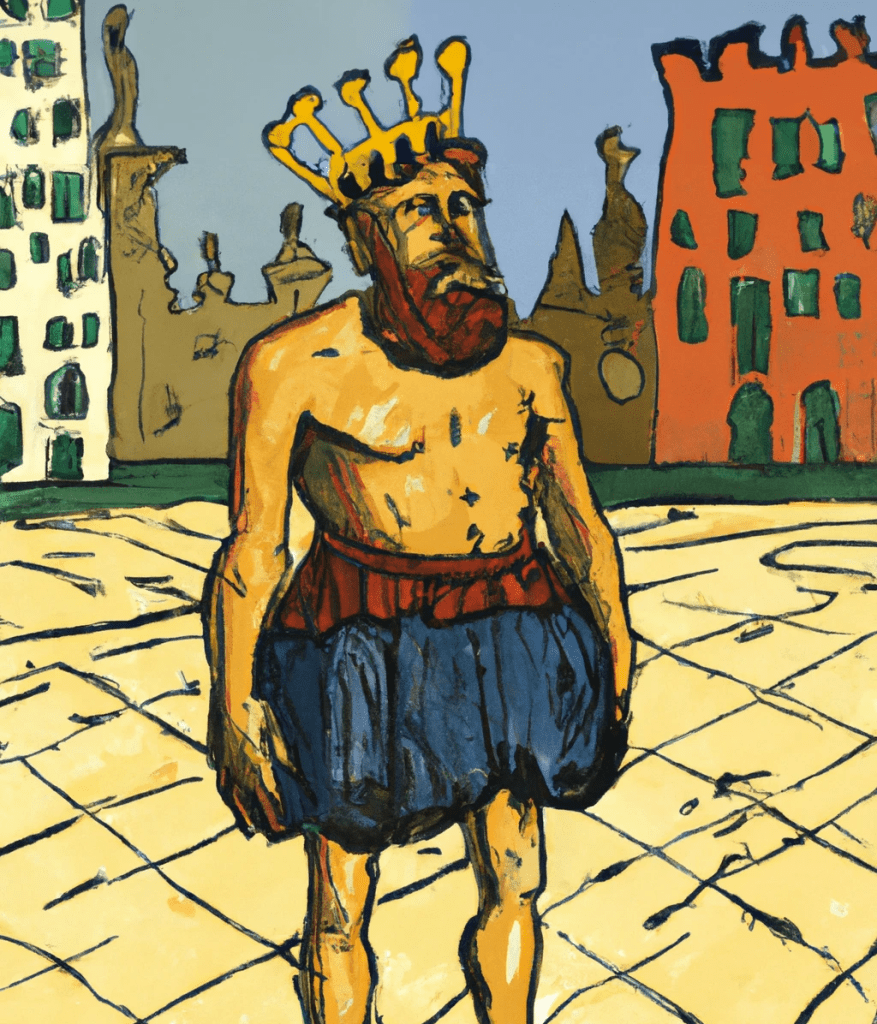
Earlier, I discussed the parable of the Emperor’s New Clothes. Take any of the issues I mentioned above and replace the “clothes” with that philosophy. The media insists that everyone else already sees the “Emperor’s clothes”, and the individual comes to believe that everyone really does. The individual feels that there is something wrong with himself that he does not see the clothes, so he advocates for the clothes even if he does not actually see them. He describes them by simply parroting the descriptions that others have said. Most shockingly, in time he may come to truly believe that he does see them, too.

And what is the harm in all of this? Why is it at a bad thing if we as a society evolve and embrace new ideas, even if it means throwing out the theologies of old? We have discarded many antiquated beliefs, such as our superstitions, and we consider that a good and progressive thing, so why not this? Why can’t everything be cast aside if it is deemed outdated and replaced with what the masses decide is good for now?

I concede that there would not technically be any harm in this if we were merely machines changing software. To the computer, there is no difference between running its original programming or running malware. It continues happily either way, because the wires and bits have no objective truth to follow. Any failure to fulfill the purpose of their designer makes no difference to the dead material that composes the machine. Even if a virus causes the machine to run overly hard until it completely breaks itself and ceases to function at all, the machine does not care.

But mankind is not this way. Mankind is not a machine. Mankind is inseparably connected to its creator and to an objective truth, and the destruction of mankind is of great consequence. We will explore this more tomorrow.

Basis for Judgment: What Comes Out of a Man

I have discussed how we tend to be shaped by our cultures, how when most people move from one place to another, they will gradually morph from the beliefs of their old community to the beliefs of their new one. I have discussed how this occurs slowly, by osmosis, gradually constraining our perceptions and imaginations until we cannot conceive of other alternatives, and the only sensible way of living seems to be the one that we currently follow.

Of course, one does not have to move to change their perceptions. The places that we live are themselves of a transient nature. Through years and generations, new philosophies arise in the same place, and what once felt like home now feels strange and unfamiliar. Here again, most people will adapt to the new norm, which is a problem if the new norm is perverse or built on lies. Without even knowing it, the general populace will gradually defile themselves, inhaling the polluted social air until it fills them.

This brings to mind a saying from Jesus: “Not that which goeth into the mouth defileth a man; but that which cometh out of the mouth, this defileth a man” (Matthew 15:11). In this I read that it is inevitable for us to be surrounded by the corrupt philosophies of the world. We are going to consume bad thoughts and bad ideas in our daily life, and that’s unavoidable. But that does not have to mean that we, ourselves, must also be corrupted. Where we should be concerned is when we start to hear those false perspectives coming back out of our own mouths. Then we know that we have not only consumed, but have also been converted.

I have seen people who tend to be more resistant to this change, who hold to their convictions, even though it makes them unusual in their changing society. It is rare to keep oneself anchored when corruption permeates us as a way of life, but it is possible. At least, it is possible when one is intentional about holding to what is true. If one is idle and inattentive, they might hold out a little longer than others, but I do believe they will lose their grip eventually. Being properly anchored to what is true is something that we must practice actively.

Basis for Judgment: Constraints of Thought

Yesterday I mentioned that most people are only socially converted to their beliefs. They gradually, through osmosis, adopt the faith, the principles, and the paradigms that their society repeats to them. Perhaps even more importantly, they adopt the limitations that come with society’s beliefs.

When we hear a falsehood repeated enough times, it goes from sounding strange and offensive to familiar and comfortable. And when our mind becomes aligned with any principle, true or false, it establishes boundaries to reject any competing notions.

The Emperor’s New Clothes)

One of the great allegories for our day is the story of The Emperor’s New Clothes. It’s widely recognized as a lesson on peer pressure and vanity, but there is another important detail in it that we must not miss: the people are duped into participating in the grand lie because they have boundaries set on their minds to keep them from seeing that it is a lie.

Remember, the yarn that is spun by the swindling tailors is that the fabric can be seen only by those who are worthy. After the first servants and counselors confirm that they do see the clothing, bounds start to be laid on everyone else’s thinking. Everyone just assumes that if they cannot see what the others do, then it must be because they are unworthy. They have had blinders put on them by the social pressure of others’ claims, such that they cannot even consider the possibility that everyone else is lying. The notion doesn’t even cross their minds.

This lie by the tailors is particularly effective because it preys upon the insecurities of the villagers. “Impostor syndrome” is a common sensation that falls upon us all. None of us are so clever or so good as we would like to be, nor so much as most of us pretend to be. Everyone feels a fraud inside, and so not seeing the Emperor’s clothes, and by extension being told that they were unworthy, only confirmed what the villagers had already suspected about themselves and they didn’t even try looking for other options.

This is why it is a young boy, still innocent and with no self doubts, who is finally be able to see through the charade. The idea that he would be unworthy was the notion that could not cross his mind, and so he was able to rightly see the truth of the matter. And when he did, it was not only the king who had his nakedness exposed. Every villager now knew that his neighbor was full of self-doubt and shame, and would absolutely lie to hide it.

Basis for Judgment: Proper Alignment

I am going to pause my analysis of Exodus for eight posts, so that I may cover a topic that's been weighing on my mind recently. Today I will begin my discussion on what we ought to align ourselves to in life, and the dangers that follow when we are misaligned.

***

There are a considerable number of Christians who become distressed and divided between the commandments of God and the principles they have been taught by society. Once these two sets of voices were nearly enough aligned that one could blend them with only moderate twisting of the self. Today, they are more firmly at odds to one other, creating an impossible divide, and a person feels they must choose one or the other.

The Unrealized Influence)

Given the choice between the commandments of God and the principles of the world, many end up hearkening to the world, but do so under the assumption that they are listening to their own inner voice. This is a defining characteristic of our world today: that everyone must be “true to themselves,” choosing “what they know in their heart to be right.” And while there is a wisdom to this thinking in theory, one has to acknowledge that most of the convictions that come out of us did not actually originate from within our hearts at all.

We are highly social creatures, and we gain our perspectives and beliefs from our surroundings, subtly and invisibly, by osmosis. We might be surrounded by voices that stress principles we do not originally agree with, but over time, without recognizing why or how, we will start to hear the same arguments coming out from inside of us. We are convinced and converted without ever realizing it.

The Pull of a Culture)

I saw this firsthand when I was a missionary in the West Indies. I visited many countries and districts. Some were primarily Christian, some primarily Hindu, and some primarily Muslim. A common phrase in each area was “born an X, die an X,” where X was the predominant religion in that region.

But the saying wasn’t true. I know this because when I transferred to other areas, I would find people who had moved there from the same place that I had left, and usually they had given up their old religion to adopt the new one that surrounded them. And this went in every direction. Hindus to Christians, Christians to Muslims, Muslims to Hindus, etc. The locals that never moved were firmly convinced that they could never change their beliefs, but the evidence suggests that their stalwartness was most often due to their environment more than their personal convictions.

And this doesn’t just have to do with religion. Travel to different places and you will see that attitudes coalesce from the community towards science, education, politics, justice, lifestyle choices, and every other domain that people have opinions on. Spend long enough in these places and you might find yourself starting to think the same way, too.

The fact that one can move to a different environment and change their beliefs does not condemn the original value system, nor elevate the new one, it merely shows that most people are socially converted only. Yet they say to themselves, “I’m just listening to my own heart.” In truth, what they are listening to is what their heart has been constrained to believe by their culture.