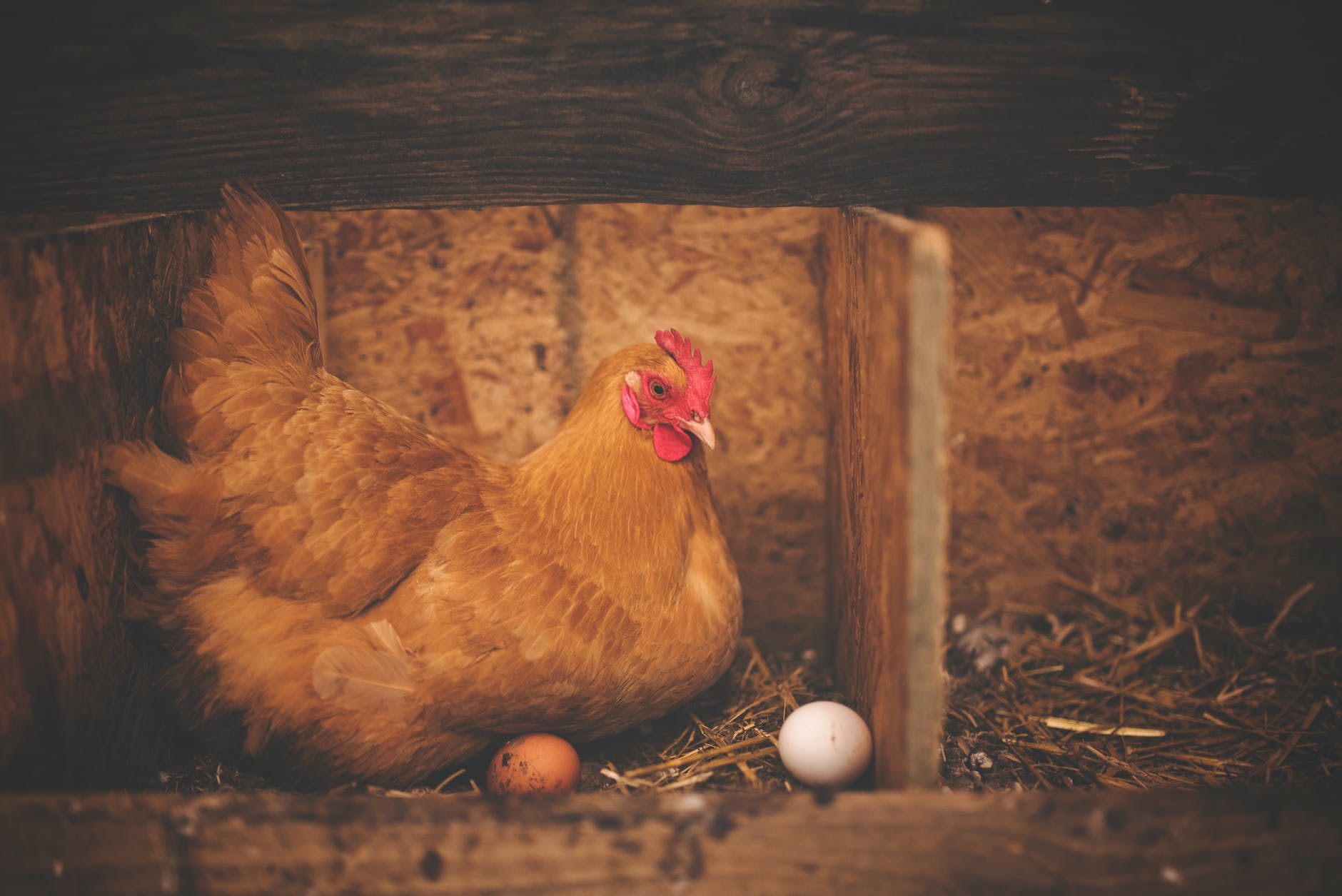
The Paradox)
We’ve all heard the classic dilemma, “which came first, the chicken or the egg?” Most people merely see this as an amusing puzzle, and quickly discard it as having no suitable answer.
But really, it is a very serious question, one that was posed by Aristotle himself over 2,400 years ago! The fact that we are still talking about it to this day, and still shrug it off without any clear explanation is a very alarming fact!
Now, to the creationist, the question really isn’t that troubling. If God created the Earth, the atmosphere, the seasons, and the universe as we know it, is it really any stretch to say that He could have architected the egg-bearing chicken also? And whether He did that with an egg or a mature fowl doesn’t really matter, He could have begun with either without any paradox.
But the materialist throws out the idea of an omnipotent creator, and puts in His place the forces of undirected, spontaneous evolution. Darwinism states that neither the chicken nor the egg came first, but a single-celled organism which, through a lengthy process of mutation and natural selection, developed into the species that we now call the chicken.
And I might concede that this would be a possibility, if we could agree that the evolution would have to have been a tool purposefully directed by the hands of an intelligent creator. But if one insists that this evolution occurred totally at random, which is the position of modern science, well that’s just plain ridiculous.
The Requirements)
Again, the proposal is that the chicken would have had to originate as some sort of single-celled organism, one which reproduced by dividing itself in half, but eventually it evolved into a creature that reproduced itself via a fertilized egg. This would mean that at some point in between there would have been a creature that still reproduced asexually, but which was also gradually developing sexual organs. Organs that eventually were able to produce and lay an egg, but initially this egg would not yet have been functional.
This means that the pre-chicken was expending energy and effort, giving up nutrients of its own body, subjecting itself to a more vulnerable state, all to produce something that was—for the time being—useless. And again, this might be acceptable if some Higher Power was requiring the life form to undergo this process, but it according to the laws of natural selection, this would mean that the species had a detrimental mutation which would have led to its extinction, not to its flourishing. This unnecessarily-handicapped pre-chicken simply would have been overrun by all the other variants that weren’t wasting energy laying undeveloped eggs.
And that’s just the matter of the chicken and the egg. But by itself, a female chicken still cannot produce a fertilized egg. Just as the species would have had to evolve from a replicating cell into a chicken that had embryonic and adult stages, it also would have had to evolve itself into male and female forms also. Thus it had go from being sexless to having sexed versions, but at least for a time those two halves would still have been reproducing asexually until they evolved into full sexual maturity. That means that there would now be two separate strands of random mutation, each evolving separately from one another, but somehow also in perfect tandem, developing in complementary ways, remaining compatible with one another once they both reached full sexual capability.
A Valid Question)
So as it turns out, the childhood question of “which came first, the chicken or the egg?” is actually a very weighty matter. It has all manner of scientific and metaphysical implications. 2,400 years later it still pokes holes in the most airtight theories of man and leaves us either with a stronger belief in our divine creator, or else a greater confusion of this inscrutable world.
 Spiritual Wanderings