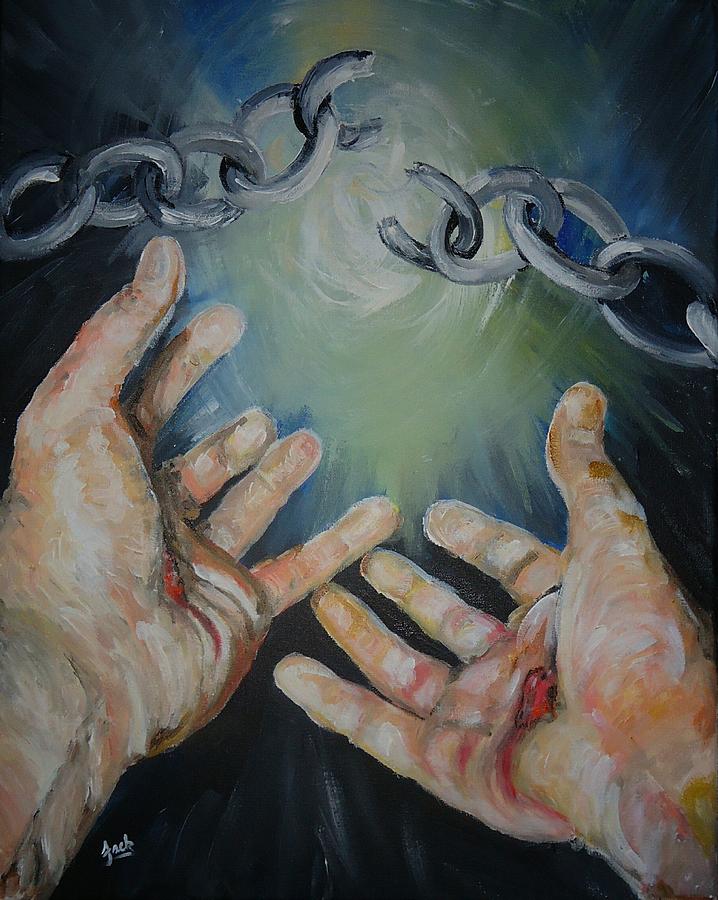
Two Kinds of Freedom)
At first glance, Genesis Chapter 38 seems like a strange anomaly in the Biblical record. It interrupts the narrative of Joseph right after he is sold into Egypt to tell the sordid tale of Judah’s family. Its plot unfolds like a trashy soap opera, culminating in Judah’s own daughter-in-law seducing him and conceiving twins. Once the chapter ends, we are whisked back to the main story of Joseph, just in time to hear about his experience in Potiphar’s house.
Genesis Chapter 38 only makes sense when it is viewed in the context of that broader narrative involving Joseph. I do not think it is a coincidence that it is placed right after Joseph is cast into slavery, and right before he rejects the advances of Potiphar’s wife and is cast further down into prison. His narrative and Judah’s provide a perfect contrast. On the one hand, Judah is physically free, but a slave to his immorality. On the other hand, Joseph is physically captive, but still the master of his own soul. Thus, the record is presenting two kinds of freedom and two kinds of slavery, and implicitly asking the reader, “which of these is truly free?” The correct answer, of course, is that Joseph is truly free, for though he is a slave an in prison, he is free in his inmost parts, while Judah is not.
Of course, the story is not presenting physical captivity as a good thing, mankind is meant to strive for all layers of freedom, but if a man wishes to be truly free, he must at the very least be the master of his own self. Any man who does not have moral control over his own appetites is fundamentally a slave, no matter the rest of his situation.
A Modern Misfocus)
Today, in our western culture, we have a great commotion of perceived shackles and demands for freedom. On the one hand, the white male is accused of still reaping the benefits of historical slavery and patriarchy, enjoying a higher freedom than women or most other races. On the other hand, we hear of blue-collar workers, predominantly white males, sick of being society’s punching bag for decades, sick of having their strings pulled by society’s elites. And then there are conspiracy theories that even those elites are for the most part powerless, their votes and influence bought and paid for by blackmail and bribery, shadowy corporations directing things from behind the scenes.
Everyone, it seems, isn’t as liberated as they would hope to be, and the majority of public discourse is set on the pursuit of freeing one class or another. It is an obsession that I believe our ancestors would find laughable, given that we are the freest people that the world has ever known. We are fighting over the slimmest margins of injustice, many of which are imagined, and we show no appreciation for the fact that our ancestors gave everything for just a fraction of the liberty that we now enjoy. Without devolving into complete lawless anarchy, we are about as free as it is humanly possible to be.
Or, at least, we are free physically. Spiritually and morally, though? We are a society that is absolutely enslaved to our appetites, to our devices, to our distractions, to our immorality, to our self-justification, to our anger and pride. We are simultaneously one of the freest and most enslaved people the world has ever known; and our focus for liberation is in completely the wrong area.
To Be Truly Free)
Perhaps we are so obsessed with our perceived injustices because our spirit accurately identifies that something is holding us down, but our heavy-lidded eyes can’t see past the physical to realize it is our lack of moral will. We settle on the assumption that it must be a physical shackle simply because we lack the imagination or the courage to consider a spiritual one. We are, therefore, a modern-day Sisyphus, doomed to an eternal effort that never achieves anything.
If we truly cared to be free, the great commotion of our time would be one of spiritual ministry. We would seek to convict the world of its sin as an act of kindness, waking up all to their true taskmaster, and the true liberation from it. We would strive as a community to abandon our shrines of distraction and learn how to rise to a collective moral mastery.
Then, and only then, we would be truly free.

 Spiritual Wanderings