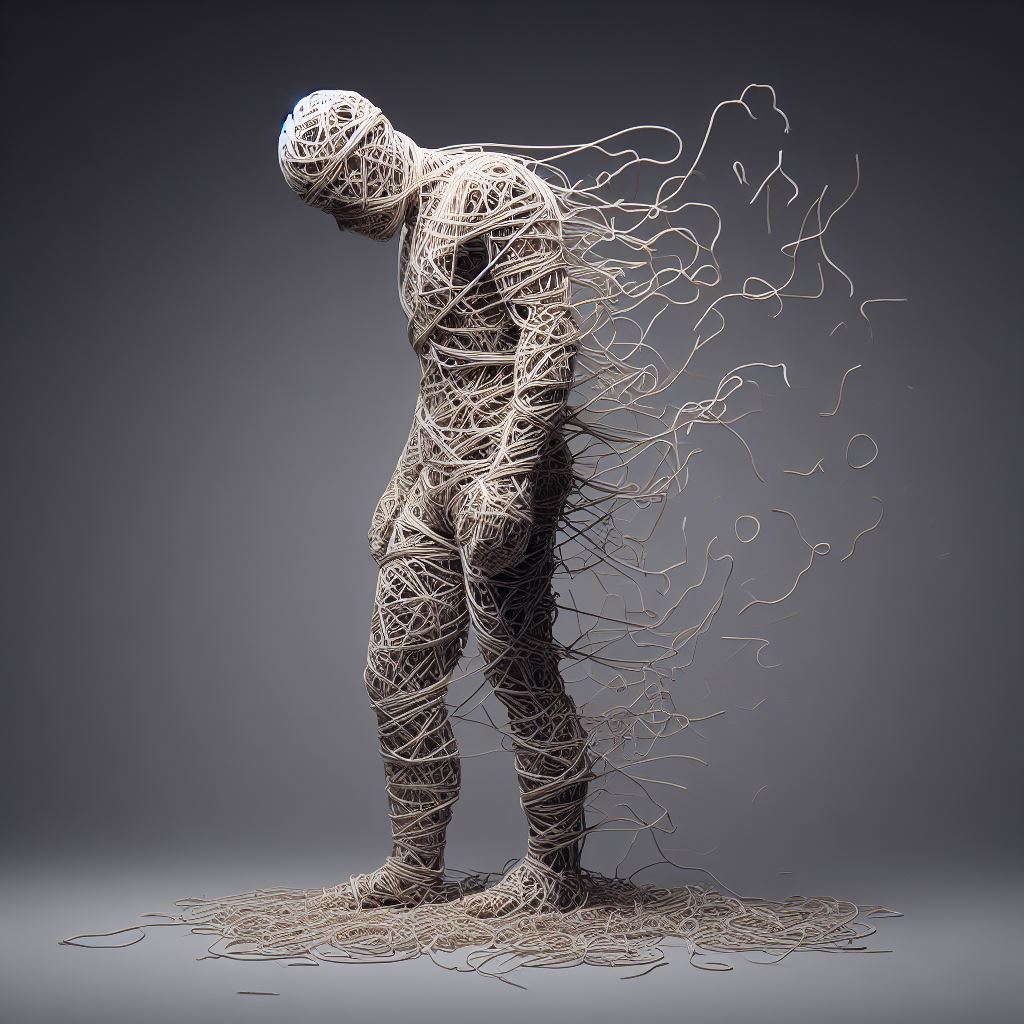
Inside Out- Internal Control

Yesterday we talked about the external influences that society puts on us, molding us into decent and productive citizens. We talked about how there is great good in this, and that we ought not to do away with it. However, we also discussed the limitations of external influence. How it can allow for a society of moral behavior, but inwardly immoral people. How it can be eroded, and when that happens, horrors follow.

Internal Control)

True stability in society requires internal control. It requires people to be inwardly converted to the principles of morality and civility, who will self-govern themselves, no matter what the laws or social norms say. Thus, laws of the land may be important, but laws of the heart even more so.

Consider how Jesus’s words align with this. “Do ye not perceive, that whatsoever thing from without entereth into the man, it cannot defile him; That which cometh out of the man, that defileth the man,” (Mark 7:18, 20). We can infer that the opposite of this statement is also true, it is not that which goes into a man, but comes out of him, that justifies him and proves him good. It is the choices from the inner place, not the outer, that truly matter.

Notice, then, how sensible the work of missionaries and proselytizers is. They do not go to change public policy, to lobby for laws, to influence the external controls. They go to the individual, convict them of moral sin, reintroduce God to heal what is broken in the heart, and leave a soul that is personally committed to doing what is good. It is hard work and is only effective on those who are open to it, but it is the most important work to maintain the fabric of our societies, let alone the saving of souls.

A Warped Priority)

You would think that we as a people would have learned the importance of this work. That we would trust that as we focused on the individual soul, that the collective society would improve. That as we fixed what is inside, all of the outer peripheries would correct themselves on their own.

As one who gave two years of my life to missionary efforts, I can tell you that that is not the case at all. Opposition to proselyting efforts, and a desire to banish them is everywhere. Both from governments and individuals. Not only this, but we live in a time where people who do have a strong moral compass are often ridiculed or considered suspect. Instead, people crave more legislation, more external control, more outer force, particularly on those they disagree with.

As discussed yesterday, this is a very dangerous attitude to take. The more society discourages and tears down internal control, the more its people will be uprooted from true morality, the more wildly they will start to swing, and eventually they will surely fall to debauchery, perversion, and destruction.

In summary, this question of inner or outer moral convictions may seem a small and simple thing, but its long-term implications are far-reaching. All of us should be sharply aware of our own reliance upon internal or external controls, and also our society’s. And for both ourselves and others, the most important work is to heal the heart within, connect God to the inner man, and establish internal moral control.


Inside Out- External Control

When we try to modify a person’s behavior by external influence, we are trying to change them from the outside-in. When a person changes their behavior by a transformation of their personal values, they are being changed from the inside-out. You perhaps have heard of this concept in psychology as having an “external locus of control,” which is when behavior is controlled by outside influence, or an “internal locus of control,” which is when behavior is controlled by personal conviction. Today we will consider the benefits and shortcomings of the first of these and then examine the second one tomorrow.

Social Order)

An external locus of control is often presented as inferior to the internal, and it is, but that doesn’t mean that it is necessarily a bad thing. Punishments for crime serve as a deterrent for serious wrongs, and social pressure keeps us civil and fair in our everyday interaction. It’s impossible to say how much our conduct would deteriorate without these external influences, but most of our worst behavior comes out when we think we’re alone. Thus, external pressure helps us behave better, even if it doesn’t make us be better.

An external locus of control is part of the glue that holds a society together. It is first introduced to us when we are very small children, where we are made to follow rules like not hitting others, and sharing our toys, and saying polite things. It provides us a template for how to interact with the rest of the world to our mutual benefit, such as by maintaining positive relationships, remaining employed, and contributing to public safety.

As you can see, this external influence is not only about discouraging bad actions but also encouraging positive patterns that benefit everyone. As such, I think there will always be a place for it, and we can be grateful for the good that it does. That being said, it’s limitations must be acknowledged as well.

Morality Without Morals)

If each person had only an external locus of control, then it would be possible to have a society that was perfectly moral in its behavior, but where no one was actually moral. People would behave only because it was the most beneficial thing to do but would likely abandon all morals once there was an advantage to do so.

Now I do not believe in a society where everyone fits that description, but some of the people do. And I fear the percentage of people who are only moral because of social pressure is increasing. Jesus described such individuals when he said, “for ye are like unto whited sepulchres, which indeed appear beautiful outward, but are within full of dead men’s bones, and of all uncleanness,” (Matthew 23:27). Thus, we live in somewhat of an illusion of civility, and every now and again the mask slips, and we are terrified to realize that we live in a society dotted with psychopaths and monsters.

There are two great fears for the society that is primarily dependent on external controls for its morality. First, that those external controls will erode, and will be discarded one after another, until all pretenses of civility are gone. The second is that the people will simply become numb to the external controls. One fateful day, they just won’t care about them anymore, and once a significant percentage of people throw off common decency, even if they are a minority, it will become a snowball effect, a race to the bottom to maintain personal advantage at the expense of all others.

In short, there is real value in external influences for good, and I believe it is worth defending and strengthening them. But it is not the ultimate answer. For that, we must look to tomorrow’s post.

Fickle Popularity

I may not be very old, but I have already witnessed the way society can swing from one trend to another. I see the masses scramble onto today’s favored platform, only to be embarrassed when it becomes tomorrow’s laughingstock.

I believe that a key component of this is that too often we choose our stance more off of who else is standing there, and not by the merits of the platform itself. The fact is, there are values to be respected in most every position. Conservatism and liberalism, inclusivity and solidarity, faith and skepticism, individualism and collectivism, a solid case can be made for each of these, and it is my personal belief that the correct position comes by taking the good parts of each.

But balance is not the typical position of society. Typically, people go all in on one or another, believing that they do so because of their commitment to its underlying ideals, but more so because of the attractiveness of the community that is built upon it.

Whenever a platform becomes too popular, it starts to attract “all kinds.” Some of the meanest and least understanding jump onto it, and they bring out all the worst extremes of that particular ideal. The rest of society can see the growing ugliness in that position, and so they take up the opposition. In order to escape the depravity of the old platform’s worst tenets, people fully commit to its opposite, until it becomes the popular thing to do. As the masses invest in that side, then they also start to attract even the uglier parts of society to their platform and the cycle repeats, over and over again.

Playing this game is exhausting. Great effort is made, but any short-term progress is eventually undone by an over-correction in the other direction. It’s a pity, because I don’t think it has to be that way. I see the potential for mankind to balance one another out, to elevate the most powerful ideals in each platform, but to circumscribe them by the bounds of all the others. By this I believe we could continually progress towards greater and greater virtue, rather than rising only to fall as has been our historical pattern. I believe this unified progression is a vision of heaven, the society that we shall have when our Lord reigns supreme.

Creating Our Own Monsters

People play a dangerous game when they insist on casting entire demographics as villains. I have seen several examples in society of everyday people that wish to “just get along” being accused of actually being the enemy. Ironically, those that take the route of disingenuous accusation tend to summon the very evil that they fabricated. They are crushed by their own myth.

Different cultures will call certain races inherently evil. Sexes are encouraged to see their interaction as inherently adversarial. Members of a caste are despised simply for being of that caste. In all of these examples, the accused are told that their lack of personal transgression does not absolve them, they are covered in sin or blood no matter what they do, fundamentally evil since the day they were born. We are told that some groups are just against other groups, always have been and always will be, and that’s all there is to it.

Division in the West is growing rapidly, and we are becoming a more race- and gender- and class-obsessed people. In earlier times we were been more willing to look past what another person is to see who another person is. I’ve recognized in myself how when speaking with others I tend to wonder what they are wondering about me, whereas before I would just speak as though we were one and the same.

Ideally we would be able to reject the false accusations out of hand. We would refuse to adopt propositions about ourselves or others that we do not believe in. We would continue to live good and wholesome lives, treating all as equals, letting the inaccurate labels just slide off our backs. But the more society pushes certain demographics to hate other demographics, the more the hated are going to accept that the haters are their true enemy. And when enough people accept these opposing side, horrible things will follow.

We may have to grapple with terrible monsters then, but it will be monsters entirely of our own devising.

Those Who Cannot Do, Deconstruct

The Human Nature)

It is in our human nature to advance and improve. We are never content with the accomplishments of the past, we always seek to be better and better. We are a race of inventors and innovators, creators and pioneers. Entirely new branches of science, technology, medicine, and mathematics are constantly being opened, and old branches pushed further than ever before.

This is a divine characteristic within us, linked to our need for personal self improvement. It shows how our hearts and minds are constantly pulled toward the ideal. We seek perfection in all its forms, and that gives us the power to do brave, new things. Just as our pioneering spirit leads us to invent life-saving methods, it leads us to engage in soul-saving repentance. This is unquestionably a good thing, and a clear sign of our divine heritage.

But what happens when we lack the innovation to improve on what has already been done, but retain the desire to advance something new?

Deconstruction in Place of Innovation)

Ever since the social sciences began, one truth has emerged above all others: people do their best when they are raised in the traditional, nuclear family.

When a society has each of its children raised by a devoted father and mother, there is less crime, less mental illness, less depression, less suicide, and less drug use. When children have a devoted father and mother they report greater happiness, participate more in their society, obtain higher levels of education, earn more money, give more to charity, and live longer, healthier lives. Society settled on the traditional, nuclear family many years ago, and there simply has never been a better system ever found.

If every alternative strategy for raising humanity has fallen short, then one would think that continued research would be focused on how to strengthen this family unit. How can we better support the working father and the nurturing mother? How can we better train the raising generation to prepare themselves for those roles? How can we remove the temptations and obstacles that lead people to choose harmful alternatives? How can we shore up the children who lose one of their parent-pillars due to some tragedy?

Remarkably, though, those are not the sort of questions that the social pundits of today tend to focus their energy on. In spite of all evidence against it, social academia continues proposing ways to subvert, twist, and fully replace the ideal family. They push for alterations to laws and social norms, even though those changes have no evidence of yielding positive results. They criticize the standards and principles that have stood for years, even when those standards demonstrably lead to a better quality of life for everyone involved.

A society that achieves the pinnacle has the unfortunate tendency to adulterate its adventurous spirit and deconstruct that ideal, crippling and breaking it simply for the sake of having a project to work on, never mind if that project destroys millions of lives along the way! Those that lack the skill to build and improve occupy themselves with tearing apart!

The Ease of Destruction)

And, unfortunately, the rule of the universe is that destruction is always easier than construction. Chaos comes more easily than order. Toppling is always faster than stacking, scattering easier than gathering, breaking more accessible than creating. Even a minority in a short period of time can undo what a majority took a very long while to accomplish. If current trends continue, the collapse of the most basic social unit will occur, and it will be many generations of horror before that good thing can be built back again, if ever at all.

In short, we have very good reason to be very fierce about promoting and protecting the traditional nuclear family, and in renouncing and destroying every bastardized alternative.