The Richness of Scriptural Symbolism- The Final Symbol

Infinitely One)

Here at the end of this series I must acknowledge that I haven’t even scratched the surface of symbols in the Bible. There are so many different symbols, found in the parables, in the actions of everyday people, in the dreams, in the prophecies, in the patterns, and in the static images. I’ve known all along that this study would never be complete, that I could not cover all of the relevant material, that at some point I would just have to call it good enough and bring it to an end. It would be impossible to ever make a full assessment of what all the symbols are and what they stand for.

Yet for all this infinite variety of symbolism, it is at the same time entirely singular as well. Every basic symbol points to something higher, and every higher symbol points to something higher still. Together they form a great upward rising column, narrowing and converging as they ascend, until they point to the one: God, Himself. All of the symbolism in the Bible is meant to funnel our attention to Him.

As another book of scripture states:

The scriptures are laid before thee, yea, and all things denote there is a God; yea, even the earth, and all things that are upon the face of it, yea, and its motion, yea, and also all the planets which move in their regular form do witness that there is a Supreme Creator.
-Alma 30:44

Throughout this series I have been trying to identify the key qualities of good symbols in the scriptures. I have mentioned that they connect to something fundamental in the human experience, that they repeated play out in our collective lives, and that they can stand for multiple things at once, even polar opposites. All of these are good hallmarks, but the most important of them all is this quality that was identified just above: that they point us upwards, ultimately leading us back to the Creator. We know that we are recognizing a good symbol when it is bringing us to our Father.

One Last Symbol)

Now I would be remiss if I didn’t acknowledge one final great trick in all this symbolism. Remember what I said: that all of these infinite symbols point upward, ascending together as a column, combining in one that is God. Thus, God is the INFINITE…ONE. And once we start talking cosmic paradoxes like that, we should immediately realize that we are talking, once again, about a symbol.

God is Himself…a symbol.

He is the condensed, singular representation of the infinity that is also Him. He is the circle that is one, finite line, which circumscribes infinite angles. He is the recursive loop that is both self-terminating and also never-ending. He is the word that is used to define all other words and thus requires all other words to define itself.

It is God who shows us symbols, and those symbols are there to show us God, and that cyclical pattern is itself a symbol that God is showing us and that is also showing us God.

Symbols are much, much more than amusing, little mysteries. They are nuggets of eternity. They are part of a system that defies our capability to fully comprehend. We may extract from them what we can, and as we do, they in turn extract from us our spiritual transcendence.
The Richness of Scriptural Symbolism- Static Images

Throughout this series we have looked at symbols in their most complex forms and gradually introduced simpler and simpler forms. We started with lived-out moments that reenact something bigger, then moved on to carefully constructed parables, and most recently we looked at brief dream sequences which stripped away context and story to provide concentrated symbolic scenes.

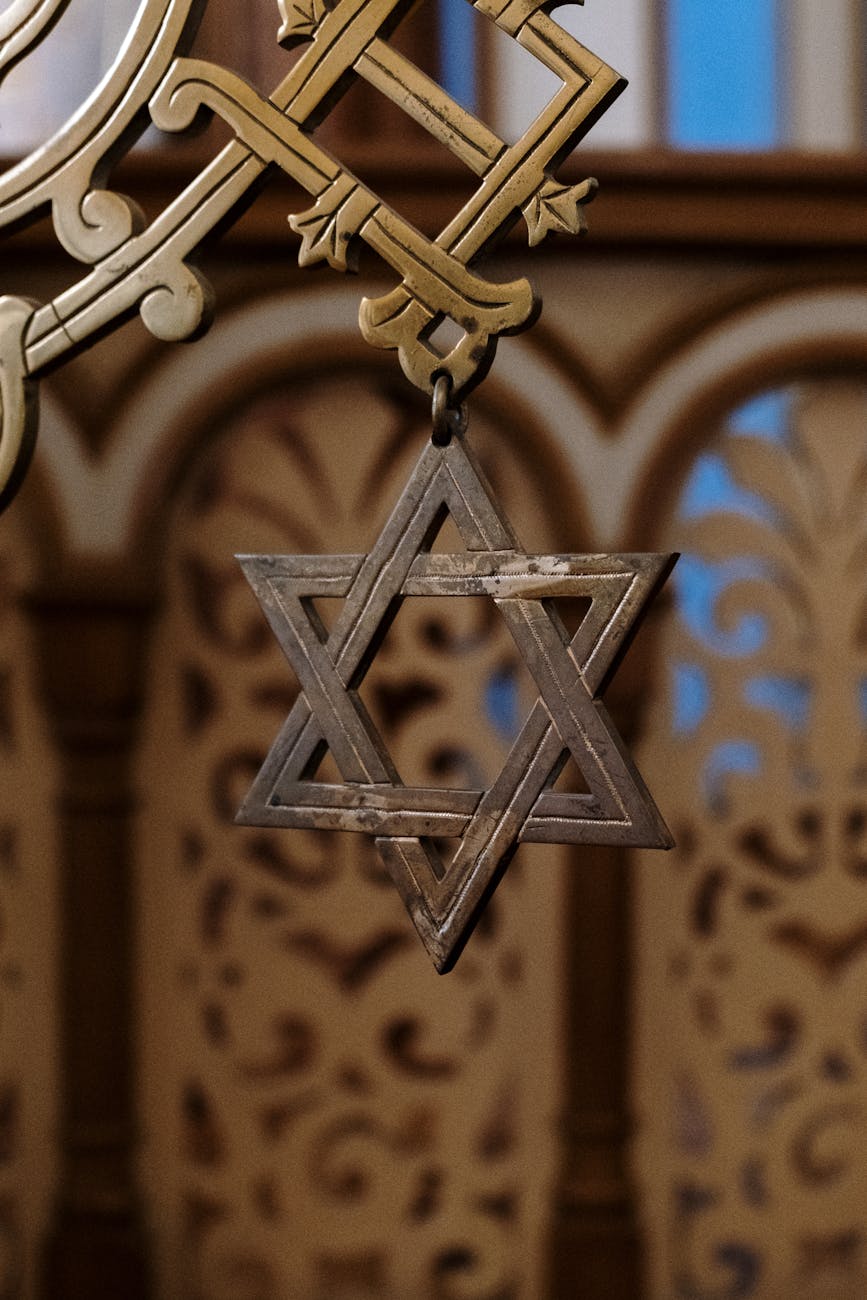
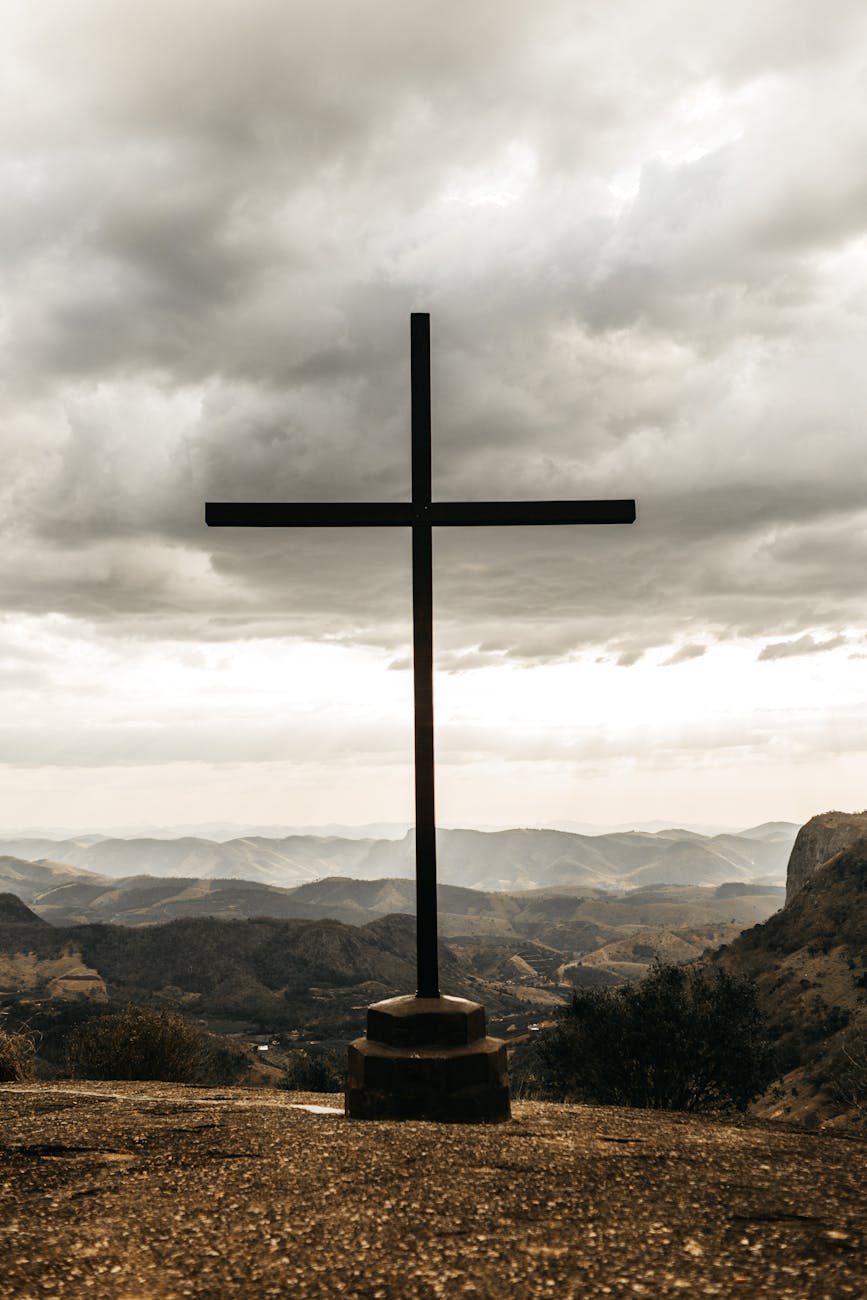
There is, of course, an even simpler form of symbols and it is probably the first form that comes to mind when we heard the word. It is symbols as single, static images. These are things like the Christian Cross, the Star of David, or the Scales of Justice.

An argument could certainly be made that the more fundamental a symbol is, the more applications and representations it will hold. This would mean that these single static images will often have the most interpretations of all.

In today’s post we will take a look at two examples of this type of symbol and consider the sorts of things that they might stand for. I should first note, though, that while both of these symbols are religious, neither is divinely established in any religious text. There is no scripture that says that these specific symbols should be part of the iconography of the Jewish or Christian people, so let us not assume that these symbols are necessarily under God’s authorship.

The Star of David)

The first symbol we will consider is the Star of David. This six-pointed star has long been a symbol of the Jewish faith and is even the central element in the flag of Israel. Perhaps the first representation that we see in it is the fact that it is a star, or a sun, thus something that provides light and guidance, or which can be a marker to guide us along our way.

We also notice that there is one large hexagon in the middle, surrounded by six small triangles that extend from its sides. This could be seen as God in the center, with all other creations gathered in observation of Him. It even brings to mind Joseph’s dream of standing in the midst of his brethren as they bowed to him.

Of course, one can also see the shapes of two equilateral triangles, one upright and one inverted, offset and overlapping. With this view in mind, we can see one triangle as God descending downward and the other as mankind extending upward, the overlap being where the two come into union with one another. To the Jew, that place of union could be seen as the Law or the temple, while to the Christian it would be Christ.

The Christian Cross)

The Christian Cross must be one of the simplest symbols ever made: two lines crossing at right angles. Of course, it immediately invokes memories of the crucifixion of Jesus Christ. When considering that application, it becomes simultaneously a symbol of man’s greatest cruelty and God’s greatest mercy, an interesting paradox.

The vertical line of the cross can also be seen to stand for God, while the horizontal line stands for the earth, or the horizon. The point of juncture in the middle then has a similar meaning to the overlapping triangles in the Star of David: the place where heaven meets earth, meaning the church or Jesus.

With our modern system of world coordination, the crossing lines can also be seen as a longitude and a latitude, suggesting the ability to pinpoint where we stand spiritually, or suggesting a guided destination for where we need to go.

Summary)

We could go on quite a bit lot longer in our analysis of each symbol. Hopefully this has been enough to establish that their simplicity does not make their applications few. Rather, it is the inverse. Because they are such a basic representation of something so fundamental, their applications are virtually infinite. They are literal signs, pointing the way to much, much more

The Richness of Scriptural Symbolism- Symbols Within Symbols

Yesterday we looked at the story of Joseph interpreting the Pharaoh’s dream, in which seven sickly and evil cattle consumed seven that were fat and good. We discussed how this was a symbol for the many times that evil has sucked the life out of that which was once virtuous and worthy, until its beauty and sweetness can no longer be remembered.

I also mentioned that there was another, larger symbol at play, but that before I could examine it, we needed to consider another story that strongly echoed that of Joseph and the Pharaoh. Today we will look at that story, and as we do, take note of how familiar it feels.

The Man of Many Parts)

This example comes from Daniel 2, which once again begins with a ruler, this time Nebuchadnezzar, king of Babylon. And, once again, this ruler had a strange dream, and none of his wise men could help him understand it, but again there was a foreign youth named Daniel who had the power to both describe and interpret his dream.

In the king’s dream, he saw a statue with a golden head, a silver torso, brass thighs, iron legs, and feet made of iron mingled in clay. Then, a great stone came and smashed the statue into pieces.

This was the symbol, and Daniel gave the king the interpretation of it: each segment of the statue represented a great kingdom that would rule supreme over the earth. Babylon was the first one of gold, but it would be superseded by another, then another, then another. With the benefit of hindsight, we can now identify all the four kingdoms as Babylon, Persia, Greece, and Rome. But all of these mighty kingdoms would eventually be broken apart by the stone, which was the kingdom of heaven.

So, there we have the immediate interpretation of it, but is there any more general reading possible? I think so. I see a broad symbol here of how mankind’s creation and power will be upended by the touch of God. Yes, it has happened in God’s kingdom expanding while all the nations that Daniel foresaw have toppled, but it also happened much earlier when God confounded the language of the people building the Tower of Babel, turning their great enterprise into chaos. It also happened when Egypt, the greatest kingdom of its time, was brought to its knees by the plagues of Moses. It happened when all the civilization in Noah’s age was drowned in the flood. I have a suspicion that it is also a foreshadowing of something yet to come, a time when our highly vaunted technology and science will be greatly frustrated by the touch of God in some way.

The Bigger Picture)

But all of this is just the inner symbol. As I have already illustrated, this story of Daniel and Nebuchadnezzar is practically a remake of Joseph and the Pharaoh. In both cases a ruler had a vision that he could not understand, but the youthful foreigner who knew God was able to make it clear. That seems to be a pattern of meaning, a representation of the righteous youth being a refresher for the old and mighty. It speaks to change and transition.

And notice, too, how Joseph foresaw a time of good being supplanted by one of evil, while Daniel saw the inverse: kingdoms of fallen man being supplanted by one of the divine. Also consider the timing of each one in the larger Israelite narrative. One vision came shortly before a time of slavery, the other just after coming into a new time of imprisonment. One came just before the birth of nation, the other just after its death.

Both of these young seers foresaw a pattern of evil and good overtaking one another. Together they saw the two halves of a cycle, a repeating dance that defined their people, and also the broader world. Good prevails, then wanes, then evil surges, then good prevails. It is the story of us all, and it is symbolized in the story of these stories.

The Richness of Scriptural Symbolism- The Pharaoh’s Dream

Thus far we have looked at symbols that were lived experiences (Jacob and Esau, Barabbas) or that were parables (the Prodigal Son, the poor man and his sheep). Today we now consider a symbol that was an image in a dream.

Seven Fat and Sickly Cattle)

This example comes from Genesis 41, in which we learn that the Pharaoh of Egypt received a strange dream that greatly troubled him. He sought an interpretation from all of his wise men, but none of them could explain it. Finally, his butler told him about Joseph, a foreign youth that he had met in jail, who possessed great interpretive powers from God. Joseph was summoned, and the Pharaoh recounted his dream to him.

In the dream, seven fat cattle emerged from the river and fed in the meadow. After them came seven more that were sickly and unpleasant, and they ate all of the fat cattle. But even though they ate such a fat meal, the seven remained just as scrawny and sickly as before.

This was the symbol, and Joseph gave the Pharaoh the interpretation of it: the seven fat cattle were seven good years with a bounteous crop and the seven sickly cattle were seven years of famine that would follow. The seven years of famine would so thoroughly eradicate the abundance of the good years, that it would be as if the abundance had never even occurred.

So, there we have the specific interpretation of it, but are there any other possible interpretations? I think so. I see in this a general concept of evil overtaking good and leaving none of it behind. This pattern can be seen in many specific instances in our lives. We see this in the addict who does shameful actions in secret and tries to cover them with an overabundance of external good deeds. The good on the surface is hollow, and does him no benefit, because he does them all with a guilty heart, so he remains as guilty and shameful as he always was. We see any time a wealthy man leaves an inheritance to a foolish and wasteful son, who then squanders all the riches until none of it is left, and he remains as foolish and wasteful as he always was.

I believe that this symbol has many universal applications, in addition to the specific one that Joseph gave to Pharaoh.

As it turns out, there is another symbol at play here, but before I can explain it, we need to consider another story that follows this exact same pattern. The similarities between that story and this one are uncanny, which speaks to the fact that they are cut from the same symbolic cloth. We will dive into that other story, and the shared theme between it and this one, tomorrow.

The Richness of Scriptural Symbolism- Barabbas

Earlier in this study I noted that every good symbol has constant reenactments following it. Every symbol that connects with the human core is seen again and again and again.

Today I want to illustrate that symbols are not only deep, though, they can also be broad. Some of them not only have multiple meanings over time, but also multiple meanings in the very first moment. I will illustrate that today with the example of Barabbas.

The Story of Barabbas)

Barabbas was a prisoner in Israel at the time of Jesus. He had quite the list of offenses. From John 18:40 we hear that he was a robber, and from Mark 15:7 we learn that he was also a seditionist and a murderer. It is most likely that he was condemned to death, waiting for his execution to be carried out when fate intervened to set him free.

His turn of fortune came as a result of Pilate seeking to spare Jesus, who he could sense was innocent any crime. It was the Passover, when it was customary for one prisoner to be released, so Pilate tried to save Jesus by stacking his freedom against that of deplorable Barabbas. If the Israelites really wanted to condemn Jesus, they would have to instead free a person who might literally kill them! Shockingly, that is exactly the choice that they made, and Pilate had to release the murderer. Jesus, of course, did go on to be killed that very same day.

Two Symbols of Barabbas)

The freeing of Barabbas is a powerful symbol, one with two immediate meanings. First of all, the release of Barabbas is symbolic of the mission of Jesus Christ and its effect upon all mankind. We are each of us Barabbas, sinners worthy of death, set free because Jesus was condemned instead. As the prophet Isaiah foretold, “But he was wounded for our transgressions, he was bruised for our iniquities: the chastisement of our peace was upon him; and with his stripes we are healed.”

Here we have a bright and hopeful symbol in the release of Barabbas, but there is also a dark foreshadowing in it as well. For just as much as it stands for the liberation of all us sinners, it also stood for the impending decimation of the Israelite people.

Within just forty years of Israel choosing Barabbas over Jesus, the entire nation would be devastated, with an estimated hundreds of thousands of Jews being slaughtered, maybe more, and the survivors scattered to the winds. But wasn’t this what they had chosen? They had had the choice between the literal Prince of Peace and a man of violence, and they had selected the latter! Hear their words as recorded in Luke 23:18, “And they cried out all at once, saying, Away with this man, and release unto us Barabbas.” Release unto us the killer…and that was just what they received.

Split Symbolism)

Barabbas’s release isn’t just a symbol with two different interpretations, it is a symbol with polar opposite interpretations! One of restored life, and one of consignment to death. It may seem remarkable that it can have both of these connotations, but it turns out that this is actually fairly regular in the scriptures. The cross is simultaneously a symbol of man’s greatest cruelty and God’s greatest love. Also, the serpent is used as a symbol of the Devil in the Garden of Eden, and of Christ when Moses raised the healing bronze serpent on the stick. The rainbow both stands as a reminder of God’s flooding the world, and His promise that He won’t do so again.

I believe that part of the reason for polar opposite symbols is because many of the deepest spiritual notions are also two-sided in profound ways. Is justice a principle of punishment for the wicked, or of exoneration for the innocent? Does God’s glory purify us or condemn us? Is the work of man creation or destruction? The answer to all of these is both. Good symbols recognize that there is a good side and a bad side to our reality, and they manage to represent both at the same time.

The Richness of Scriptural Symbolism- The Natural Order

I have shared about the symbol at the core of Jacob receiving Esau’s blessing and I have shared about another symbol at the core of the Good Samaritan. Both of these examples show how good symbols reflect real life and today’s story is yet another example of that, but also of another principle that I wish to illustrate.

David’s Sin)

The story of David in the Old Testament is at times triumphant and at times tragic. Everything turns upon one pivotal moment, where he betrays his own conscience and destroys an innocent man. The story begins, of course, with him seeing Bathsheba bathing from the roof of his palace, then bringing her to him and committing adultery. When she became pregnant from the encounter he tried to obfuscate the parentage of the child, and when that failed, he ordered her husband to be placed at the forefront of a battle where he would likely be killed, which was exactly what happened.

But what David did in secret was fully known to God, and the Lord sent His prophet, Nathan, to tell him a symbolic story. In 2 Samuel 12:1-4 we read that story:

There were two men in one city; the one rich, and the other poor. The rich man had exceeding many flocks and herds: But the poor man had nothing, save one little ewe lamb, which he had bought and nourished up: and it grew up together with him, and with his children; it did eat of his own meat, and drank of his own cup, and lay in his bosom, and was unto him as a daughter.

And there came a traveller unto the rich man, and he spared to take of his own flock and of his own herd, to dress for the wayfaring man that was come unto him; but took the poor man’s lamb, and dressed it for the man that was come to him.

The story is, of course, a symbol for David. He is the rich man that had everything yet took from the poor man who had so very little. Not only this, but it is a symbol for all injustices in which the rich have further extended themselves by crushing those beneath them. This type of injustice is, unfortunately, fundamental to the human condition, and Nathan condenses it expertly into this one, short story.

The End of the Symbol)

Because Nathan’s story is so direct and so fundamental, it is only natural to feel a powerful emotional reaction to it. David certainly did, and the account in 2 Samuel records that response:

And David’s anger was greatly kindled against the man; and he said to Nathan, As the Lord liveth, the man that hath done this thing shall surely die!

Obviously, David had not realized that he, himself, was the subject of the story. His was the own head that he was proclaiming death upon!

This dramatic example illustrates one of the other hallmarks of good symbols: they make plain to us the natural order and summon from us the correct resolution to any unnatural situation.

The fact is, each one of us is imbued at birth with basic morals and truths. Deep at our core, we understand justice even before we can put words to the notion. It is ingrained in us, and a good symbol can help us cut through all of the bias and distraction, seeing plainly what the natural order is, how it has been twisted, and what must be done to set it right.

If David had known that he was the real subject of the story, he may well have squirmed and tried to justify his actions. But since he was absorbed in the fundamental violation of the natural order described in the story, he could not help but exclaim the harsh penalty that was necessary to set things right. By recognizing the answer to the fundamental, he had also found the answer to the specific. Such is the power of a truly good symbol.

The Richness of Scriptural Symbolism- A Modern Reenactment

My last post was about Jacob and Esau, and how they unwittingly reenacted something deep and eternal and fundamental to the destiny of us all. The hope of us all on judgment day was manifested in their little family drama. They were expressing a symbol of something that didn’t even know lived within them. In my last post I also promised that I had another example of this, a personal one, and today I will share that with you.

Passing on the Way)

This story takes place when I was twenty, serving as a missionary in the country of Guyana. My companion and I spent each day under the blistering Caribbean sun, meeting people on the street, sharing messages in homes, and helping run the affairs of the local branch. Our days were always very full, and one morning we were zipping along the streets on our bicycles, hurrying to our next appointment.

“Hello, Brother Ravi!” we waved as we zoomed past a member of the local congregation. He smiled and called out “good morning,” to us, then went back to slowly pulling himself along the road by his toes. Brother Ravi, you see, was in a wheelchair, too weak in the legs to stand, and too weak in the arms to push the wheels, so he was left to dangle his feet onto the dirt and gravel road, grip with his toes, and inch his way forward at a snail’s pace.

My companion and I turned down two more streets before suddenly we stopped and looked at one another.

“What are we doing?!” I said.

“Why didn’t we help him?!” he responded.

We immediately turned around and raced back to help Brother Ravi get home. As we approached, however, we found that someone else had already stepped in to do it. It was a man who looked extremely ragged. His hair was unkempt, his clothes were full of holes, and his legs wouldn’t bend at the knees. By putting his weight on the handles of the wheelchair, he barely managed to keep his balance, awkwardly shuffling down the street with Brother Ravi. Both the stranger and Brother Ravi were in good spirits, though, happily chatting to one another, with Brother Ravi giving directions to his home. It was clear from their conversation that this was their first meeting, the man was a stranger who stepped in simply because he saw a need.

Even though we were younger and more fit, it didn’t seem right for us to take over this stranger’s kind act of service. With a sense of guilt, my companion and I turned our bikes and continued on our way.

A Story from Long Ago)

It was only when reflecting on this experience that I realized we had reenacted a story that I’d already heard many times before. Brother Ravi, the stranger, and us two missionaries had all unwittingly taken part in the story of the Good Samaritan. Brother Ravi was the man in need on the side of the road, the stranger was obviously the Good Samaritan who went out of his way to help another, and my companion and I had played the unfortunate part of the priest and the Levite, two men specifically called to help those in need, but who had instead hurried on their way. We had abandoned our rightful duty, and it had fallen to another to fill that gap.

There is much that I have learned from that experience, but for now let us consider how the story of the Good Samaritan is full of symbols that manifest themselves in our lives, even without us realizing it at the time. As it turns out, humanity is full of examples of those who should help falling short, leaving strangers to take over the responsibility instead. I won’t go into the details on all of these, but you can see these themes among The Kindertransport, The Righteous Among Nations, and The White Helmets. These were all volunteers who stepped in to help when official aid was lacking or absent.

An important lesson from these symbols having so many applications is that we should never read these stories and say, “This is the one thing that that story is supposed to represent.” Because if it is a truly good symbol, it hasn’t finished representing all that it is meant to represent. There is no one, single, interpretation. Was Jesus’s story meant to symbolize the state of ancient Israel at the time? Yes. Was it also meant to represent me and my companion passing by Brother Ravi? Yes. And a thousand other instances of this pattern as well. It is a story that has played out through the past and will surely play out again in the future.

The Richness of Scriptural Symbolism- Constant Reenacting

In my last post I mentioned that good symbols connect to the very core of the human experience. They identify something that is fundamental to our race, which means they keep showing up in the lives of countless individuals. This means that they will be reenacted by people who have no idea that that is what they are doing. Today I will give a scriptural example of this, and in my next post one that is more personal.

Receiving the Father’s Blessing)

The last time I studied the story of Jacob obtaining Esau’s blessing, I noticed a symbol in it that I had never seen before. In the Genesis account, Jacob dresses in the clothes of his brother Esau, prepares meat in the same manner as Esau, and presents himself under the name of Esau in order to receive the blessing that his father has for his elder brother. In this moment, it doesn’t appear that anyone involved in the charade saw it as anything more than an isolated family drama, but it was actually a sign of something bigger than them all.

Jacob’s presentation in the guise of his elder brother reflects how each of us hope to be presented to the Lord on judgment day. Obviously, we won’t actually be fooling God, but by laying down our own lives and taking up Christ’s, we hope to be introduced under the name, appearance, and deeds of Jesus, our elder brother. He, alone, is worthy of God’s blessing, but because we can be adopted under his name, we can receive his blessing as though we were him.

As I said, I do not think that Jacob, Esau, Isaac, and Rebekah had this in mind when they performed their little drama, but that symbol comes from the very roots of the human soul. It is baked into us, and it is not surprising that it rises to the surface now and again in our lives.

As we look for good symbols to guide our lives, we should take special note of patterns that emerge seemingly at random, but which echo things of a more eternal nature. We should consider if what we see in our typical day is, in fact, a new bud on a plant whose roots extend far, far below.

The Richness of Scriptural Symbolism- Eternal Wisdom

The Perpetual Relevance of Symbols)

The Bible is a library of many different things, including historical accounts, legal instructions, moral teachings, prophetic sayings, psalms, letters, and gospel testimony. One of its defining features is its rich symbolism, which people continue to find new interpretations and new meanings for even today.

Some of the text in the Bible is, at a minimum, over 3000 years old. It is a rare thing to have words from that long ago that still resonate and have meaning to us today. Such an accomplishment demonstrates a profound understanding of the human condition, for it is only by identifying and representing something that is fundamental to humanity itself that these symbols can be consistent through all changes of culture and context. A symbol that is tied to the very core of the human soul will re-manifest itself perpetually, keeping its importance forever new.

They say that those who do not learn from history are doomed to repeat it. But history is but a record of how people reacted to their fundamental human nature, and since fundamental human nature persists, history will repeat itself again and again, whether we have studied it or not. Every great setback that we will face in the future has already been observed, and the way that each of those setbacks will be overcome is also already knowable. When the old evils return, it is the timeless symbols of ancient scripture that will guide us back to the light.

The Qualities of Good Symbols)

So far, we have identified one hallmark of good symbols: that they represent a core part of the human soul and thus reappear eternally through each generation. With the rest of this study, I want to consider what other hallmarks of good symbols, so that we may know how to separate the perpetually useful from the context dependent.

It will be necessary to provide specific examples of scriptural symbols as a part of this study, and when I do so, I will specifically use ones from the Bible. This will serve a secondary objective of this study, which is to demonstrate the intrinsic value of that book. That being said, this study will by no means be a comprehensive list of all the greatest symbols within the Bible. It remains the responsibility of each of us to find those nuggets for ourselves and to integrate them into our own lives.