To Live Freely: Part Fourteen

Scatter-Brained)

This series has already gone on for longer than most of my others, and I think it has also been more disorganized and rambling as well. I’m sorry if its meandering manner has put you off. This blog is my place for me to mull over the very things that I’m grappling with personally. You’re reading the transcript of my thoughts as they are happening, and it doesn’t make for the tidiest structure. This topic in particular has been a real puzzler, because it has been a back-and-forth fight in my own life to fully orient myself to the truth. I am so weary of knowing better and doing worse and feeling guilty, so I am perplexed by this problem, and I believe this study has reflected that fact.

I understand if watching me grapple with these problems in such an unrefined way isn’t particularly useful for you, and no one should feel obligated to stick around if they’d be better served elsewhere. I think I’ve muddled around in this area for nearly long enough, though. I have one last topic I want to cover, then I will try to summarize what I’ve discovered in all this exploration.

I will spend this post and the next sharing the different degrees that I have oriented myself to the truth in my own life. I’ll cover my least and middling truthful states today, then progress to my most truthful mode tomorrow.

Oblivious)

The most difficult flaws to remedy are the ones you never see. I have been guilty of attesting that I hold certain values most dear, while then suggesting otherwise in my actions. For example, I have maintained that my family is of utmost importance to me, and yet I have been detached and distracted from them by the most trivial of things. It is a sharp return to reality when my children ask me why I’ve been staring at my phone all day instead of playing with them.

It’s discouraging to realize that I’ve been a hypocrite, and even more shocking is that I wasn’t even aware of that hypocrisy until someone called me out on it. I’ve been so detached from the needs of others that I didn’t even realize I was neglecting them. The presence of my children’s father in their lives really matters, and if I say that I truly believe that to be true, then I ought to live like it.

I think I find myself in these moments of self-betrayal because I am tricked by my immediate desires. One of the key reasons why I am lost in my phone is because that is a low-energy activity, and I am feeling tired. But often I only feel tired because I didn’t get to bed at a good time the night before. Now when I stay up late, I don’t consciously think to myself “I am choosing personal entertainment now over being present with my children tomorrow,” but that’s ultimately how it turns out.

Another way that I am seduced by my immediate desires is that I have a thought pop into my head of something I want to look up, and I think that I can do it real quick and be back before anyone notices the absence of my attention. I’m trying to have my cake and eat it, too. I’m trying to have my personal interests met while simultaneously creating the illusion of constant presence. Suffice it to say, it doesn’t work. Even if I did pull of the charade, and no one ever caught on, I would still be being dishonest.

Trying, but Slipping)

I also have areas where I fully recognize that I’m not living in harmony with what I know to be true, and I am genuinely trying as hard as I can to correct that. Or at least, I’m trying as hard as I can until I become frustrated by the fact that I’m still not changing, and I give up on the whole endeavor. I try to force myself into alignment with the truth, but it seems the harder I try, the more quickly I fail. How can I feel so passionate about the need to take care of my body, for example, and make such strong commitments to live differently, and then still break my diet again and again? Really, if I could have one wish, I would simply want to be able to live like the man I already want to be.

As I’ve spent time in therapy and twelve-step groups I think that my dramatic efforts to force myself into a particular way of life are getting in my own way. I need to be able to surrender control and let my Higher Power carry me. But then, I start wondering why I do so poorly at surrendering to God. I try to surrender “better,” and that just means I’ve taken it all right back to myself. Instead of trying to change myself by my own power, now I’m trying to earn grace by my own power, and that is a contradiction.

I will say, I do take some comfort in the fact that I do keep coming back to this place of trying, though. After I get burned out and discouraged and give up and walk away, I do always come back. I feel proud of the fact that I keep trying to orient myself to the truth, regardless of the frustration. That means I am being truthful in my intentions, if not in my results. I have hope that at some point I’ll be able to find the proper harmony if I keep trying again.

To Live Freely: Part Thirteen

What is Truth?)

I have spent quite a while examining different reasons for why one should live in accordance with the truth, and I have been calling out the ways that we try to excuse ourselves from doing so. Hopefully each one of us will be convinced at some point that we must live in harmony with fundamental truth, aligning ourselves to the universal good.

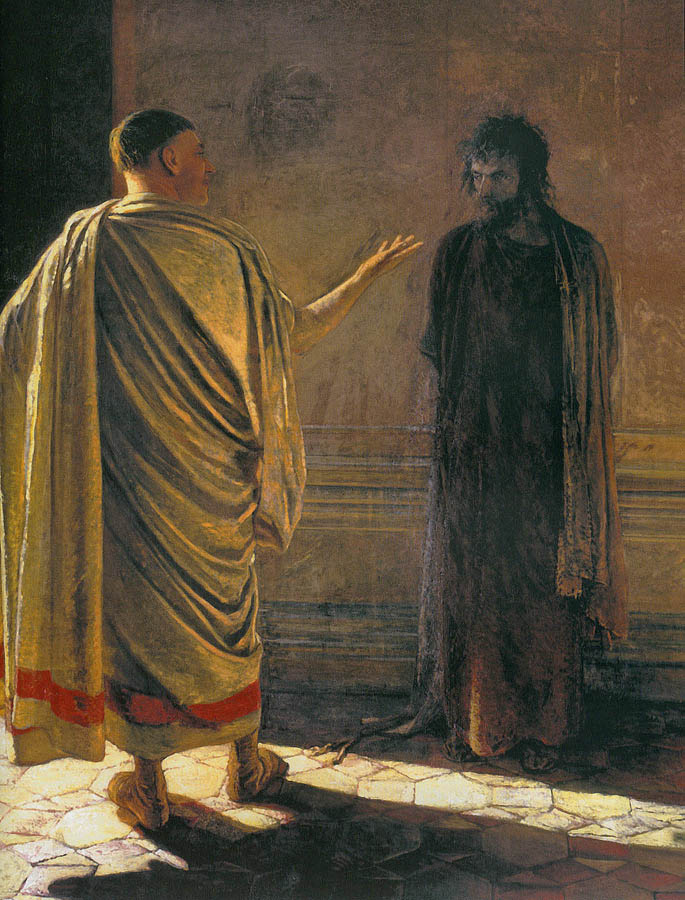
But, even if we do come to this conviction, we may find a new question that takes its place. It is the same question that Pilate famously posed to Christ: “What is truth?” It seems that the answer to that should be obvious, but any serious examination on the matter will soon uncover a few issues. Most particularly, we will likely find it difficult to distinguish what is THE TRUTH from merely “my truth.”

Consider that many of us hold different principles inside of us that we identify with the truth. Two men confronted by the same injustice might be stirred by their conscience to two different actions. One of them might feel called to meekly endure the offense, remaining patient and longsuffering. On the other hand, the other man might feel compelled to stand up for what is right and challenge the oppressor. Frankly, neither of these reactions feels fundamentally wrong to me. Perhaps towards less severe injustices the passive response seems more fitting, and towards grievous injustices the bold response, but there is a great deal of overlap where either seem entirely appropriate, and I would not call any person wrong for behaving one way or the other. But at the same time, in a single person each response is mutually exclusive to the other. So which way is actually correct?

Furthermore, two men acting in sincere accordance with their conscience is one thing, but what about the issue of us misidentifying our wants with our conscience? I’m sure we can all call out social movements that claim to be based in truth and conscience, but which are clearly just justification for selfish and immoral practices. Making matters even more complicated, while sometimes we know in our hearts that we are being dishonest, most often we really do delude ourselves into thinking that our own personal wants just happen to align with what is cosmically right. How can I recognize what is actually true, and what is just me trying to get my own way?

A Point of Reference)

Both of the issues that I have presented are a result of defining the truth locally. If each person is let alone to define their “own truth,” then there will be as many distinct truths as there are people. We will probably each settle on some genuine pieces of conscience, but also much that is colored by personality or selfish desire. Aligning ourselves with “our truth” will therefore disappoint us, both on a personal and universal level. On the personal level, it will disappoint us because we will come out looking very much the same as who we already are. We will not have any sense of transcendence, of having been called up and made into something new and better. On the universal level, we will never have unity and common purpose. We will remain entrenched in embittered battles against one another, everyone convinced of their own rightness above all others.

If this enterprise of humanity is to move forward, then there absolutely has to be some underlying, fundamental truth established outside of all of us that we can each defer to. There has to be an external truth that is real and consistent, so that we may all come into union when we separately align ourselves to it. If the truth is defined by a person, or if it is shifting in its nature, then we will never find harmony with either conscience or community.

If, however, we do settle upon a universal truth that exists outside of us all, then both of the issues mentioned above are resolved. Now we have a standard that all other “self-truths” can be compared against. Selfish desires, misinterpreted as truth, are immediately recognized as such and discarded. Also, in the example of the two men choosing differently, but according to their genuine conscience, it is possible that the universal truth is broad enough to harmonize with both decisions. While the universal truth will certainly never contradict itself, it does seem reasonable to me that it could allow some range of individual, moral choice within its domain.

Is it any wonder, then, that the bedrock of every civilization has been religion? Be it the Bible, or the Quran, or the Torah, or the Bhagavad Gita, or the words of Buddha, each culture has composed itself around words that are said to have descended from on high. They might have come through the mouths of prophets and sages, but they are not interpreted as the words of those prophets and sages. They are understood to be the words of the external, of the divine, of God in some form or another.

Cultures that detach themselves from sacred truth do not remain cultures for long. As a society they break apart and become an anarchy. As individuals they become stunted and cease to improve their situation. They lag behind the rest of the world, both technologically and ethically, and they are soon destroyed by the whims of the world.

So, going back to our idea that only the life founded upon the truth is free, even after we accept this fact we still have to identify what the truth really is. And in order to do this, we’re going to have to find a source outside of ourselves, and outside of any other person. At some point we’re going to have to find God and discover THE TRUTH for ourselves. Choosing to found ourselves upon the truth is therefore no mere decision that we make once in our current place and then have the matter resolved. Choosing to be founded upon the truth means deciding to go on a great journey. It is a quest of exploration, discovery, and refinement, and it will last us the rest of our lives and then some!

To Live Freely: Part Twelve

Integrity)

There is a common saying: “do as I say, not as I do.” One typically gives it when exposed as not living what they preach. I must admit I feel a twinge of guilt every time I tell my children not to eat sweets before their dinner…but then I violate that rule myself all the time. It’s not that I don’t believe what I’m telling my kids, it’s just that I’m not as disciplined as I ought to be.

Of course, there is a great honesty in being able to admit that we aren’t living how we know we should. Being aware of this gap between our convictions and our behaviors is, in the conscientious person, the first step to closing that distance. One who is sincerely trying to rectify this inconsistency is acknowledging that they are not currently built upon the truth, but they are in the process of moving towards it.

If, on the other hand, we recognize the gap between our behavior and what is right, but we aren’t troubled enough by that difference to try and change, then we are living without integrity. We are pointing at the flaw in our foundation and saying, “I’m okay to live with that.” We are establishing for ourselves a hierarchy where the conscience is made inferior to our current level of comfort.

Which is, of course, is another character flaw. In fact, it is a more fundamental flaw than the one that we started with. As bad as any other shortcoming might be, even more damning than it is unwillingness to change. This is the one crack in our foundation that prevents all other cracks from being patched. One might notice a logical conundrum here: if one has the flaw of being unwilling to change, how can one change themself to stop being that way? Is their situation totally hopeless? Thankfully not! We have to remember that we are divine souls, not machines. Our flaws are not irreversibly programmed into us. We have the ability to choose the very things we have never been willing to choose before. Not only that, but we also have the capacity to be redeemed by divine intervention, having changes made in us by God that we did not have the power to make ourselves.

Progress, not Perfection)

Compare the mantra of “do as I say, not as I do,” to the oft-told story of Gandhi and sugar. It is said that a woman came to Gandhi, asking him to tell her son that he should cut sugar out of his diet. Gandhi agreed, but first asked the woman to leave with her son and come back a number of weeks later. The woman did so, and in the second meeting Gandhi gave the desired counsel to the son. The woman was grateful, but asked Gandhi why he couldn’t have just had the talk with her son when she came the first time. His response was that he could not tell the son to stop eating sugar, because at that time he was still eating sugar, too!

This story, whether true or not, illustrates the principle of choosing to change oneself rather than be a hypocrite. This isn’t to say that we must all be perfect before we can advocate for what is true, but at the very least it should be expected that we are actually, genuinely trying to do the things we counsel to others.

This is what we aspire to: genuine trying. As it says in the Alcoholics Anonymous Big Book: “No one among us has been able to maintain anything like perfect adherence to these principles… We claim spiritual progress, not spiritual perfection.” Those that sincerely try to live in accordance with their conscience will all fall short, but because their intentions are sincerely aligned with the truth, they are still in harmony with it. If we try to play our notes at our sincere best, even if we occasionally get some of them wrong we are still part of the music.

To Live Freely: Part Eleven

The Fearful Secret)

Yesterday I shared the story of the rich, young ruler and Jesus. It is an example of how our Maker is able to reveal to us exactly who we really are, all of the happy truths about ourselves, and all of the difficult truths as well. I suggested that sometimes we need that outside help to know what’s really going on inside of us, because there seems to be a subconscious part inside that frustrates our efforts to figure that out. I suggested that one reason why that inner part hides the truth might be because it believes we won’t take those issues on even if we know what they are. It would rather leave us dissatisfied, but blissfully ignorant, than to have us live in full exposure to our most basic flaws.

But this isn’t the only sort of deception that happens within ourselves. When I was living my pornography addiction, I knew full well what I was doing and why it was wrong. I was not deceived about myself, but I did deceive the world. I did everything in my power to conceal this secret shame. I hated to even be around when the topic of pornography was discussed, yet I would behave as though I was fervently committed in renouncing its evil. Why did I play this charade? Why did I feel like it would absolutely kill me to say “I do this behavior that I am ashamed of?” Why am I now able to discuss it openly and not feel such a terrible terror at being exposed?

I’ve given this some thought, and I’ve settled on what I think is a key difference between where I am now and where I was then. The reason I couldn’t talk about the hard realities of my life earlier was because I hadn’t yet been forgiven.

Coming Clean)

For someone who was terrified of ever talking about my addiction, I suddenly found myself doing it a very good deal all at once. As soon as I decided to come clean to my wife I realized that I also needed to speak with an ecclesiastical leader. Once I spoke with my ecclesiastical leader he told me that I needed to meet with a recommended therapist. After the first meeting with my therapist he convinced me to enroll in an addiction recovery program and have weekly meetings with a group of other men in recovery.

Over and over and over I was relating to people all that I had been secretly doing for years. Even in these safe places I felt very distressed about this. After I made my confessions I would wake up each day in absolute shock for what I had done. I felt like I was still asleep, stuck in a bad dream, hoping that I would yet wake up and realize I hadn’t done this terrible thing!

Again, I’d like to draw your attention to the story I shared yesterday of Jesus and the rich, young ruler. After Jesus exposed the man’s love for wealth we are told that the man went away “grieving” (Mark 10:22). He was emotionally distressed to have his weakness revealed, and that was exactly how I felt. Clearly I was a long way from my situation today, where I can speak candidly about my personal demons with complete strangers online in a blog post!

When I consider what experiences helped me to shift my feelings, I have two memories come to mind. One was the moment where I was accepted back into full fellowship with my church and was able to partake of its communion. The other was during a spiritual retreat in the mountains where I felt God express His love and approval of me on an extremely fundamental level. Together those two experiences represented my transition from being condemned by my sins to being forgiven of them.

After those experiences I could speak more freely and openly about my wrongs because…well…they just didn’t matter any more. Certainly I don’t make light of them, or minimize the harm that they caused, but frankly they just aren’t my burden to carry any longer. Christ took them from me, and now they are his to deal with.

Losing the Burden)

When we feel like we would rather die than reveal our worst secrets, that is an indication that we are still unforgiven. We feel the full weight of guilt, of unworthiness, of despair. We live a lie because we know that the truth will damn us. The rich, young ruler wasn’t ready to have his flaw resolved, so he remained damned by it, unforgiven, and he left Jesus in a state of grief. I don’t believe his story had to end that way, though. When we take the step of telling the truth and admitting that it damns us, we open the door to being saved from that destruction by the Savior. Instead of being consumed, we find ourselves forgiven. The rich, young ruler could have confessed that Jesus saw him rightly, and that this flaw would damn him, and then he could have asked for to be healed, just as the blind and the lame had done. I believe that Christ would have done it, and the man would have been made free. Then he wouldn’t have to sorrow, he would be able to tell of his experience and his transformation freely and with joy.

To Live Freely: Part Ten

The Unnamed Delusion)

In my last post I spoke about how many of us believe that the right and proper way to live is in accordance with the truth, yet at the same time we lie to everyone, including ourselves, about all the wrongs that we do. We are each a person divided, feeling the truth in our heart, transgressing it in our bodies, and refusing to acknowledge the gap in our minds.

Quite frankly, we avoid the hard truths on such a regular basis that we typically don’t even notice that we do it. The fabrications we soothe ourselves with are so practiced and so regular that they don’t even register. Thus, we might examine the general state of our life and admit that something feels off, that it seems we must be living under some self-delusion, but genuinely have no idea what that delusion even is. How can we make a change if we cannot name what the change that we need to make is?

This idea of knowing the name of our hidden, inner truths has its roots in many ancient cultures. There has long been a notion that if you know the true name of an entity, then you could gain power over it. I have seen for myself that there really is something to this. Sometimes the entire battle has been simply to correctly label the problem that I’m struggling with. Other times, it is only the first battle in the war of a lifetime. In either case, it is always the first step towards overcoming that part of my self.

So how do we identify the real, sometimes unpleasant truths lurking inside?

In many cases we we are so close to the issues that we can’t see them clearly, and we need to be shown them from an outside perspective. That might mean having a deeply earnest conversation with a trusted family member or friend. It might mean soliciting the professional insights of a qualified therapist. Certainly it means getting on our knees and asking our Maker to reveal ourselves to us.

The Great Physician)

Let us never forget that this is one of Christ’s essential roles. During his sojourn on Earth he demonstrated his ability to diagnose the state of a person’s soul. He was able to reveal people to themselves, to cut straight to the heart and show them the truth plainly. Let us consider one example of this, the story of Christ and the rich, young ruler (Mark 10:17-22)

And when he was gone forth into the way, there came one running, and kneeled to him, and asked him, Good Master, what shall I do that I may inherit eternal life?
And Jesus said unto him, Why callest thou me good? there is none good but one, that is, God. Thou knowest the commandments, Do not commit adultery, Do not kill, Do not steal, Do not bear false witness, Defraud not, Honour thy father and mother.
And he answered and said unto him, Master, all these have I observed from my youth.

At first Jesus gives the man a general answer, listing out all the basic things that everyone is instructed to do. But the man is sincere and earnest and he wants more than this. He does all of these things already, he always has, still he questions what he must do to inherit eternal life.

We aren’t told explicitly the young man’s inner thoughts, but I cannot help but wonder if he was much like the sort of person I described above: knowing that something was off, but not knowing what. Perhaps he could tell in his heart that there was something lacking within him, some difficult truth about himself that he had not identified, and he needed the help of the Master to know what it was.

Then Jesus beholding him loved him, and said unto him, One thing thou lackest: go thy way, sell whatsoever thou hast, and give to the poor, and thou shalt have treasure in heaven: and come, take up the cross, and follow me.
And he was sad at that saying, and went away grieved: for he had great possessions.

Jesus respects the man’s earnestness by finally giving him the real answer. The young man was indeed obedient and faithful, but Jesus reveals to him the fundamental flaw still at his core was his love of wealth. That dependency on the worldly things was what still stood between him and God. Clearly it was an accurate diagnosis, too, for the man made no attempt to dispute the matter, nor to correct his attitude. He had been seen–really seen–what was inside and he was distressed by what was revealed.

I do believe that one of the reasons we conceal our hard truths from ourselves is because we know that we won’t deal with the problem if we open the door to it. Part of us has decided that it is better to be forever agitated by “something” feeling off inside, but not knowing what it is, than to know what the problem is and be crushed by our inability or unwillingness to do anything about it.

The secret-keeper inside of us says, “Yes, you are a slave. But you’re not ready to risk everything for a rebellion, so why should I show you who your master is? Better that you just go home and try to forget everything about this.”

To Live Freely: Part Nine

Turning Inward)

I have spent the past while examining the principle of truthfulness in broad strokes. I have explored why it is a moral ideal, and why it is beneficial to society as a whole. But people are brought into alignment with truth on an individual basis, and one of the first truths that we must resolve ourselves to is the truth of who we are. Given that, I am going to shift gears with the rest of this series to examine truth within the self.

And the fact is, probably very few readers had any disagreement with my thesis at the beginning of this series. You probably agreed that only a life founded on truth is truly free. This is the sort of statement that we hear and nod along to without a second thought. Something inside of us just intuitively knows that this is the case.

And yet…if we get truly honest, none of us live in accordance with this principle perfectly, and few of us even try. We say that embracing the hard truths is essential for a stable and thriving life, but then we shirk those hard truths at every turn. We preach principles that we do not abide by and renounce the very behaviors that we do. Lying, cheating, and stealing, though we aver it is wrong to lie, cheat, and steal. We try to hide these shameful behaviors from the world. We try to hide them from ourselves, looking for a distraction any time our conscience tries to show us what we are doing. And then, when a light does manage to shine upon our wrongs we make excuses, brushing them off as inconsequential or permitted due to our circumstance. In short, we are hypocrites all!

The Part That Resonates)

So why do we so readily agree with the statement that we should all live in truth?! Why do we have such an immediate agreement to something in principle, but then a reluctance to agree with it in our practice? I see this phenomenon as the clearest evidence that people are divided beings. Every individual has two parts hidden within, and though they belong to the same person, those parts don’t agree with one another at all.

I feel this dual nature is what Paul was speaking to when he famously wrote “For that which I do I allow not: for what I would, that do I not; but what I hate, that do I” (Romans 7:15). There is a very real part of us that recognizes and responds to truth. That part is most manifest when we hear a nugget of pure wisdom and we intuitively know that it is right, not even requiring any sort of proof. That part of us just knows what is true and it wants to live in harmony with that truth.

But then there is another part that doesn’t fully believe in this concept. Part of us believes that even if truth is the fundamental foundation of the world as a whole, that it can still cheat that system. It thinks that it can fool the world into giving us what we want.

Of course, these two sides are at complete odds to one another. On the one hand we believe that adherence to the truth is the principle by which we obtain all that we desire, on the other hand we also think we can get what we want by trespassing that very same principle.

Getting Curious)

The part of you that thinks you can prosper by denying your conscience doesn’t like to be examined. When asked why we do the things that we know are wrong, why we advocate for behaviors but then don’t follow them, we tend to squirm beneath the light and try to wriggle away.

But if you are ever to overcome these baser instincts, you’ve got to start taking them head-on. An excellent first step would be to acknowledge that you do exactly the hypocritical sort of behavior that we’ve been examining, and then meditate as to why you do it. Without judgment, ask yourself “why do I think truth is fundamental to happiness, but still shirk from the truth in these certain areas of my life?” At some point we must all contemplate why we do the things that we do. At some point we have got to own up to our inconsistencies. For simply acknowledging our own untruthfulness is the first step towards becoming truthful.

To Live Freely: Part Eight

I am concluding the section of this study where I examine the ways that we set others upon false foundations and all the negative consequences that follow. I’ve considered individual cases thus far, but now I want to turn my scope broader. After all, one way to prove the invalidity of a proposition is to apply it on a universal scale and then see if it maintains its original appeal. With today’s post I will hold the philosophy of the “helpful lie” to this universally-applied metric and see what the result of it is.

Applied in Reverse)

Suppose a religion were to have as one of its tenets that all other religious persuasions ought to be suppressed or destroyed. Clearly things would not work out so well for the members of that same religion if everyone else adopted the same principle towards them! It is a self-destructive policy, because it cannot be applied in reverse without destroying the originator. On the other hand, a religion having a fundamental tenet that there should be religious freedom for all others would be itself benefited and protected if the same principle were applied back to it again.

So I say to the person that believes in using beneficial lies to protect other people, you would do well to consider how you would feel if this same principle was applied back towards yourself, and also universally to all other people. You might say that you are comfortable with people telling you the same sort of lies that you tell to others, but that isn’t a fair comparison. Your idea of what is okay to lie about is your own personal opinion, so to be consistent you would have to be accepting of other people using their own judgment as to what is appropriate to lie to you about. Also, you might feel you could trust the decisions of those who are equal to you in intelligence and morality, but that also isn’t a fair comparison. You are less intelligent and moral than some of those that you lie to, so you must consider how you would feel being at the mercy of those who are less intelligent and moral than you.

Does that sound like a comfortable proposition, being subjected to the false realities concocted by the basest and meanest of society, entirely according to their own opinion and judgment? I’m certain it does not!

When one supports themself in telling a “white lie,” they give all other people permission to do the same, and that’s really not a trend that ought to be being perpetuated. On the other hand, when one firmly decides to tell the truth, they revoke the right of all others to lie. If enough of us were to insist on truth-telling for ourselves, and renounce lying on the part of others, we would likely start to see a ripple of truthfulness throughout our society. Convictions, once held by enough people, influence even those who have not become totally committed to them. And even if we don’t reach the point of mass adoption, at least those who perpetuate honesty will be living in a accordance with a principle that is constructive, not destructive.

Lies Upon Lies)

But let us go back to this notion of lies being told at all levels of our society. I have already discussed in a previous post how a lie, by its definition, separates everyone that stands upon it from the ground level of life as it really is. Everyone who believes in the lie is now out on a ledge which might break under its own weight, particularly as more and more people take residence upon it.

And now, extend that with the realization that many people who are already founded upon a lie are also telling additional lies upon it. People are exponentially multiplying the confusion, carving out more and more from the true foundation, extending ledges out upon ledges, building their deceitful worlds without any knowledge of where the center of balance even is. At some point, we will have the straw that breaks society’s back, and all will crumble in violence and chaos.

And I’m not merely saying that from a theoretical perspective, I believe the notion is borne out by a simple examination of history. I feel that these compounded lies are the only way to explain such collective insanity as was seen at Auschwitz and the Gulag. The deceit might have seemed “harmless” enough at first, a simple mischaracterization of national pride or social inequity. But then that deluded premise was compounded with faulty reasoning for how to address the issue and aggressively expanded by the masses taking hold of the idea, until an entirely untenable reality was force upon millions, killing countless of innocents and eventually collapsing the entire experiment under its own weight.

The only system which is sure to be equal and fair to everyone, the only one that is sure to be founded on solid bedrock, is the one that stands firmly on the ground of the truth. That truth may be unpleasant, and without any simple solutions, but dealing with it directly is the only possible way to make genuine progress. All other strategies are temporary structures, at times very pretty, but all of them doomed to fall.

To Live Freely: Part Seven

I’ve spent several days discussing why we should not deceive others, even when we say we are doing it for their own good. After yesterday’s post I thought I was finished with the matter, but some more thoughts have occurred to me that I would like to get down. Today I want to call out how improbable it is that our lies can be harmless in the long run, and tomorrow I will look at the matter from a more global scale.

The Arrogance of a Lie)

When we lie, we concoct a world that is in some way different from the real one. Most of us think we will get away with a “little, white lie” because we think we are concocting a world that is virtually indistinguishable from the real one. We believe that the person we deceive will still continue along the general path of reality, just with an imperceptible tint slightly coloring their view.

But that is a supremely arrogant assumption. If telling such a lie were even possible, it could only be done by having a perfect understanding of our subject and their context in life. We would have to know what they already know and believe so that our lie would not have any unintended side effects. For example, if our lie was about another person, we would want to know what our subject already thought and felt about that person in great detail, so that our deceit wouldn’t warp the relationship in any way.

We would also require a comprehensive view of our subject’s situation in life to know if our lie, seemingly harmless by itself, might unravel in terrible ways when combined with other factors. Not only this, but we would also need to be prophetic, anticipating all future states that our subject would be in, so that our lie would not become harmful in future situations.

And finally, if this is to be at all moral, we must also know that our subject, if made aware of this intended deception, would willingly choose to have it administered to them. Obviously we cannot ask them that, but we have to somehow know for certain that this is what they would choose. For even if you did believe that it was genuinely good for this person to be deceived, everyone should still have the right to embrace hard truths if that is what they choose.

Of course, none of us know all of these things when we set out to deceive another. As such, we are not at all sure whether telling them this lie is good for them or not. If we could be honest about our deceit, we would admit that it really isn’t about doing what is best for them at all. It is about what is doing what is best for ourselves. We are trying to moderate and manage another person’s experiences in a way that is more pleasant for us to deal with. It is, put simply, entirely selfish.

Gambling)

When we tell another person a lie, what we are really doing is gambling with their safety and their happiness. We are putting their heart on the line, rolling the dice, and hoping for our desired outcome. We hope that we won’t hurt the other person, we tell ourselves that that won’t happen, but we create the very real possibility that it might happen. That is our exposure, that is what is on the table to lose, and we are deliberately making a decision to accept that. And what’s more, with every lie we are stacking the odds higher and higher against the person’s happiness, but most of us still continue rolling the dice for as long as we possibly can.

Gambling with just money is morally questionable enough, certainly there can never be any justification for doing so with another person’s heart. No matter what sort of justification you might have for your lie, it should be abundantly clear that it is still immoral. Even if the odds of success were far in our favor, it would still be fundamentally immoral.

As I’ve explained above, we have nowhere near the perspective or the intelligence for even half decent odds of success. It’s impossible to know what the chances really are, but in my experience, virtually every lie gets undone eventually. The house always wins sooner or later, but we’re stupid and arrogant enough to think that we’re the ones in charge. We are totally, unjustifiably confident, and so much so that we’re betting with the most valuable commodity that we can. Is there any more obvious a recipe for failure?

To Live Freely: Part Six

Summary)

I have been discussing two examples of how we try to make someone’s life better by convincing them of a fundamental lie. I have attempted to refute both examples, and to illustrate how each ultimately causes further harm to the individual.

The first issue I have presented with “helpful” lies is that they disconnect the victim from reality, and if the person ever falls back to that reality by discovering the truth of the matter it causes them great pain. They have the pain of the truth now compounded with the fact that they were deceived and left to act in a way that was against their own wellbeing.

The second issue I presented is that someone lying to protect others from disagreeable notions is ironically reinforcing those same hated notions. If one has to lie to cover something unpleasant, it generates suspicion that the unpleasant thing is, in fact, the truth. Think of a suspect of a crime, giving an alibi that is proven to be false. That doesn’t necessarily mean that he committed the crime, but it definitely fosters suspicion that he has. A “protecting” lie only undermines itself in the long term.

The Human Desire)

In both of these cases there is a strong sense of lies getting in the way of the person being deceived. Let’s explore that a little bit.

When all is said and done, everyone is trying to live their lives and accomplish good things along the way. We all want to secure basic comforts, we want to belong to something greater than ourselves, and we want to achieve things that we can be proud of. And while these are simple criteria to list out, they are by no means simple or easy to accomplish! Life is genuinely difficult, and there are all manner of frustrations that naturally arise and must be overcome if we are to ever realize our deepest desires. In fact, we all need help if we’re to meet these ideals, and if someone isn’t able to help, then we at least expect them to stay out of the way!

Every distraction or confusion is an unnecessary hurdle, adding to the already difficult work of life, and a lie is certainly both distracting and confusing. By definition, a lie warps, obfuscates, or completely masks the truth. It makes the path ahead more difficult and sometimes impossible to perceive, thus increasing the chances of us stumbling along our way.

Consider that all of the offenses that we might commit against another person are, at their fundamental level, a frustration of the other person’s ability to achieve these core life desires. To kill, to steal, to abuse, to insult, to lie; all of these get in the way of life, comfort, belonging, and/or purpose. This is why these behaviors are considered antisocial. They are wrong to do because they unjustly take what matters most. Lying is often the most subtle of these aggravators, which is why we sometimes disregard it, but it still remains just as fundamentally wrong as all the other types of harm.

Self-Delusion)

In these most recent posts I have been arguing why it is wrong to set another person on a deceitful precipice, but it is also just as wrong to do it to ourselves. My core contention in this series is that we must recognize and overcome our tendencies towards self-delusion and self-minimizing.

There are hard truths that we don’t want to face, realities that we would rather pretend away, lies that we would prefer to live. And because we are the ones doing these things to ourselves, we somehow feel that it is okay. But as we’ve just discussed, living under this delusion frustrates our core desires, even when they are self-imposed. It’s never okay to stand in the way of our own dreams.

The thing about self-delusion is that only the self can choose to come out of it. Someone else can call you out on your folly, they can even stage an intervention, but none of that makes the real difference. You can hear everything that they say, you can even admit that they are right, but still go right on living detached from it all. Only you hold yourself prisoner, so only you can set yourself free.

To Live Freely: Part Five

Review)

In my last post I started considering whether it was a viable strategy to help someone live a richer, happier life by causing them to believe a falsehood. The idea was that if we can discredit this approach, then what remains is to live a life founded on the truth.

We discussed the example of a husband concealing an affair from his wife, in order to spare her the pain of it. The conclusion was that this sets her up to do things that actively work against her, undermining her own stability in life as she extends her dependence on a tenuous marriage. A key takeaway was that this foundation of a lie leaves the wife in a reality that is increasingly detached from the truth, resulting in horrible pain when, and if, she suddenly falls back to the real world.

Today I wanted to consider a new example, though, one where the parents of an adopted child lead him to believe that he is their biological son. The issue of a painful return to reality certainly applies to this case as well, we have all heard the stories of a child who only learns in their adulthood that they were adopted, and how that revelation was a terrible shock to them.

But this particular example also brings to mind another inherent danger in setting another person on a foundation of mistruth, one that must not go overlooked.

Covering a Lie With a Lie)

What is the reason why the parents wants their child to be believe he is their biological son? In virtually every case it is genuinely meant as a kindness. They want their child to feel that he is no less than any other, that he is just as valid and real a part of their family as he possibly could be. In their hearts he is the same as a biological son, so they want him to live as if that were the case.

But why does the child need to feel that he is a biological son to feel equal to one? What harm is there if he knows that he is adopted? It is because the parents know that there are those in the world that view adopted children as lesser. They know that some people would hold that fact against him and make him feel shamed for it. They want to protect him from such unkindness.

But here is the moment where the twisting of the truth turns back to bite those who would wrest it. The parents are actually perpetuating the very stigma that they refute. There is a cycle here where parents hide the adoption from the child because the world would use it against them, but one of the chief reasons why the world thinks there is something wrong with being adopted is because it is treated so secretively by parents. If the child does uncover the fact that he is adopted at some point, what does his parents’ concealing of that fact suggest to him? It implies that his adoption really was shameful, that it was a nasty, secret thing that had to be hidden. If his origin really was just as valid any other, then why was there a need to conceal it? There is nothing that marks something as an object of shame more than trying to hide it.

I do realize that parents may not want to fight that battle against society with their own child. Let someone else challenge that stigma and pave the way for accepting all children as equal. But the fact still remains that by not challenging the problem directly, they are only making it worse. So yes, the parents were entirely well-meaning, but as I have mentioned before, well-meaning intentions do not necessarily equate to moral behavior.

If the parents really feel that there is no difference between a biological child and an adopted one, then they ought to be able to openly talk about the truth of the situation and reinforce in their child that there is no need to feel ashamed about that truth. And if parents secretly do feel that there is a difference, but they don’t want to admit to that, then once again they are trying to extract happiness and meaningfulness out of a lie. They need to consider what is real and what is true, or at least what their best understanding of it is, and then they should live in accordance with it.