To Live Freely: Part Four

Living a Lie)

Thus far I have shown an example of those who live in the full light of the truth and are more fulfilled as a result, I have also demonstrated how building our science and technology on physical truths resulted in far greater accomplishments than could be achieved in any other way, and I have also illustrated the chaos that arises by accepting untruth. I have presented each of these as demonstrations of how being founded upon truth brings about greater growth and fulfillment and knowledge than any other course.

There is another way that we can strengthen the argument for living a life founded on truth, and that is by refuting its alternative. Let us consider an opposite philosophy, such as “sometimes a person will flourish more if they believe a lie.” If we can provide evidence that this is false, then that leaves as the only other option that we should live in the truth.

And this philosophy we will seek to discredit is no mere imagined thing. There really is an idea in our society that people will be happier if they don’t have to deal with certain unpleasant realities. It isn’t only suggested that they are better of living in ignorance of a truth, but that they should actively believe something that is opposite to that truth. One example is that a husband shouldn’t tell his wife about an affair, and another is that a child should be led to believe that his parents are biological, when in reality he is adopted.

We will examine both of these, and point out the damage, not comfort, that is inherent in each. Today we will cover the first example, that of whether infidelity should be concealed from a spouse.

The Fall)

The reason typically given for hiding a betrayal of marriage is that it only causes the innocent spouse to feel pain and anguish that she doesn’t deserve, better to let her remain happy with her home and family life. It is the burden of the unfaithful spouse to carry his transgression himself, not hurting those that did nothing wrong themselves. This is his penance.

There is much that is initially appealing in this line of reasoning, but it is extremely condescending to the faithful spouse, and also it sets her upon a treacherous trajectory. By the husband doing one thing, and then allowing his wife to believe that he didn’t, he has rotated her alignment away from reality, and worse, done so without her consent. Falsely aligned, the wife is now put in the awkward position where she might now be the instrument of her own continuing harm. She might willingly take on debt with her husband for a large purchase, such as a new home, only to be hurt financially when he announces his intention to divorce, and the property must be divided. She might unknowingly abet her own betrayal by encouraging a friendly relationship with the very person her husband is sleeping with, or even just by staying at home and watching the children while he goes out for another liaison. She might burn bridges with people that cast aspersions against her husband, even though they are the ones genuinely acting in her favor. She will continue to invest care and warmth in a man who can only offer shallow counterfeits in return, which means wasting more and more of her time and energy. She will lose years that might have been spent with a more faithful partner.

There are numerous ways that a deceived wife is likely to dig the foundation out from under herself, totally oblivious until the ledge she is standing upon suddenly breaks and she falls and hurts herself. When one is first told a lie there is a separation between their reality and true reality. As time continues that gap can only expand. Breaking the ledge and falling from perspective to reality is a painful experience. The higher the drop, the more injury incurred.

Even in the case that the wife never does catch on to the truth, it is still morally wrong to leave someone in danger of that fall, especially when the distance of that potential fall is growing greater with every passing day. Yes, she would be hurt by the truth, but then the wound could heal and there would be no threat of continuing harm. To instead leave the spouse in a place of constant and increasing danger is an act of criminal negligence.

Of course, most of us know that a spouse who decides to shield the other from the truth is almost certainly doing it more out of self-preservation, no matter what noble motivations they might pretend to. Yet even if we were to find a case where the intent really and truly was only to spare the heart of the betrayed spouse, good intentions alone do not make an action moral. One of the key things that makes an action moral is whether it creates good, or at least the potential for good in the life of the other. One of the key things that makes an action immoral is whether it creates evil, or even just the potential for it in the life of the other. In the long term, deception can only foster evil, not good, and so it is immoral.
To Live Freely: Part Three

Propositions and Predicates)

I have explained the necessity of adhering to physical truths in the field of aviation. In order to overcome the forces of gravity and air resistance, great minds had to search out the realities of the physical world and build machines that would act in accordance with them. Today I’d like to consider another example of this in the world of logic. This time we won’t just consider the usefulness of truth, though, but also the chaos of untruth.

There is a concept in mathematics called propositional and predicate logic. In this system, propositions are statements of truth, such as George is Abe’s father, Steven is George’s father, and Marcus is not Abe’s brother. These are simple facts that contain a single piece of valid information. Then there are predicates, which are rules for how these propositions can be combined to reveal entirely new truths. For example, we might have a predicate that if A is the father of B, and B is the father of C, then A is the grandfather of C. Given our initial propositions, we can derive that George is Abe’s Grandfather, a fact that wasn’t in the original set of information.

This might not seem that useful, but once we expand our set of propositions and predicates to thousands of items there are literally millions of implied facts that a computer can derive from, something that our brains simply don’t have the capacity to process. Our modern-day databases are built upon this system of logic, allowing a large dataset to have its parts combined in a multitude of ways, revealing hidden patterns and trends, secrets and truths that were hiding in plain sight.

Let’s build expand on our example of a family tree to see this process more clearly. Suppose we have the following propositions and predicates (feel free to skim over these):

Propositions:
#1 George is Abe's Father
#2 Susan is George's wife
#3 Penny is Susan's daughter
#4 Penny is Abe's sibling
#5 Helen is George's sister
#6 Gabe is Marcus's father
#7 Steven is Marcus's maternal grandfather
#8 Agnes is Helen's mother
#9 Steven is Agnes's husband
#10 Howard is Susan's father
#11 Jill is Susan's mother

Predicates:
#1 If A is the father/mother of B, and B is the father of C, A is the grandfather of C
#2 If A is the father/mother of B, and B is the mother of C, A is the grandmother of C
#3 If B is a parent of A, and C is the husband/wife of B, then C is also a parent of A
#4 If A is the father/mother of B, and C is the other parent of B, then A is the mother/father
#5 If A is the father of B, and C is the mother of C, then A is B's husband and B is A's wife
#6 If A is the child of B, and C is the child of B, then A and C are siblings
#7 If A is the maternal grandfather of B, and B's mother is C, then A is the father of B
#8 If A is the sister of B, and B is the parent of C, A is the aunt of C
#9 If A is the child of B, and B is the aunt/uncle of C, A is C's cousin
#10 A cousin is not a sibling
#11 A mother is not a father

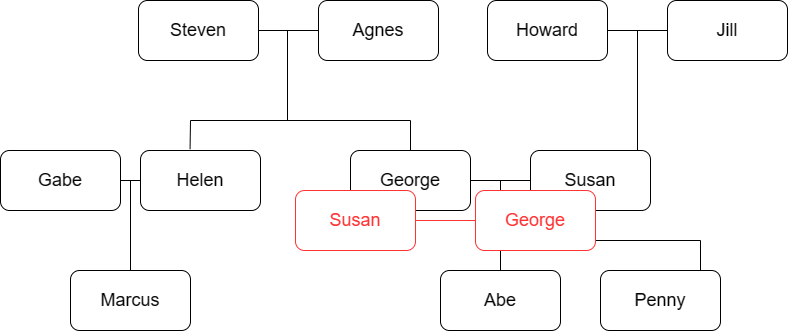
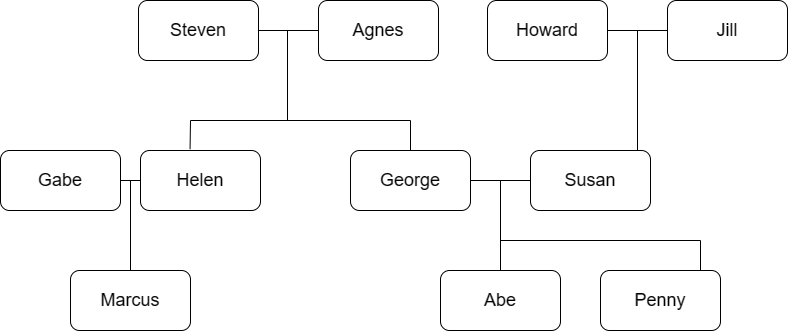
Given this setup, we could piece together the following family tree:

This tree is a visual representation of all the separate facts we get by combining all of our initial information. We can ask our system any number of questions, even ones that go beyond the scope of the original data set, and it can derive answers for them. It will answer yes, no, or uncertain, and so long as our propositions and predicates are all correct, then we can know that any derived answer is also correct. This data is a source of truth because it is based on logically sound principles.

A Twist)

But what if all of our propositions and predicates are all correct…except one? What if among all the truth facts and rules we include just one falsehood? It might occur to you that this would tarnish our confidence in the system, because there would always be a possibility that the answer it gave to us was that one lie. But actually, the effect is far, far worse. It has been proven that introducing just one logical falsehood into a system such as this will make any possible lie seem true. It won’t just be one lie that comes out of the system, it will be all lies. That might seem improbable, but allow me to illustrate.

To the system up above I will introduce one logical falsehood. Given the previously established rules, it is impossible for this to be the case, but I am going to enter it as a fact even so:

Susan is Abe's father

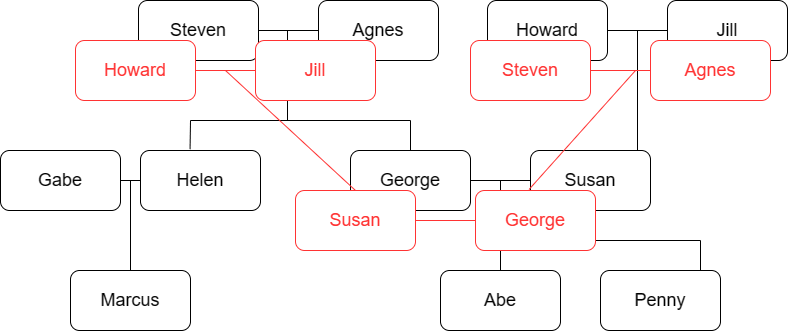
This statement is completely contrary to the logic of Predicate #11, but we add it to our system regardless. This creates a logical contradiction, and now let us look at all the new falsehoods we are able to infer from it. By Predicate #4 we can infer that since since Susan is Abe’s father, then Abe’s other parent, George, must be his mother.

Of course, we previously had derived that Steven and Agnes were Abe’s paternal grandparents, because they are George’s parents. But now that we know that George is Abe’s mother, then they must also be his maternal grandparents. By the same token, Howard and Jill are now no longer only Abe’s maternal grandparents but also his paternal.

Of course, now that we know that Howard is Abe’s paternal grandfather we can combine that with the already-known fact that Agnes is his paternal grandmother, and we can now infer that they are married together, something we never knew before! And by the same token, Steven and Jill are now also married together. Thus all the grandparents are intermarried in some sort of free-love commune! This does have the unfortunate effect of making George and Susan, Abe’s parents, siblings to one another in addition to still being husband and wife! Furthermore, since Abe’s parents are also siblings, then his sister Penny is also his cousin because her mother is the sister of Abe’s father (and her father is the brother of Abe’s mother).

But we aren’t even really going yet! We still haven’t invoked the powers of NOT and ELIMINATION. First let’s consider the NOT. Predicate #10 stated that a cousin is NOT a sibling, and Predicate #11 that a mother is NOT a father. So, since we just proved that Penny is Abe’s cousin, then she is NOT his sibling. Of course, she also is his sibling, since Proposition #4 explicitly says so. Thus, she is his sibling, and she is not. These are both totally valid answers in the eyes of our data set. And Abe’s parents George is his father and Susan is his mother, but also, they are not. And his grandparents are his grandparents, but also, they are not.

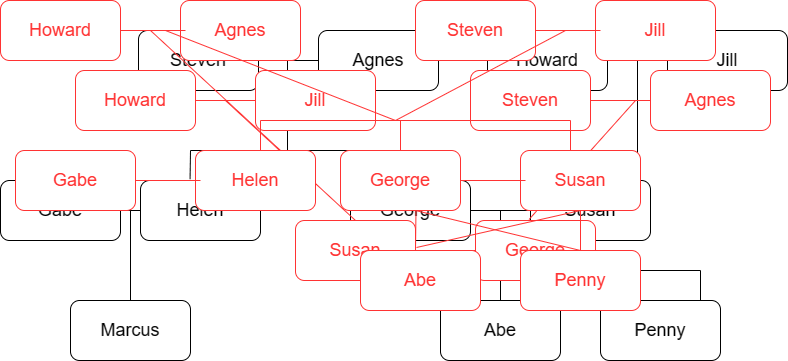
And now that we’ve shown that we can prove that the exact same relationship can and cannot exist simultaneously, by ELIMATION we can also prove that every relationship can and cannot exist. So, from the initial data set we know that Abe has a sibling. But who is it? Well, we can go through each member of his family and prove that they are not that sibling. So, let’s do that for every family member except one, Steven, and now we know, by process of elimination, that Steven must be the one who is Abe’s sibling. And by the same process we can prove by process of elimination that it is Agnes, and Howard, and Gabe, and Helen, and George, and Susan, and Marcus. And by the same process they are all his father, and all his mother, and all his aunt, and all his uncle, and all his cousin, and all his grandfather, and all his grandmother.

I’m not going to try to show the family tree at this point, because it is simply all names connected to all other names in every possible way. But also…all names connected to none of the others. Every statement is true. Every statement is false.

Our data set was useful at one point. It was full of true statements, and it could be used to infer many other true statements. But now, after a single lie the entire thing has been corrupted. The only answer it has to provide are “yes, no, maybe, I don’t know…I guess it depends on how you look at it.” It has lost all confidence and isn’t useful for anything.

And sure, this is a rigorous and mathematical system, which is particularly prone to collapsing at the slightest instability. The system in our minds is far more nuanced, able to continue functioning with illogical assumptions and idiosyncrasies…but only to an extent. The same principle does apply to us to at least some degree. Adopt the wrong belief and suddenly every other concrete conviction starts to be undermined by it. People start going through logical acrobatics to try and make incompatible beliefs fit together, corrupting all that was once good and losing the certainty they once had. We cannot accept a lie without somewhat losing our grip on all truth.

To Live Freely: Part Two

Built on Truth)

Yesterday I shared how twelve-step programs teach their followers embrace a fully truthful view of themselves. The ever-feared Step 4 requires its members to conduct “a fearless moral inventory,” classifying their every flaw and weakness, though also their abilities and strengths. I pointed out that the people that take such steps with sincerity are the most fulfilled individuals that I know, living a higher form of life than any other. I gave this as evidence that only a life founded on truth is truly free.

Today I’d like to consider another example that illustrates how holding unapologetically to the truth will always result in the fastest and best development of a system. This example arises from the world of physics and technology, but in my estimation it translates seamlessly to the humanities.

Taking Flight)

Let us consider the advances mankind has seen in the aviation and space exploration fields, the ways that we ventured higher and with greater control into our own atmosphere. For untold thousands of years, humanity was entirely unable to suspend themselves in the air. The only way to elevate oneself was to climb a tree, or a mountain, or build a tower. All of these required the tall object to be firmly rooted to the ground, therefore being nothing more than an extension of that ground.

It wasn’t until 1783 that the Montgolfier brothers invented the first hot air balloon. They had observed that a pocket of hot air, contained within a canvas, became more buoyant and would rise. Many of their initial theories were actually quite incorrect. They originally believed that smoke itself was the buoyant entity, and they certainly had no understanding of air molecules being excited by the increase of temperature. Nonetheless, even if they did not fully understand the physical truths at the molecular level, they had found a way to act in accordance with them, and so for the first time in millennia, man was able to ascend untethered to the heavens.

The Wright brothers surpassed these relatively simple principles of buoyancy when they honed in on the truths of aerodynamics, invented the first airplane, and conducted the first powered flight in 1903. To their credit, they seem to have been quite cognizant of their own ignorance. They knew that they did not know all the forces that were at play, or the exact mathematical expressions to describe them. This was why they built the wind tunnel, so that they could learn by trial-and-error the correct size and shape to maximize the lift of their ailerons. They progressively brought their designs into harmony with the truths of aerodynamics by a systematic process, even while not understanding why those truths were what they were, and the result lifted mankind even farther.

Of course, following the Wright brothers, this scientific and systematic approach to understanding the laws of nature would revolutionize the world at an accelerated rate. Gone were the days of attributing unexpected and inclement weather to the whims of emotionally unstable gods. It had become the common consensus that the universe was operating according to a consistent system, one which could be measured, modeled, and predicted. Thus, great minds were no longer limited to approximating the truth by trial-and-error anymore, they could actually capture it within mathematical algorithms.

This completely changed how man and his machinery related to the world. Invention began taking place primarily on the math sheet and the computer simulation, and only when mastered there translated to the real world with working results. Real-world practice led to more variables in the algorithm, more work with the algorithms led to better practice. Years of this cycle led to, in1969, humanity crowning all its aviation and propulsion accomplishments with the first landing on the moon. Here was mankind’s final and decisive victory over the atmosphere! We had such a mastery of understanding and such a power of invention that we could suspend ourselves within our airspace, traverse to any other point within it, and even break out of its confines entirely.

Increasing Truth)

Lifting off of the ground in a balloon came about by an accidental alignment with some of the physical truths. Powered flight required more deliberate and systematic experimentation to generally stub out the shape and bounds of that truth. Voyage to the moon, however had demanded a perfect and continuous model of the truth. As man increased his knowledge of the truth and synchronized his efforts with it, his reach literally extended to the heavens.

It is interesting to note how each successive milestone increased in difficulty at an exponential rate, yet they were each achieved in exponentially shorter timespans. As already mentioned, it was thousands of years before the Montgolfier brothers built their gravity-defying balloon, but only an additional 120 years until the Wright brothers conducted their first flight, and then only 66 more years before the moon landing took place. Truth is a vein that reveals more and more precious ore the longer you keep digging at it.

These examples also illustrate that truth is accumulative. Each of these inventors was able to expand and build upon what had been done before, established on the tower of knowledge already erected by the great minds of the past generations. This idea was famously captured by Newton, who stated, “if I have seen further, it is by standing on the shoulders of Giants.” It is poetic that Newton uttered this, for he predated all of the others mentioned thus far. More than 100 years before the Montgolfier brothers and their balloon, he discovered the truth of gravity, which was the first foundational truth that needed to be understood if anything was ever to rise above it. He became one of those same giants he spoke about, and all the other men I have mentioned were perched upon his shoulder. The first giant, though, the bedrock at the bottom of this stack of innovation, is Truth itself.

Before man discovered the physical truths of the world, he was able to muddle about and survive in some regions of the world and go extinct in others. He could prosper in some of his endeavors and be frustrated in others. Life and death, success and failure, these all seemed to be according to the random whims of unknown forces. But when man started to recognize the physical truths that defined his world and lay his foundation upon them, he thrived and flourished. Living in truth means living in harmony with the once-mysterious forces. This is demonstrably true for the physical world, and it is just as true for the spiritual.

To Live Freely: Part One

Axiomatic Truth)

There is a concept that has come up a few times in my previous series, including the last one. I have spoken to the matter in brief here and there, but now I want to consider it more fully. The concept is that living in the truth is the foundation for a full and happy life. Said another way, facing the facts as they really are is the only way to be truly free. Said a third way, only those who are willing to face the truth unflinchingly are ever truly alive.

This is a principle that is basic and fundamental to life. It is so foundational that sometimes it is difficult to really get a grasp on it. Axiomatic truths are, by definition, self-evident in their truthfulness, requiring no argument to prove them. That’s all well and good, but it means that if you then try to explain why an axiom is true you’re going to have a very hard time of it! Explanations tend to lead to circular logic, such as “living in truth is the foundation for a full life because…it just is!”

One way to come to full appreciation of these fundamental truths is to look at them in reverse. Fundamental truths are prerequisites for many other things in life, and by examining those things that are built upon foundational truth we obtain evidence that the underlying axiom really is true, for if it were not the things that we have observed could not be. We find that the fundamental truth is necessarily true, because it is necessary for it to be true for other observable things to be so.

Even so every good tree bringeth forth good fruit; but a corrupt tree bringeth forth evil fruit. A good tree cannot bring forth evil fruit, neither can a corrupt tree bring forth good fruit.... Wherefore by their fruits ye shall know them. -Matthew 7:17-18, 20

Jesus describes the same idea in these verses where he teaches that we may recognize that which was good by whether it brought about good or not. So if we want to know whether “a life founded upon the truth is joyful and free” is a true statement or not, then we merely have to look at those who live in harmony with this belief and see what sort of life they possess. I will begin my series today by doing exactly this. I will look at an example of people who are built upon this axiom, living their lives with the assumption that it is absolutely true. We may observe the reality of their lives, and infer whether they built upon a solid foundation or not.

The Happiest of People)

I have mentioned before how the addiction-recovery groups I have attended are singularly focused on living in harmony with truth. Any addict working a twelve-step program can tell you that one of its most fundamental tenets is that we take a fearless inventory of our lives, facing all of the unpleasant and difficult truths in our character. Where most people attempt to cherry-pick their best qualities and define themselves by those, addicts in recovery open the door to all of their qualities. We do not care if the description of us is pleasant, only that it is true.

And what comes about by this strict adherence to seeing things as they really are? For an answer, let me offer an anecdote that occurred to me personally. I was speaking with an ecclesiastical leader about my efforts to overcome my addictions, and my time spent in my recovery group. As soon as he heard that I was part of a twelve-step program he said to me, “you know, I’ve never been a part of such a program, but I have been a witness to its meetings and its members, and those are the most humble, most sincere people I have ever met.”

The reason why the twelve-step program has grown at such incredible rates since its inception is entirely due to the quality of the men and women one meets when they walk through the door. People see men and women who have not only gained freedom from the most terrible of vices, but who also live with a clearness and a joyfulness that simply isn’t to be found anywhere else. Furthermore, the fact that that light has remained consistent throughout the decades and continues to burn brightly in every new generation of members is a testament to the fact that the happy way of life was not due to some pre-existing condition in the first AA members, but is cultured in its members from the principles that they live by. If people had not seen throughout the years that these people had uncovered a superior way of life by their principles, then no one would have stayed and joined the crew, and it would have been a long-extinct experiment.

It was the evidence of this joyful peace that also drew me into the ranks of the twelve step program. It might seem a counter-intuitive thing to say, but I quickly recognized that I had never seen a happier, more satisfied, and more productive people, than these addicts who sincerely identified their miseries and their flaws. One would have thought that bringing out those heavy truths would have crushed them, but so far as I could see those weights, once surrendered, were being taken away, so that they could live free and unfettered. They attested that one had to truly see their shackles before they could receive the key to undo them. Though I was not then converted to the notion of living my life strictly in harmony with the truth, I was persuaded enough by what I saw to give it a try. My result has been much the same as theirs.

But you don’t have to take my word for it. Even if you don’t consider yourself an addict, go and visit a few of the local meetings in your area. See for yourself what manner of men and women these are, and what sort of lives they lead. Granted, every group has its own culture and its own level of sincerity about the work, but attend a few different ones and you will quickly see that there is a clear correlation between those that genuinely face the hard truths and those that live joyful and free.