I have been examining our need for approval and validation in our lives, and how we can seek it from other sources than the people around us. Thus far I have discussed the practice of giving approval and validation to our own selves, and this certainly an important practice, but it isn’t the end of the story.
Today we will start to examine another source of approval and validation, one that is higher than any other. We will start by looking at the most perfect example of a man living with this sort of higher approval in his life.
Divine Approval)
The Father hath not left me alone; for I do always those things that please him. - John 8:29

And Jesus lifted up his eyes, and said, Father, I thank thee that thou hast heard me.
And I knew that thou hearest me always. - John 11:41-42

And lo a voice from heaven, saying, This is my beloved Son, in whom I am well pleased. - Matthew 3:17
We often speak of the pain that Jesus endured, but he also must have had moments of wonderful rapture as well. Can you imagine knowing with the same surety that he did that God loved you, saw you, and appreciated everything that you did? Can you imagine hearing God’s voice literally speaking out loud to say that He was pleased with you?
Forget about the validation of other people, what further approval would you need if you were regularly having experiences like this?! I believe each of us knows, deep down, that somehow this is the sort of the validation that we were made for!
If we are the children of God, then we are wired to need His approval. Children need to know that their father sees and appreciates them. We speak so much of our need to be obedient to Him, but that’s only half of the story. We need to be obedient to Him so that we may feel His approval. You cannot get away from this need, it is part of your identity as His son or daughter.
And that is why saying “I don’t need anyone else’s approval to be happy” is misguided. Or rather, it is misguided when it is applied to more than just the human race. Each of us has inside of us a hole that only God can fill, and so long as we keep trying to fill it with the approval of other people, or deny that the hole exists at all, we are going to be left agitated, incomplete, and perpetually frustrated.
Most of the time, we don’t even consider the absence of God’s approval when we try to make sense of this frustration inside of us. We might even ask Him to bless us with the approval from others, and then wonder why He didn’t answer that prayer! He doesn’t, because in His wisdom He knows that isn’t what we really need.
In conclusion, the world doesn’t meet the need for acknowledgement and approval that we need, nor indeed can it. This need for praise is based in our relationship as children of a Heavenly Father, and His is the only approval that can satiate our souls.
Which is all well and good to understand…but now how do we get to hear those sorts of messages from Him? We’ll take a look at that with tomorrow’s post.
In my last post I spoke about a practice of giving myself words of validation and appreciation. I explained how this process has helped to satisfy my need to have my good deeds seen and acknowledged. By providing this kindness for myself, I able to let go of unhealthy obsessions, such as trying to coerce love and attention out of others.
The way that I give myself this validation and appreciation is very simple, with only a few steps to follow. Basically, these steps come down to showing myself the same consideration and attention that I would to another person. I certainly don’t want to be sending myself a message that I am being taken for granted!
The steps I follow in this process are:
Set aside time. I wouldn’t want to praise the good someone else had done in an offhand manner, so I don’t do that to myself either. I like to wait until the evening, after the kids have gone down and I am able to have a conversation with myself free from distraction. This practice doesn’t ever take me too long, but I make sure it can last for as long as it needs.
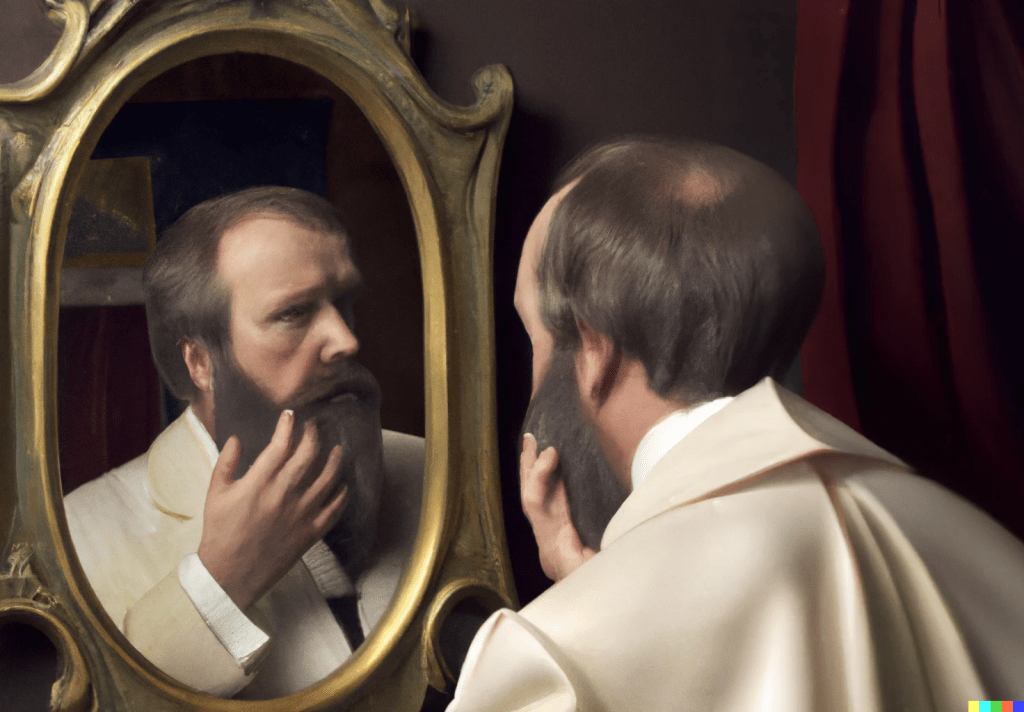
Look myself in the eye. This, of course, requires a mirror. I don’t want to hear these words of kindness from a faceless, inner place. I make the effort to look myself full in the eye and show my sincerity as I speak.
Speak out loud. It’s easy to be self-conscious about this practice, and at first it was tempting to just think the words in my head or mutter them under my breath. But I realized that I needed to literally hear these words. This is another reason why I wait for the evening, when I can go to an isolated place and not suddenly have someone walk in on me.
Be specific. The last thing I want to do is broadly tell myself “good job, today.” The whole point of this is to call out all of the individual things that I did that I feel proud of. One-by-one, I go through each point and acknowledge and express gratitude for it directly. And I use my knowledge of my own inner workings to call out things that no one else could. Like “I know you were a bit unsure about approaching that stranger to see if he needed help, but you were bold and went forward anyhow.” As you can see, I’m not only specific about the event (approaching the stranger), but also about the good quality shown (being bold).
Pause and listen. Once I’ve covered all the things that were at the forefront of the mind, I pause to listen to my own heart. Have I forgotten something? Did some of my words not feel right? I make sure that I stay in this moment until I feel totally seen and appreciated.
Reiterate my love. Last of all, I make sure that I know that I love and care for myself, that I see and appreciate myself, and that I will continue to be there for myself.
And this is the process that I follow. When I am on top of my self-care and recovery, I try to do it once every day. It does take a commitment of time and effort, but frankly that’s a big part of what gives it its value. All of us want to know that we’re worth it for someone to go out of their way to care for us, and why shouldn’t that someone be our own self? Honestly, even if we had another person who perfectly fulfilled that need for us, we still need to learn to treat ourselves this way as well.
I can attest that as I have done this work, I have seen a marked improvement in my emotional outlook and a definite increase in my life satisfaction. I highly recommend that you give this practice a try and see what it does for you.
All that being said, self-appreciation isn’t the end of the story. There is one particular source that I still feel we all need to feel the approval of: God. The rest of these posts will be exploring that side of things, I’ll see you tomorrow as we dive into it!
Yesterday I brought up the common sensation we all have of not being appreciated as we ought to be. I examined why others don’t validate us in the way that we wish they would, and I also pointed out that in many cases they literally can’t.
At this point one has to make their peace with a fact of life: you will never receive exactly the validation, recognition, and appreciation that you desire from other people. Some people, some of the time, might say some of the right words, but there will always be some things left unseen, unappreciated, and unsaid.
This realization brings one to a crossroad. On the one hand, you could simply accept this dissatisfaction as a necessary part of life, an unpleasant but unavoidable reality that you just have to bear and move on with. On the other hand, you could start to consider outside solutions. Maybe no other person can give you all the validation that you need, but is it possible that you’ve been looking in the wrong place for it all along?
To choose that satisfaction is impossible is the more cynical option, it is to accept life as inherently broken. Unfortunately, some might aspire to such a cynical view as a show of strength. They might say, “I don’t need anyone else’s approval to be happy.” In my experience, however, simply denying the longing inside me does nothing to make it actually go away. I might say it doesn’t bother me anymore…but really it does. And so long as it’s going to keep bothering me, I may as well see if there’s not an alternative.
And in my contemplating, I have come up with two better, more reliable sources of validation. Today we will look at the first.
Love Myself)
One of the problems I mentioned with seeking approval and validation from others is that most of the good we do in life will be imperceptible to those around us. Another reason was that even when our good is recognized, the exact words of affirmation that we need to hear are a personal secret. Only we know exactly what qualities we feel that we most need to be appreciated for.
And so, what better person to provide the specific and targeted validation that we need than our own selves? Of all the people on Earth, only we know all the good that we have done, and only we know what qualities we exercised to do it.
I first considered giving approval and validation to myself after learning about Internal Family Systems, which suggests that your personality exists as several different entities, such as the wounded child who still hurts from a trauma in your past, and the protector who pushes others away in order to protect that child. My therapist guided me through a program in which I, as the authentic self, work with each of these different parts, unburdening them and giving them validation. After a while, I realized that I didn’t have to wait for those hurt and frustrated parts to come and find me, though, I could proactively care for them by letting my authentic self speak words of kindness and praise to them at any time that I wished.
Matters of Concern)
Even after having the idea of giving myself this self-appreciation, I still had my skepticisms about the practice. On the one hand, I suspected that I wouldn’t be satisfied. I felt that what I really wanted was validation from others, people who had said that they cared for me, but then took my contributions to the relationship for granted. How was validating myself supposed to resolve those relationship problems? My other concern was that I would give myself an over-inflated ego. I already felt like I was obsessed with the praise of others, wouldn’t patting myself on the back just extend my narcissism further?
I think that these were valid concerns to have, and I’m glad that I had them in mind from the beginning. Since I knew what dangers to watch out for, I felt I could experiment, and at the first sign of trouble I could abandon the practice altogether.
Thus I moved forward, and though I did not start this practice until recently, much to my surprise I have already seen both of these concerns be emphatically refuted. It is true that I have still felt taken for granted in some of my relationships, but now that I am receiving validation from myself, I no longer feel like I have to get the approval of others. For years these other people have been my only hope for validation, so I had a codependent relationship with them. I haven’t dared to speak my mind, for fear of losing what little I had. Now that I’ve learned that I can meet those needs without them, though, I am finally free to speak up for myself. I can tell them how I feel, and if they respond with hostility, I am perfectly content to end the unhealthy relationship.
And it has been much the same with my other concern. Being able to receive approval and validation from myself has disintegrated the need for the praise of the world. After a showing love and appreciation to myself, I really feel okay with the idea that I might never have the broader love and acclaim that I once dreamed of. As it turns out, it isn’t really fame that I wanted, it was a listening ear, even if only my own.
Self-Care)
Recognizing and calling out the good things that I do is now one of my fundamental practices of self-care. It has taken my peace and fulfillment out of the hands of unreliable sources and brought them under my own jurisdiction.
So how exactly do I do this practice? I’m out of time for today, but I’ll spell out the simple steps I follow with tomorrow’s post. Maybe it’ll be useful for you as well.
Something I’m sure that all of us have noticed is that there’s never any shortage of people to criticize us when we do something wrong!
Do what you feel in your heart to be right - for you'll be criticized anyway ~ Eleanor Roosevelt

Whatever course you decide upon, there is always someone to tell you that you are wrong. ~ Ralph Waldo Emerson

Remember, the only taste of success some people have is when they take a bite out of you. ~ Zig Ziglar

Great spirits have always encountered violent opposition from mediocre minds. ~ Albert Einstein

All that was great in the past was ridiculed, condemned, combated, suppressed ~ Nikola Tesla
Whether to shine a light on what is wrong with us, or else to disparage what is right with us, there is always another who will criticize and tear us down. Unfortunately, it doesn’t seem to work the other way. When we feel that we are deserving of praise, there never seem to be enough to appreciate what we have accomplished.
Some might say that this is just a pessimistic view, that we are more prone to remember the negative commentary than the positive. At least to some degree, this is true. I have caught myself bemoaning the lack of appreciation for something I have done, when suddenly I remember that someone actually had complimented me about this earlier.
However, even after recognizing this phenomenon, I still feel that neither I, nor anyone else, receives an adequate dose of being seen or appreciated. I am convinced of this, because I have realized that much of this notion of being unappreciated is an inevitable reality of our human existence. Let us consider why this is so.
Not Being Seen)
It seems to me that the majority of things that I would like to receive validation and appreciation on are things that no one else will even see. Not because they are inconsiderate, not because they are inattentive, but because they occur in the secret recesses of the heart where I am the only witness.
Day-to-day behaviors of mine might seem meaningless or arbitrary to any other person, even though they required a moral choice on my part. It could be that I felt an old grudge rising up and I let it go, or that I drove down a different street to avoid an object of lust, or that I perfectly coordinated my schedule to make sure I had ample time to play with my son.
Dozens of these moments might occur in a single day, with no fanfare and no recognition. I suppose I could draw attention to them, spelling out to others exactly what I went through inside, but in most cases that would feel like petty boasting.
These are good moments in our lives, perhaps the best moments, yet by their nature they will pass unnoticed by any other.
Not Being Acknowledged)
Sometimes the good that we do is witnessed by other people, but they fail to recognize or appreciate it. Whether as a father working to provide for his family, or a mother caring for her children, or a church leader picking up the phone whenever a member of his parish calls, or a citizen volunteering in the community, we all have ways that we do good simply as a matter of habit.
Unfortunately, when we make a pattern of doing good, it is easy for others to take that good for granted. They don’t see doing our duty every day as a moral decision, and most days it might not be…but some days it totally is! Just because something is a duty, doesn’t mean it isn’t worthy of recognition.
On the flip side, the world also tends not to recognize when we are justified in retaliating against another but chose not to do so. It’s not very common that we say to one another “thank you for not demanding your pound of flesh from me” even when it required a superhuman effort from the other person not to do so!
Not Hearing the Right Words)
Finally, we have the situation where someone does recognize that praise is deserved, but they lack the time and insight to be specific and meaningful with it. Not all words of appreciation are created equal. A generic “good job, everyone” to the entire group doesn’t begin to acknowledge your individual efforts and virtues. Even worse, many who know that they ought to compliment another feel awkward about doing it and will avoid making any sort of eye contact. This suggests that the giving of praise is a chore to them, rather than a sincere expression of appreciation. Earlier I suggested that pessimism might cause us to forget most of the compliments we receive, but perhaps the real issue is that most of the praise we get is phony, so we don’t make note of it anyway.
Of course, sometimes people do show us appreciation that is heartfelt, sincere, and made while holding our gaze. And while the gesture is appreciated, sometimes even this won’t land just how we would like. This is because people will compliment us based off of the qualities that they think are important, rather than the ones that we really needed to hear. I might say to you, “that’s a wonderful poem you’ve written, the rhyming and the meter are perfect,” and in your own head you might think “well…yeah…I’ve always been good at rhyming and meter, but this was the first time I tried to have a spiritual connection through my craft.” By complimenting the polish rather than the subject matter I have failed to give you the praise you needed to hear most.
Of course, knowing which specific virtues you need to have reaffirmed requires an intimate knowledge of your inner self. The right words for the same behavior will be totally different from one person to the next, so knowing the exact words to say is often beyond the capability of the one giving the praise. We can appreciate that the intention was on the mark, even if the words weren’t quite, but the sense of dissatisfaction may persist all the same.
Alone in Our Needs)
To receive sincere appreciation and refreshing validation is a very rare occurrence. The lack of them is in some part due to the laziness and thoughtlessness of others, but as we’ve illustrated, much of it is simply beyond the capability of others to provide for us.
Are we to simply accept this sense of dissatisfaction as having no solution? Well, yes and no. We need to accept that we are never going to have complete satisfaction from other people, but we don’t have to accept that other people are the only ones who can satisfy this need.
Throughout the rest of this study I will discuss what other sources of validation we can have. I will begin tomorrow by introducing a new practice I have recently implemented in my life, one that has already brought me much of the validation and contentment I have longed for. See you then!
In my last post I discussed the therapeutic process of revisiting childhood trauma and mourning the things that might have never been fully processed at the time. In many cases this means finally shedding the tears that had been bottled up for far, far too long.
But I’ve been in therapy groups, and I’ve certainly seen a resistance to this process, particularly among the men who feel like openly weeping is unmanly. Is there a validity to this sense of stoicism, or is it a misalignment in our society? Well, today we will address this question by looking at the example of the greatest man that ever lived: Jesus Christ.
Become as a Little Child)
The primary reason why many feel ashamed to show their unbridled emotion is that they want to be mature and composed. They don’t want to appear as a little child. But what was it that Jesus said to his disciples about little children?
And Jesus called a little child unto him, and set him in the midst of them, and said, Verily I say unto you, except ye be converted, and become as little children, ye shall not enter into the kingdom of heaven. Whosoever therefore shall humble himself as this little child, the same is greatest in the kingdom of heaven. - Matthew 18:2-4
Humble yourself as a little child. Give up your pride and your show of false strength. Stop trying to prove that you’ve got this all taken care of and let yourself admit that you were really hurt.
And in case you aren’t sure that Jesus’s declarations applied to matters of showing one’s weakness and hurt, let us consider another example that he gave in a moment of great distress. In the Garden of Gethsemane, when he was bowed under the pain of the atonement and the anxiety of the coming crucifixion, this was his response:
And he went forward a little, and fell on the ground, and prayed that, if it were possible, the hour might pass from him. And he said, Abba, Father, all things are possible unto thee; take away this cup from me: nevertheless not what I will, but what thou wilt. - Mark 14:35-36
Jesus feels scared and hurt, and he falls on his face and calls to his “Abba.” Abba is a Hebrew word for “father,” and it denotes both intimacy and submission, something like “daddy” and “sir” all rolled into one. “Daddy/sir, you can do anything, will you take this hurt from me? But I’ll go through with it if you ask.”
Jesus has been many things to his followers. He has been called “master,” and “teacher,” and “prophet.” But to his God, Jesus is “as a little child.” Vulnerable, open about his pain, asking for help, and submissive.
Later still, when Jesus was upon the cross, he cried out in a moment of agony:
And at the ninth hour Jesus cried with a loud voice, saying, Eloi, Eloi, lama sabachthani? which is, being interpreted, My God, my God, why hast thou forsaken me? - Mark 15:34
Previously, when raised upon the cross, Jesus had been magnanimous to his killers: “Father, forgive them; for they know not what they do” – Luke 23:34. He had been considerate to the well-being of his mother: “He saith unto his mother, Woman, behold thy son!Then saith he to the disciple, Behold thy mother! And from that hour that disciple took her unto his own home” – John 19:26-27. But to his God, once again, Jesus was a little child, crying out and asking why he was alone.
To Every Thing There is a Season)
To every thing there is a season, and a time to every purpose under the heaven: A time to weep, and a time to laugh; a time to mourn, and a time to dance; - Ecclesiastes 3:1, 4
The words and example of Jesus Christ perfectly line up with these words of wisdom in Ecclesiastes. Yes, there is a time for stoicism. There is a time for power. There is a time for projecting strength and not weakness. One has only to consider Jesus chasing out the vendors in the temple with a whip to see that there is even a time for anger!
But also, there is a time for weeping, mourning, and being broken. One of the great examples of Christ, which too often goes overlooked, was how he filled the full measure of human emotion. He showed all of his feelings, at the appropriate time. Reserved when he ought to be, confident when he ought to be, distraught when he ought to be, and pained when ought to be. He assured his disciples that there was nothing to fear (Mark 4:39-40), but he also wept at the death of Lazarus (John 11:35).
To claim that you ought not feel or show an entire sector of the emotional spectrum because you are a man, is to claim that that you are more of a man than Jesus. God did not give us our feelings with the intent that we would ignore half of them, all of them were given for our good. Yes, they need to be governed and managed at times, but that does not mean suppressed out of existence!
Previously, I presented the mourning of old trauma as a matter of emotional therapy, and it is, but it is also a matter of spiritual significance as well. We cannot be the full person that God intended for us to be until we truly embrace the full person, broken inner child included.
I know by experience that Christ calls each of us to step into the hurts of our past. Not only that, he asks us to step into those places with him. He goes with us into those defeated places, he asks us to open up the hurt and let the tears flow, and then he applies his healing balm and saves the lost soul within. Mourning our old wounds, with our Savior by our side, is arguably the most sacred act that we will ever do. May we all go through this beautiful process, so that every lost child can be healed and be saved.
This morning I was sitting in my living room when I heard the sound of collisions in quick succession and the cries of my two-year-old daughter. She had fallen halfway down the staircase, and now she lay in a heap, physically tender and emotionally broken.
As you might expect, for the next several minutes she was inconsolable, wrapped in the arms of her mother, wailing as the tears streamed from her face. There was no real damage to her physically, but the terror of falling and the momentary pain had greatly unnerved her.
And then, all at once, she stopped crying, bounced out of her mother’s arms, and went about her day like nothing had happened!
This, of course, is common in the life of a young child. A moment of pain or of fright brings them crashing down, but after a good cry they’re perfectly fine and will soon forget that anything ever happened. One might be tempted to say that this whole thing is silly, likely they are getting all worked up about something that didn’t matter at all, but really this is a sign that their emotions are operating exactly how they should. Being able to stop and have a cry is the child’s way of quickly and effectively processing the trauma, and then they are able to leave it in the past where it belongs.
Unwept Tears)
Sometimes, however, children don’t cry when they ought to. The tears well up in their eyes, but they blink them back and power forward. The primary reason for not crying is that the child doesn’t feel that it is safe to cry, and this situation might occur more frequently than you’d expect.
Consider the example of a child lost at the supermarket. They may feel terribly scared and alone, but many of them won’t actually cry about it until they are back in the arms of a loved parent, which is the only place that they feel safe enough to let the tears come.
Another example would be when the child is surrounded by antagonists. A child that is being bullied at school will often feel that they have been humiliated enough without showing their aggressors the tears in their eyes as well.
There may also be social pressures not to cry. Young boys will feel like they must become stoic and reserved, like men. Though they may suffer a considerable ordeal, such as being in a dangerous car accident, if they don’t see their father shed any tears about it, they will feel that they shouldn’t either. Girls have their own form of this, too, feeling that they must stuff their feelings down in order to not make a scene. They will feel it is their responsibility to not add drama to an already tense situation, to hold the peace and not rock the boat.
There are many other examples that could be given of times and places that a child’s psyche knows that it ought to cry, but they don’t because it feels unsafe or wrong to them to do so. Thus, they are at odds with their own self, suppressing their nature under a show of control.
The Work of Therapy)
I once had a therapist who would quote that “the wound un-mourned is a wound unhealed.” Most of us don’t realize that when we suppressed our tears as children, we essentially covered up the wound without ever treating it. Just like physical wounds, emotional wounds can get infested. Infection will grow within them, and then that infection will come out in odd, seemingly unrelated placed. Many times, we believe that there isn’t a reason behind the bad things that we do as an adult, but after we revisit and mourn our childhood trauma, we suddenly find the motivation to do the wrong thing has evaporated away. Our emotions are like a prairie dog village, with many seemingly unrelated openings at the top, but a whole network of interconnected tunnels hiding down below.
One of the greatest works of therapy is identifying those unwept, unhealed moments of trauma from our past, going back to them, and crying for them like we should have at the time. With the help of a counselor, one has revealed to them the fact that the scared, hurt child is still very alive and well inside. They find that child, weep with it, and bring it to a place of safety.
Of course, I have seen many men in my recovery groups that feel extremely uncomfortable with getting emotional. We are grown men, and we’re convinced that crying is unbecoming of us. But what we must remember is that it isn’t necessarily us who needs to cry, it’s the young boy inside of us. All we’re doing is letting our body be a vessel for that child to get out what it has kept locked away for so long. In this sort of context and for this sort of purpose, tears could never be more dignified.
And, when we do let ourselves go through the full mourning process, just like my two-year-old daughter we’ll suddenly bounce back up and feel such a lightness and relief. We don’t realize just how much our old hurts were holding us down until we suddenly feel the weight of them sliding off our backs. And all things considered, it is a relatively easy thing to do. I never ceased to be amazed that a hurt, held onto for more than twenty years, can be released in only twenty seconds.
But what about the words of scripture? Do they support returning to the state of a little child? Do they approve of such vulnerable, open-hearted weeping? Come back tomorrow as we take a look at the words of Christ, himself, and the example that he set with his very own life.
Over the last two posts I’ve examined the nature of statistics, and why they shouldn’t be used to predict one’s personal journey in recovery. I’ve spent time explaining that statistics are meant as a measurement of external uncertainty, and to model a group, but how they cannot represent your internal, individual state.
There is also one other limitation of statistics that makes them a poor crystal ball into your personal future. This is that every statistical survey has to clearly define the criteria that it is measuring for. Success and failure are described in clear, binary terms, which often fail to perfectly capture our nuanced, complicated world.
As an example, most surveys related to addiction seem to define success as simply not having another slip or relapse. People in recovery are surveyed, they answer if they have had a relapse since starting recovery, and that becomes the statistic of recovery. And even if the survey is more in-depth, it tends to only be this narrow, easily digestible slice that gets represented in web articles and everyday conversation.
And as the data shows, it turns out that most addicts who enter recovery will slip at some point in their first year. So, in conclusion, most addicts will fail their recovery and never get better.
Recovery vs Sobriety)
Well, no. It’s not as simple as that. Anyone that has been in close proximity to an addiction recovery program will be very familiar with the statement that “relapse is part of the journey.” Which is to say, that yes, almost everyone will relapse, but no, that doesn’t mean that their recovery journey is a failure.
Recovery is a process, and in most addicts, it means following the program, failing in a moment of weakness, and then recommitting to the program. Over time, rather than all at once, the addict pries off the grip of vice until he finally he can live free of it. Then, at last, he will be sober. When we fixate our surveys on the number of addicts who remain sober in the first year, we seem to be suggesting that sobriety doesn’t come at all unless it comes in that first twelve months.
So, are there addicts who at some point or another quit and never turn back? Yes. In my experience, if addicts are sincere and committed, then many, if not all, will achieve this state. It’s just that the point in the recovery program where this freedom is won is different for every addict. Thus, defining success as who quits cold turkey as soon as they start the program is an arbitrary and unhelpful goal.
Of course, I want to be sensitive to the fact that addicts want to stop acting out immediately. Their spouses want them to stop acting out immediately. Everyone who knows what’s going on with them wants them to stop acting out immediately. So, of course, at the outset everyone is going to want the addict to be in the small percentage who really do stop acting out as soon as they start the program. The problem is that if the addict “fails” at that goal, then the discouragement might make him give up the program entirely, when he would have eventually achieved success if he had kept with it. What is it that really matters? Immediate success, or just success?
What I am hopefully making clear is the difference between sobriety and recovery. Recovery is working the program faithfully and consistently, bit-by-bit freeing the captive soul. Sobriety is the desired fruit of all that labor, which ripens sooner in some lives and later in others, but all can achieve it if they keep working at their recovery.
One Day at a Time)
It is only natural to wonder what one’s chances of obtaining sobriety are but putting too much stock in the reported statistics is not only discouraging, it is deceiving. Immediate sobriety is not the one, true metric of an addict recovering.
If one wants to know if they will be successful in recovery, they have only to ask themselves if they are going to work the program of recovery for this one day. If their answer is yes, and they actually follow through on that, then yes, they are being successful in recovery. And if they can say and do the same tomorrow, then yes, they are in recovery for that day, too.
This, of course, brings us to the famous twelve step mantra “one day at a time.” The idea is that focusing on lengths of time past one’s immediate control is a fruitless effort. Long-term sobriety is not the result of mustering up the courage to be sober for an entire decade, but by mustering up the courage for a single day, one after another. Thus, ironically, most addicts who achieve ten years of sobriety do it by not worrying about the decade. If the addict is to consider months and years and decades, he does it in retrospect, looking backward upon the mountain of sobriety that was raised, almost by accident, one grain of sand at a time.
The odds of success in your recovery are not determined by what other people did in their first year of recovery. That doesn’t matter to you in the least. All that really matters is the decisions that you make for yourself this very day. This is the only metric of success, and in that field no survey has been conducted. You are the one that will record the numbers for yourself, you are the one who will create your own, personal statistics of success, and you are the one who will define what your fate is to be. In the end, success or failure is entirely up to you.
Yesterday I discussed the use of statistics to predict how likely a person in recovery is to maintain sobriety. These sorts of statistics can be discouraging, as they often make it seem like the addict is unlikely to ever obtain lasting sobriety.
I made the case, however, that statistics have their time and place, but cannot be applied in every situation. They are useful for representing the level of uncertainty in the observer, but not for describing the actual state of the observed. Thus, a coin that is covered only exists in one state (heads or tails), but the uncertainty of the observer is divided between two (heads and tails).
Today I want to consider another fact of statistics which makes it unhelpful in determining what your personal future entails. That fact is that statistics are a tool for measuring groups, but not individuals.
The Sad Case of Sally Clark)
There is a tragic real-life example of how the misapplication of a broad statistic to a single individual is both in appropriate and dangerous. Sally Clark was an English woman who lost one son to SIDS (sudden infant death syndrome) in 1996, and then lost a second son as well in 1998. This was terrible enough, but then it was made worse when Clark was tried for murder. One SIDS death in the family was believable, but two?
As it turned out, there was no concrete evidence to show that Sally Clark had killed either of her two children, but the prosecution brought in Professor Sir Roy Meadow to describe the statistical probability that this mother would have lost two sons to the same rare cause.
Professor Meadow argued that the odds of such an occurrence would be 1 in 73 million, an event so improbable that it could be rejected as a virtual impossibility. Mathematically, he said, Sally Clark had to be a murderer. The jury was convinced, and Sally Clark was sentenced to life in prison.
Four years later, though, it was discovered that the lab reports on the deceased children had omitted clear evidence of the two sons’ deaths being due to natural causes. Clark’s conviction was overturned, and she was released. At this point, though, she had already slipped into a terrible depression, and died shortly thereafter of alcohol poisoning.
Professor Meadow’s application of statistics was torn apart by other mathematicians and statisticians. The numbers he arrived at were simplistic and faulty and he never considered calculating what the likelihood for a mother committing double infanticide is, about 4.5-to-9 times more unlikely than double-SIDS as it turns out! Perhaps most importantly, though, he had made the critical mistake of applying group statistics to an individual.
Consider this, if the odds of a double-SIDS family were genuinely 1 in 73 million, then that would mean for every 73 million mothers you would expect at least one to have lost two children to the phenomenon. 1 in 73 million does not mean that the event does not occur, it means that it does, and you will start seeing multiple occurrences once your population pool is large enough. 73 million is large, but it is not unfathomable for a population. It was inevitable that someone would show up with this situation at some point or another.
By Professor Meadow’s logic we could look at every mother on earth, one at a time, and for each individual conclude that it is too improbable to believe she has lost two children to SIDS. And thus, we would go through the entire population, believing none of them could have suffered that ordeal, when by Meadow’s own statistics there would have been over a hundred women who actually did.
It is the same with addiction recovery. Statistics can define the pattern for a group of addicts, as every group will inherently have a certain likelihood for certain behaviors. But when we apply those likelihoods to the individual we make the subtle, but damning mistake of saying that if something is improbable for everyone, then it is improbable for anyone.
Groups Within Groups)
Statistics can model the group, but they cannot model you. And they especially cannot model you when you consider that inside every group there are more specific subgroups, each with their own accompanying statistics.
By this I mean that most statistics on recovery cover a very broad spectrum of addicts. The odds of sobriety that they give tend to include individuals who have been working a 12-step program for twenty years, and individuals who showed up for the first time today. It includes those that have come of their own volition and those who came only because a judge ordered them to. Clearly not everyone in this broad group is as likely to remain sober as every other.
Every time you take the next step in recovery, you come into a new subgroup, which is represented by better and better odds. Maybe 1-in-10 of all addicts will stick with recovery, but just by returning for the second week you might now belong to a group with a 1-in-9.5 success rate. Do your “step 4 inventory” with another member of your program and you come into another subgroup with even higher levels of recovery. Earn your one-month chip and enter yet another higher-recovery subgroup.
Not to suggest that you are improving your own odds, only that the group statistics are converging more and more to who you actually are. Or at least they would be if the research were conducted down to such granular levels. But you don’t have to take my word for it. Start going to recovery programs for any sustained amount of time and you will quickly see that there is a clear correlation between amount of time working on recovery and length of sobriety.
You Are You)
Hearing discouraging statistics might make you feel like you don’t have a chance of recovery. But never forget that in order to even define the odds researchers must first find a number of successes. They couldn’t say 1-in-10, or 1-in-100, or 1-in-anything until they had found that 1. Never mind what the group pattern might be, the fact remains that there are people who do achieve sobriety, and whatever their methods to get there, it’s safe to assume that they weren’t putting too much stock in “what their odds” were. They got better because they got better. They weren’t 1 in a group, they were 1 in themself, and they decided for themself what that themself was going to be.
Governing your life by statistics is not only a misunderstanding of the science, but also a dangerous game of self-fulfilling prophecy, one that can ironically change the statistics on the subject. There is no statistics on you as an individual. There are statistics on the group, and they are useful for understanding the group, but the group is not you. The group can be documented, but to quote Lawrence of Arabia, for you as an individual “nothing is written.”
In addiction recovery it is natural to wonder what one’s chance of success is. If you’re like me, then shortly after you start a program, you’ll be googling something like “what percent of addicts relapse?” I’ll just tell you right now, the results are not encouraging. Depending on your personal flavor of addiction, your chance of never slipping again might be as low as the single digits. This can be a very discouraging realization, both for the addict and for any loved ones that are involved. It can be enough to make one feel that “once an addict, always an addict.”
But I am here to tell you that statistics like these are next to useless when it comes to predicting what your personal story will be. Something about them rang false to me when I first started recovery, and after walking the journey for several years, I gradually came to understand the reasons why.
Statistics of Uncertainty)
Let’s suppose I hold out a coin in front of you, heads-up, and ask you what the chances are that it is heads-up.
“Well it is heads-up,” you might say. “So 100%.”
“But there are two sides, aren’t there? So isn’t it a 50/50 chance?”
“No, I can see it. It’s 100% heads-up, and 0% tails.”
And you’d be right.
Now suppose I cover the coin with my other hand, but I do not rotate it. Still 100% heads?
“Of course,” you say, “it may be covered, but I still know what state it is in. 100% heads up.”
But now suppose I call our friend in, I show him my closed hands, and I tell him there is a coin underneath. I ask him what is the chance that it is heads.
“50%” he says, “and 50% tails.”
And he is right. But you still know it is 100% heads and you are also right.
You are both right because when we talk percentages and statistics we are not talking about the actual state of the coin, we are talking about the state of our own uncertainty. With your inside knowledge you are 100% certain of what the coin is and our friend, without that knowledge, is 50% certain. The numbers you give represent a state of your own selves and not the coin.
And what of the coin? It just is what it is. It isn’t 25% something, or 50%, or even 100%. It just is heads-up or it isn’t, and no matter of ignorant guessing is going to change what it is, even when that guessing is based on statistically sound principles. And not only is the coin what it is, it is also going to be what it is going to be. The mystery and uncertainty of what a flipping coin will land on is only a side-effect of how we view only a narrow slice of time, moving forward at a gradual rate.
The Statistics of You)
And as much as the coin just is what it is, you just are what you are, too. And as much as the coin is just going to be what it is going to be, you are just going to be what you are going to be as well. When you decide to go to recovery, you don’t split off a hundred separate universes and spin a cosmic roulette wheel, hoping it lands on one of the ten realities where you happen to stay sober. When you decide to go to recovery you just are going to see it through, or you just aren’t.
Outsiders may remain uncertain of whether you will maintain sobriety or not. They are ignorant of your inner state, so the best they can do is estimate your chances as a percentage. But you are not an ignorant outsider. You know what your state is and what it isn’t. If you’re honest with yourself, you probably already know whether you’re going to be acting out later this week or not.
The reason why the statistics didn’t feel like an appropriate fit to me when I started recovery was because I knew my own state. Outsiders didn’t know, but I did. I knew some of my group were only there because their wives made them come, but I wasn’t. I knew some were just going through the motions, but I wasn’t. I knew I was going to faithfully be at my recovery group every Tuesday night, and I knew that I was going to be doing my recovery work every other night of the week. I knew that my commitment was real, and I knew that my intentions were serious.
Now you may not be so certain of yourself over the next month and year and decade, but it is possible to be certain of the now. And unlike flipping a coin multiple times, your behavior in the future is affected your behavior in the past. What you choose today weights you more towards one side for the next day. If you are certain of sobriety today, and you follow through with that, then you will be that much more likely of sobriety tomorrow as well.
The Scope of Statistics)
Statistics have their place in the world. They help in defining the probabilities of what is unknowable, and they are useful for modelling large groups. But you are knowable, at least to yourself, and you are an individual, not a group. We’ve spoken to the first of those points today and we’ll examine the other one tomorrow.
Never forget the wonderful fact that you are a person who has free will. You get to choose. You are not a spinning roulette wheel. You are the card that draws itself, and the coin that turns itself. You get to decide your own outcome.
Thus far I have appealed to the mind and to the heart for why the addict needs to bring his secret shame to light through confession. I have shared how my own self-delusions prevented me from confessing for a time and how I was saved after I finally broke through them.
My testimony would be incomplete, however, if I did not bring up what the words of scripture have said upon the matter. It is not only good philosophy and psychology to confess, it is good religion.
And it shall be, when he shall be guilty in one of these things, that he shall confess that he hath sinned in that thing: - Leviticus 5:5

He that covereth his sins shall not prosper: but whoso confesseth and forsaketh them shall have mercy. - Proverbs 28:13

And I set my face unto the Lord God, to seek by prayer and supplications, with fasting, and sackcloth, and ashes: And I prayed unto the Lord my God, and made my confession, and said, O Lord, the great and dreadful God...we have sinned, and have committed iniquity, and have done wickedly, and have rebelled, even by departing from thy precepts and from thy judgments: - Daniel 3:3-5
In Leviticus, the book of the law, the Israelites were commanded to confess. It was one of the key steps towards forgiveness, and it was meant to be understood that cleansing would not occur until this ritual had been observed. Thus, by doctrine itself we are shown that we must confess.
Then, in the book of Proverbs we are told that he who does not confess shall not prosper. The book of Proverbs is not a statue of law like Leviticus. It is a collection of wisdoms observed from Solomon’s life experience. Thus, by the words of wise counsel we are again told that we must confess.
And finally, in the book of Daniel, we see the prophet in a moment of personal spiritual practice. Daniel is not performing a formal ritual or giving an address to others, he is being compelled by his own conscience in a personal act. Something in his heart just tells him that he needs to be “confessing my sin and the sin of my people” (verse 20). Thus, by the example of righteous people we also see that we must confess.
By doctrine, by wisdom, and by example, the scriptures make clear that the sinner who wishes to be clean must make their confession.
“But,” one might say, “couldn’t this only mean confession to God? Do the scriptures really say that I have to bring imperfect human beings into the matter? I’ll just work things out with God and that should be enough.” Well, let’s see if the scriptures do have anything to say on that matter.
Confession to Others)
Then went out to him Jerusalem, and all Judæa, and all the region round about Jordan, and were baptized of him in Jordan, confessing their sins. - Matthew 3:5-6

Confess your faults one to another, and pray one for another, that ye may be healed. - James 5:16

Many of those who believed now came and openly confessed what they had done. - Acts 19:18
Here we have three verses that speak to the need for confession to others is addition to God. The passage in Matthew definitely seems to be suggesting that those who were baptized of John the Baptist were making known to him exactly what wrongs they were having washed away by his baptism. The passages in James and Acts make even more explicit the fact that the early saints were confessing “one to another,” and doing so “openly.”
In my personal experience, the need to confess to another human soul is due to our misconception that our faults make us incapable of being loved by another person. We need to break that illusion, and the only way to do so is to confess to another and see how they respond. Some of the most powerful moments of my life have been sitting in a twelve-step group where I have shared the deepest, most vulnerable parts of myself, and then had my brothers look me in the eye and say “Abe, me too. I’ve been right there myself and I want you to know that I still love you. You may still be in the ugly parts of your journey, but I absolutely respect you for taking this step in the right direction.”
Yes, these are messages that we need to hear from God directly, and at special moments He does say them directly to us. But in my experience, He usually reminds me of these messages through His living angels, the brothers and sisters all around me. When I find a safe place, among godly people, and I make my confession to them, then they are flooded with the love of God and speak to me the words that He gives them.
The Promises of Christ)
We have looked at the words and examples of prophets and apostles, both in the Old Testament and in the New. We have considered my personal experiences as well. But what of the words of Christ, himself? What promises has he made to those who come forward and make confession?
Whosoever shall seek to save his life shall lose it; and whosoever shall lose his life shall preserve it. - Luke 17:33

A new heart also will I give you, and a new spirit will I put within you: and I will take away the stony heart out of your flesh, and I will give you an heart of flesh. - Ezekiel 36:26
No doubt these verses have several applications, but one of them is most certainly to this matter of confession. I have already mentioned how the addict tries to hide his shame because he is trying to preserve his sham life. Christ assures us that the preservation of the old will ironically end in its destruction. The only way forward is to give up the old life. Once we shine a light on the secret, then the secret life dies, replaced with one of authenticity. Lose your life of fearful self-management and give birth to a new one of faithful surrender. The stony heart comes out and one of flesh takes its place.
And he said to them all, If any man will come after me, let him deny himself, and take up his cross daily, and follow me. - Luke 9:23
What a fitting description for the addict who overcomes his fears and rationalizations and embraces confession! To do this he must overcome his every basic nature, the pattern he has lived his whole life by, the very reasoning of his own mind. He must “deny himself,” take up the cross of the thing he dreads most, confession, and follow Jesus into that crucible.
Paul communicated this same idea to the Galatians when he wrote “I am crucified with Christ: nevertheless I live; yet not I, but Christ liveth in me:” (Galatians 2:20). Denying ourselves and taking up our cross leads to being “crucified with Christ.” Many the addict has said that he felt like making his confession would kill himself. That sounds like hyperbole until you consider it in this spiritual sense. They were actually right; it would kill them. The carnal them! But in that crucifixion, they discovered Christ living within them. Through and in and of him, they were saved.
For my yoke is easy, and my burden is light. - Matthew 11:30
I mentioned in my last post that as terrible as the consequences of confession might seem, they end up being miraculously less than what we expect. First, because almost every addict finds that the world and nature are kinder and more forgiving than they had given them credit for. Their sins had made them cynical, and they had then projected that cynicism onto the world. And secondly, because even when a burden does come, it is tremendously alleviated by the sense of new life within.
And this is exactly what Christ promises us in this verse from Matthew. His yoke and his burden may have some weight, but they are easy and light, certainly far more so than the iron shackles we’ve been dragging around thus far!
***
In the end, I did not make the decision to confess because I was convinced of the promises in these scriptures. I had heard them, and at times they did stir something within me, but I was far beyond faith when I finally gave in to the truth. I did not unveil my shame because I expected salvation, I did it because I was finally willing to accept damnation.
But, as it turns out, these verses make no requirement for the disciple to have the right expectations when he makes his confession. I found out for myself that you can take this step for virtually none of the right reasons, and mercy will still swoop down and make its claim upon you. It was only in hindsight, after I had already had the reality of these promises come true in my life, that I read these verses and realized that I had engaged in a contract with God without ever realizing it. In hindsight I can testify with all my heart that these promises are true. They were true for me, right down to the smallest detail, and they will be true for you!









 Spiritual Wanderings