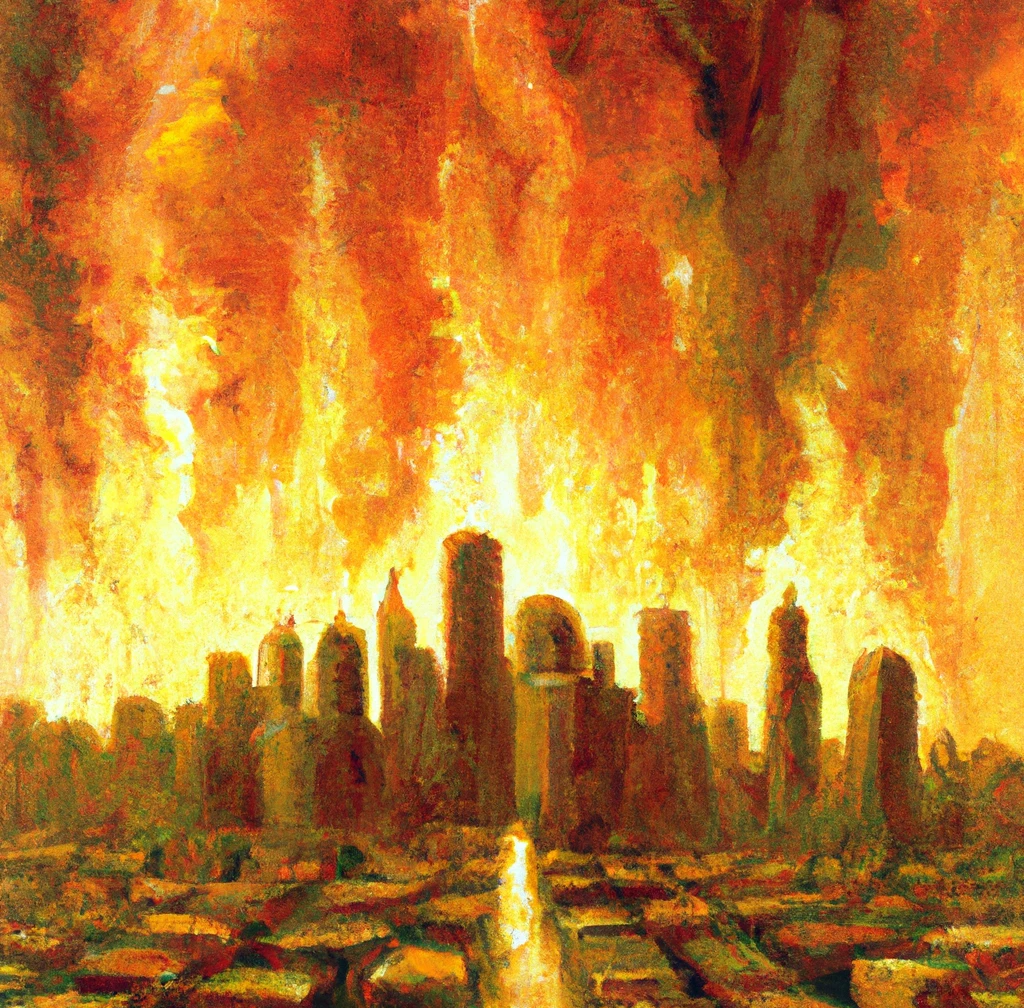
God and Abraham and Sodom and Gomorrah

I have already reviewed the account of the Lord’s destruction of Sodom and Gomorrah in my standard scripture study, but the story has been on my mind lately and I wanted to address a few points about it in greater detail. All the verses I will be discussing can be found in Genesis 18-19.

God’s “Haggle”)

What first prompted my thoughts on this story was hearing a celebrity give it as evidence of God’s capriciousness, an example of Him being so petty and heartless that He would bargain and haggle over the lives of His children before destroying them. This is, of course, in reference to Abraham petitioning the Lord if He would spare the city for fifty souls, then forty-five, then forty, etc.

And Abraham drew near, and said, Wilt thou also destroy the righteous with the wicked?
 Peradventure there be fifty righteous within the city: wilt thou also destroy and not spare the place for the fifty righteous that are therein?

So, let me first point out that these accusations are obvious falsehoods, completely misrepresenting the story as it is written. God did not haggle or bargain over how many people it would take for Him to spare the city and He never changed His position on the matter. Abraham’s position changed, but not God’s.

The first thing to note is that God never brought numbers into the matter. He simply expressed His judgment, which was to destroy the city, no numbers attached whatsoever, and it was only Abraham who brought up the idea of sparing the city if a particular number of righteous people lived there.

Abraham wanted to know whether God would have spared the city for 50 righteous, and God assures that He would have… but there just aren’t 50. Abraham wanted to know if God would have spared the city for 45 righteous, and once again God indeed would have… but there just aren’t 45. And so on and so on, until Abraham reaches his own personal limit for mercy: 10 righteous souls to spare the city.

That Abraham presses the matter no further than 10 seems to suggest that he, himself, could not condone sparing the city for any less righteous than that. Even he felt it was justified to lose nine or eight righteous, if it meant that such a terrible evil could be blotted from the earth. And, once again, God shows that His mercy extends as far as Abraham could ever hope for. God, too, would have spared the city for 10 righteous…but there just aren’t 10.

When I read the account in Genesis 18, it is not about God and Abraham haggling, it is about Abraham not yet fully trusting God, and him exploring the limits of God’s mercy until he is convinced that God’s judgment is worthy of his trust. God had pronounced judgment, but Abraham wasn’t able to trust that judgment until he was convinced that God came to that determination by due prudence and fairness, and God indulged Abraham’s tests because He wanted to earn Abraham’s trust.

Thus, there is no haggling going on in this story and no changing of God’s mind. God was simply allowing Abraham to double-check His calculations so that Abraham could begin to learn to trust the Lord’s decisions.

God’s Mercy

And, as it turns out, not only was God as prudent and merciful towards Sodom and Gomorrah as Abraham, He was even more so. For after there were not even 10 righteous in the city Abraham would have surrendered any good souls to their destruction, but God would not. God shows us in this story that He cares for even the individual righteous soul, the 1 over the 99. Thus, while He was determined to destroy the city, first He sendt two angels to draw Lot and his family out of the midst of it.

In the records we have, Abraham never beseeched the Lord for the life of his nephew, Lot, even though he knew that Lot lived in the path of destruction. Abraham seems to have been ready to let his own kin die as a justified sacrifice for this destruction of evil. It was only because God was more good than Abraham that Lot and his family were spared.

A Lesson for Abraham)

Abraham’s willingness to sacrifice the righteous for the greater good returns again later in his story. When God commanded Abraham to sacrifice Isaac, we do not see a moment of hesitation in Abraham’s response. He forthrightly makes preparation, goes to the place of sacrifice, binds his son, and raises the knife to take the lad’s life. Abraham knew that his son was good, but as with Sodom and Gomorrah, he was willing to sacrifice that good to fulfill the demands of the Lord. But then, as with Sodom and Gomorrah, God intervened to save the good and provide another way.

I wonder whether Abraham being commanded to sacrifice Isaac was, in part, a way for God to teach Abraham a lesson that He had tried to teach with Sodom and Gomorrah, but which hadn’t fully clicked yet. I wonder whether Abraham was too quick to believe in the God that would sacrifice good to destroy evil. I wonder if God temporarily assumed that role when He commanded Abraham to sacrifice Isaac, so that He could then dispel that illusion from Abraham once-and-for-all. I wonder if one of God’s lessons to Abraham in that moment was “Stop seeing me as the God of sacrifice, the God of taking, the God of destroying evil. See me as the God of saving, the God that brings back, the God of redemption!”

This is, of course, pure speculation. I don’t claim to know that this was the subtext to Abraham’s trial, or even if it’s likely. It is simply something that I wonder about. At the very least, it does stand out to me that we have no account of Abraham pleading for Lot’s life nor Isaac’s, and yet God saved them both. Whatever else those facts mean, surely they mean that these stories show God’s mercy, not wrath. They show His care, not indifference. They show His compassion, not brutishness. They show that God is a God who can be trusted when He declares His judgment because He has already analyzed the situation more than we ever could, and He cares for the innocent more than we ever would.

Scriptural Analysis- Exodus 1:1-7

1 Now these are the names of the children of Israel, which came into Egypt; every man and his household came with Jacob.

2 Reuben, Simeon, Levi, and Judah,

3 Issachar, Zebulun, and Benjamin,

4 Dan, and Naphtali, Gad, and Asher.

5 And all the souls that came out of the loins of Jacob were seventy souls: for Joseph was in Egypt already.

6 And Joseph died, and all his brethren, and all that generation.

7 And the children of Israel were fruitful, and increased abundantly, and multiplied, and waxed exceeding mighty; and the land was filled with them.

Exodus takes a step backwards and recaps some of the information that we had at the end of Genesis. It reiterates all of the sons of Jacob who lived with him in Egypt, it reminds us that there were seventy descendants in their party, and it reminds us of the passing of Joseph.

Not only Joseph, though, it further extends the narrative to state that all of that generation were passed away. This truly marks the end of an era. The age of the patriarchs is officially closed and now begins the time of the Israelite nation.

Seventy descendants might make for a large family gathering, but hardly an entire civilization. Verse 7, however, shows that the Israelites “increased abundantly,” even to the point that “the land was filled with them.” Let us remember that this is the fulfillment of a promise that God had been making to the patriarchs ever since Abraham: that they would become a great nation. The fulfillment of other promises is still to come, but this is the one upon which all those others was predicated. At times the fulfillment of this promise appeared quite uncertain, as Abraham’s lineage remained a very small population in danger of extinction at every turn, but in this verse we see that God proved faithful through it all.

But while this represents one step forward, we are of course about to hear about another string of setbacks, enslavement and genocide, making the success of Abraham’s descendants uncertain once more. Yet again, faith will be required, the Israelite nation will be the perpetual underdogs, and they will have to depend on God’s salvation at every hand.

Scriptural Analysis- Genesis 25:7-10

7 And these are the days of the years of Abraham’s life which he lived, an hundred threescore and fifteen years.

8 Then Abraham gave up the ghost, and died in a good old age, an old man, and full of years; and was gathered to his people.

9 And his sons Isaac and Ishmael buried him in the cave of Machpelah, in the field of Ephron the son of Zohar the Hittite, which is before Mamre;

10 The field which Abraham purchased of the sons of Heth: there was Abraham buried, and Sarah his wife.

Here we have the end of Abraham’s story. 175 years, many of them spent in tents beneath the stars, but with numerous travels in between. For years he waited for his promised son, and in the end he sired not one, but two, great nations. He raised a mighty household, fought in battle, and was a digger of wells. His death brought back together his two first sons, Isaac and Ishmael, who laid him to rest with his wife, Sarah, in the cave he purchased for them.

Looking back at his story what stands out to me is that Abraham was steady and flexible at the same time, like a strong reed. His experiences required a great deal of shifting and adapting, moving with life as it rose and fell, yet through all that change he also maintained a steady faith in Jehovah, and followed God’s instructions to the letter. He was bold enough to campaign to God that Sodom and Gomorrah should be spared for the sake of the righteous, but also willing to acquiesce in the event that those righteous could not be found.

Another quality that stands out is Abraham’s great trust that things would work out. When he and Lot parted ways he accepted the worse portion of land. When Lot was again captured by armies he gave battle to them. When instructed to set Ishmael and his mother free he did so. When tasked with sacrificing his own son he complied. None of these were pleasant tasks, things that anyone would naturally want to do, things that one would expect to find success in. But he did them all anyway, and as he had been promised, all of them worked out for his good.

The third quality that stands out to me is Abraham’s deep sense of duty. All throughout his story we see examples of him giving his God, his family, and his neighbor what each of them is due. He treated them all with courtesy, even when he had received offense from them or their household, as in the case of Abimelech’s servants. Two scenes that particularly show Abraham’s good manners is how he receives the three heavenly messengers before the destruction of Sodom and Gomorrah, and how he negotiates with Ephron to buy the burying place for Sarah.

Abraham made a deep influence on the lives of those who knew him, but his heritage at this point was very small. The righteous nation God had promised would not manifest for a few generations more, but when it did it would be built upon the foundation that he so faithfully laid down.

Scriptural Analysis- Genesis 25:1-2, 5-6

1 Then again Abraham took a wife, and her name was Keturah.

2 And she bare him Zimran, and Jokshan, and Medan, and Midian, and Ishbak, and Shuah.

5 And Abraham gave all that he had unto Isaac.

6 But unto the sons of the concubines, which Abraham had, Abraham gave gifts, and sent them away from Isaac his son, while he yet lived, eastward, unto the east country.

After Sarah’s passing Abraham took another wife, who bare him six sons that we hardly hear anything about. Abraham gave gifts to all of these sons and then sent them away to establish their own households, retaining the full inheritance for Isaac. Giving the inheritance to a single son was a common custom of the time, but more than that, God had chosen Isaac to carry on His covenant, and not the other sons.

Similarly, God would select only one of Isaac’s sons to receive the covenant promise: Jacob. But then, in the next generation, all of Jacob’s twelve sons would be included in the covenant, not just one. Thus, the decision for how the covenant was passed along to each generation was God’s to make, and then the father’s inheritance followed suit.

While God’s reasoning for which sons he chose for the covenant are not always elaborated, we do see in the case of Jacob and Esau that God selected the son who was more faithful. It seems likely that the continuation of the covenant was based on one’s worthiness, rather than a matter of random election.

Scriptural Analysis- Genesis 24:5-9

5 And the servant said unto him, Peradventure the woman will not be willing to follow me unto this land: must I needs bring thy son again unto the land from whence thou camest?

6 And Abraham said unto him, Beware thou that thou bring not my son thither again.

7 The Lord God of heaven, which took me from my father’s house, and from the land of my kindred, and which spake unto me, and that sware unto me, saying, Unto thy seed will I give this land; he shall send his angel before thee, and thou shalt take a wife unto my son from thence.

8 And if the woman will not be willing to follow thee, then thou shalt be clear from this my oath: only bring not my son thither again.

9 And the servant put his hand under the thigh of Abraham his master, and sware to him concerning that matter.

There is a natural hesitation in us when asked to make a pledge that depends on elements not under our control. What if we simply can’t fulfill that promise? Of course it is good to have faith in the face of the unknown, but faith is a muscle that is strengthened over time, and sometimes we lack the faith that the moment requires.

To the servant’s credit, he tries to find a solution to help bolster his commitment. He asks if he should just bring Isaac back to the land of Ur of the Chaldees if he fails in the first attempt to find a wife. He is ready to commit to try and to keep trying, he’s just not so sure on guaranteeing success.

Abraham absolutely does not want his son brought back to that land, so he turns down the servant’s idea, but then he does two things to help inspire and alleviate his servant. The first is that he encourages the man by saying that this is the will of God. God was the one who made a solemn covenant to Abraham that a righteous nation would be raised through Isaac, so God is actively interested in Isaac finding a righteous companion, and He will prepare the way for the servant’s success. The servant has nothing to fear.

However, in the case that the servant does still fear, Abraham then tells him that if he is unable to find a wife for Isaac then he is free of any obligation. That would, of course, leave Abraham without a solution to his problem, but Abraham isn’t concerned about that. Unlike the servant, he has sufficient faith in this plan that he does not require a backup. Thus Abraham is extending his own faith to cover the lack of his servant’s in this instance.

Scriptural Analysis- Genesis 24:1-4

1 And Abraham was old, and well stricken in age: and the Lord had blessed Abraham in all things.

2 And Abraham said unto his eldest servant of his house, that ruled over all that he had, Put, I pray thee, thy hand under my thigh:

3 And I will make thee swear by the Lord, the God of heaven, and the God of the earth, that thou shalt not take a wife unto my son of the daughters of the Canaanites, among whom I dwell:

4 But thou shalt go unto my country, and to my kindred, and take a wife unto my son Isaac.

I mentioned in the previous chapter that the purchase of Sarah’s tomb would be the last duty that Abraham personally fulfilled. Here we see him concerned about whom his son will marry, but he is too old to handle the matter on his own. So he calls his eldest servant and solemnly charges him to find a worthy wife in Abraham’s place.

The land that Abraham instructed his servant to search was the one where his brother Nahor had lived. Nahor had not come to Canaan with Terah, Abraham, and Lot. He had parted ways with them many decades ago. But Abraham had received word that Nahor’s household had grown, with eight new sons and grandchildren. Grandchildren who had never met Abraham or seen the land of Canaan. Was there a daughter among them who would be willing to throw in with a people and a place that were entirely unknown to her?

Scriptural Analysis- Genesis 23:15-19

15 My lord, hearken unto me: the land is worth four hundred shekels of silver; what is that betwixt me and thee? bury therefore thy dead.

16 And Abraham hearkened unto Ephron; and Abraham weighed to Ephron the silver, which he had named in the audience of the sons of Heth, four hundred shekels of silver, current money with the merchant.

17 And the field of Ephron, which was in Machpelah, which was before Mamre, the field, and the cave which was therein, and all the trees that were in the field, that were in all the borders round about, were made sure

18 Unto Abraham for a possession in the presence of the children of Heth, before all that went in at the gate of his city.

19 And after this, Abraham buried Sarah his wife in the cave of the field of Machpelah before Mamre: the same is Hebron in the land of Canaan.

Here we have the conclusion of this gentlemanly negotiation. At Abraham’s insistence, Ephron names the price for the cave and accompanying field. Ephron follows it up with “what is that betwixt me and thee?” which I take to mean, “four hundred shekels is unimportant to me, you really don’t need to pay for this.” But Abraham keeps to his word and measures out the full amount.

And there are two details to note here. Abraham is paying in full right up front. There is no loan, no interest, he covers the whole thing at once. The second detail is that Abraham is paying with “current money” that was still good “with the merchant.” Nothing outdated, nothing counterfeit, nothing left to be paid off. It was a full transaction and the matter is completely resolved.

Then verse seventeen and eighteen speak again to that reason that Abraham paid for this land so quickly and carefully: so that the ownership would be “made sure.” The entire transaction had been done “in the presence of the children of Heth,” so that there were many witnesses to it.

Only now, when Abraham has done absolutely everything within his power to make Sarah’s resting place permanent and sure, does he lay her down to her burial. He has made as much certainty as any mortal ever could that she will never be disturbed in her slumber.

There are some wonderful lessons to be gleaned from this chapter about how to treat friends and family with honor and dignity. Abraham is the epitome of a gentleman in these passages, treating everyone with graciousness and also fulfilling his every duty.

Scriptural Analysis- Genesis 23:8-13

8 And he communed with them, saying, If it be your mind that I should bury my dead out of my sight; hear me, and entreat for me to Ephron the son of Zohar,

9 That he may give me the cave of Machpelah, which he hath, which is in the end of his field; for as much money as it is worth he shall give it me for a possession of a buryingplace amongst you.

10 And Ephron dwelt among the children of Heth: and Ephron the Hittite answered Abraham in the audience of the children of Heth, even of all that went in at the gate of his city, saying,

11 Nay, my lord, hear me: the field give I thee, and the cave that is therein, I give it thee; in the presence of the sons of my people give I it thee: bury thy dead.

12 And Abraham bowed down himself before the people of the land.

13 And he spake unto Ephron in the audience of the people of the land, saying, But if thou wilt give it, I pray thee, hear me: I will give thee money for the field; take it of me, and I will bury my dead there.

The extreme good manners continue in this part of the story. The people of Heth have asked Abraham to name whatever plot of land he wants as a burying place for Sarah. He approached them meekly and at their mercy, but now they have encouraged him to speak his desire directly. So emboldened, Abraham names a cave that belongs to Ephron, and asks him to name what that place is worth and he will pay it. Continuing with the politeness, Ephron says Abraham may certainly have the cave, and he will even give it to him freely, no pay is necessary. Abraham, of course, refuses, and insists on paying whatever the fair price for the plot of land is. And Abraham is making the right choice here because of three reasons.

The first is that it will provide Abraham security. With an official payment his ownership of the land becomes sure. No one will be able to doubt that Abraham legally owns the cave, as there will be a clear transaction to prove his rightful purchase of it.

The second is that this is doing right by Ephron. This whole conversation has been public, polite, and formal, and Ephron could possibly feel compelled to offer up his land for free, even if he didn’t really want to. But Abraham won’t let Ephron be taken advantage of that way. He will give the man what he is due.

The third reason is that this is doing right by Sarah. She is Abraham’s beloved wife, and he should be willing to sacrifice his personal possessions for her. He wouldn’t insult her memory by giving her a resting place that he obtained cheaply. This is him showing that she is worth it.

Scriptural Analysis- Genesis 23:3-7

3 And Abraham stood up from before his dead, and spake unto the sons of Heth, saying,

4 I am a stranger and a sojourner with you: give me a possession of a buryingplace with you, that I may bury my dead out of my sight.

5 And the children of Heth answered Abraham, saying unto him,

6 Hear us, my lord: thou art a mighty prince among us: in the choice of our sepulchres bury thy dead; none of us shall withhold from thee his sepulchre, but that thou mayest bury thy dead.

7 And Abraham stood up, and bowed himself to the people of the land, even to the children of Heth.

No sooner did Abraham rise from his grieving than he went to buy a place to bury Sarah.

Notice how Abraham describes himself to them: “a stranger and a sojourner.” He is well aware that he has foreign roots, that he is not like the natives of this place. But in return the people call him “a mighty prince among us.” They revere him and are honored by his presence. They state that every one of them will gladly give a plot of land for his sepulcher. Abraham bows before them, perhaps to show gratitude for their response, perhaps to still show humility before moving on with his request.

The good manners here are abundant, and they will only continue as the narrative proceeds. Abraham is meek and unassuming, but that doesn’t mean he is passive-aggressive. He shows a great deal of decorum before making his request, but then he still makes it, clearly and plainly. These verses show what it is to walk the fine line of being polite, but direct.

Scriptural Analysis- Genesis 23:1-2

1 And Sarah was an hundred and seven and twenty years old: these were the years of the life of Sarah.

2 And Sarah died in Kirjath-arba; the same is Hebron in the land of Canaan: and Abraham came to mourn for Sarah, and to weep for her.

Sarah was Abraham’s longtime companion and friend. From one journey to the next, Abraham had to part ways with one family member after another, but she remained his constant partner. Now, though, after 172 years, Sarah finally took a separate journey of her own.

Abraham has had many causes to attend to throughout the Genesis chapters. He has proven honorable and devoted with Lot, Abimelech, and God. He has faithfully fulfilled his duty to each in turn. Now his story is winding to its close, and there are not going to be any more duties to perform, just a quiet retirement until he rests in his grave.

Or rather, almost it is time for that retirement. Before he comes to that there remains one last duty for Abraham to fulfill, and it is fitting and touching that it is to his wife, Sarah. Now that she has died he must find a place to bury her, and the entirety of this chapter is about Abraham diligently seeking and finding the perfect resting place for her. We will read in the next chapter how he begins entrusting his duties to his servants, but this one task, this is the last that he will undertake with his own hand.