The only one with the authority to dismantle your belief in God,
Is God, Himself.
Criticizing Another’s Faith- Summary
Wandering Thoughts)
I’ve spent the last two weeks on this series, discussing the ineffective and outright bigoted ways that people evangelize against other faiths. It is a subject that has stirred my passions many times in the past, and certainly again while writing each post. At several points I thought I was finished but then had “one more thing” that I wanted to include. I apologize that this hasn’t made the series very structured. What you see in this blog is my personal study in its raw form, not a refined or final product.
As such, I thought I ought to make one final post to summarize everything that came before, to try and bring it into a clearer, more concise package. Here are what I personally take out as the core distinctions described in this study:
1. The distinction between having a respectful dialogue on doctrinal differences and trying to win an argument over the beliefs of another.
A respectful dialogue on doctrinal differences is defined by:
- Seeking a sincere understanding of the other’s position.
- Letting each side define their own beliefs.
- Acknowledging personal uncertainty, admitting to gaps that are filled by faith.
- Being open to being wrong, to gaining greater enlightenment and changing.
- Being driven by a spirit of brotherhood, with genuine appreciation for one another.
Trying to win argument over the beliefs of another is defined by:
- Being filled with a spirit of destruction.
- Trying to define the faith of the other.
- Mocking what is sacred to the other.
- Maintaining absolute certainty in one’s position, considering it impossible to be wrong.
- Being fueled by a spirit of contempt, needing to own one’s opponent, needing to condemn them.
2. The distinction between evangelizing for a faith vs evangelizing against a faith.
Evangelizing for a faith is defined by:
- First establishing a genuine relationship of care and respect for the other party.
- Speaking from the beauty of your gospel.
- Inviting all to listen and learn more if they wish.
- Presenting your doctrine as something to add to the faith they already have.
- If the other party is not interested in investigating further, still maintaining respect and an ongoing relationship of brotherly-kindliness.
- Leaving all judgments to God, not assuming His position.
Evangelizing against a faith is defined by:
- Describing all that is wrong in the other’s faith.
- Seeking to take away what faith a person has.
- Condemning the other person, standing in for God to judge them.
- Offering your doctrine as the last remaining option after their original faith has been destroyed.
- Creating a relationship of spiritual dependency in the other person.
In Conclusion)
I spent so long on this subject because I believe it describes a pernicious evil that goes largely unrecognized in our culture. It is presented under the guise of “I’m trying to help save souls,” but secretly seeks to crush them. It is one of the most relevant modern examples of a wolf in sheep’s clothing, and it is those sneaky, camouflaged sins that need the most attention to call them out.
I also wanted to be clear that I’ve been on both sides of these matters, and I shared about those experiences a few times in this study. I know what it is to have a positive, uplifting, mutually-faith-reinforcing conversation with people that believe differently from me. I also know what it is to want to win an argument and decimate the doctrines of another person. I’m trying to live after the better pattern now, but I have at times given in to ego and pride just like anyone else. As such, I know the spirits that lie behind both approaches. I know that the first kind is good, and of God. I know that the second is evil, and of Satan.
I know the pure, clarifying, life-giving water of genuine spiritual dialogue. I know the devilish surge of adrenalin in the wine of contention. The latter is seductive, but the former is life-giving, and I hope that you and I may approach one another as brothers and sisters and share a drink of it together.
Sincere Disagreement

I would far rather have a man disagree with my genuine beliefs, than for him to disagree with fabricated positions I have never held.
If you try to tell me what I believe to discredit my faith, then your disagreement with me is not rational, it is emotional.
Faith in What We Will Gain

Faith is not the belief that we already have what it takes
It is the belief that we will gain what we need along the way
You Believe Something False
There are so many different interpretations of scripture, so many opposing theological opinions, so many churches that have divided over incompatible beliefs. Is man saved by faith, or works? Are our fates predetermined, or dependent on free will? Should we believe in theosis true, and if so to what extent? Is God a trinity, or separate persons? Is the Bible a closed canon, or can there be new prophets and revelations? Is the rapture pre-tribulation, or post? What is the correct mode of baptism? Do any Old Testament traditions still apply today, and if so, which ones? Should women serve as pastors? Does God approve of same-sex relationships?
With so many different interpretations and opinions, the only way to assume that a certain church has the correct answer on all of them is to believe it is the one, true church, and that all others have gone astray. But even in that case, within the narrower scope of that single religion’s theology, there would still be room for a plethora of different personal beliefs, most of which would necessarily be false.
It is therefore unrealistic to assume that everything that you or I believe is correct. It is far more probably that as Isaiah said, “All we like sheep have gone astray; we have turned every one to his own way,” (Isaiah 53:6). Obviously that scripture applies to our sins, but surely also to our own misguided beliefs.
Each of us must reason as best we can, and obey as we see understand, but we must also have the humility to recognize that we are surely wrong in one way or another and be willing to make dramatic changes as needed. We must be open to ideas that before seemed impossible to us. We must always remain teachable. We must never be so sure of ourselves that we resist the corrections of the Lord. Ultimately, there is no belief that should be so precious that we would be unwilling to relinquish it if required by God.
Ascend, Decline, or Plateau- Disordered Within
The Difficulty of Change)
In the first post of this series, I mentioned that I wanted to examine times where we wish to improve our moral character, but we just don’t seem able to. This is a strange phenomenon. One would think that all we have to do to make is a change is just decide to do it. That certainly seems to be enough to make other sorts of changes, such as updates to our daily schedule, our focus of study, and our social connections, but when it comes to changes of moral quality, it often is a very different story. Though we are totally converted to the change in our head, though we promise ourselves that things are going to be different, we fall back into our old foibles again and again.
A huge section of psychological study is just, “I wish I was doing this differently, but I just don’t know how to.” It remains a great riddle that all of humanity has grappled with through the ages.
I don’t pretend to have all the answers, but I have learned a little from what has worked (and what hasn’t) in my own life. In my last post I mentioned that I have had occasional moments of epiphany in my life, times where my core beliefs slid into their proper order, and when that has happened real moral change suddenly became possible. I don’t know if this is the only method to making lasting moral changes, but it does at least seem to be a method.
Searching for a Breakthrough)
Of course, recognizing this pattern does not get me much closer to being able to make changes on a whim. Spiritual epiphanies don’t just occur on demand. In fact, there have been many times where I have known the exact core beliefs that I have out-of-order, but I still haven’t known how to force their rearrangement in my life.
I’ll take a moment here to describe a specific example of that. For years I grappled with Jesus’s words in Matthew 10:37: “He that loveth father or mother more than me is not worthy of me: and he that loveth son or daughter more than me is not worthy of me.” It made sense, logically, that Jesus needed to be the highest priority in my life, that I needed to be more devoted to him than to any other. But accepting that in the head was not the same as feeling and living it in my heart. I could tell that in my heart the order was flipped. For me, family was more important than Christ. I didn’t think that was good, I didn’t want to remain that way, I just didn’t know how to make the change happen.
That was my state for years, until one day, out of the blue, I realized that in that scripture I could substitute “obey” for “love,” and “conscience” for “Jesus.” So, it became, “He that obeys father or mother over his own conscience is not worthy of me.” This resonated deeply in my heart. I knew that each of us must follow the impulse of our conscience, even when loved ones disagreed. And really, what was a commitment to follow conscience over family than a choice to love Christ over any other relation? I didn’t just become converted to my substituted-text version of the verse; I also become converted to the original wording!
And then, just like that, I was able to become more consistent in my moral behaviors, because the hierarchy had been improved in my heart. Jesus, and by extension God, really did become first for me, and so it was natural to realign parts of my life to match that order. I successfully made the breakthrough and enjoyed the changes, but not according to my own efforts or will. It just came upon me one day seemingly of its own accord.
What is Disordered?)
I realize this may not be the silver bullet that one might hope for. I cannot bring you to the destination, I can only suggest where you might find the proper path, and then you must still make the journey.
If there is some moral behavior that you have long wanted to change, but been unable to, it might be worth asking, “What is disordered in my core beliefs that keeps me from this change?” Have you set something at a higher priority than you should have? Have you neglected something fundamental that you are languishing without? Have you been too afraid to make a sacrifice that you know needs to be made?
If you can identify this, there still remains the matter of actually making the change in the heart. It is probably a hard thing to do. It might be something that can be done in an instant but scares you to death. It might be something that you want to correct right away, but it will take years to understand exactly how to do so. It might be something that just one day works itself out on its own, and you have no control over exactly when that happens.
Misalignments in our core beliefs are tricky to correct, but that explains why the moral behaviors locked behind them remain stubbornly out of reach. This is hard work, but it’s also the most important work of life.
From Failure to Faith
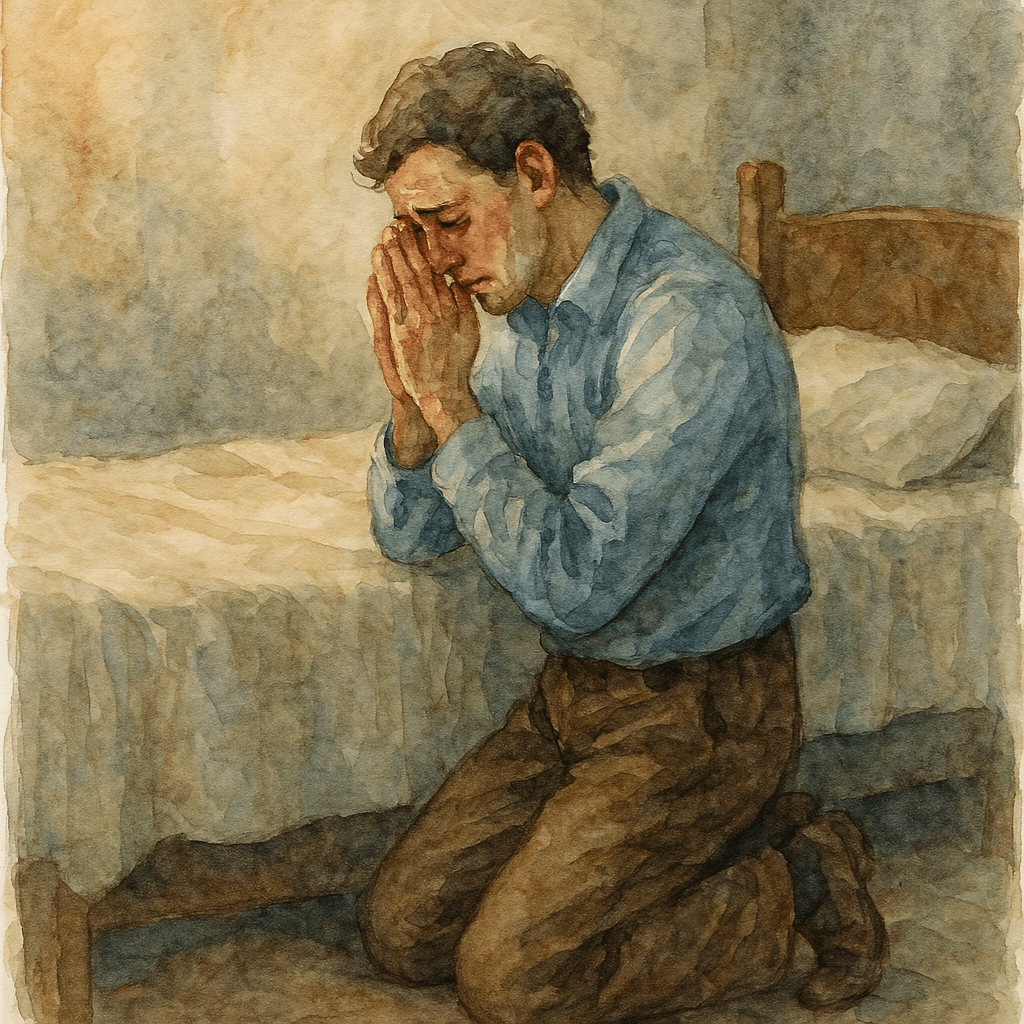
Those that say they will not follow God’s commandments until they are convinced that He is real overlook the fact that even the truly faithful regularly struggle to keep His commandments also. Even a strong belief in God’s reality does not suddenly cause us to swallow our appetites and live as perfect saints.
Indeed, it is our struggle with our moral behavior that leads so many of us to believe in God in the first place. Our belief in Him begins as we let go of our misplaced belief in ourselves. We try to change our hearts on our own, we consistently fail, we lose all trust in our own power, throw our last hope on a God that we are not sure of, and then experience a miracle as He changes what we never could.
Thus, the cynic’s disbelief of the Almighty and dismissal of the commandments is not due to having not explored God enough, but due to having not explored his own heart enough.
The Basis for Following the Commandments: Summary
In this series I noted society’s progressive departure from traditional Western ethics and morality, which are founded upon the Judeo-Christian commandments. I identified three core pillars of belief that are essential for wholehearted adherence to these commandments. They were:
- Belief in the reality of the Judeo-Christian God
- Belief that the Bible contains the genuine commandments of that God
- Belief that those authentic commandments are essential for true happiness in life
If someone lacks any one of these testimonies, then they are not likely to be motivated to actually follow the commandments.
Review)
As we discussed, belief in the reality of the Judeo-Christian God means believing that God is real, that He is our creator, that He is benevolent, and that He is all-powerful. Put another way, we need to believe that God is someone we can actually trust. We trust Him because He is good, and the things He says are genuinely meant to bring us joy, and we trust Him because He is capable, so if He says something is for our ultimate joy He will be able to deliver on that promise.
Overlapping with that testimony is the third one, which is to believe that God’s instructions are THE BEST way to obtain happiness and purpose in our lives. So long as we think we can figure out a better plan than God’s we will hold ourselves back from His law. To have this testimony means that we trust in Him more than anything else, even more than we trust in ourselves. It means that His word carries greater weight than any other.
Finally, even if we believe that God is real, and that His word carries greater weight than any other, we still need to know what those words are. To follow the commandments we have to believe that the Bible is genuine scripture, divine words that originated from that real and trusted God. Without this testimony, one is left to operate only on the direct whispers of God to our own heart, which I believe for most of us occurs less frequently than the number of times we need guidance in our lives. At some point we need to adopt principles on faith, and one must have a testimony in the Biblical commandments to follow them
Cultivating Testimony)
Some people seem to come by these three pillars of testimony naturally. Their inner core is already perfectly aligned with each tenet and they accept and live the ethical principles of Christianity without struggle.
But I believe that is not the case for most of us. I believe that most of us do not naturally have all three of the core beliefs mentioned here. Maybe we have one, maybe two, maybe none of them at all. However, not naturally having all three pillars of belief does not mean that we should just abandon the Christian ethic. It turns out that most testimonies do not come before the trying of the law, but after. Most of us don’t know what we believe until we live it. Either we try the right thing and then become convinced that it is right, or we try the wrong thing and then become convinced that it is wrong.
So if you lack any or all of the core pillars mentioned above, I would implore you to not give up on their ideas, but to put them to the test. Pause and think what sort of life you might live if you did already believe in them all, and then try living that way for a time. See whether you find a greater sense of wholeness, peace, and joy from that lifestyle or not.
I don’t want to extend this study long enough to lay out the evidence for the following assertions, but perhaps I will do so at another time. The Christian ethic has been the bedrock of Western civilization, and has brought greater innovation, illumination, and relief into the world than any other thing. It would be naive and foolish to discard it without ever giving it serious consideration and experimentation. If it has uplifted so many billions, it really might lift you as well. Certainly it has done so for me.
The Basis for Following the Commandments: Part Two
In my last post I stated that the question of whether it is reasonable to abide by God’s commandments rest on three fundamental pillars. It is not the point of this study to try and prove each of these pillars, only to establish that they are the core issues that must be wrestled with when deciding whether to follow the traditional Christian principles or not. It is left to the reader to discover what answer he or she has to every point.
The first of these core pillars has to do with the reality of the Judeo-Christian God. Is there a supreme creator of the universe, one who calls Himself our Father, who seeks our eternal salvation? There are many different possible representations of who or what that God would be, whether personified or disembodied, whether dwelling in the heavens above or emerging from within the human heart, but for the purpose of this study all that matters is the question of whether a benevolent and all-powerful creator exists. This requirement is itself divided into three parts. As taught in the Judeo-Christian tradition, God must be:
- Real
- Good and Benevolent
- All-powerful
If God were not good and benevolent, then His laws would not necessarily be for our benefit. They might not be given to us out of love, designed to bring about our greatest happiness, and so adherence to them might be counterproductive to our nature. If God is not all-powerful, then He may not be able to secure for us the promised blessings that obedience to His law is supposed to provide. We would have no assurance that following His law would give the peace, joy, serenity, and wholeness that has been foretold of. And if God is simply not real at all, then obviously both of the above failings apply.
And so, it is up to the sincere seeker of truth to determine: do you believe that God is real? Do you believe that He loves you, and only provides laws that are meant to secure your ultimate happiness? Do you believe He has the power to deliver that happiness as promised?
If the answer to any of those is “no,” do you wish it was otherwise? Is there some experience or barrier in your life that prevents you from believing in such a God? Would you be willing to live as if such a God did exist, if only to see whether He manifests Himself to you in time?
Or, if the answer to all of those is “yes,” then one knows that God’s commandments to us are motivated by love, and that they are empowered to bring us the peace and serenity we need. Following such law would be a privilege, and it would be the great desire of the true believer to find out exactly what are the details of that law. And that brings us to our second point, are the commandments taught in traditional Christianity the true law of this true God? We will discuss that matter in the next post.
Right Before Belief

Sometimes you have to do what’s right
Before you believe in it
To find out that it’s real

