For a society to function properly, its people must cooperate with one another. They must share a ruleset. They must have mutually beneficial expectations, and those expectations must be honored. All of this is necessary, because the world is too large and too complex for each of us to handle all aspects of it on our own. The advantage of a well-functioning society is that certain people can dedicate themselves to understanding one particular system and then disseminate to everyone else the essential information without them having to repeat the work. Shared rules also allow us to take complex interactions and reduce them to simple predetermined actions.
From what movies we watch, to how we navigate the road, to how we prioritize world affairs, “trusting the experts” and following predefined rules is the optimal strategy. I do not have enough time to watch every film, so I read reviews to only watch the best ones. I trust the rules of the road, so I can navigate complex group operations, like two lanes merging into one. I listen to news reports so that I know which issues I want to help my society overcome. I have not personally verified all of this information, but I trust in those that have, and assume my life will be optimal as result.
Trust Exploited)
But implicit trust is the most valuable commodity in the entire world, and the exploitation of it can be very lucrative.
What if a movie studio realizes that it can buy falsely positive reviews? The trust of the people will lead to increased ticket sales.
What if a driver realizes that he can hurriedly follow the car in front of him during a zipper merge to advance a space in traffic? He gets to his destination faster.
What if a news agency realize that they can sensationalize the news and fabricate outrage? Their ratings and ad revenue increase.
In each case, trust is turned into advantage, and one party is progressed beyond what could be achieved by honest means. Perhaps the short-term gain is justified by the assurance that one infraction is not going to break the whole system. The general populace will still benefit by trusting the institutions, and this one dishonest gain will amount to little more than a rounding error in the ledgers of society.
But when trust is exploited by one party, others will realize what has happened, and some will want to tip the scales in their favor also. Experience has proven that when the bond of trust has been broken once, and successfully profited from, a mass of other bad actors will soon follow.
Trust Broken)
And what happens when trust is broken repeatedly? It dies.
I watch a string of bad movies that came highly recommended, and I stop going to the movies altogether.
I get cut off in traffic repeatedly, and I start competing with every other driver on the road.
I realize the causes I supported made me a pawn in some party’s power grab, and I stop listening to the news media entirely.
I do not “trust the experts” anymore. I do not engage in the systems and rules as designed. And I am not the only one becoming cynical. Once enough of us are bitter and disillusioned, the movie industry collapses, violence becomes rampant on the roads, and conspiracy theories abound. The society stops being a society, and becomes instead a mass of angry individuals, all distrusting of one another. Divisions and public violence increase, and eventually the entire nation faces its demise. Perhaps strangest of all, there might even still be a majority of people who want to be honest and want to engage with the systems as intended, but the risk of trust outweighs its benefits, and so separating, not uniting, becomes the new norm.
When one is raised in a cohesive society, it is easy to take its trust systems for granted, but in truth, they must be guarded most carefully. For when they are broken, everything is lost. I do not know how far things can go and still be repaired, but at some point, the death of the nation must become inevitable.
1 And the Lord said unto Moses, Hew thee two tables of stone like unto the first: and I will write upon these tables the words that were in the first tables, which thou brakest.

2 And be ready in the morning, and come up in the morning unto mount Sinai, and present thyself there to me in the top of the mount.

3 And no man shall come up with thee, neither let any man be seen throughout all the mount; neither let the flocks nor herds feed before that mount.
God and Moses are concluding their discussion in the tabernacle, but they have to meet again on Mount Sinai. As I suggested in the last chapter, I suspect that this means that the meeting in the tabernacle was only a sort of preliminary or planning stage for how God and Israel would proceed forward together, and now Moses needed to come into the mountain so that he and God could formalize His contract with the people.
Indeed, things are going to even be put in official writing, and Moses is to bring two new tables of stone for the Lord to etch His law into as He did the last time Moses went up into the mount. The first tablets, of course, were broken by Moses when he saw the idolatry that the Israelites had got up to during his absence.
Note that this story is allegorical for a common aspect of the human experience. All the time we are breaking a moral law, then relying on God’s grace to re-establish the broken contract. Christians play out this pattern when they regularly partake of the bread and the wine, the idea being that we regularly stray from Christ, so we must regularly recommit ourselves to him. When we do this, it is humbling to reflect on the fact that we are playing out something that goes all the way back through humanity, even to Moses and his stone tablets from Mount Sinai.
I have explained the necessity of adhering to physical truths in the field of aviation. In order to overcome the forces of gravity and air resistance, great minds had to search out the realities of the physical world and build machines that would act in accordance with them. Today I’d like to consider another example of this in the world of logic. This time we won’t just consider the usefulness of truth, though, but also the chaos of untruth.
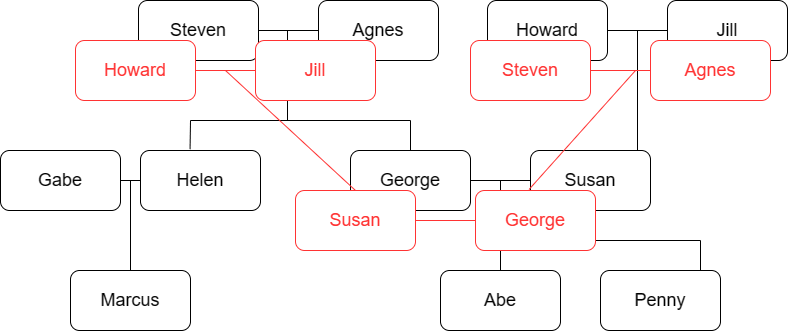
There is a concept in mathematics called propositional and predicate logic. In this system, propositions are statements of truth, such as George is Abe’s father, Steven is George’s father, and Marcus is not Abe’s brother. These are simple facts that contain a single piece of valid information. Then there are predicates, which are rules for how these propositions can be combined to reveal entirely new truths. For example, we might have a predicate that if A is the father of B, and B is the father of C, then A is the grandfather of C. Given our initial propositions, we can derive that George is Abe’s Grandfather, a fact that wasn’t in the original set of information.
This might not seem that useful, but once we expand our set of propositions and predicates to thousands of items there are literally millions of implied facts that a computer can derive from, something that our brains simply don’t have the capacity to process. Our modern-day databases are built upon this system of logic, allowing a large dataset to have its parts combined in a multitude of ways, revealing hidden patterns and trends, secrets and truths that were hiding in plain sight.
Let’s build expand on our example of a family tree to see this process more clearly. Suppose we have the following propositions and predicates (feel free to skim over these):
Propositions:
#1 George is Abe's Father
#2 Susan is George's wife
#3 Penny is Susan's daughter
#4 Penny is Abe's sibling
#5 Helen is George's sister
#6 Gabe is Marcus's father
#7 Steven is Marcus's maternal grandfather
#8 Agnes is Helen's mother
#9 Steven is Agnes's husband
#10 Howard is Susan's father
#11 Jill is Susan's mother

Predicates:
#1 If A is the father/mother of B, and B is the father of C, A is the grandfather of C
#2 If A is the father/mother of B, and B is the mother of C, A is the grandmother of C
#3 If B is a parent of A, and C is the husband/wife of B, then C is also a parent of A
#4 If A is the father/mother of B, and C is the other parent of B, then A is the mother/father
#5 If A is the father of B, and C is the mother of C, then A is B's husband and B is A's wife
#6 If A is the child of B, and C is the child of B, then A and C are siblings
#7 If A is the maternal grandfather of B, and B's mother is C, then A is the father of B
#8 If A is the sister of B, and B is the parent of C, A is the aunt of C
#9 If A is the child of B, and B is the aunt/uncle of C, A is C's cousin
#10 A cousin is not a sibling
#11 A mother is not a father
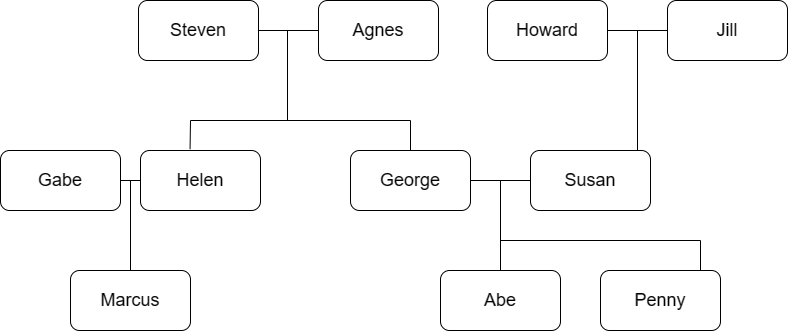
Given this setup, we could piece together the following family tree:
This tree is a visual representation of all the separate facts we get by combining all of our initial information. We can ask our system any number of questions, even ones that go beyond the scope of the original data set, and it can derive answers for them. It will answer yes, no, or uncertain, and so long as our propositions and predicates are all correct, then we can know that any derived answer is also correct. This data is a source of truth because it is based on logically sound principles.
A Twist)
But what if all of our propositions and predicates are all correct…except one? What if among all the truth facts and rules we include just one falsehood? It might occur to you that this would tarnish our confidence in the system, because there would always be a possibility that the answer it gave to us was that one lie. But actually, the effect is far, far worse. It has been proven that introducing just one logical falsehood into a system such as this will make any possible lie seem true. It won’t just be one lie that comes out of the system, it will be all lies. That might seem improbable, but allow me to illustrate.
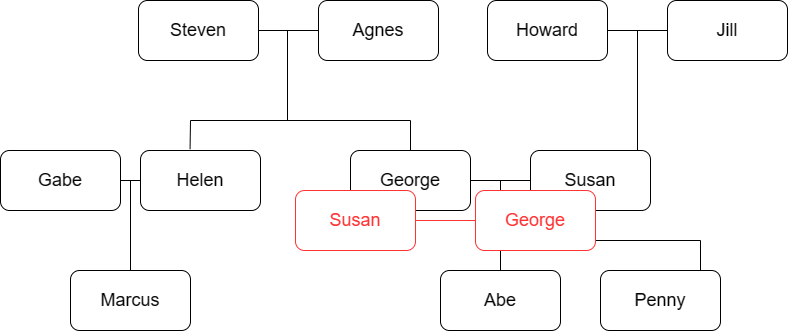
To the system up above I will introduce one logical falsehood. Given the previously established rules, it is impossible for this to be the case, but I am going to enter it as a fact even so:
Susan is Abe's father
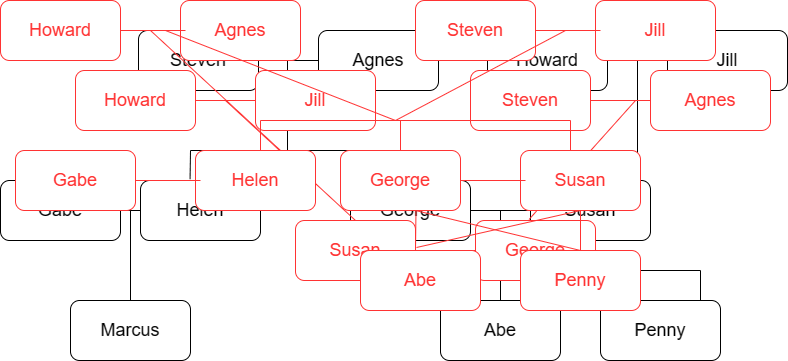
This statement is completely contrary to the logic of Predicate #11, but we add it to our system regardless. This creates a logical contradiction, and now let us look at all the new falsehoods we are able to infer from it. By Predicate #4 we can infer that since since Susan is Abe’s father, then Abe’s other parent, George, must be his mother.
Of course, we previously had derived that Steven and Agnes were Abe’s paternal grandparents, because they are George’s parents. But now that we know that George is Abe’s mother, then they must also be his maternal grandparents. By the same token, Howard and Jill are now no longer only Abe’s maternal grandparents but also his paternal.
Of course, now that we know that Howard is Abe’s paternal grandfather we can combine that with the already-known fact that Agnes is his paternal grandmother, and we can now infer that they are married together, something we never knew before! And by the same token, Steven and Jill are now also married together. Thus all the grandparents are intermarried in some sort of free-love commune! This does have the unfortunate effect of making George and Susan, Abe’s parents, siblings to one another in addition to still being husband and wife! Furthermore, since Abe’s parents are also siblings, then his sister Penny is also his cousin because her mother is the sister of Abe’s father (and her father is the brother of Abe’s mother).
But we aren’t even really going yet! We still haven’t invoked the powers of NOT and ELIMINATION. First let’s consider the NOT. Predicate #10 stated that a cousin is NOT a sibling, and Predicate #11 that a mother is NOT a father. So, since we just proved that Penny is Abe’s cousin, then she is NOT his sibling. Of course, she also is his sibling, since Proposition #4 explicitly says so. Thus, she is his sibling, and she is not. These are both totally valid answers in the eyes of our data set. And Abe’s parents George is his father and Susan is his mother, but also, they are not. And his grandparents are his grandparents, but also, they are not.
And now that we’ve shown that we can prove that the exact same relationship can and cannot exist simultaneously, by ELIMATION we can also prove that every relationship can and cannot exist. So, from the initial data set we know that Abe has a sibling. But who is it? Well, we can go through each member of his family and prove that they are not that sibling. So, let’s do that for every family member except one, Steven, and now we know, by process of elimination, that Steven must be the one who is Abe’s sibling. And by the same process we can prove by process of elimination that it is Agnes, and Howard, and Gabe, and Helen, and George, and Susan, and Marcus. And by the same process they are all his father, and all his mother, and all his aunt, and all his uncle, and all his cousin, and all his grandfather, and all his grandmother.
I’m not going to try to show the family tree at this point, because it is simply all names connected to all other names in every possible way. But also…all names connected to none of the others. Every statement is true. Every statement is false.
Our data set was useful at one point. It was full of true statements, and it could be used to infer many other true statements. But now, after a single lie the entire thing has been corrupted. The only answer it has to provide are “yes, no, maybe, I don’t know…I guess it depends on how you look at it.” It has lost all confidence and isn’t useful for anything.
And sure, this is a rigorous and mathematical system, which is particularly prone to collapsing at the slightest instability. The system in our minds is far more nuanced, able to continue functioning with illogical assumptions and idiosyncrasies…but only to an extent. The same principle does apply to us to at least some degree. Adopt the wrong belief and suddenly every other concrete conviction starts to be undermined by it. People start going through logical acrobatics to try and make incompatible beliefs fit together, corrupting all that was once good and losing the certainty they once had. We cannot accept a lie without somewhat losing our grip on all truth.
Yesterday I mentioned how some victims of abuse might twist their experience into self-justification. By leaning into their righteous indignation, they will try to dismiss any wrongs that they themselves do. They have created in their mind a sense of blamelessness, such that no matter what they do they cannot be held be accountable for it. The world was terrible to them first, after all, so any wrong they do now is just a well-deserved retaliation.
This is the angrier side of victimhood. It is not the only warped perspective that can be developed, though. There is also the sad, depressed option that we will discuss today.
This sort of victim can be described as being fundamentally broken. After suffering pain at the hands of another they go back and highlight their own failings, convincing themselves that they in some way deserved the pain that they received, justifying the abuser’s crimes for them. They might even call up transgressions that were totally unrelated from the abuse, assuming some cosmic power had been tabulating all of their secret, guilty deeds and sent the abuser as a force of karmic justice.
There are also victims who do not consider themselves as being particularly guilty before the abuse, but now, because they were a participant in such a violent or dirty experience, they feel forever tainted by it. They feel as of some sort of evil was transferred to them by their abuser. Thoughts, once innocent, are now overrun with horrible memories and images. They may be horrified by these images, but they self-identify with them still the same.
Divorced From Reality)
Whether such a person thinks they earned their suffering beforehand, or whether they think that they have been permanently scarred after the fact, the intense demoralization leads them to accept or seek out further injury, because that’s just what they think they belong to now. This creates a sort of self-fulfilling prophecy, where they really do become responsible for the continuation of self-harm, reaffirming to themselves that they just aren’t any good. Thus, they become entrenched in this new, corrupted identity. Left unchecked, this cyclical self-harm and self-loathing behavior can take them to all sort of terrible extremes, even to the premature ending of their lives.
But for anyone on the outside, anyone who knew the victim both before and after the traumatizing event, it is abundantly clear that the sufferer is not living in a way congruent with reality. No number of past flaws can justify another person being abusive to you, neither does having evil forced upon you make you evil yourself. What other people have done is what they have done, it justifies or condemns them and no one else. In an ideal world, suffering and abuse would have absolutely no bearing on how the victim views themselves.
Of course, the victim might even know all of this in their head as well. They might know that they shouldn’t blame themselves, they might staunchly stand in defense other victims, but knowing something in one’s head and treating others a certain way does not mean that the same goes for what’s inside. The victim can believe in their head that they are innocent and deserving of love while feeling the exact opposite in their heart. It isn’t a matter of needing to be convinced, it is a matter of needing a transformation in the heart.
Of course, even if the victim sets aside all the false narratives and self-deceptions, the truth that takes their place is still bleak and tragic. Their heart is broken. Their innocence is gone. They have seen the evil world, and no amount of knowing that that isn’t their fault will change the fact that they have seen it. They should not blame themselves for what they suffered, but even if they do manage to cease doing so that doesn’t mean that everything is fine now.
Stray Hearts)
We’ve spent some time now examining both the situation of the perpetrator and of the victim. In each case we have seen the tendency for them to have a heart divided from truth and reality. The perpetrator is in denial of his wrong or he makes it his entire identity. The victim feels that he is justified in every bitter, angry thing that he does now, or he feels fundamentally broken. All of these states are based upon the person latching onto a lie at their core.
Neither the perpetrator nor the victim should view themselves as irredeemable or incorruptible. They should be able to hold an honest appraisal of their flaws and virtues at the same time. Getting to this place is going to be a process. Core lies will have to be excised, as if by emotional surgery, and truth is going to have to be applied regularly, like a salve.
We’ve also considered that even when the perpetrator and the victim get past their self-deceit, the truth they are left with is still stark and damning. Yes, it is better to embrace truth than deception, but at this point that still does not amount to healing. It is a step in the right direction, though, but we still need to consider the other steps that follow.
We’ve spent quite some time discussing the problem, the ways that both perpetrators and victims wander into strange, forbidden lands. The following posts will now be dedicated to understanding the journey back to wholeness.
And ye shall offer for a sacrifice unto me a broken heart and a contrite spirit. And whoso cometh unto me with a broken heart and a contrite spirit, him will I baptize with fire and with the Holy Ghost, even as the Lamanites, because of their faith in me at the time of their conversion, were baptized with fire and with the Holy Ghost, and they knew it not.
COMMENTARY
And ye shall offer for a sacrifice unto me a broken heart and a contrite spirit Thus far in this study I have examined our need to give up our stony heart for one of flesh, and also the need to humble ourselves enough to receive that transplant. Under that context, consider today’s verse. Here the Lord speaks of our old heart needing to be broken and sacrificed before we are baptized into His fold. In other words, coming to God is going to break the person that we were! Is it any wonder that fully coming to God is so difficult for us then? Is it any wonder that we shrink back into our calloused heart at the first sign of complete surrender? We edge closer and closer to the precipice, tease at taking the plunge, but there remains a world of difference between getting close to the edge and actually taking that leap of faith. We want to have a full life, but are we willing to give up what little we already have to receive it? Because there just isn’t space for Him to raise the new us so long as we’re still clinging to the old one. It isn’t a cruelty of God to ask for a sacrifice of our heart, it is simply a necessity.
There is a childish fear in us that if we make someone upset our friendship is over forever. That if we are sent to prison we can never be a part of society again. That if we, or our parents, go through a divorce we will never be whole again. That if we do something wrong, there isn’t a reason for others to like us anymore.
In short, many times in life we have a sense of something breaking and we believe that now it must always be broken. And while sticks and stones might work that way, living things have always had a remarkable ability to heal. And so forgiveness and second chances and mended hearts are a very real part of life. And when it is the hardest to believe in them is when they need to be believed in the most.
No man can serve two masters: for either he will hate the one, and love the other; or else he will hold to the one, and despise the other. Ye cannot serve God and mammon.
And Elijah came unto all the people, and said, How long halt ye between two opinions? if the Lord be God, follow him: but if Baal, then follow him. And the people answered him not a word.
COMMENTARY
No man can serve two masters: for either he will hate the one, and love the other Previously we considered Pharaoh, who wanted the God of the Hebrews to give him reprieve, but also wanted to maintain his control over the Hebrew slaves in direct defiance to that God. As the famous saying goes, though, you cannot ride two horses. If you try, you will only tear yourself, which, tragically is exactly what happened to Pharaoh. By trying to have his cake and eat it, too, he lost his firstborn child. Many men and women lose the most precious things by trying to clutch to two opposing realities at the same time. Powerful addictions, in fact, often stem from a division of the soul, one where a person genuinely believes in a greater good, and professes it loudly, yet secretly lives a lesser evil on the side. A wedge is gradually driven into the heart, pressing deeper and deeper, until eventually things start to break.
How long halt ye between two opinions? if the Lord be God, follow him: if Baal, follow him. Each of us only has room for one reality and one master. It is simply not in our nature to thrive so long as we are divided against ourselves. Thus each one of us must choose which reality we will embrace, and then embrace it with all our hearts, letting go of all the rest.
The purpose of this study was to consider all the different ways in which we become lost or broken, and how the atonement of Jesus Christ addresses each of these issues. Through this study I have gained a greater appreciation for how multifaceted that sacrifice was, and how it fulfills many laws and overcomes many challenges and defeats many enemies all at once in order to rescue us. For each one of us has been lost and broken in many and unique ways, and your remedy must be different than mine. We require a surgeon who is prepared to care for every kind of wound, and every combination of wounds. I was also struck during my study by how deeply aware the gospel is of this situation. I found that the scriptures, which written millennia ago, already held the answers to questions that I only thought to ask today. Let us review what those questions and answers were.
We Are Broken and Lost in Diverse Ways
As suggested above, we are each wounded in unique and diverse ways. During the course of this study I broadly described those wounds under three categories: wounds that we inflict upon ourselves, wounds that are inflicted on us by others, and wounds that are inflicted on us by the fallen world. Without exception, each of us is broken under each of these categories. But, of course, each category can itself be expanded into innumerable instances, each of which comes with its own individual heartache. The regret of telling a lie is different from the guilt of giving in to lust, which is different from the pain of being insulted, which is different from the shock of losing a loved one, etc. Heaven is a place of perfect cleanliness, perfect peace, and perfect joy. And as such, we are ill fitted for it if we are filthy, or conflicted, or even sad. Which, of course, we all are. Not only that, but we are filthy without the power to clean ourselves, conflicted without the power to mediate our own peace, and sad without the power to give ourselves lasting joy. We are not only lost, we are lost without any power to find the path back. Isaiah 53:6- All we like sheep have gone astray; we have turned every one to his own way. John 5:6-7- When Jesus saw him lie, and knew that he had been now a long time in that case, he saith unto him, Wilt thou be made whole? The impotent man answered him, Sir, I have no man, when the water is troubled, to put me into the pool: but while I am coming, another steppeth down before me.
Being Broken is Mandatory in a Fallen World
Our hubris is that we so often think we can do something about this brokenness. We believe that if we exercise enough self control, we will never sin. We think that if we wall off our heart, we will never be hurt by another. We hope that if we take enough precautions, we will never fall to the misfortunes of the world. And if we have already suffered any wounds, we tell ourselves that we can work around them, or else that we’ve cured them by sheer force of will. In other words, we live in supreme denial. Mortals trying to defy gods. Just who do we think it is that we are trying to bowl over with our grit and spunk? Our foes are Satan, human nature, and the very world, beings and forces that are immortal, that have broken men long before our birth and will continue to do so long after our death. Which death we should make special note of. Each of us was born, and therefore subscribed ourselves to entropy and deterioration. We will decay until everything is broken. We must. It is not that it is hard to resist, it is that it is impossible. We were born into it, and the frantic way in which we try to control this world only proves how fully we live under its fear, and therefore under its power. Isaiah 2:22 (TLB)- Puny man! Frail as his breath! Don’t ever put your trust in him! Job 38:31-33- Canst thou bind the sweet influences of Pleiades, or loose the bands of Orion?Canst thou bring forth Mazzaroth in his season? or canst thou guide Arcturus with his sons?Knowest thou the ordinances of heaven? canst thou set the dominion thereof in the earth?
The Laws of the World Must be Fulfilled
But then, perhaps we aren’t as foolish as all that. Perhaps all of our hustle and bustle is due to a true intuition that burns inside. Even though this world is unfair, in our hearts we know that there should be order and balance. Even though others hurt us, in our hearts we know that there should be healing. Even though we let ourselves down, we know that there should be second chances. There is a seed of divinity in us, and it refuses to accept the terms of fallen mortality. And this is not wrong. We were given that fire in order to seek our own better nature, and to be agitated into seeking salvation from our own brokenness. We just need to stop trying to save ourselves by our own power, and start looking for a method that actually works. Jesus Christ is the mediator between the laws of the fallen world, and the divine law that burns in our hearts. He is uniquely capable to satisfy both without denying either. And so, even though we will sin and that sin must be matched with damnation, Christ has already endured the depths of hell in Gethsemane, that law is therefore fulfilled, and we can have the second chance that our heart knows we should. And even though we will be hurt by others, which our mortal justice requires retaliation for, that retaliation is given to Christ instead, that law is fulfilled, and we obtain healing for our hurt and forgiveness for our hurter. And even though we will suffer sickness and death, Jesus has also endured that death, that law is fulfilled, and we will obtain a resurrection. In this life, all the demands of mortal law have been fulfilled, and whether in this life or the next, all the expectations of our divine soul will be fulfilled as well. Luke 4:18- The Spirit of the Lord is upon me, because he hath anointed me to preach the gospel to the poor; he hath sent me to heal the brokenhearted, to preach deliverance to the captives, and recovering of sight to the blind, to set at liberty them that are bruised. John 16:33- These things I have spoken unto you, that in me ye might have peace. In the world ye shall have tribulation: but be of good cheer; I have overcome the world. Revelation 21:4- And God shall wipe away all tears from their eyes; and there shall be no more death, neither sorrow, nor crying, neither shall there be any more pain: for the former things are passed away.


 Spiritual Wanderings