Stop Trying to Change the World

Stop trying to change the world. When people use that term today, all they mean is finding fault elsewhere and making others change.

Which doesn’t work, because they are doing the same thing, finding fault in you, and trying to make you change.

And in this cycle no one actually changes. They only become more entrenched.

So, stop trying to change the world.

Just change yourself.

Reasons for Disbelief- Social Pressure and Rationality

I spoke a little bit yesterday about how some are more loyal to a group than to God. They let society be the highest authority of what is right and what is wrong, or of what can be believed and what is preposterous. I’d like to delve a little deeper on this matter, examining the reasons for this “popularity ideology,” and how it gives people reason to stop believing in God.

Abbreviated Learning)

A major contributing factor to this is that people tend to optimize their learning by relying heavily on their trust in an authority. We do not all look through telescopes or microscopes to discover what can be found there, we just accept what we have been told by those that have.

And this predisposition to trust isn’t a flaw in us, either. It is an essential characteristic for us to progress as a race. Taking things on authority allows us to “stand on the shoulders of giants,” depending on the discoveries that came before us to be valid so that we can build something greater on top of them. Research and discovery is conducted at the outer limits of the human understanding, pushing the boundaries further than they’ve ever been pushed before. Were it otherwise, and each of us had to individually reinvent the wheel, our progress would be limited to only the things that can be accomplished in a single life-time.

While building on past work without a full context can result in catastrophic errors, and occasionally has done so, the net result has clearly been positive. We move forward and improve more often than we stumble and fall backward.

But what is the point of all this? Simply that we should recognize that we have this built-in instinct to believe anything claimed by another person, so long as they seem rational and decent. We hear what they say, and we try to update our model of the world with that new information so that we can save the time it would take for us to verify it on our own. As already discussed, this is a good thing in many cases, but clearly it also creates the potential for us to be manipulated from time-to-time.

A War of Ideas)

If a seemingly-rational person teaches a principle that does not perfectly align with the beliefs that we held before, we tend to stretch and rotate our convictions to make the new one fit also. If we cannot make the old fit with the new, because the two are in direct contradiction, we will find ourselves divided, which is both logically and emotionally painful. Sooner or later, one conviction will give way to the other, if only to restore our inner equilibrium.

All too often, the decision of which side to align oneself with has less to do with the strength of the arguments, and more to do with social pressure. It is far easier to turn one’s back on a passive object, like the Bible, than the people who are actively arguing against proper theology. It is easier because the Bible’s arguments can be shut out by just refusing to read its passages, whereas the messages of society crowd in on us no matter what we do. We feel much more obligated to give some sort of response to the challenge of other people than to faceless books. Thus, just to restore a sense of logical consistency, we might very well discard the old faith, abandon the texts it comes from, and replace it with the philosophy espoused by the incessant babbling.

So what is Reason #3 for Disbelief? Allowing our convictions to be overrun by our instinct to adopt the views and opinions of other people. This mostly represents the rational side of social pressure, but obviously there is an emotional side to it also. Tomorrow we will examine that.
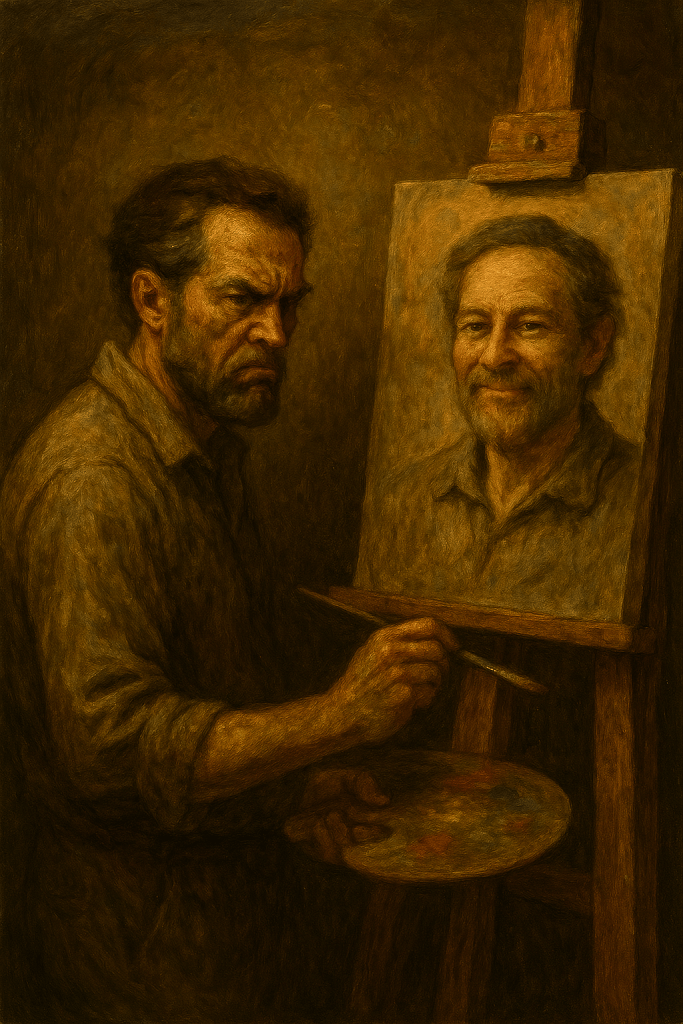

Victims of Our Own Lies

Our own self is the primary victim when we lie. First, we do something against our conscience, then we lie about what we did, which gives the message that our fake, external image is of greater value than the true self. This wounds us. We cannot be so dismissive of a part of ourselves without that part hitting us back later on. A war begins within.

Heavy waves of guilt come from one side, telling us that we must tell the truth and stop denying who we truly are, but from the other side comes stifling and suffocation, applying greater and greater pressure on the conscience to deny the truth and accept the fiction. And with all the guilt and the suffocating, we are only hurting our own self in between.

We cannot have peace if we are at war, we cannot have wholeness if we are broken in two. If we are ever to stop beating ourselves the war must end, which means that one side or the other must surrender. And when we come to realize this fact, then we must come to realize another: the conscience cannot surrender. The true, authentic voice will never be killed because it is simply our natural, resting state. It exists because we did what we did, and made of ourselves what we made of ourselves, and there is no way to undo those facts. To live a lie without frustrating and twisting ourselves is fundamentally impossible, because part of ourselves is inseparably tied to unchangeable reality. The only surrender that we really can make is to surrender the lie. Surrender the phony public image. Surrender to the truth.

Thought for the Day: Inevitable Disappointment

An argument that is made for giving in to our hedonistic desires is that it is cruel to perpetually deny and disappoint ourselves. But really, disappointment is a given. For on the one hand we want one thing, but on the other hand we want its opposite.

We want to get away with telling lies, but we also want to be understood as we truly are. We want to lust, but we also want to have mastery over self. We want to treat ourselves as the center of the universe, but we also want to be part of something that bigger than ourselves. We want to be lazy, but we also want to be there when others need us.

Disappointment, frustration, self-denial…one way or another all of these are inevitable. And so long as one side of us has to be disappointed, why not make it be the carnal, selfish, and dishonest side?

Free Will vs God’s Control- 1 Corinthians 10:13, 2 Nephi 2:11

There hath no temptation taken you but such as is common to man: but God is faithful, who will not suffer you to be tempted above that ye are able; but will with the temptation also make a way to escape, that ye may be able to bear it.

For it must needs be, that there is an opposition in all things. If not so, my firstborn in the wilderness, righteousness could not be brought to pass, neither wickedness, neither holiness nor misery, neither good nor bad. Wherefore, all things must needs be a compound in one; wherefore, if it should be one body it must needs remain as dead, having no life neither death, nor corruption nor incorruption, happiness nor misery, neither sense nor insensibility.

COMMENTARY

God will not suffer you to be tempted above that ye are able; but will with the temptation also make a way to escape
For it must needs be, that there is an opposition in all things
In each of our lives, God preserves our freedom by allowing us to be drawn towards good, but also to be drawn towards evil. There are bounds set so that no temptation will be able to overwhelm us without our consent, but also no force for good will overwhelm us without our consent either. Exactly how far those bounds are placed will vary for each one of us, according to our own personal strengths and weaknesses, but they will always present us with the same opportunity to freely choose.
Thus you may assume that you will always have a reason to remain faithful, and you will always have a reason to turn faithless. You will always live as a person divided, so that then you may choose which half of yourself to follow. There is no mistake in this, it is by design. Thus that the world is a place divided is evidence of a God who is in control, not evidence against it.

Knit Our Hearts- Luke 17:3, Matthew 5:39

Take heed to yourselves: If thy brother trespass against thee, rebuke him; and if he repent, forgive him.

But I say unto you, That ye resist not evil: but whosoever shall smite thee on thy right cheek, turn to him the other also.

COMMENTARY

If thy brother trespass against thee, rebuke him
Resist not evil
There is a variety of opinions among the faithful whether we are justified in correcting those that are wrong or not. When we gently call out a brother or sister that mistreats us are we doing them a kindness, as I suggested yesterday? Or are we guilty of unrighteous judgment, of trying to take out the mote while a beam is in our own eye?
To add to the confusion is that both sides of this debate have verses to back them up. Consider the two I have laid out here. Are we supposed to rebuke another, or turn the other cheek?
However a closer reading of these verses will dispel any perceived inconsistency between them. If one looks at what is said, we will realize that these two different behaviors were prescribed for dealing with two different sorts of people.

  1. If thy brother trespass against thee…
  2. Resist not evil

The first verse is describing how disciples are meant to behave towards one another. We are supposed to love each other, and help each other become the best that we can be. That means encouraging, guiding, and when necessary, correcting. So long as our intentions are brotherly, all is well.
The second verse is describing how disciples are meant to behave towards evil. There are those in the world that have no positive intent when they interact with you. When they cast stones at the church they are purely trying to do harm. To these our counsel is simply to mitigate as much damage as possible. Do not provoke, do not return cruelty for cruelty, just meekly let their storm pass and move on.
With this clarification we can see that these two different behaviors are actually supporting the same basic principle: to be a peacemaker. We improve the world where it is possible, and we do no harm where it isn’t.

Knit Our Hearts- James 3:2 (NIV); Proverbs 9:9, 27:17

We all stumble in many ways.

Give instruction to a wise man, and he will be yet wiser: teach a just man, and he will increase in learning.

Iron sharpeneth iron; so a man sharpeneth the countenance of his friend.

COMMENTARY

We all stumble in many ways
Give me a list of moral dilemmas, ethical quandaries, and human behaviors to judge. I will answer each one and I will invariably feel that all of my answers are the right answers, or in other words I will feel that my opinion is the same as God’s. Every man believes that he judges rightly.
But if I ask you to answer this same list of questions, you might answer some the same as me, but you will inevitably answer others of them differently. And for all your answers you will be just as convinced of your own rightness as I am of mine, and this would mean that at least one of us must be wrong, even when we are convinced that we are right.
If we’re being perfectly honest, though, it isn’t just one of us that is wrong. Neither you nor I will be totally right in all of our judgments because we are flawed and imperfect beings. In one of our disagreements I might be the one in error, but in another disagreement it might be you.
Every man believes that he judges rightly, but every man is at least somewhat mistaken.

Give instruction to a wise man, and he will be yet wiser
A man sharpeneth the countenance of his friend
Exploring the differences in our beliefs can be a painful exercise, because it is very easy to get one’s pride tangled up in it. If one is not careful, then feelings are hurt and bitterness comes out. However, if both parties are willing to shelve their pride and sincerely seek truth, then something remarkable occurs.
First we can examine our areas of disagreement objectively. By questioning our motives we may discover a bias that blocked our discernment. With time and care we can each improve, or sharpen, the other’s understanding.
There is another benefit as well. Though we may have differences of opinion, we also certainly have agreements. As I suggested yesterday, in those places where our opinions overlap our confidence in having judged rightly greatly increases. There, in our mutual agreement, we begin to see God in our midst.

Our Dual Nature- 2 Nephi 2:11

For it must needs be, that there is an opposition in all things. If not so, my firstborn in the wilderness, righteousness could not be brought to pass, neither wickedness, neither holiness nor misery, neither good nor bad. Wherefore, all things must needs be a compound in one; wherefore, if it should be one body it must needs remain as dead, having no life neither death, nor corruption nor incorruption, happiness nor misery, neither sense nor insensibility.

COMMENTARY

For it must needs be, that there is an opposition in all things
Life without contrast would be meaningless. If there were not two separate states then one would not require any action to reach the desired state, they would already be there. If there were two separate states, but no medium of resistance between them, then one would not require any effort to reach the desired state, they would transition freely.
Doing good would be meaningless, if good was the only option. Doing good would also meaningless, if evil existed, but there was no temptation to perform it. We call someone’s actions good because of how they overcome the opposition to do that good.

Having no life neither death, nor corruption nor incorruption, happiness nor misery, neither sense nor insensibility
Adam and Eve may have had the perfect paradise in Eden, but could they possibly have realized such? Could they be grateful for health and comfort having never experienced sickness or pain? Could they be happy having never felt sorrowful? Was giving birth to children even an option when there wasn’t a possibility for death at the other end of the spectrum?
God does want us to be innocent, but can we say He wants us to be ignorant?
In the Garden of Eden everything was clean, but it meant nothing because filthiness wasn’t an option. Again, if all God wanted was cleanliness, all He had to do was not plant a Tree of Knowledge of Good and Evil. But He did, and through that filthiness entered the world, and now being restored to cleanliness requires a difficult path of repentance on our part and the sacrifice of God’s Son. Wouldn’t this suggest that the difficult path was His intention for us? That the value is in the struggle?

Our Dual Nature- Question

In my last study I examined how God gives us laws so that we may receive blessings and grow spiritually. But then we require a Savior to save us, because inevitably we end up breaking those laws instead. It frankly seems like a very roundabout way of doing things, which would suggest that there is more to the story.

Our problem, of course, comes from the fact that there is a good part to our nature (the spiritual), and a bad part (the carnal). If we just didn’t have this carnal side, then it seems like everything would be solved! We wouldn’t be swayed by temptation, we could effortlessly keep all of God’s laws, and we wouldn’t require saving.

So a few questions naturally arise. Why do we have this carnal side to us then? What is God’s reasoning behind raising imperfect children who require a Savior to rescue them? How does this all fit into His plan?

Commandments and Personal Revelation- Question

I know that the commandments can be a delicate topic in today’s world. Some feel that certain commandments don’t apply anymore and others despair at a world that has abandoned God’s way. We know that Jesus brought a close to laws regarding animal sacrifice, and the question arises whether that is validation for us declaring other laws as out-dated as well. Perhaps God has a more lenient view of society’s current trends than we give Him credit for… or maybe we are just trying to refashion Him into an idol that permits us to do all the things we want to.

Now I do not intend to use this blog to try and argue which commandments still apply and which do not. Rather I want to explore the question of how can a sincere disciple seek to know and follow God’s will in such a puzzling word? With so many competing voices how can we tune into His alone and know what He wants us to do?

That directly leads us to the issue of personal revelation. We pray to God and we want to hear Him speaking back to us, but recognizing revelation as such is a difficult process. How do we know that what we felt was really God’s message to us, and not just us projecting our personal desires onto Him? What if we feel we aren’t receiving any message at all?

The questions are many, hopefully we’ll be able to find some satisfying answers to them. We’ll begin by taking a closer look at the commandments and the purpose of God in giving them to us. In the meanwhile please feel free to share your own journeys in this regard. How have you dealt with confusion in knowing what God’s laws are? What do you do if you feel certain about one of His commandments, and then find someone who feels just as certain in the opposite direction? I’d love to hear about your experiences.