The most important change to make
Is to develop the ability to make changes
Answers, but Not Truth
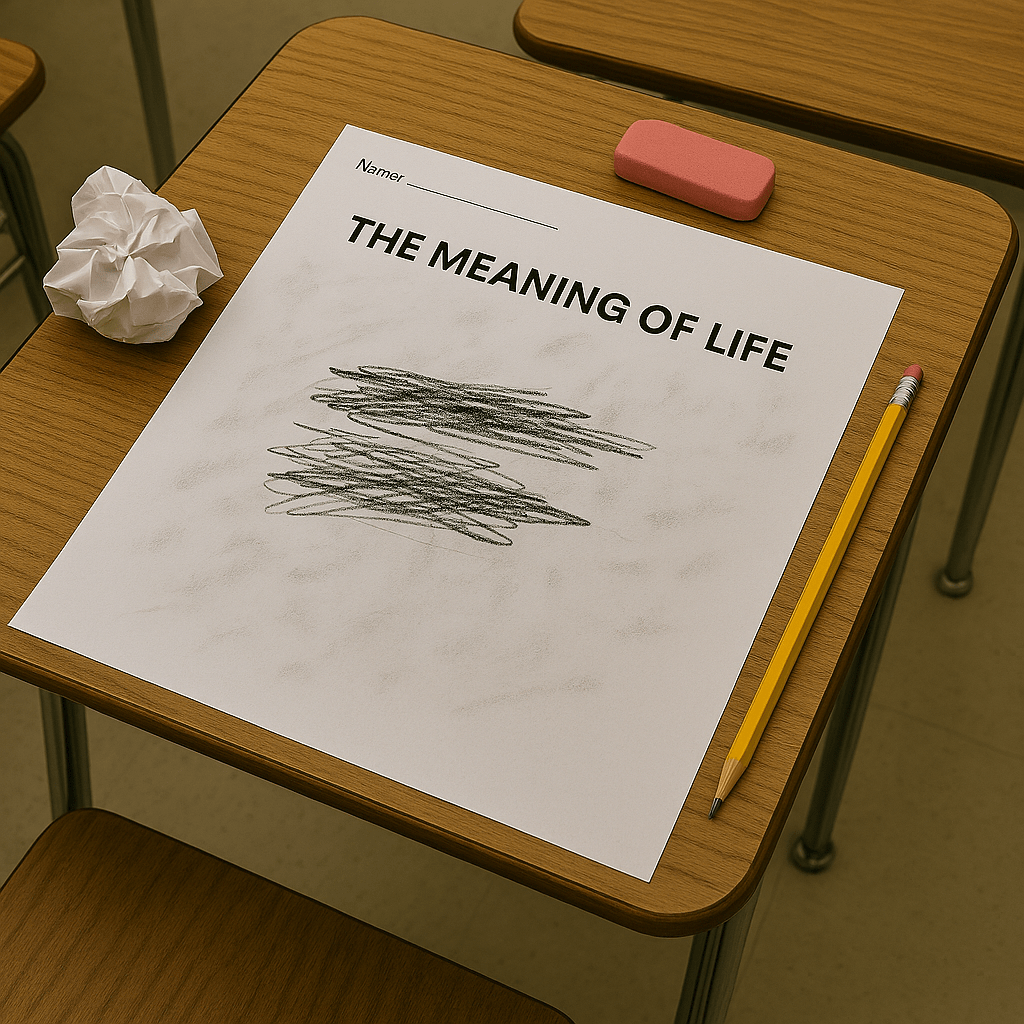
We are exhausted and cynical
Running into dead-ends everywhere
Because we live in a world full of answers
But not truth
A Cynical Fate

Cynicism is simply recognizing the true fate of mankind
Absent God
Reasons for Disbelief- The Perceived Immaturity in Childhood Things
The Evolution of My Faith)
When I was a child I had a very simple faith in the gospel. I simply believed what I had been taught, and I accepted it without question. As I became an adolescent and a young man, I became far more critical of my beliefs, requiring more concrete reasons to believe in them. I took apart each component of my theology and tried to understand its purpose and prove whether it was worthy of my devotion or not.
Fortunately, my critical examination proved to be extremely rewarding. I came to realize there were far richer reasons to believe in the gospel than “because my parents said so.” It turned out that the evidence for the gospel was deep and varied, and the curious, critical mind could plumb its depths forever, constantly finding greater meaning and greater justification in faith.
False Maturity)
Looking back, I see what my thought process was as an adolescent and young adult. My logic was that if I had once been a child, and had a simple mind, then anything that I believed in in that state was likely also childish and simplistic. Thus, my childhood faith became suspect merely by association.
And, to be sure, some overly-simplistic childhood notions were discovered, such as believing that society was comprised purely of “bad guys” that always did what was wrong and “good guys” that never did. But there was also much of my old belief system that turned out to be even truer than I had ever known.
Sadly, I know others who reached their adolescent, skeptical phase and never progressed any further. They let their skepticism call into question their faith, but they didn’t seek a meaningful answer. They didn’t conduct their own research or dive deeper to find out the truth of the matter. They found it easier to throw out baby Jesus with Santa Clause, discarding the pale imitations of faith without ever finding the genuine article. The skeptic who does not find the real truth hardens into a cynic, actively resisting any further opportunities for growth.
Such an individual has arrested their intended development. Normally it is a good thing to pass through the phase of skepticism, culling the mind of everything that is superstitious and unfounded while deepening one’s roots into the truer truth that remains. But like many blessings, skepticism is two-sided, becoming a curse to those that misuse it.
***
This is Reason #1 for Disbelief: being stuck at an adolescent stage of skepticism, having pushed out all childhood beliefs and becoming hardened and cynical through the process.
There are other reasons for disbelief, and I will examine them over the next few days. I hope this series will be helpful to those who have temporarily lost their way, as well as those trying to rescue a loved one. All the world will be better when all of us can better believe.
Maintaining Hope in a Doomed World
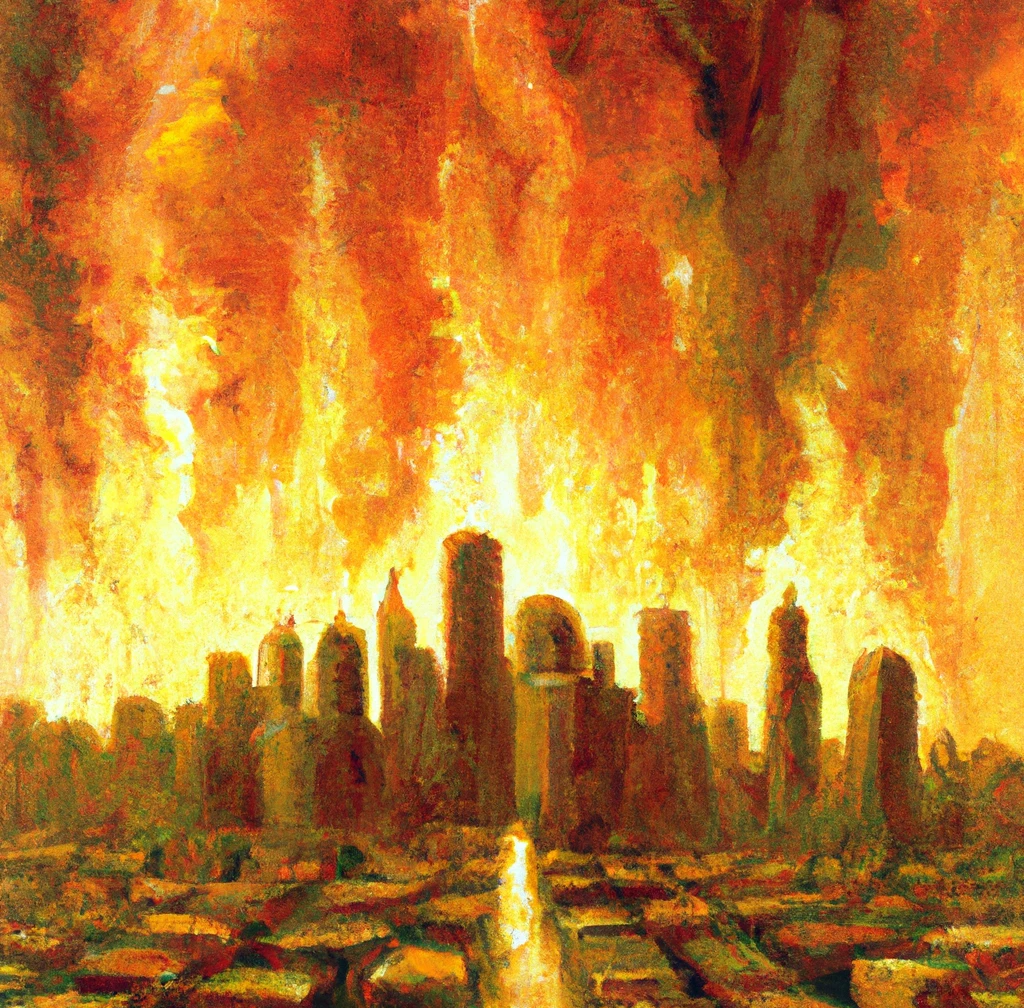
A Vision of Destruction)
The Bible’s descriptions of the final days have struck fear into the hearts of many people. Even those who are otherwise unacquainted with the stories and messages of the Bible are still familiar with its visions of fire and brimstone raining down upon the world, destroying all the wicked, administering God’s judgment before the return of Christ. The passages also describe the terrible persecution that will first afflict the faithful, and that the world will ultimately reject the gospel message before they feel the wrath of heaven.
Given all this, it can be easy to feel pessimistic about ministry efforts in the world today. We’ve skipped ahead and read the end of the story and we already know that the world as a whole does not become convinced by the missionary efforts of the righteous. So why bother protesting evil? Why speak against the ways that society is moving towards its own destruction? The world is just going there anyway, so why not just separate yourself from it and live as a faithful hermit?
The Many and the One)
If, indeed, we are in the last days, there is a sort of logic to all those cynical, nihilistic questions. If we are fast approaching Armageddon, then no matter what we do the world is still doomed to fail, and so any effort on our part to save it are also doomed to fail.
But saving the world or abandoning it aren’t our only options.
Maintaining the light of hope and optimism, even in the midst of a world falling apart, only requires us to shift our perspective from the many to the one. I have made this point previously, that anyone who is focused on saving the whole world will be disappointed, but anyone who is focused on saving the individual may yet find success.
We could see ourselves as firefighters standing before a blazing building. Perhaps the fire has spread through too much of the structure to save it. Perhaps the whole thing is coming down no matter what we do. But what about the individuals that are trapped inside? There may yet be time to rush in and get as many of some of them as possible out to safety before it all comes crashing down!
Even if the earth is going to hell in a handbasket there is still a work for us to do, a challenge for us to meet, and a success for us to achieve. We can follow Christ’s admonition to stop fixating on the ninety-and-nine, and to go in search of the one, bringing it back with great rejoicing!
The fate of the world is already known, but the fate of you, your loved ones, and your neighbors still hangs in the balance.
Optimism in a Falling World- Summary
I think the studies that do me the most good are the ones that expand my understanding of what it even means to be a follower of Christ. The more I am able to redefine my paradigm to be like his the more I am able to walk in his footsteps. And this study absolutely made me take a long, hard look at what it really means to be a Christian. And along with that realization came another: I’m often not a very good one.
Which might sound like a self-condemning conclusion, but really it is not. Realizing how far one has yet to go is a sign that they are actually upon their way. One must first have a solid foundation in a subject before they can appreciate the full depth of their ignorance.
This isn’t what I expected to find when I began this study. I really wasn’t sure what the answer to my periodic cynicism towards the world would be, but I didn’t think it would be: the problem is in you, so become a better Christian. A sharp, yet loving reproof. An invitation to become more so that I can be more happy.
Here are three fundamental concepts that came up while conducting this study.
Cynicism is a Product of Despair)
Some of us are naturally more optimistic than others. Some see the glass as half full while others view it as half empty. Yet I am convinced that pervasive cynicism is not anyone’s natural state. Each of us begins this life as children, and children as a whole are far more believing and optimistic. They have to learn to see the world more darkly.
At some point each one of us has our brightness broken. To one degree or another each of us was mistreated while still innocent. At the very least, every small child comes astray of someone having a bad day sooner or later. But it isn’t just what others do to us that break us, either. There are also the times we violate our own conscience. Through each of these processes we feel guilty and dirty, our souls are distressed, and we cannot correlate the promise of eternal joy with how wrong we feel inside. In this we come to understand what it truly means to be in hell.
And so long as we cannot see our own way to brighter fields we’re never going to be able to see it for the world either. If forgiveness seems inaccessible for what we have done, if our wrongs are more than we can ever do, then surely it is the same for the world’s even greater evils. In short, it does not seem humanly possible for that which is broken to be made whole once more.
Moroni 10:22- And if ye have no hope ye must needs be in despair; and despair cometh because of iniquity.
Matthew 18:3- And said, Verily I say unto you, Except ye be converted, and become as little children, ye shall not enter into the kingdom of heaven.
Believing in Others is a Product of Being Saved)
But of course there is a message of hope for those caught in such dire straits. When I began this study I really hadn’t intended to cap it off with yet another examination of Jesus Christ’s atonement, yet it found its way to the heart of my research even so. Because at the end of the day every worldly problem has its root in those fundamental problems of a fallen world and moral compromises. And those both have their solution in his atoning sacrifice.
If we ever want to have more hope in the world, then we first need to be able to have hope restored in ourselves. And if we want to have hope in ourselves, then we need to stop seeing our happy ending as being dependent on our own actions, and instead let it rely on the actions of one who has already succeeded. Then we start to see our triumph as a sure thing, and our hope becomes unshakeable.
When the reality of these facts truly sinks in for our own selves, then it is easy to see that the same sure triumph is available to all the rest of the world, too. We stop seeing other peoples’ problems as being their responsibility to solve. Just as with us, we know it has already been solved for them if they will just accept it. There no longer remains any question of whether they are now “too bad” or “too far gone” to make their way back. I mean, yes, they absolutely are too far gone to bring themselves back, but now we know that that doesn’t matter. What matters is that they are never too far gone for him to bring back.
1 Corinthians 15:56-57- The sting of death is sin; and the strength of sin is the law. But thanks be to God, which giveth us the victory through our Lord Jesus Christ.
Matthew 19:25-26- When his disciples heard it, they were exceedingly amazed, saying, Who then can be saved? But Jesus beheld them, and said unto them, With men this is impossible; but with God all things are possible.
The Salvation of Self Must Come First)
Of course feeling reclaimed from our own guilt and despair isn’t just a one-time thing, either. We will feel the reality of Christ’s redeeming love once initially, be filled with hope for all mankind, but then need to refresh those feelings many times over throughout our lives. In my case the old pessimism comes over me gradually when I am not paying attention. I have thought that I was still in a good place, but then suddenly looked all about me and wondered how I had wandered once more into fields of despair.
I began this study by trying to focus on the despair and not on where I stood. I began by looking at the external and not the internal. But at least I was looking, and over the past couple weeks my focus has gradually shifted back to where it needs to be.
And this leads me to the final point of this study. If I ever look at the world, see naught but wrong, and cannot fathom of any way to correct it, then my first instinct should be to consider what is amiss in myself. I cannot help lift anyone until I first stand on firmer ground, just as Jesus could never have pulled Peter upwards if he had also been floundering in the Sea of Galilee.
Matthew 7:5- Thou hypocrite, first cast out the beam out of thine own eye; and then shalt thou see clearly to cast out the mote out of thy brother’s eye.
Luke 22:32- But I have prayed for thee, that thy faith fail not: and when thou art converted, strengthen thy brethren.
Optimism in a Falling World- Question
I have always meant for these studies to be based around universal and timeless questions, rather than obsess over whatever the latest social controversy is. But of course I am a member of this world and I cannot help but feel affected by the great, rolling movements that disturb it.
And in all these passing tumults I have often seen a repeated theme of discord. I have an overwhelming sense of sides unwilling to work together, of a world falling apart, and of an impending fallout looming ahead. And as one man in a sea of billions I feel helpless to turn that tide. Even the scriptures foretell of our world falling to ruin before the second coming of Jesus Christ.
When I consider thoughts like these I find it very difficult to invest in what appears to be a losing battle. What would be the point? Shouldn’t I just take care of myself and let the world fall away?
But that doesn’t feel right to my heart either. Despair has never been one of the virtues championed by the gospel! With this study I want to examine how we can remain optimistic in a world falling away. What exactly is our duty to society as it becomes increasingly disinterested with our mission? How did the early disciples remain motivated in the face of apostasy and martyrdom? What can we do to increase our sense of hope, and what is that hope founded in?
In the meantime I’d love to hear about your own experiences dealing with cynicism. Have you ever lost faith in humanity, but then found it restored? Or are you even now struggling to keep your “perfect brightness of hope” alive? What have you asked in prayer and done in your actions to help with this matter?
A Surety of Truth- Matthew 7:4, Proverbs 21:1, John 18:38
Or how wilt thou say to thy brother, Let me pull out the mote out of thine eye; and, behold, a beam is in thine own eye?
Every way of a man is right in his own eyes: but the Lord pondereth the hearts.
Pilate saith unto him, What is truth? And when he had said this, he went out again unto the Jews, and saith unto them, I find in him no fault at all.
COMMENTARY
How wilt thou say, Let me pull out the mote out of thine eye; and, behold, a beam is in thine own eye?
Every way of a man is right in his own eyes
I examined in my previous study how each of us is biased and flawed in our own way. Each of us has our personal way of making mistakes. But though this shortcoming applies to us all, we often refuse to see ourselves this way. Most of us tend to see our perspective as being perfectly right, even after receiving evidence to the contrary.
The truth is that we inevitably have limitations and errors in both our observation and our reason. The truth is that we will inevitably misconstrue some things. But instead of accept this, we still assume that we see rightly, and then we warp reality to try and make sense of the insensible.
Pilate saith unto him, What is truth?
Fortunately, we do not have to remain so deluded forever. Some are able to break out of their arrogance and admit their failings. For some of us this will only occur when our mistaken beliefs cause us serious harm, and we are forced to face the fact that we are blind guides, stumbling about in vain.
Having made this admission, we are somewhat enlightened. We are able to admit that we are biased, and unable to discern authentic truth on our own. But then there is a danger of entering another delusion. Like Pilate, we might then become cynical, doubting that there is any such thing as universal truth. If we cannot be entirely sure of what is perfectly right, it is tempting to soothe ourselves with the claim that there is no perfectly right.
Assuming that there is no truth is just as deluded as when we believed we had no fault. We have traded one extreme for another, and are still trying to project our own limited perspective on the rest of the world. There is still a better way.
A Surety of Truth- My Better Truth
The journey of discipleship is mostly a slow and gradual process. We make a sincere commitment to following our Savior, we make him the central force in our life, and then we incrementally become more aligned to his nature. Slowly our behavior pulls itself into harmony with our conscience, and one day we look back and are amazed at how far he has brought us.
But every now and again the changing of the heart is not so effortless or subtle. At some moments we come to a critical juncture, one that will make a dramatic impact one way or another. For now that we have become improved, and can see more clearly, we finally realize that a long-held pillar of our belief is deeply flawed. Where before it seemed a critical foundation of truth, we now see it as an attempt to shore up our childish misconceptions.
To topple it seems a terrifying prospect, though, as we are uncertain what else might break if we do. Is it possible to let go of a misconception without letting go of everything else along with it? If the rotting wood is a piece of your foundation, what happens when it is removed?
I once faced this very dilemma after I had been cleaning up my soul for nearly a year. With the Lord’s help many layers of grime had been cleaned from my windows, and I was finally starting to see a clearer view of reality. And through them I suddenly came to the realization that maybe God wasn’t the severe and condemning Father I had always made him out to be. I knew the scriptures said “God is love,” but I had always seen Him as “tough love.” He punished me for my own good, I believed. My default prayer always began with “I’m sorry for…”
But now, this image just wasn’t lining up anymore. It didn’t fit with the new God I was discovering, and I felt as though God was hurt that I continued to approach Him in that manner. I was actively becoming a better person, and it didn’t have anything to do with a God who punished me into it. He had been overflowing me with grace, not fear, and that had been what made the change in me.
Was it heresy to let go of the old image of God, to try approaching Him in a different way? A part of me insisted yes, but another part said it had to happen, or else I would be forever limited. And in between those two I was amazed that I simply got to choose. Truth is truth, no matter what, but to align with it is a personal choice.
In the end, I chose the reality that I felt was truer: that of a kind and loving God.
A Surety of Truth- Question
In my previous study I considered how each of us has our own personal beam or mote within the eye. As flawed humans we all have a bias, and as a result see patterns in the world that are not there. However we never see our own biases as biases, we see them as empirical truths, inseparable from the foundations of reality.
If we are lucky, one day we will have our perspective irreconcilably challenged, such that we cannot deny that we were wrong. There are few blessings as wonderful as realizing that we have been wrong. For knowing that we were wrong is a prerequisite to becoming better.
But in that effort to become better some confounding questions arise. Now we know that our personal truths were flawed…how can we have confidence that the next truths we settle on will be any better? If we humans are fundamentally flawed, then are we doomed to just always hold fractured philosophies?
With this study I want to consider how we go from a broken belief system to a sure one. How can be confident in our principles, after we were let down by our previous ones? How can we know when we know rightly? How can we not be paralyzed by the fear that we will still make mistakes even as we try our best? How can we accept the guidance of wise leaders, while also accepting that even wise leaders will have some opinions that are wrong?
I would be curious to see how you have dealt with these conundrums in your own life? How do you avoid crippling yourself with doubts? Have you ever had to reconstruct your beliefs after one of your pillars was toppled? What is the core foundation of your belief system now?
 Spiritual Wanderings