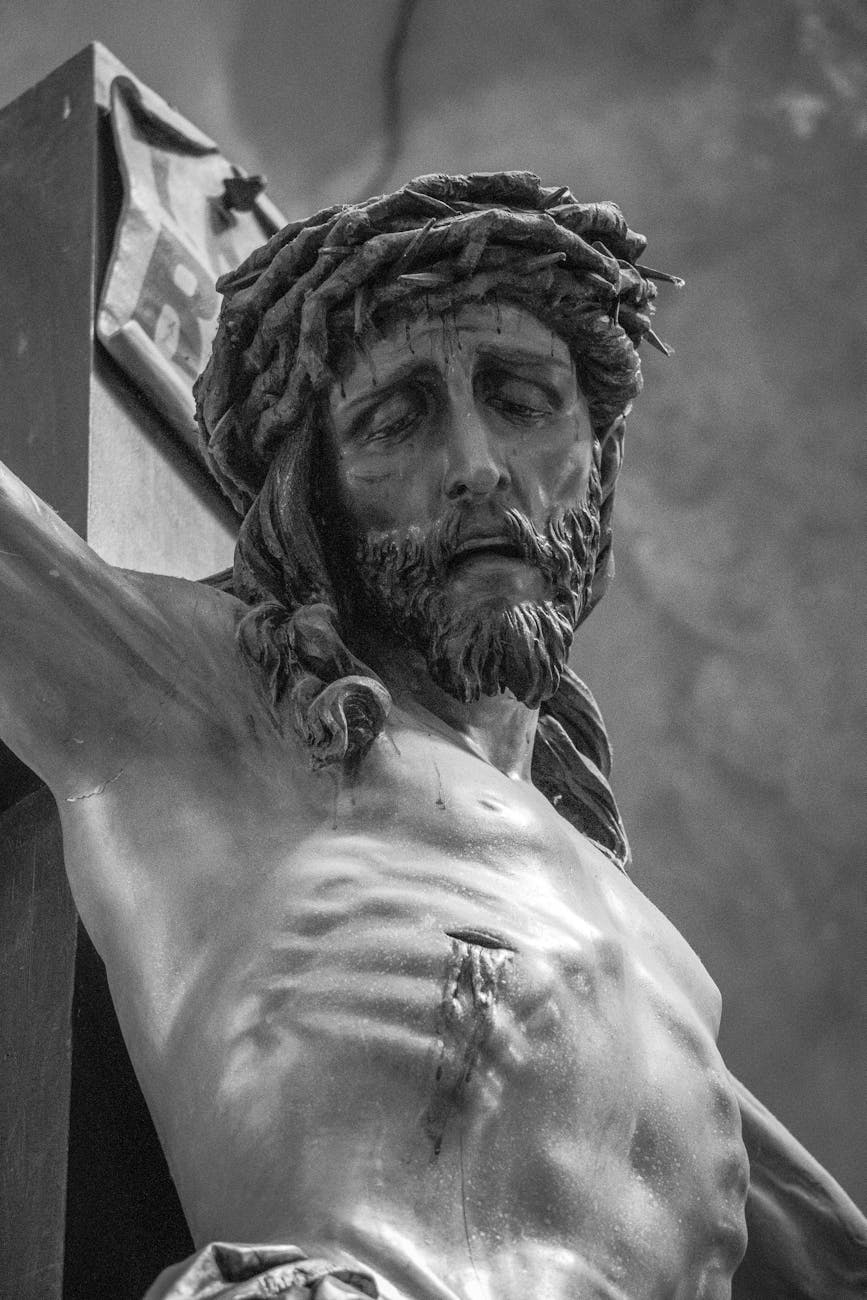
Scriptural Analysis- Leviticus 3:2-5

2 And he shall lay his hand upon the head of his offering, and kill it at the door of the tabernacle of the congregation: and Aaron’s sons the priests shall sprinkle the blood upon the altar round about.

3 And he shall offer of the sacrifice of the peace offering an offering made by fire unto the Lord; the fat that covereth the inwards, and all the fat that is upon the inwards,

4 And the two kidneys, and the fat that is on them, which is by the flanks, and the caul above the liver, with the kidneys, it shall he take away.

5 And Aaron’s sons shall burn it on the altar upon the burnt sacrifice, which is upon the wood that is on the fire: it is an offering made by fire, of a sweet savour unto the Lord.

In the last post we discussed the difference in meaning between the Meat Offering and this Peace Offering. These different meanings are reflected in the different steps of the sacrifices, as we can see in today’s verses. For the Meat Offering, there was no death involved. The offeror merely gave some grain, or flour, or baked goods. The absence of a death would certainly help maintain the joyful levity that that offering represented. But with the Peace Offering a death was mandatory, which is much more fitting for the thoughtful and emotional themes of reconciliation to the Lord that the sacrifice represented.

The fact is that death is a necessary component for any reconciliation. It might be the death of the ego, where I finally put an end to my ideas and my behavior, letting them die, so that I can be reconciled to another. Or it might be the death of individuality, such as when a man marries a woman, and they lay to rest their solitary lives to begin a new one of unity. Certainly, it can also be the death of the Savior, who paid the ultimate price so that we can have ultimate oneness with God again.

And so, in this symbolic offering, a life is appropriately taken, and the fat of the animal, which represents its passions, its energy, and its drive, are laid on the altar and burned. The offeror gives up all these things to instead be subsumed into the Almighty.

SacrificeEligible oblationStepsExplanation
Peace OfferingCattleGratitude for reconciliation
Animal is slainGiving up old life for one of unity with another
Fat burned on altarGiving up old plans, passions, and drives

Full table.

Thy Sins Are Forgiven

One of the most common phrases of Jesus’s ministry was “thy sins are forgiven thee.” When the paralytic man was lowered to him through the roof, Jesus first forgave the man’s sins, then healed his body. When the woman of many sins wept on his feet and anointed them with ointment, he also told her that her many sins were forgiven. The woman taken in adultery he did not directly forgive, but he did provide her a stay of execution and implored her to sin no more, implying that he was giving her time to seek the same forgiveness that the others had received.

Even as he was dying on the cross, Jesus had two famous moments of forgiveness. He interceded for the Romans who were carrying out his execution, observing that they were acting without understanding. He also promised the repentant thief that the two of them would see each other in paradise, implicitly forgiving him of the very sins that the man was being put to death for.

These are nice moments to think on, times where Jesus gave the greatest gift that we can experience in this life. I can’t imagine reading these stories and not being moved with happiness and hope.

But I think it also worth noting the deep gravity behind them also. I think we should always remember that when Jesus said, “thy sins are forgiven thee,” that forgiveness did not pop out of nowhere. Yes, it was given freely, but it was not acquired freely. Every time Jesus uttered those words an implication followed, “thy sins are forgiven thee, because I will die for them.”

In Hebrews it states:

For where a testament is, there must also of necessity be the death of the testator.
For a testament is of force after men are dead: otherwise it is of no strength at all while the testator liveth.
Hebrews 9:16-17

Surely, part of the reason why the death of the testator, Jesus, was necessary, was because his New Testament would take the place of the death penalties in the Old Testament. Thus, when Jesus let the woman taken in adultery go free…it was only because he was going to be killed in her place. And in all the other cases where Jesus pronounced “thy sins are forgiven thee,” those were only words until he paid the price that would give them actual force. The wages of sin are death, and so forgiveness of sin could only be real after his death for them.

We rejoice whenever Jesus’s words of forgiveness, mercy, and healing come upon us, and well we should. We marvel at how freely we receive them, how they seem to come from out of nowhere. But in the midst of our joy, we should remember that the freeness of them is only an illusion from our perspective. In reality, with every word of forgiveness Jesus gives to us, he is agreeing to die for them also.

Prepared to Fail- Martyr or Traitor

Silence)

In yesterday’s post I examined how torture and threats of violence to loved ones are used as tropes in Hollywood to transfer power and knowledge from the hero to the villain. I suggested that the frequency of this pattern might make us believe that these are foregone conclusions, it might train us to give the same response if ever we face the same pressure in our own lives.

One might argue, these are simply narrative tricks, and all they are looking to do is move the story along, not influence personal perceptions in the real world. I would agree that these films may not have the intention of cultivating a defeatist mentality in their viewers, but that can still be their effect when compounded all together. And what’s more, there are examples that are much more explicit in their message.

Silence is a film based on a 1966 novel where Jesuit priests witness the torture and killing of Christian converts in 17th century Japan. While the priests do not actually have their faith broken, two of them ultimately decide to renounce Christ as it is the only way to get the Japanese officials to stop murdering the people. In the film and novel this denial of faith is presented as a morally correct choice, and one that Christ would approve of. However, that argument is not rooted in any actual words of the Savior, it is justified by inventing a message from Christ within its fiction.

I certainly would never dismiss the seriousness of such a situation in real life, and if I ever met a person who abandoned their faith in such a moment, I would firmly leave the judgment for that in the hands of God. But I will judge fictional and solipsistic media that tries to say that sometimes the right thing to do is the wrong thing to do.

Joan of Arc)

Let us look at another example actually from history, one that is actually encouraging. Joan of Arc lived in 15th century France, and she proclaimed to have had visions with angels, which called her to fight for France’s liberation from England. While she went to battle and achieved great victories, ultimately, she was captured and stood trial before the English church.

Joan was found guilty of various sins, including heresy, and brought to the Tower of Rouen and shown the instruments of torture that would be used on her if she did not recant her spiritual claims. She bravely refused, and the judges thought it unwise to actually go through with the torture, so she was spared. Two weeks later, though, she was brought to the execution platform and told she would be burned at the stake that very day. This time they meant it, and this time her conviction wavered. She signed a confession that all her claims had been false.

But that was not the end of her story or her convictions. Only a few days later, pained by her false confession, she reasserted all her previous claims, and accepted the consequences that would follow. On May 30 she was put to the flames, and as she burned to death she called out to Jesus. Today she is considered a saint.

As I said yesterday, I cannot know whether I would prove faithful or not in such a trial. And as I said today, I leave to God the judgment of those who cannot hold to their convictions in such moments. But what I can do and say is that faithfulness to the truth is always the right answer. I can say that I hope to always be true to my Lord. I can say that we have sufficient evidence that people really can remain faithful, even in the face of torture, death, and the loss of loved ones. When evil comes in all its power, there is no foregone conclusion that we must fall to it. We may yet prove faithful and true; we may be martyrs rather than traitors.

The Richness of Scriptural Symbolism- The Natural Order

I have shared about the symbol at the core of Jacob receiving Esau’s blessing and I have shared about another symbol at the core of the Good Samaritan. Both of these examples show how good symbols reflect real life and today’s story is yet another example of that, but also of another principle that I wish to illustrate.

David’s Sin)

The story of David in the Old Testament is at times triumphant and at times tragic. Everything turns upon one pivotal moment, where he betrays his own conscience and destroys an innocent man. The story begins, of course, with him seeing Bathsheba bathing from the roof of his palace, then bringing her to him and committing adultery. When she became pregnant from the encounter he tried to obfuscate the parentage of the child, and when that failed, he ordered her husband to be placed at the forefront of a battle where he would likely be killed, which was exactly what happened.

But what David did in secret was fully known to God, and the Lord sent His prophet, Nathan, to tell him a symbolic story. In 2 Samuel 12:1-4 we read that story:

There were two men in one city; the one rich, and the other poor. The rich man had exceeding many flocks and herds: But the poor man had nothing, save one little ewe lamb, which he had bought and nourished up: and it grew up together with him, and with his children; it did eat of his own meat, and drank of his own cup, and lay in his bosom, and was unto him as a daughter.

And there came a traveller unto the rich man, and he spared to take of his own flock and of his own herd, to dress for the wayfaring man that was come unto him; but took the poor man’s lamb, and dressed it for the man that was come to him.

The story is, of course, a symbol for David. He is the rich man that had everything yet took from the poor man who had so very little. Not only this, but it is a symbol for all injustices in which the rich have further extended themselves by crushing those beneath them. This type of injustice is, unfortunately, fundamental to the human condition, and Nathan condenses it expertly into this one, short story.

The End of the Symbol)

Because Nathan’s story is so direct and so fundamental, it is only natural to feel a powerful emotional reaction to it. David certainly did, and the account in 2 Samuel records that response:

And David’s anger was greatly kindled against the man; and he said to Nathan, As the Lord liveth, the man that hath done this thing shall surely die!

Obviously, David had not realized that he, himself, was the subject of the story. His was the own head that he was proclaiming death upon!

This dramatic example illustrates one of the other hallmarks of good symbols: they make plain to us the natural order and summon from us the correct resolution to any unnatural situation.

The fact is, each one of us is imbued at birth with basic morals and truths. Deep at our core, we understand justice even before we can put words to the notion. It is ingrained in us, and a good symbol can help us cut through all of the bias and distraction, seeing plainly what the natural order is, how it has been twisted, and what must be done to set it right.

If David had known that he was the real subject of the story, he may well have squirmed and tried to justify his actions. But since he was absorbed in the fundamental violation of the natural order described in the story, he could not help but exclaim the harsh penalty that was necessary to set things right. By recognizing the answer to the fundamental, he had also found the answer to the specific. Such is the power of a truly good symbol.

Condemned Before Redeemed

Before we can be redeemed, we have to be condemned. Before we can be reborn, we have to have perished. Before we can be healed, we have to be broken.

And we have to be condemned, and perished, and broken, because we don’t recognize our natural fallen state until what little good we have is taken away. Though death is our certain end, we don’t feel the reality of it until we sin. Sin reveals to us the fallen nature we were always under and makes death itself more real to us. Sin brings upon us a sense of condemnation both for our guilt and our mortality.

Thus, we start in a state of innocent delusion, and we break that delusion by being awoken to our state of condemned mortality. But then we are reborn from that state of condemned mortality, not back into a state of delusion, but into the genuine article of eternal life. Though first we had to die, we are reborn into the reality of redemption.

God’s Body: The Beginning and the End

Part of God)

I have spent some time discussing how viewing ourselves as part of God whole allows us to better accept the trials of life that come our way. Yes, those times still hurt, but we understand that since we are a part of God, He isn’t asking us to go through anything that He isn’t willing to face Himself. He is right there experiencing the exact same pain alongside of us, thus able to provide both perfect empathy and healing care.

Of course, exactly what it would mean to be “a part of God” is still open to interpretation. We do know that individual cells are part of the organ, the individual organ is part of the body, the individual body is part of a community, the community is part of a nation, and the nation a part of the human race. Man is both made up of parts and a part of something more. He is in the middle of an order that extends out to places smaller and larger than we know. Could it be that both its root and its end, its smallest origin and its largest aggregate, are one and the same God?

A Divine Struggle)

Considering that such might be the case, that all of us might be from God and for God, then that raises some interesting ideas as to what we are all doing here, and why difficulty and pain are a necessary part of this earthly existence. Consider these verses from Paul in his letter to the Corinthians:

For he must reign, till he hath put all enemies under his feet. The last enemy that shall be destroyed is death.
-1 Corinthians 15:25-26

If we are all a part of God, then the greatest thing that this collective body of God could do is learn how to overcome every ill and affliction, including its own death. This gives a fascinating lens with which to view the increase of corruption and chaos around us. Could it be that this mortal trouble is not contrary to the plan, but exactly in accordance with it? Could it be that the plan is to take on all trouble by degrees, so that the body of God may struggle through every trouble and overcome it? And if that is so, then each of our individual struggles is part of the striving and overcoming of the whole!

Scriptural Analysis- Exodus 31:12-14

12 And the Lord spake unto Moses, saying,

13 Speak thou also unto the children of Israel, saying, Verily my sabbaths ye shall keep: for it is a sign between me and you throughout your generations; that ye may know that I am the Lord that doth sanctify you.

14 Ye shall keep the sabbath therefore; for it is holy unto you: every one that defileth it shall surely be put to death: for whosoever doeth any work therein, that soul shall be cut off from among his people.

This chapter changes its subject at the end, now becoming a reminder from God that the Israelites are not to break the sabbath day. God’s words reiterate the same requirements that were given with the ten commandments, the key feature being that there must be no work done on that day. It is to be holy, and therefore free of the crass pursuit of worldly wealth and resources. It is to be a day dedicated to rest and worship.

In verse 13 God calls this commandment to keep the sabbath day holy a “sign between me and you throughout your generations.” Other commentators have noted that the word used for “sign” here is also applied to the law of circumcision. Depending on the translation it may be called “token,” but it is the same Hebrew word in both cases (אוֹת). Thus, keeping the sabbath was going to be an identifying sign and token, something that set the Israelite apart from all the rest of the world, just as circumcision was.

In verse 14 God gives the penalty for those that break the sabbath, which is death. God further explains that this is because such a person’s soul is already “cut off from among his people.” That person has already made himself an outsider, a non-Israelite, and physical damnation was to immediately follow the spiritual.

Today this sounds extremely harsh, though even the modern Christian living under the new law will still testify that sin brings upon us the death of the soul. We also say that the loss of the soul is far more tragic than the temporary cessation of life in the body. Thus, there are many modern Christians that are scandalized by physical death as a punishment yet maintain belief in a far worse fate. This is a contradiction caused by a lack of conviction in the true value of the soul.

Is the Old Testament God Evil? – Response to Common Defenses #3

I have been examining God’s command to slay the entire population of a nation, and in my last post I responded to the defenses that suggested such an action was justified, and that God has the moral right to do such a thing. I concluded that such an argument makes sense to me when viewing the destruction of a wicked nation as a whole, but when zooming in to the level of individual children being destroyed, it is still uncomfortable.

Today we will look at another category of defense for these verses, which argues that the destruction of these innocents may actually have been an act of mercy. Here are two examples of that line of reasoning.

  1. From the eternal perspective, death is simply an awakening from a painful dream into glory.
  2. When a nation becomes truly depraved, their own children suffer most. Some of these children were already being killed in pagan sacrifices, and those that lived were fixed on a path of corruption. Cutting this misery short was an act of mercy.

This line of argument is taking a common principle of life and extending it to the extreme. We all know that there are things that are unpleasant, that no one wants to go through, and which under normal circumstances would be wrong to subject another person to; yet we also know that there are exceptions to this principle when it prevents the person from experiencing greater harm, or when it is a step towards greater joy.

For example, under normal circumstances it is wrong to shove another person, and wrong to advise a person to cause themselves pain. But what if you are shoving the person out of the way of a charging horse? Or what if you are encouraging someone to go through painful physical therapy so that they can walk again. Because your underlying intention is good, and because the intended outcome is good, it actually becomes an act of kindness and love to shove and to encourage painful exercise.

An important realization here is that at first thought we might think it is fundamentally wrong to cause someone pain, but clearly that isn’t the case. If all I hear is that someone caused another to feel pain, I still don’t actually know whether that person did something good or bad. Causing pain is not objectively wrong. The intent to harm is.

But does this reasoning extend all the way to death? It is more challenging for us to see the ultimately good consequence that might follow death, because for us death is the end. We do not see anyone receive any positive consequence that comes after having passed through it. Of course, we’ve all been told that there is the potential for experiencing a terrific good after death, but that is something we can only imagine for now. The degree to which death disquiets us is a metric for just how real heaven is in our minds.

Summary)

If these things are true, then it is understandable why from God’s perspective His consignment to death might be an act of great mercy, but why it seems cruel from ours. Our view of the exchange is being halted in the middle, just long enough to see the hard part of the bargain, and none of the good return.

A stronger testimony of the afterlife might improve my outlook on these passages, but I still have a lingering concern. Even if God has great enough rewards to make up for any type of death, why not subject the innocent to the most peaceful demise imaginable? Why not make all the infants die peacefully in their sleep, as opposed to by the sword? I’ll keep these questions in mind as I continue with this analysis.

Is the Old Testament God Evil? – Response to Common Defenses #1

Yesterday I shared some of the common defenses to criticisms of God commanding the destruction of innocents in the Old Testament. I divided those defenses into three categories, and I would like to respond to each of those categories one at a time, explaining what I find convincing or unconvincing about them. Today, I will look at the first category, which was defenses that say that God never actually commanded such a slaughter. Here are two examples of this argument:

  1. God is exaggerating. If I say my favorite sports team “murdered” the other team in last night’s game I’m using the exact same sort of hyperbole. We never do read a verse describing the actual slaying of children, it was only the enemy army that was killed.
  2. This was the work of man, not God. Either corrupt leaders claimed to do this under God’s command, or translators misattributed these messages to God when it was really called for by man.

I wanted to start with these arguments because, frankly, I find them particularly unhelpful. That isn’t me saying that these claims are false, for all I know they could be completely valid, I’m just saying they are only conjecture and that they dodge the real issue.

Personally, it does not bother me to say that the Bible is the word of God…seen through a human lens. I am fine with acknowledging that it has several different versions of the same stories, not all of the details agree with one another, there is the possibility of human malfeasance and error, and some cultural nuances are lost on most of today’s readers. Because of all this, it is possible that when I read a passage, I am not actually getting the pure intention with which it was originally spoken.

But I think it is a dangerous to make oneself judge over which parts are genuinely from God and which parts should be cut out of our faith. To those that say that these passages are misinterpreted, or misattributed, or misunderstood, my reply is, “well, you may be exactly right…but what if God really did say this?”

If your testimony is dependent upon a particular reading of the Bible, and at some point you learn that your reading is false, does that mean that you no longer believe? If we can only accept God with the understanding that He did not order the destruction of these Canaanite nations, then must we reject Him if actually He did make that order? Is that the same conditional faith that we wish to inspire in others? To put their whole hearts and trust in God…well, as long as He didn’t order the destruction of the Canaanites?

Speaking for myself, I don’t know whether God really commanded the slaughter of innocents, but I seek to maintain my faith in Him regardless of whether He did or not. I seek to be able to trust in Him no matter if I understand His reasons or not. To that end, I choose to interpret these difficult passages as literal and accurate, so that I may work my heart into a place of believing no matter what.

Summary)

To be clear, I’m not saying that it is worthless to learn the evidence that lays behind these sorts of claims. I’m all for educating people to the fact that God may not have really commanded this thing. As long as that is not the end of the discussion, as long as there follows: “but even if He really did say to slaughter every man, woman, and child, I am still at peace because…”

Which is exactly what I hope to establish as I pursue this study. Thus, tomorrow I will continue by responding to the defenses that are designed to maintain faith in God regardless of Him ordering such a destruction.

Scriptural Analysis- Exodus 23:25-26

25 And ye shall serve the Lord your God, and he shall bless thy bread, and thy water; and I will take sickness away from the midst of thee.

26 There shall nothing cast their young, nor be barren, in thy land: the number of thy days I will fulfil.

In return for the Israelite’s faithfulness, God now makes some significant promises. He assures them of the basics, bread and water, and also that He will heal them of their diseases. He says that “the number of thy days I will fulfil,” meaning they will be a people that live full lives without meeting an early demise. Thus, God is ensuring the necessities for a full life. Not only this, but nature itself will be particularly blessed for them, their livestock giving birth to healthy young and the land yielding its fruit.

Notice in these promises that God is removing from the Israelites much of the curses He pronounced to Adam and Eve. He had told Eve that “I will greatly multiply thy sorrow and thy conception; in sorrow thou shalt bring forth children.” Obviously the Israelite women would still face the pains of childbirth, but would not suffer the anguishes of infertility or maternal or infant death, given God’s promises that there would not be barrenness or shortened days. God had told Adam that “cursed is the ground for thy sake. Thorns also and thistles shall it bring forth to thee.” Obviously the Israelites would still have to labor for their food, “in the sweat of thy face shalt thou eat bread,” but here He describes that the land would no longer be actively working against them.

What we read here is the first step in the Lord reclaiming His people from the fall. Humanity had been in an extremely dejected state, and now God’s people were half-exalted, living blessed lives. God had begun the work of taking the sting out of death and the victory out of the grave (1 Corinthians 15:55).