
The soul is most imperiled, not by suffering, but by believing that it doesn’t need God.
It is not despair that goes before the fall, but pride.
Thus, the world will destroy itself from its richness, not its want.
The soul is most imperiled, not by suffering, but by believing that it doesn’t need God.
It is not despair that goes before the fall, but pride.
Thus, the world will destroy itself from its richness, not its want.
We have discussed different aspects of the power in the human voice. As shown in the last post, when different voices are combined together the power grows exponentially. There are even scriptural examples of this, such as when the shout of the Israelites broke down the walls of Jericho. That is very impressive, but whether it is a good or a bad thing depends on which side of the wall you are on.
As we saw in the last post, the compounded power of universal communication has led to the most tremendous advances in technology, which have included many things that are good for mankind. But at the same time, we have also increased our methods of self-destruction. Historically that has involved the creation of artillery shells, nuclear bombs, and the ability to hack a nation’s infrastructure systems. Today we are seeing all-new threats, such as individuals becoming displaced by robotics and AI and social media dividing us into deeply entrenched factions. Our ability to divide and destroy has always grown in lockstep with our ability to create.
The scary thing is just how far our compounded power extends. Just as one Israelite shouting at a time would never bring down the walls of Jericho and one man working at a time would never build the Golden Gate Bridge, so too our weapons of destruction surpass any individual reach. Once these looming threats start to tip over, it will be well beyond anyone’s power to right them before they come crashing down on our heads.
And this danger was already known thousands and thousands of years ago. It was recorded for our own education, but we did not heed it. In the book of Genesis, Chapter 11, we read:
And the whole earth was of one language, and of one speech.... And they said, Go to, let us build us a city and a tower, whose top may reach unto heaven; and let us make us a name, lest we be scattered abroad upon the face of the whole earth.
There was one language, and one people, and they spoke with one voice, desiring to build a tower all the way to heaven. While the scriptural account does not get explicit in their ultimate intentions, tradition has assumed it was to for a direct assault on heaven. Whether literally or symbolically, their effort was to make something so great that it could dethrone God.
Breaking from the hand of your own creator is logically the greatest act of self-destruction that anyone could ever do. Thus, it was an act of mercy and preservation when God broke their tower, and made them unable to combine their voices, and scattered them across the world. Yes, it made them weaker, but it also limited their ability to destroy themselves.
Today, we have progressively broken down those barriers. We have rediscovered each other, learned one another’s language, and found ways to combine our voices as one. We are much the same now as the people who built the tower of babel, and we seem to quickly be approaching another act of hubris and self-destruction.
Of course, every vision of paradise does necessitate all the people united as one, but it assumes that mankind has learned to let go of his tendency for self-destruction, so that he may unite without danger. That certainly has not happened today, so the danger of our united voices is very, very real.
I have spent the past several days reviewing the common defenses that are made for God having commanded the Israelites to destroy the Canaanite nations. I found some of the arguments more compelling than others. However, even the ones that had strong points were not so convincing that I lost all discomfort for these passages. I find what remains for me is a sense that God was justified to have commanded these actions, but I still wish He wouldn’t have. The more that I delve into the details, the more I realize that the problem isn’t in the details.
I think this is a common mistake when raising and addressing issues related to God. We are dealing with a matter of spiritual unrest and are trying to resolve it in intellectual terms. We too often assume that our feelings are invalid if we cannot express it as a logical argument. Therefore, the critic will experience negative feelings towards these verses and will give logical arguments against them. The defender of these verses will respond in kind by providing logical rebuttals. Even if those rebuttals are sound, they will do nothing to convince the critic, because the logic wasn’t where the problem began. It isn’t the critic’s mind that needs to be converted, it is the heart.
Thus, my response to all of the defenses that we have covered thus far is, “yes, you have some good points, and maybe it all makes sense in my head…but I still just feel sad about it.” In my next post I will try to take a different approach to addressing these concerns. I think it is time we took the matter to a higher level of consciousness. I wish to make an appeal, not the to mind, but to the Spirit. We will see how that goes tomorrow.
Before I can begin any discussion, I need to reference the verses that are the most controversial in the Old Testament account. Here are three passages that include God’s mandate that Israel kill every member of the nations that had earned His disfavor.
And when the Lord thy God shall deliver them before thee; thou shalt smite them, and utterly destroy them; thou shalt make no covenant with them, nor shew mercy unto them (Deuteronomy 7:2).

But of the cities of these people, which the Lord thy God doth give thee for an inheritance, thou shalt save alive nothing that breatheth: But thou shalt utterly destroy them; namely, the Hittites, and the Amorites, the Canaanites, and the Perizzites, the Hivites, and the Jebusites; as the Lord thy God hath commanded thee (Deuteronomy 20:16-17).

Thus saith the Lord of hosts, I remember that which Amalek did to Israel, how he laid wait for him in the way, when he came up from Egypt. Now go and smite Amalek, and utterly destroy all that they have, and spare them not; but slay both man and woman, infant and suckling, ox and sheep, camel and ass. (1 Samuel 15:2-3).
God does not hold back in these commands of war. The destruction that He calls for is total and absolute. A divine mandate to destroy is already enough to cause the modern reader to raise an eyebrow, but I think there is a specific aspect to this that is even more distressing than the rest. It is the destruction of the innocents. Slaying enemy soldiers in battle is one thing, but the verses from 1 Samuel specifically call out the slaughter of the infant, who obviously would have been incapable of doing any wrong. Why would God command the death of one such as that?
That is the aspect that I must grapple with as I move forward with this study. To be clear, I do not have to rely on imagination to discuss what is troubling in these passages, they are difficult for me personally. Thus, exploring the issue will also be an exploration of my own faith and conscience.
Tomorrow I will introduce the criticisms and defenses of God that have already been made, and then we will go into greater detail on each point, as well as on my own interpretations and conclusions.

A reality based upon a lie can only end in obliteration
For a lie is the inversion of reality
26 And the Lord said unto Moses, Stretch out thine hand over the sea, that the waters may come again upon the Egyptians, upon their chariots, and upon their horsemen.

27 And Moses stretched forth his hand over the sea, and the sea returned to his strength when the morning appeared; and the Egyptians fled against it; and the Lord overthrew the Egyptians in the midst of the sea.

28 And the waters returned, and covered the chariots, and the horsemen, and all the host of Pharaoh that came into the sea after them; there remained not so much as done of them.
Now the Egyptians were bogged down in the middle of the channel and the Israelites were clear on the other side. There was no need to keep the passage open any longer, and God commanded Moses to seal the way shut. Notice how in a single action, the closing of the sea, God both saved His people and destroyed His enemies. The same act can be both salvation and damnation.
Verse 27 once again makes reference to the time of day, stating that the sea returned to its proper place “when the morning appeared.” Pharaoh’s army, it would seem, first came into the view of the Israelites in the evening, causing them to despair as the sun set on them, literally and figuratively . But then, in the night, when they were their most powerless, God worked a miracle for their salvation, and in the rising of the sun their future was made hopeful once more. A new dawn, once again both literal and figurative.
And so the sea’s walls cascaded together in a sudden, dramatic flood. The Egyptians, we are told, tried to flee, but they could not outrun the rush of water. All the army was covered. The chariots, the horsemen, the host, none of them survived.
Note that verse 28 specifies that “all the host of Pharaoh that came into the sea” were destroyed. The phrase “that came into the sea” might suggest that not all of Pharaoh’s army charged between the waves and that some of them could have been spared. This is what fuels hypotheses that Pharaoh might have actually survived that day. Given the arc of his story, and his stubbornness thus far, and God’s prior comments about gaining honor upon Pharaoh specifically, and verse 23’s declaration that “all Pharaoh’s horses, his chariots, and his horsemen” charged into the sea, I am inclined to believe that Pharaoh did not survive. Indeed, I find it most likely that verse 28 is merely saying that the Lord destroyed “all Pharaoh’s army, which army came into the sea,” and thus there were no survivors whatsoever.
5 And it was told the king of Egypt that the people fled: and the heart of Pharaoh and of his servants was turned against the people, and they said, Why have we done this, that we have let Israel go from serving us?

6 And he made ready his chariot, and took his people with him:

7 And he took six hundred chosen chariots, and all the chariots of Egypt, and captains over every one of them.
Pharaoh received word that the Israelites had fled beyond the three-days-distance allotted for their sacrifices. It was clear that they were on the run, never intending to return, though as I have mentioned before, it must have been obvious to Pharaoh that this was always their intention.
Of course, even an expected insult is still an insult, and verse 5 tells us that not only did Pharaoh’s heart turn against the Israelites, but also the hearts of his people. Before, Pharaoh’s counselors had beseeched him to give in to the Israelites’ commands, and he had refused. But now all of Egypt was united in wanting revenge upon God’s chosen people. They had lost their crops, their economy, their firstborn, and they had been spoiled under false pretenses. What also might have been a factor in the Egyptian civilians’ wrath was that the battlefield would now be out in the wilderness, not in their heartland. This time the people wouldn’t be caught in the crossfire between God and their king, so perhaps that emboldened them to support a further provocation.
Thus, Pharaoh gathered his army for battle, and he, himself, rode with them. Verse 7 mentions that “he took six hundred chosen chariots, and all the chariots of Egypt.” That “and” suggests that 600 was not the total number of chariots, probably it was only the number of his personal guard, with many other chariots making up the rest of his cavalry. Also, it is to be assumed that he had many foot soldiers to further support the cavalry. Several ancient historians (Josephus, Patricides, Ezekiel) all describe a different number for this army, but averaging all of their estimates suggests that the force might have very well stood in the hundreds of thousands of men.
As mentioned earlier, the Israelite camp is estimated to have been about two million souls, but most of that was women and children, and even the men presumably did not have proper weapons to fight with, nor any advanced tools of war such as horses and chariots. Thus, Pharaoh was leaving with a force of sufficient strength that he really could kill the entire Israelite nation if he wanted. Perhaps he meant to bring a residue back to be his slaves again, or possibly he really meant to slaughter them all!
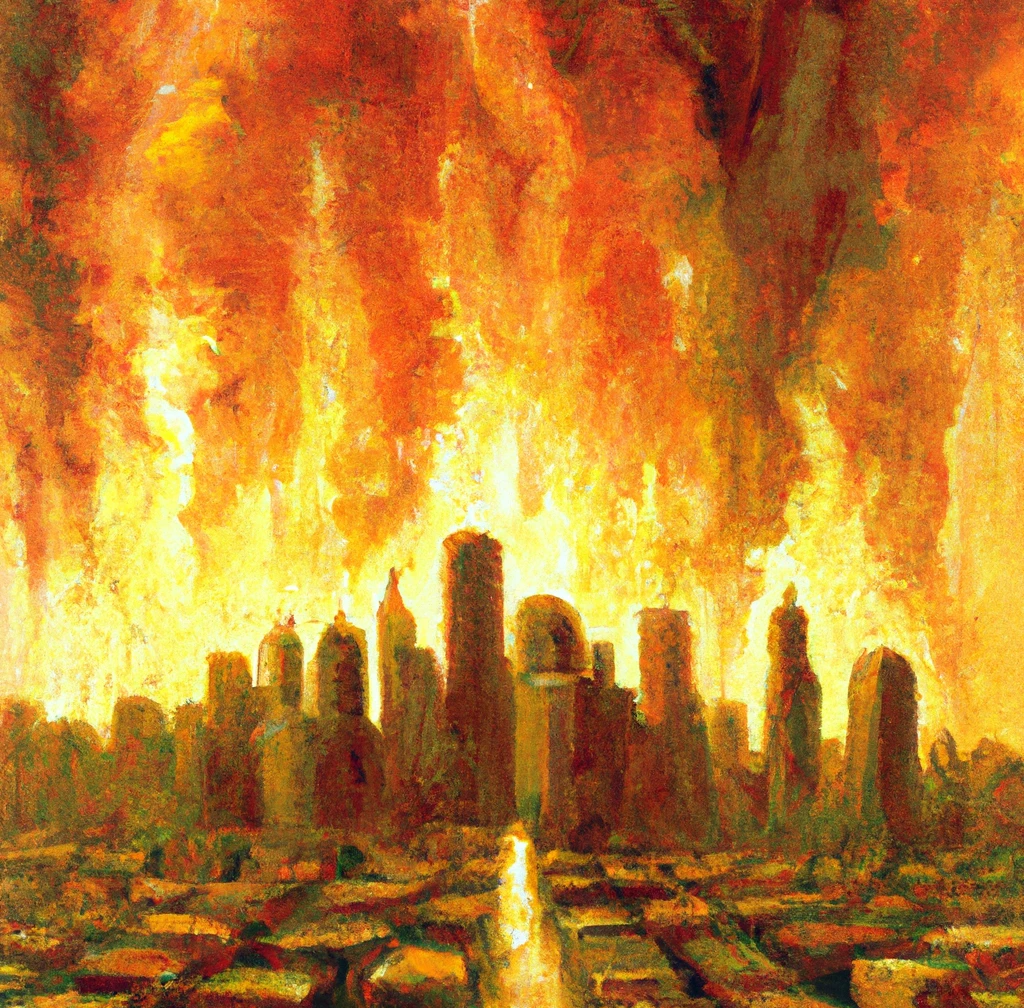
I have already reviewed the account of the Lord’s destruction of Sodom and Gomorrah in my standard scripture study, but the story has been on my mind lately and I wanted to address a few points about it in greater detail. All the verses I will be discussing can be found in Genesis 18-19.
What first prompted my thoughts on this story was hearing a celebrity give it as evidence of God’s capriciousness, an example of Him being so petty and heartless that He would bargain and haggle over the lives of His children before destroying them. This is, of course, in reference to Abraham petitioning the Lord if He would spare the city for fifty souls, then forty-five, then forty, etc.
And Abraham drew near, and said, Wilt thou also destroy the righteous with the wicked?
 Peradventure there be fifty righteous within the city: wilt thou also destroy and not spare the place for the fifty righteous that are therein?
So, let me first point out that these accusations are obvious falsehoods, completely misrepresenting the story as it is written. God did not haggle or bargain over how many people it would take for Him to spare the city and He never changed His position on the matter. Abraham’s position changed, but not God’s.
The first thing to note is that God never brought numbers into the matter. He simply expressed His judgment, which was to destroy the city, no numbers attached whatsoever, and it was only Abraham who brought up the idea of sparing the city if a particular number of righteous people lived there.
Abraham wanted to know whether God would have spared the city for 50 righteous, and God assures that He would have… but there just aren’t 50. Abraham wanted to know if God would have spared the city for 45 righteous, and once again God indeed would have… but there just aren’t 45. And so on and so on, until Abraham reaches his own personal limit for mercy: 10 righteous souls to spare the city.
That Abraham presses the matter no further than 10 seems to suggest that he, himself, could not condone sparing the city for any less righteous than that. Even he felt it was justified to lose nine or eight righteous, if it meant that such a terrible evil could be blotted from the earth. And, once again, God shows that His mercy extends as far as Abraham could ever hope for. God, too, would have spared the city for 10 righteous…but there just aren’t 10.
When I read the account in Genesis 18, it is not about God and Abraham haggling, it is about Abraham not yet fully trusting God, and him exploring the limits of God’s mercy until he is convinced that God’s judgment is worthy of his trust. God had pronounced judgment, but Abraham wasn’t able to trust that judgment until he was convinced that God came to that determination by due prudence and fairness, and God indulged Abraham’s tests because He wanted to earn Abraham’s trust.
Thus, there is no haggling going on in this story and no changing of God’s mind. God was simply allowing Abraham to double-check His calculations so that Abraham could begin to learn to trust the Lord’s decisions.
And, as it turns out, not only was God as prudent and merciful towards Sodom and Gomorrah as Abraham, He was even more so. For after there were not even 10 righteous in the city Abraham would have surrendered any good souls to their destruction, but God would not. God shows us in this story that He cares for even the individual righteous soul, the 1 over the 99. Thus, while He was determined to destroy the city, first He sendt two angels to draw Lot and his family out of the midst of it.
In the records we have, Abraham never beseeched the Lord for the life of his nephew, Lot, even though he knew that Lot lived in the path of destruction. Abraham seems to have been ready to let his own kin die as a justified sacrifice for this destruction of evil. It was only because God was more good than Abraham that Lot and his family were spared.
Abraham’s willingness to sacrifice the righteous for the greater good returns again later in his story. When God commanded Abraham to sacrifice Isaac, we do not see a moment of hesitation in Abraham’s response. He forthrightly makes preparation, goes to the place of sacrifice, binds his son, and raises the knife to take the lad’s life. Abraham knew that his son was good, but as with Sodom and Gomorrah, he was willing to sacrifice that good to fulfill the demands of the Lord. But then, as with Sodom and Gomorrah, God intervened to save the good and provide another way.
I wonder whether Abraham being commanded to sacrifice Isaac was, in part, a way for God to teach Abraham a lesson that He had tried to teach with Sodom and Gomorrah, but which hadn’t fully clicked yet. I wonder whether Abraham was too quick to believe in the God that would sacrifice good to destroy evil. I wonder if God temporarily assumed that role when He commanded Abraham to sacrifice Isaac, so that He could then dispel that illusion from Abraham once-and-for-all. I wonder if one of God’s lessons to Abraham in that moment was “Stop seeing me as the God of sacrifice, the God of taking, the God of destroying evil. See me as the God of saving, the God that brings back, the God of redemption!”
This is, of course, pure speculation. I don’t claim to know that this was the subtext to Abraham’s trial, or even if it’s likely. It is simply something that I wonder about. At the very least, it does stand out to me that we have no account of Abraham pleading for Lot’s life nor Isaac’s, and yet God saved them both. Whatever else those facts mean, surely they mean that these stories show God’s mercy, not wrath. They show His care, not indifference. They show His compassion, not brutishness. They show that God is a God who can be trusted when He declares His judgment because He has already analyzed the situation more than we ever could, and He cares for the innocent more than we ever would.
16 Then Pharaoh called for Moses and Aaron in haste; and he said, I have sinned against the Lord your God, and against you.

17 Now therefore forgive, I pray thee, my sin only this once, and entreat the Lord your God, that he may take away from me this death only.
Pharaoh repents once more, again admitting that he has sinned against the Lord. This time, though, he also takes the dramatic step of setting restrictions on the forgiveness that he seeks. “Forgive, I pray thee, my sin only this once,” he tells Moses. Also he asks that God “may take away from me this death only.” This seems to be Pharaoh saying he is so sincere about this repentance that he doesn’t need any other chances. If he were to violate his word again, then God and Moses shouldn’t forgive him any more! Then the punishment and the death that he asks to be spared from this time should be delivered in full measure.
Thus, Pharaoh was literally, and of his own volition, putting the lives of himself and the other Egyptians on the line. He was willingly inviting destruction should he go back on his word, and so one would think that this would be the end of the whole affair.
But it wasn’t. Even after this, Pharaoh would go back on his word yet again, and his words that God should withhold forgiveness and administer death would prove prophetic.
14 And the locusts went up over all the land of Egypt, and rested in all the coasts of Egypt: very grievous were they; before them there were no such locusts as they, neither after them shall be such.

15 For they covered the face of the whole earth, so that the land was darkened; and they did eat every herb of the land, and all the fruit of the trees which the hail had left: and there remained not any green thing in the trees, or in the herbs of the field, through all the land of Egypt.
These verses are full of dramatic phrases to describe just how great the multitude of locusts were. Verse 14 not only makes the point that they were more severe than had ever before been seen, but also the bold claim that neither would there be any swarm so severe ever again! Such a claim could only be made from a place of omniscience or prophecy. We are not told when and how the Lord told one of his servants that there would never be such a mass of locusts again, but apparently He did and the author was aware of that fact.
I’m captivated by the colorful imagery that verse 15 presents: “the land was darkened” by how the locusts “covered the face of the whole earth.” It then continues with the theme of light and color by further describing how “there remained not any green thing.” There is a clear picture being painted of how the locusts took away the color of the land, covering it in darkness.
Going back to the theme of how the curses represent the effects of sin, this description of the locusts seems to highlight how our sins cover and destroy all that was once beautiful, colorful, and growing. In environments of pervasive sin new creation is snuffed out. Think of the Dark Ages, a time where the words of Christ were made inaccessible to the common man, and at the same time innovation and invention halted and even moved backwards. Life became dark and dreary, without inspiration or beauty. Only as the words of scripture were translated, printed, and made available to all did the light of innovation and invention return to the people. When it prevails en masse, sin consumes all that is good and leaves the soul barren. When the truth prevails, it breathes life and color into all.
 Spiritual Wanderings