A movie trope is a recurring plot element that is seen across many different titles. They are a quick and easy way for a writer to reuse patterns that have worked before, and a movie that is full of them is considered lazy and unoriginal.
Tropes provide easy answers to moments of necessary transformation. One common transformation in movies is where the villain needs to gain knowledge to foil the hero’s plan. Another is where the hero has the upper hand, but then that dynamic is flipped, putting the villain in the position of power. In both of these cases, the hero and his allies have something important, knowledge or power, and there needs to be a way for the villain to take that from them.
Common tropes to quickly achieve both of these transformations are to have the villain torture a member of the hero’s group, or to threaten the loved ones of the hero.
You can see this in Pan’s Labyrinth, where Captain Vidal tortures a member of the Spanish Maquis to extract the location of the rebel group. You can see this in Gladiator, where Commodus threatens Lucilla’s son to get her to divulge the plot to overthrow him. And these tropes show up again and again in many, many other stories.
These serve as a narrative shorthand, but what sort of message do they send to society when used so constantly?
A Different Story)
The truth is that torture and threats to loved ones have been used throughout history to try and break the convictions of real people. Early Christian families were burned at the stake, or had their bodies mangled, rather than deny their fealty to their Lord. I’m not saying that such firmness of character is common, or that all of us would hold up under that pressure, but I do think it is important to recognize that the way movies portray such moments as an already foregone conclusion is untruthful.
Whether I could withstand torture or threats to my loved ones, I do not know, but it is good for me to remember that with God people have been able to endure these things and more. Rather than let these fictions poison me with the notion that everyone has a limit on their faithfulness, I’d rather be encouraged by true stories that show that the determination of the soul can be immeasurable.
Tomorrow I’ll conclude this little study by looking at two more examples of conviction and those that surrender them and those that hold on to them.
1 When Jethro, the priest of Midian, Moses’ father in law, heard of all that God had done for Moses, and for Israel his people, and that the Lord had brought Israel out of Egypt;

2 Then Jethro, Moses’ father in law, took Zipporah, Moses’ wife, after he had sent her back,

3 And her two sons; of which the name of the one was Gershom; for he said, I have been an alien in a strange land:

4 And the name of the other was Eliezer; for the God of my father, said he, was mine help, and delivered me from the sword of Pharaoh:

5 And Jethro, Moses’ father in law, came with his sons and his wife unto Moses into the wilderness, where he encamped at the mount of God:

6 And he said unto Moses, I thy father in law Jethro am come unto thee, and thy wife, and her two sons with her.
Back in Exodus 4, when Moses had left the land of Midian to return to Egypt, we were told that Moses had taken his wife, Zipporah, and sons with him. It was during this sojourn that Moses had been reproved for having not yet circumcised his sons, and Zipporah had done the deed for him.
Today we learn from verse 2 that Moses apparently sent his wife and children back to Midian, though, and they had resided there with Zipporah’s father while Moses finished his work in Egypt. We are never given an explanation as to why Moses had sent them back. Perhaps they were in danger from Pharaoh after the curses Moses brought against Egypt. Perhaps Moses’s calling required his constant attention, and they would receive more care in Jethro’s home.
In any case, it may very well have been an extended absence of multiple years, but at last the family was all together again. At the end of this chapter we will hear that Jethro did not stay with the Israelite people in the wilderness, though. He came simply to return Moses’s family to him, observed the good that had been done to the Israelite people, offered some counsel to Moses, and then took his leave and went back to his own land. Being a priest, he must have had a work and a flock of his own to attend to, and he only lingered long enough to show Moses the ropes for leading the sheep in this region.
It is in our human nature to advance and improve. We are never content with the accomplishments of the past, we always seek to be better and better. We are a race of inventors and innovators, creators and pioneers. Entirely new branches of science, technology, medicine, and mathematics are constantly being opened, and old branches pushed further than ever before.
This is a divine characteristic within us, linked to our need for personal self improvement. It shows how our hearts and minds are constantly pulled toward the ideal. We seek perfection in all its forms, and that gives us the power to do brave, new things. Just as our pioneering spirit leads us to invent life-saving methods, it leads us to engage in soul-saving repentance. This is unquestionably a good thing, and a clear sign of our divine heritage.
But what happens when we lack the innovation to improve on what has already been done, but retain the desire to advance something new?
Deconstruction in Place of Innovation)
Ever since the social sciences began, one truth has emerged above all others: people do their best when they are raised in the traditional, nuclear family.
When a society has each of its children raised by a devoted father and mother, there is less crime, less mental illness, less depression, less suicide, and less drug use. When children have a devoted father and mother they report greater happiness, participate more in their society, obtain higher levels of education, earn more money, give more to charity, and live longer, healthier lives. Society settled on the traditional, nuclear family many years ago, and there simply has never been a better system ever found.
If every alternative strategy for raising humanity has fallen short, then one would think that continued research would be focused on how to strengthen this family unit. How can we better support the working father and the nurturing mother? How can we better train the raising generation to prepare themselves for those roles? How can we remove the temptations and obstacles that lead people to choose harmful alternatives? How can we shore up the children who lose one of their parent-pillars due to some tragedy?
Remarkably, though, those are not the sort of questions that the social pundits of today tend to focus their energy on. In spite of all evidence against it, social academia continues proposing ways to subvert, twist, and fully replace the ideal family. They push for alterations to laws and social norms, even though those changes have no evidence of yielding positive results. They criticize the standards and principles that have stood for years, even when those standards demonstrably lead to a better quality of life for everyone involved.
A society that achieves the pinnacle has the unfortunate tendency to adulterate its adventurous spirit and deconstruct that ideal, crippling and breaking it simply for the sake of having a project to work on, never mind if that project destroys millions of lives along the way! Those that lack the skill to build and improve occupy themselves with tearing apart!
The Ease of Destruction)
And, unfortunately, the rule of the universe is that destruction is always easier than construction. Chaos comes more easily than order. Toppling is always faster than stacking, scattering easier than gathering, breaking more accessible than creating. Even a minority in a short period of time can undo what a majority took a very long while to accomplish. If current trends continue, the collapse of the most basic social unit will occur, and it will be many generations of horror before that good thing can be built back again, if ever at all.
In short, we have very good reason to be very fierce about promoting and protecting the traditional nuclear family, and in renouncing and destroying every bastardized alternative.
21 And Moses was content to dwell with the man: and he gave Moses Zipporah his daughter.

22 And she bare him a son, and he called his name Gershom: for he said, I have been a stranger in a strange land.
I wonder what sort of life Moses expected when he fled to Midian. I can only assume that he thought he would never return to Egypt, that he intended to start over with a new life in a new land. It makes sense, then, that he would take the daughter of the priest for his wife and settle down with a family.
However, he is still removed from this place in his heart. One would think that the birth of Moses’s son would be an event that might anchor him to this new life, but instead he used the moment to confess a lingering feeling of being “a stranger in a strange land.” Moses has been blessed with life, family, and home, but he does not belongs here. This will never be his place, and as we will see where he really belongs is with his people in Israel.
I have explained the necessity of adhering to physical truths in the field of aviation. In order to overcome the forces of gravity and air resistance, great minds had to search out the realities of the physical world and build machines that would act in accordance with them. Today I’d like to consider another example of this in the world of logic. This time we won’t just consider the usefulness of truth, though, but also the chaos of untruth.
There is a concept in mathematics called propositional and predicate logic. In this system, propositions are statements of truth, such as George is Abe’s father, Steven is George’s father, and Marcus is not Abe’s brother. These are simple facts that contain a single piece of valid information. Then there are predicates, which are rules for how these propositions can be combined to reveal entirely new truths. For example, we might have a predicate that if A is the father of B, and B is the father of C, then A is the grandfather of C. Given our initial propositions, we can derive that George is Abe’s Grandfather, a fact that wasn’t in the original set of information.
This might not seem that useful, but once we expand our set of propositions and predicates to thousands of items there are literally millions of implied facts that a computer can derive from, something that our brains simply don’t have the capacity to process. Our modern-day databases are built upon this system of logic, allowing a large dataset to have its parts combined in a multitude of ways, revealing hidden patterns and trends, secrets and truths that were hiding in plain sight.
Let’s build expand on our example of a family tree to see this process more clearly. Suppose we have the following propositions and predicates (feel free to skim over these):
Propositions:
#1 George is Abe's Father
#2 Susan is George's wife
#3 Penny is Susan's daughter
#4 Penny is Abe's sibling
#5 Helen is George's sister
#6 Gabe is Marcus's father
#7 Steven is Marcus's maternal grandfather
#8 Agnes is Helen's mother
#9 Steven is Agnes's husband
#10 Howard is Susan's father
#11 Jill is Susan's mother

Predicates:
#1 If A is the father/mother of B, and B is the father of C, A is the grandfather of C
#2 If A is the father/mother of B, and B is the mother of C, A is the grandmother of C
#3 If B is a parent of A, and C is the husband/wife of B, then C is also a parent of A
#4 If A is the father/mother of B, and C is the other parent of B, then A is the mother/father
#5 If A is the father of B, and C is the mother of C, then A is B's husband and B is A's wife
#6 If A is the child of B, and C is the child of B, then A and C are siblings
#7 If A is the maternal grandfather of B, and B's mother is C, then A is the father of B
#8 If A is the sister of B, and B is the parent of C, A is the aunt of C
#9 If A is the child of B, and B is the aunt/uncle of C, A is C's cousin
#10 A cousin is not a sibling
#11 A mother is not a father
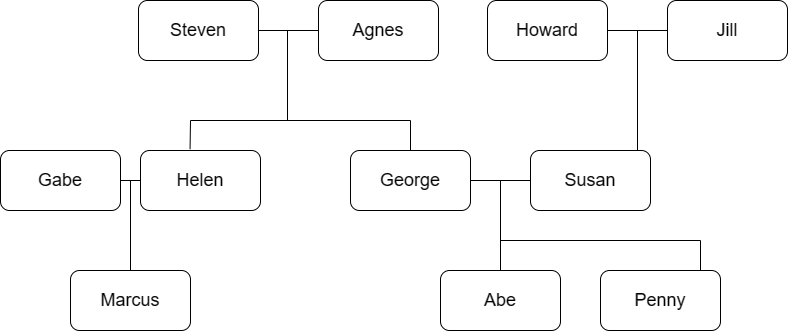
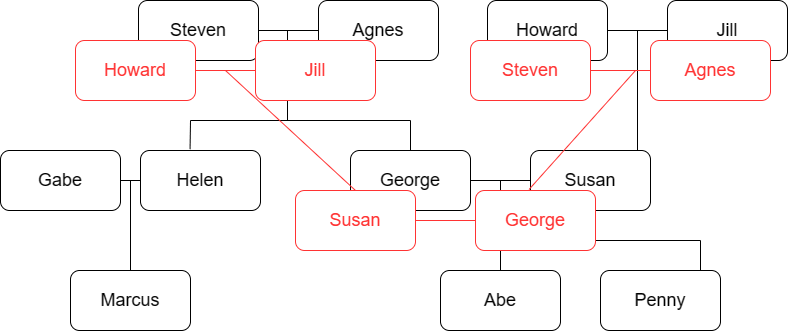
Given this setup, we could piece together the following family tree:
This tree is a visual representation of all the separate facts we get by combining all of our initial information. We can ask our system any number of questions, even ones that go beyond the scope of the original data set, and it can derive answers for them. It will answer yes, no, or uncertain, and so long as our propositions and predicates are all correct, then we can know that any derived answer is also correct. This data is a source of truth because it is based on logically sound principles.
A Twist)
But what if all of our propositions and predicates are all correct…except one? What if among all the truth facts and rules we include just one falsehood? It might occur to you that this would tarnish our confidence in the system, because there would always be a possibility that the answer it gave to us was that one lie. But actually, the effect is far, far worse. It has been proven that introducing just one logical falsehood into a system such as this will make any possible lie seem true. It won’t just be one lie that comes out of the system, it will be all lies. That might seem improbable, but allow me to illustrate.
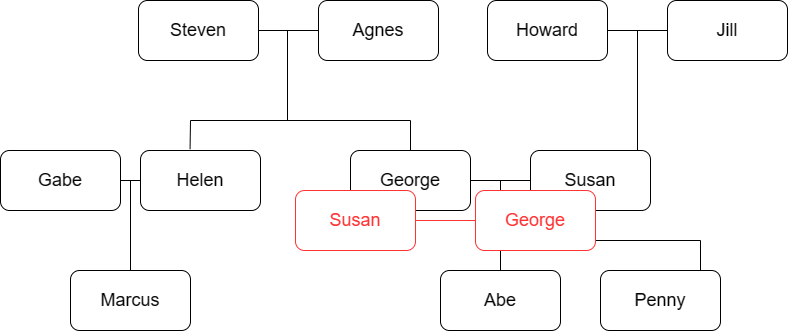
To the system up above I will introduce one logical falsehood. Given the previously established rules, it is impossible for this to be the case, but I am going to enter it as a fact even so:
Susan is Abe's father
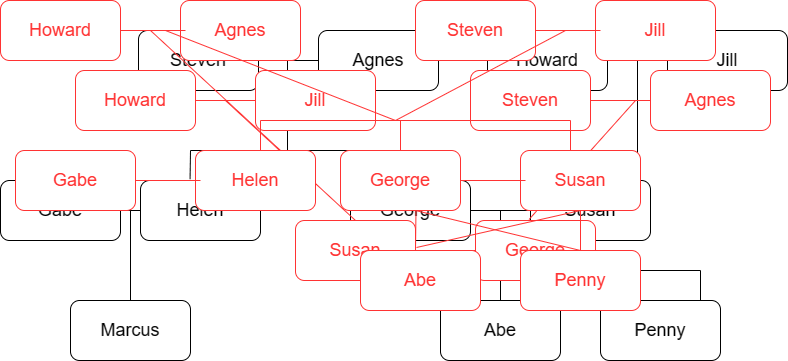
This statement is completely contrary to the logic of Predicate #11, but we add it to our system regardless. This creates a logical contradiction, and now let us look at all the new falsehoods we are able to infer from it. By Predicate #4 we can infer that since since Susan is Abe’s father, then Abe’s other parent, George, must be his mother.
Of course, we previously had derived that Steven and Agnes were Abe’s paternal grandparents, because they are George’s parents. But now that we know that George is Abe’s mother, then they must also be his maternal grandparents. By the same token, Howard and Jill are now no longer only Abe’s maternal grandparents but also his paternal.
Of course, now that we know that Howard is Abe’s paternal grandfather we can combine that with the already-known fact that Agnes is his paternal grandmother, and we can now infer that they are married together, something we never knew before! And by the same token, Steven and Jill are now also married together. Thus all the grandparents are intermarried in some sort of free-love commune! This does have the unfortunate effect of making George and Susan, Abe’s parents, siblings to one another in addition to still being husband and wife! Furthermore, since Abe’s parents are also siblings, then his sister Penny is also his cousin because her mother is the sister of Abe’s father (and her father is the brother of Abe’s mother).
But we aren’t even really going yet! We still haven’t invoked the powers of NOT and ELIMINATION. First let’s consider the NOT. Predicate #10 stated that a cousin is NOT a sibling, and Predicate #11 that a mother is NOT a father. So, since we just proved that Penny is Abe’s cousin, then she is NOT his sibling. Of course, she also is his sibling, since Proposition #4 explicitly says so. Thus, she is his sibling, and she is not. These are both totally valid answers in the eyes of our data set. And Abe’s parents George is his father and Susan is his mother, but also, they are not. And his grandparents are his grandparents, but also, they are not.
And now that we’ve shown that we can prove that the exact same relationship can and cannot exist simultaneously, by ELIMATION we can also prove that every relationship can and cannot exist. So, from the initial data set we know that Abe has a sibling. But who is it? Well, we can go through each member of his family and prove that they are not that sibling. So, let’s do that for every family member except one, Steven, and now we know, by process of elimination, that Steven must be the one who is Abe’s sibling. And by the same process we can prove by process of elimination that it is Agnes, and Howard, and Gabe, and Helen, and George, and Susan, and Marcus. And by the same process they are all his father, and all his mother, and all his aunt, and all his uncle, and all his cousin, and all his grandfather, and all his grandmother.
I’m not going to try to show the family tree at this point, because it is simply all names connected to all other names in every possible way. But also…all names connected to none of the others. Every statement is true. Every statement is false.
Our data set was useful at one point. It was full of true statements, and it could be used to infer many other true statements. But now, after a single lie the entire thing has been corrupted. The only answer it has to provide are “yes, no, maybe, I don’t know…I guess it depends on how you look at it.” It has lost all confidence and isn’t useful for anything.
And sure, this is a rigorous and mathematical system, which is particularly prone to collapsing at the slightest instability. The system in our minds is far more nuanced, able to continue functioning with illogical assumptions and idiosyncrasies…but only to an extent. The same principle does apply to us to at least some degree. Adopt the wrong belief and suddenly every other concrete conviction starts to be undermined by it. People start going through logical acrobatics to try and make incompatible beliefs fit together, corrupting all that was once good and losing the certainty they once had. We cannot accept a lie without somewhat losing our grip on all truth.
5 And he lifted up his eyes, and saw the women and the children; and said, Who are those with thee? And he said, The children which God hath graciously given thy servant.

6 Then the handmaidens came near, they and their children, and they bowed themselves.

7 And Leah also with her children came near, and bowed themselves: and after came Joseph near and Rachel, and they bowed themselves.
Waiting behind Jacob were all of his family, and Esau was anxious to meet them. Originally, I had thought that he had staggered them in order to give the ones in the rear a chance to escape if things went very badly, but it seems they were already much too near for that to have been Jacob’s strategy. Instead, it seems that he had been preparing them for presentation in the event that things went very well. Which, thankfully, they did.
So now Jacob introduces his household, one branch at a time, showing Esau that he has not only grown in age and servants and flock and wealth, but also in family ties. The boy who had left their father’s tent had had nothing and nobody, but he had made his way, and had had come into his own. Evidently Esau had grown as well, able to marshal hundreds of men, a veritable army. Yet he also seems to have grown in his capacity for tenderness of feeling. The two boys had become men.
22 And God remembered Rachel, and God hearkened to her, and opened her womb.

23 And she conceived, and bare a son; and said, God hath taken away my reproach:

24 And she called his name Joseph; and said, The Lord shall add to me another son.
At long last the Lord saw fit for Rachel to conceive a child of her very own. After watching her sister and the two handmaids be able to what she could not, miraculously her womb was opened, and she gave birth to a son.
And Joseph is to become a mighty man, the greatest of all his brethren. Of course, it will be a long road before he realizes that, and first his brethren will despise and betray him. And it has occurred to me that Joseph might have always been the odd-one out because of his unique heritage. There were six sons born of Leah, two of Zilpah, and two of Bilhah. Thus, every one of the boys had at least one blood brother, except for Joseph.
Joseph would be the one and only son of Rachel until many years later. And having been born after all the other ten, he was surely much younger than the first ones. And that’s not all, there is also the fact that he was the favorite son, born of the favorite wife. Thus, there were many factors to isolate Joseph and make him despised of by his brethren, and it is little wonder that he ended up in such a complicated situation with them later on.
20 And it came to pass after these things, that it was told Abraham, saying, Behold, Milcah, she hath also born children unto thy brother Nahor;

21 Huz his firstborn, and Buz his brother, and Kemuel the father of Aram,

22 And Chesed, and Hazo, and Pildash, and Jidlaph, and Bethuel.

23 And Bethuel begat Rebekah: these eight Milcah did bear to Nahor, Abraham’s brother.
Previously we learned about Abraham’s family, which had included his father Terah, brothers Nahor and Haran, and nephew Lot. Terah, Abraham, and Lot had left the land of the Chaldees for Canaan, but Haran died and Nahor had stayed behind. In today’s verses we learn that Nahor had become a father to eight sons of his own, the youngest of which was Bethuel.
These verses may seem like a random aside, but in a couple chapters this information will become very relevant when Abraham’s servant seeks a suitable wife for Isaac, and finds her in Bethuel’s daughter, Rebekah.
It is interesting that Isaac and his cousin Bethuel presumably never met one another. Their fathers parted ways long before they were even born. Yet one’s heritage and kin remain of great importance in the Biblical narratives, and distance and time do not dim the connections one has to their family.
26 And Terah lived seventy years, and begat Abram, Nahor, and Haran.

27 Now these are the generations of Terah: Terah begat Abram, Nahor, and Haran; and Haran begat Lot.

28 And Haran died before his father Terah in the land of his nativity, in Ur of the Chaldees.

29 And Abram and Nahor took them wives: the name of Abram’s wife was Sarai; and the name of Nahor’s wife, Milcah, the daughter of Haran, the father of Milcah, and the father of Iscah.

30 But Sarai was barren; she had no child.

31 And Terah took Abram his son, and Lot the son of Haran his son’s son, and Sarai his daughter in law, his son Abram’s wife; and they went forth with them from Ur of the Chaldees, to go into the land of Canaan; and they came unto Haran, and dwelt there.
The genealogical verses aren’t the most exciting passages of scripture to me, and I usually skim past them to get to the actual stories. But this time I at least paid attention to the relationships around Abraham, and it was fascinating to gain some context for his story.
Here we meet Terah, who has three sons: Abram (later Abraham), Nahor, and Haran. Haran died earlier than the rest, but he had a son named Lot, who became a sort of stand-in for his father. Throughout the rest of the record we hear about him as if he was the third brother: Abram, Nahor, and Lot.
Haran also had a daughter before he died, named Milcah, who married Abram’s other brother, Nahor. Nahor and Milcah later had a grand-daughter named Rebekah, who would become the wife of Abram’s son Isaac. In later chapters we will also have revealed to us that Sarai was actually Abram’s half-sister, the daughter of his father Terah, but not of his mother.
I’ve never before given so much consideration to Abram’s family before. I didn’t reflect on the fact that he was a son and a brother, and that those ties affected him throughout the rest of his tale. In fact, his story begins as that family splits up. Terah, the father, leaves for Canaan with Abram and Lot, but Nahor stays behind.
At this point a place called Canaan may not sound very significant, but we’ll be hearing a lot about it later on. It is to be the home of the Israelite kingdom after they flee Egypt, and the majority of the Biblical narrative takes place there. For now, though, the family doesn’t quite make it to Canaan. They stop instead at the nearby city of Haran, which has the same name as Abram’s deceased brother, but I don’t know whether the two are connected.
But behold, the Jews were a stiffnecked people; and they despised the words of plainness, and killed the prophets, and sought for things that they could not understand. Wherefore, because of their blindness, which blindness came by looking beyond the mark, they must needs fall; for God hath taken away his plainness from them, and delivered unto them many things which they cannot understand, because they desired it. And because they desired it God hath done it, that they may stumble.
COMMENTARY
But behold, they despised the words of plainness, and sought for things that they could not understand. Their blindness came by looking beyond the mark. I have already mentioned how we make the mistake of seeking greatness through worldly possessions and fame, usually because that path seems more accessible than the overcoming of self necessary for spiritual enlightenment. There is yet another way that our desire for greatness can become misaligned, though. As we see in today’s verse, that way is to “look beyond the mark.” I have known those that were caught up trying to achieve some great and important thing, even a spiritual thing, all while leaving the fundamental things that mattered most undone. There was a funeral for a man whose church members came to attest what a volunteering and sacrificing person he had been, how he had always been willing to pitch in and help wherever another member of the congregation needed it. The family of the man responded by saying that was nice, but they had never known such a person in their own home. In their life he had been an entirely absent figure, too busy taking care of things that were “more important” than his own family. We must be careful that we do not become so obsessed with finding greatness that we fail to see the opportunities for it right in front of us. Continuing with the example of one’s own family, it is all too easy to say “many people in this world have their family, so there isn’t anything particularly noteworthy about that.” Then we might take that sector of life for granted, and look for something more unique to satiate our desire for greatness, forgetting how rare a truly happy family is in this world, and how long-reaching an investment in the home is to the lives of those that were blessed there. As each of us seeks our own personal greatness, we ought to pause several times to consider if there is any greatness already before us that we have been overlooking because of our vanity.
 Spiritual Wanderings