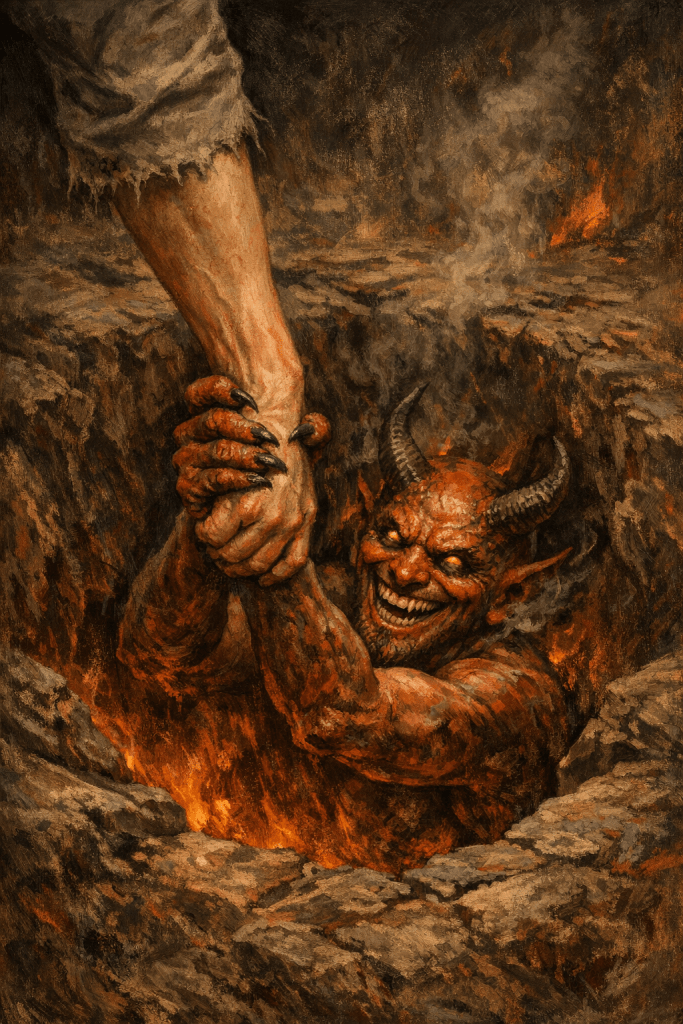
The Devilish Deflection

Anything that follows these statements is devilish and designed to harm mankind.

  • “Yes, I know that’s the commandment, but…”
  • “Yes, that is true, but…”
  • “Yes, that’s what the scriptures say, but…”

Whatever the following justification is, it probably sounds very nice, though. It probably invokes certain virtues. But it is still authored by Satan. For anything that would excuse against God’s word cannot be of God. Anything that would justify sin has to be of the Devil.

And given our particular upbringing, that might be hard to accept. We may have been indoctrinated by our society such that we cannot see God’s word as being for the best, and yet in the full perspective of things it always will be. And the excuses that takes us away from His word might sound for the best, but in the full perspective of things they will always cause pain and suffering.

Scriptural Analysis- Leviticus 9:23-24

23 And Moses and Aaron went into the tabernacle of the congregation, and came out, and blessed the people: and the glory of the Lord appeared unto all the people.

24 And there came a fire out from before the Lord, and consumed upon the altar the burnt offering and the fat: which when all the people saw, they shouted, and fell on their faces.

Here we have the only private moment in the ritual, where Moses and Aaron enter into the tabernacle and disappear from the view of all of Israel. Not only was it not seen what transpired in there, it isn’t described in the instructions given to Moses for this moment. At the very least, it seems likely that Moses and Aaron would have gone through the inner-tabernacle rituals, such as lighting the lamps, burning incense, arranging the shewbread, and sprinkling blood. Did Aaron also commune with God directly? Did he speak with God face to face, as Moses had? We do not know. This moment has been kept private from all the world, just as our most sacred moments are typically kept private.

We do know that after they emerged, God responded in a grand show of divine approval. A heavenly flame went forth and consumed the offerings upon the altar. A few chapters ago we heard that the flame of the altar was never to go out. Fresh fuel had to be added to it in perpetuity. It seems that the flame that they had to keep burning was this same divine flame! This is obviously symbolic of the divine flame that lives in each of us, put in us by the grace of Christ, but which must be regularly nourished.

The significance of this miraculous flame is clear. When the Israelites had finished the construction of the tabernacle, the cloud of the Lord covered it and His presence claimed and accepted it. But that had just been the acceptance of the physical structure. Now God is accepting the priests and their labor. Thus, the body of the tabernacle and its soul are deemed acceptable to the Lord, and what transpired there would be imbued with His authority.

Scriptural Analysis- Leviticus 8:18-21

18 And he brought the ram for the burnt offering: and Aaron and his sons laid their hands upon the head of the ram.

19 And he killed it; and Moses sprinkled the blood upon the altar round about.

20 And he cut the ram into pieces; and Moses burnt the head, and the pieces, and the fat.

21 And he washed the inwards and the legs in water; and Moses burnt the whole ram upon the altar: it was a burnt sacrifice for a sweet savour, and an offering made by fire unto the Lord; as the Lord commanded Moses.

In our last post we had the sin offering as part of the consecration process of Aaron and his sons and priests, and today it is immediately followed by the burnt offering. Thus, the spiritual sequence for the priests was to first give up their sinful ways, and then to give their lives to God. Tomorrow will move on to the consecration offering, which completes the journey, and represents oneness and unity with God. That is the entire gospel journey in three simple steps.

And notice, that even though these rituals have been fulfilled in Christ, the underlying path still remains the same. Repentance for sin, surrender of self, and unity with God are still the path of discipleship even today. Not one jot or tittle has passed, only the manner in which we interface with that underlying pattern.

The ancient Israelites were not a people so different as we might think. We have more in common with them than not. And, most importantly, at the fundamental level we are identical. Just like them, we still are afflicted by sin. We still struggle to surrender our will to God. We still suffer from separation from the Almighty. We still need sacrifice, surrender, and grace to overcome those challenges. We are still God’s children, and He is still our Father. The path for us to follow has always been there, unchanged. The unique details of modern life are but surface periphery, meaningless vapor in the wind, while He remains a constant through it all.

Scriptural Analysis- Leviticus 8:6-9

6 And Moses brought Aaron and his sons, and washed them with water.

7 And he put upon him the coat, and girded him with the girdle, and clothed him with the robe, and put the ephod upon him, and he girded him with the curious girdle of the ephod, and bound it unto him therewith.

8 And he put the breastplate upon him: also he put in the breastplate the Urim and the Thummim.

9 And he put the mitre upon his head; also upon the mitre, even upon his forefront, did he put the golden plate, the holy crown; as the Lord commanded Moses.

We already discussed the symbolic elements for each individual piece of the priestly vesture when we first read about them in Exodus. Today let us consider the significance of clothing as a general rule. Clothing has always been a symbol for taking on an identity, for becoming someone. Wearing clothes is like putting on a second skin or entering into another person.

As pointed out in yesterday’s post, Aaron and his sons were officiating in the place of Moses, and by extension, of God. Thus, Moses was enclothing the priests with himself and with the Lord. When the priest performed in his office, personal failings or scruples with other Israelites would need to be set to the side. It wouldn’t matter what you thought of Aaron or what he thought of you, because Aaron wasn’t really the one leading you through the ritual, God was. And you were reminded of that fact by seeing Aaron in these godly clothes.

Another universal symbol of clothing is uniformity. When people wear exactly the same articles, as the priests did, that would further reinforce the notion that these were not individuals anymore. They were one and the same: God. There was no advantage to being serviced by this priest, rather than that one, because the same clothes, therefore the same identity, therefore the same God, was through it all.

What Darkens the Soul


You will at times be selfish. You will be unwise. You will believe wrong things. You will hurt those that you love. You will give in to fear. You will judge wrongly.

None of this is good, but it is common and accepted. Many of these sins will be committed without thought, without meaning to do wrong, but afterwards realizing that your behavior went astray. Do not worry. Christ has atoned for all of these and obtaining forgiveness is easy.

Much more significant are the moments where God has already granted you clarity, where you have a sure understanding of what is right, and you sin against that knowledge anyway. You feel the full weight of your conscience, and you defy it anyway. And you do so because following your conscience would come at great personal cost. You learn that your soul has a price, and you have just exchanged it for that price.

These are the moments that truly defile you. These are the infractions that darken the soul. These are the choices that sin against the light. These are the times that lead to true damnation.

Of course, even here, repentance is possible, but it will be at an even greater cost than what you first sold your soul for. You must go back and correct the very choice you made wrong, and the consequences for doing right will be even higher now. It will hurt, you may be sure of it, but you may also be sure that it will be worth it.

Scriptural Analysis- Leviticus 6:27-30

27 Whatsoever shall touch the flesh thereof shall be holy: and when there is sprinkled of the blood thereof upon any garment, thou shalt wash that whereon it was sprinkled in the holy place.

28 But the earthen vessel wherein it is sodden shall be broken: and if it be sodden in a brasen pot, it shall be both scoured, and rinsed in water.

29 All the males among the priests shall eat thereof: it is most holy.

30 And no sin offering, whereof any of the blood is brought into the tabernacle of the congregation to reconcile withal in the holy place, shall be eaten: it shall be burnt in the fire.

I discussed yesterday how the animal to be sacrificed not only stood in for the sinner but was also symbolic of purification as well. Today’s verses continue to make that dual meaning even clearer. It is a symbol from man of what is wrong, what he must give up, but it is also a symbol from God of what is right, what He gives to us out of mercy. How fitting a duality, given that it is in our broken and wrong places that so many of us truly discover the Lord.

Verse 28 emphasizes the purifying quality of the sacrificed animal in an interesting way. It talks about how if a clay pot held the meat at any point, it must be broken, whereas a brass pot could be reused, though it had to be scoured first. Some scholars have suggested that this scouring was not about removing impurities from the brass vessel, but to removing purity. The brass pot had to be reclaimed them from its exalted state to one of regular, earthly use, whereas the clay pot had to be broken was because its material was porous, thus the residue holiness couldn’t be scrubbed out.

That interpretation might be accurate, though I see another possibility as well. Perhaps the two different treatments were symbolic of the differing effects that God’s purification has on His children. Some people receive the purification of God as a condemnation because they are still united to their sin, thus the purifying process breaks them. It would make sense that cruder, “earthen” vessels would be used to symbolize that. Meanwhile, the other effect of God’s purification is that those who are already more aligned to Him survive and become improved by the experience. That is represented by the more durable, refined brass pot.

And, of course, this pattern continues fractally. Even inside the righteous soul that survives God’s purification, there is still the part that is broken and the part that is improved. Both exist within the same person. Part of us is shattered and discarded when we meet the Lord, but part of us finally comes into its own and shines.

Scriptural Analysis- Leviticus 6:19-23

19 And the Lord spake unto Moses, saying,

20 This is the offering of Aaron and of his sons, which they shall offer unto the Lord in the day when he is anointed; the tenth part of an ephah of fine flour for a meat offering perpetual, half of it in the morning, and half thereof at night.

21 In a pan it shall be made with oil; and when it is baken, thou shalt bring it in: and the baken pieces of the meat offering shalt thou offer for a sweet savour unto the Lord.

22 And the priest of his sons that is anointed in his stead shall offer it: it is a statute for ever unto the Lord; it shall be wholly burnt.

23 For every meat offering for the priest shall be wholly burnt: it shall not be eaten.

In addition to the burnt offering of a lamb, once every night and once every morning, there was also to be a meat offering of flour every night and morning. The flour was to be baked first, then burned as a bread or a wafer until fully consumed.

We have already heard that when the meat offering was from a common Israelite, there was a portion given to the priests. But since the meat offering described here was from the priests themselves, there was no portion for them, and all of it was given to the Lord. There can be seen in this a hierarchy, a flow, moving upwards and ultimately finding its destination in God. Just as God is the originator of all things, He is the terminus of all things as well.

All of our creations stem from the first creation made by God. And all of our sacrifices ultimately find their rest in Him. We come and go as links in a chain. At the beginning of the chain is a post, and at the end of the chain is a post, and both posts are God.

The Death of the False Self

Perhaps the greatest obstacle to God winning our souls is that true conversion requires an interaction with the genuine self. And we, being a highly social and impressionable species, very rarely exist as our genuine self. Most of us spend our lives as a collage of other people’s thoughts and beliefs and attitudes. We hear a question, and we immediately know the pre-scripted answer that we have been told by others. God reaches out to us, but all He finds is fragments of Darwin, Nietzsche, and Oprah.

And so, before God corrects the false image we have of Him, He first must shake loose the false image we have of our own self. He thwarts our pretend identity. He puts us in situations where our pale imitations and our tired platitudes fail spectacularly. He does for us what He did for Abram, and Jacob, and Saul, stripping us down and leaving us barren, and lame, and blind.

Seek the death of the false self. Unearth the real you. Learn how to think outside the catechisms that you have been given. Only then will you be able to find your real identity, like Abraham, and Israel, and Paul. Only when you have the real you can a proper introduction be made between you and the Father.

Overwhelming Passion

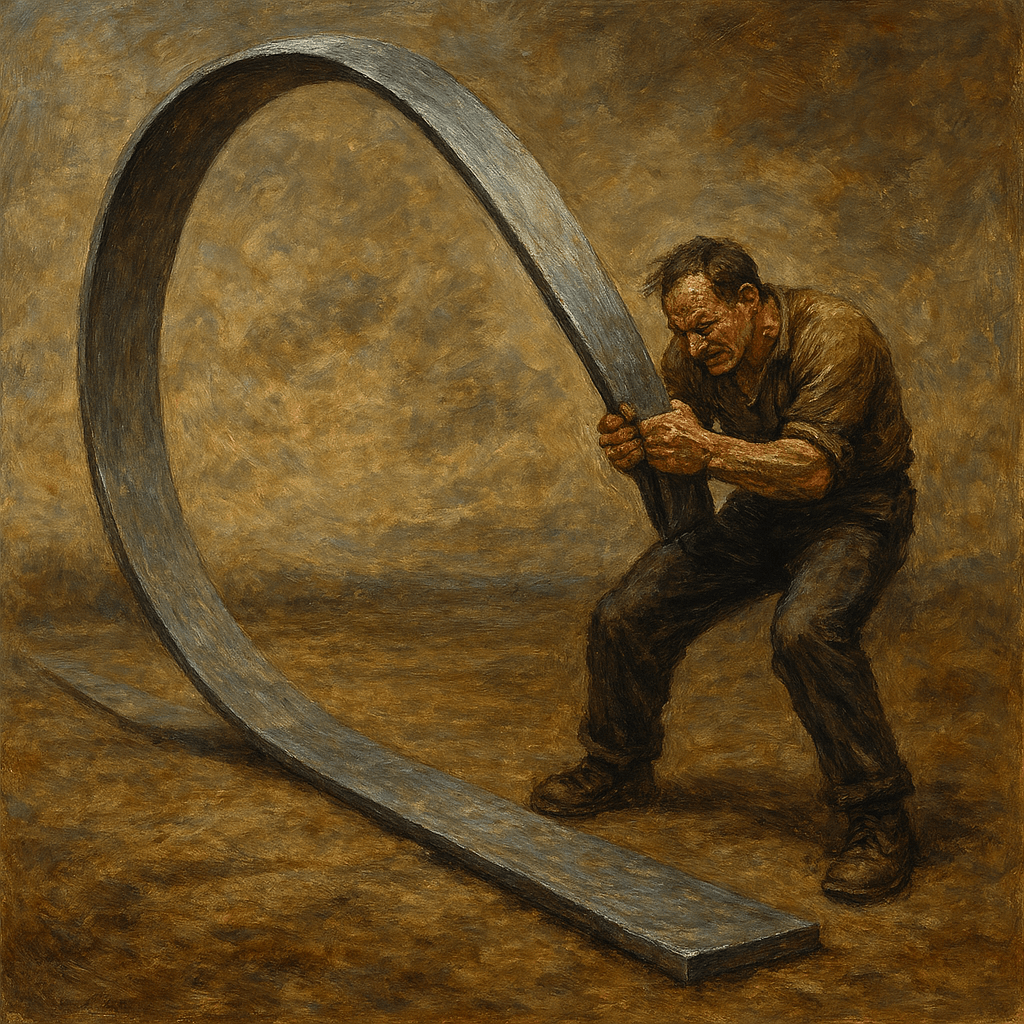
We have many stories of people who are in want of strength, who plead for the Lord to empower them for the task ahead, and so it is in some cases. However, many of us carry a burden that is exactly the opposite. We have been given a passion that is too powerful for us to handle on their own.

If we turn that passion to self-indulgence it damages us with its overpowering stream. if we try to ignore it, it builds up pressure until it bursts out in painful ways. This passion could be a great gift, but it will instead be a great danger if we never learn what to do with it.

God gave us this passion so that we are meant to do with it is pour it back into Him. He is not only the well that forever gives He is also the well that can forever take. Only into Him can we safely disperse our passion, our energy, and our drive, and not be harmed by the flowing power.

We were never designed to operate on our own. God made us with oversized hearts so that we can fit the extra parts into Him.