6 Moreover he said, I am the God of thy father, the God of Abraham, the God of Isaac, and the God of Jacob. And Moses hid his face; for he was afraid to look upon God.
After giving Moses the instructions to remove his shoes, God introduced Himself more fully. He explained that He is God, and not just any “god,” but the God of Moses’s forefathers. The interaction of the Lord with Abraham, Isaac, and Jacob were, of course, the thing of legend, and Moses’s reaction to joining that same association was one of deep humility, even fear.
Throughout the scriptures we see that whenever Lord enters such an intimate closeness with a child, it is because He is about to give them a calling that will consume the rest of their life and change countless souls around them. It was the case for the patriarchs, and it was certainly the case for Moses as well. There is an incredible gravity to these moments, and whenever they show up in the scriptural record one may know that whatever comes next, everything is about to change!
5 And he said, Draw not nigh hither: put off thy shoes from off thy feet, for the place whereon thou standest is holy ground.
There is much to be discussed about God’s command that Moses not come any nearer until he had first “put off the shoes” from his feet. For starters, this illustrates that there are conditions to enter God’s innermost circle. Some things in the gospel have no conditions upon them, they are given freely to all, such as the gift of life and having the spirit of Christ within us, but other things do have conditions. If we are to dwell in the full glory and holiness of the Lord, there are preparations that we must all perform.
This leads into a second point, which has to do with the fact that Moses was performing a ritual with God. He was learning a specific manner of dress and behavior, a certain way of conducting himself with the Almighty. This foreshadows the exhaustive detail that Moses will give to the Israelites for the dimensions of the tabernacle, the ornate instruments to be housed therein, the dress and decorum of its priests, and the appropriate offerings to be made there. Ritual would become a hallmark of the Law of Moses, and we see him being inducted into its patterns here in this verse.
A final point worth considering is why God commanded Moses to remove his shoes. One reason might be that shoes tend to be the hardest article of clothing that we wear, preventing one from treading softly. They also tend to be the dirtiest article of clothing, carrying all the dust and dirt from everywhere that we have been. Taking off the shoes can therefore be symbolic of setting aside our sins and our hardness, proceeding forward as gently and cleanly as we can. We remove our burdens so that we can better come to God. The symbolism of shoes and feet will return at various times throughout the scriptures, such as when Jesus cleans the feet of his disciples, and in many of these instances the symbolism remains consistent.
1 Now Moses kept the flock of Jethro his father in law, the priest of Midian: and he led the flock to the backside of the desert, and came to the mountain of God, even to Horeb.
2 And the angel of the Lord appeared unto him in a flame of fire out of the midst of a bush: and he looked, and, behold, the bush burned with fire, and the bush was not consumed.
3 And Moses said, I will now turn aside, and see this great sight, why the bush is not burnt.
4 And when the Lord saw that he turned aside to see, God called unto him out of the midst of the bush, and said, Moses, Moses. And he said, Here am I.
There is special symbolism in Moses’s new occupation being that of a shepherd. This is a type for Christ, and also a foreshadowing for the future role that Moses will have in guiding the Israelite masses. He is learning how to herd a multitude of sheep, in preparation for herding a multitude of people.
I also think it is notable that Moses was simply going about the duties of his day-to-day life when the burning bush appeared off to the side. This seems to be how it plays out for must of us. We’re just living our little lives as best we can, when suddenly a glimpse of something greater catches our eye, and we are invited to step into a much bigger story. We can ignore it if we want, continuing on a pre-appointed path, or we can make a diversion to see what this bigger story is.
And that is what Moses did. Noticing a miracle, he decided to “turn aside,” change his predetermined course, and get closer to understand. There is a basic faith in this, a willingness to give up original plans to seek divine holiness. If Moses had instead been too absorbed in his sheep, he would have missed this call to liberate and lead the people of Israel.
And notice what verse 4 tells us: God saw Moses turn. God was watching closely and took special notice of this shift in Moses’s intention, and apparently this was the prerequisite to God speaking to him. For no sooner does Moses turn then God calls out. Moses’s answer has special significance, too. By saying “here am I,” he is not only declaring his physical location, but also that he is present and ready in his soul. God is calling for all of Moses, and Moses is saying “here am I.”
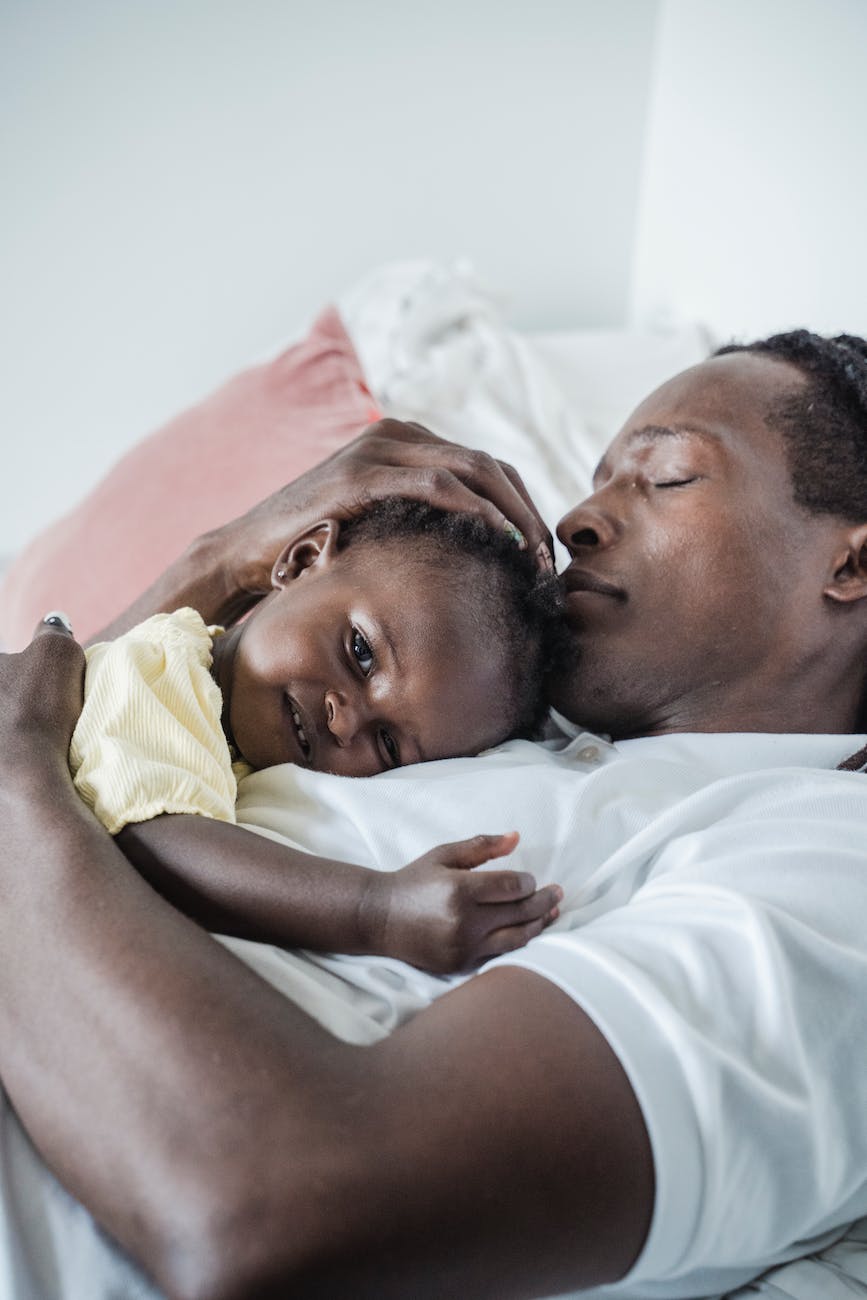
I had a tender moment yesterday with my three-year-old daughter. She had an ear infection and my wife had scheduled an appointment to go and get a prescription, but in the meantime she was irritable and sad. I had a few minutes of break from work, and I saw her moaning on the couch and asked her if she would like me to hold her. She nodded, so I sat down, put her on my lap, wrapped my arms around her, and gently rocked back-and-forth. She gradually started to breathe more deeply, relaxed into my chest, and stopped her fussing. She was calm and content in her daddy’s arms. I have learned from past experiences that it is also helpful in these moments to show some attention to the little details, such as noticing if her fingers are dirty and meticulously cleaning them with a washcloth, one-by-one.
The thing that stood out to me from this most precious moment was that I didn’t even resolve her underlying problem in the slightest! I couldn’t hurry up her doctor’s appointment, and her ear infection wasn’t reduced in any way by my holding and rocking her, but she was comforted still the same.
I realized that it is very much the same with me. I have had sacred moments where I was able to let go of everything else and just be held by my Heavenly Father. I have felt connected to Him as He showed awareness and attention to the littlest of details, washing my hands meticulously and methodically. And when all was said and done, He usually didn’t take away the issue that was originally distressing me, and there was still a process ahead of me to overcome it, but that was okay, because I felt comforted and cared for in the moment, and that was all I needed to keep moving forward.
Individual notes might have a beautiful resonance, but if they stand alone they seem random and purposeless. It requires as an external composer who can arrange them in a sequence for them to have a greater function and beauty. Each note knows nothing of the greater song, yet each is essential to it.
So it is for the stars in the heavens. Individually each is beautiful, but if separated from the rest there are no constellations, no signs of the seasons, no greater whole in the heavens. The full picture only comes when all are taken as a whole, but the whole can only exist because of the individual contribution of each member.
And so it is also for us and the good that we do. We do not know the greater song, the greater sign that we are a part of. We try to live good lives, we try to help where we can, we try to make something beautiful, and each of our efforts are worthy in their own way, but they tend to be localized and short-lived. But if we could see how all of our small, random efforts were being combined and arranged alongside of one another, we would realize that a great author and composer has arranged us with purpose and intent, forming a crescendo, a constellation, a beautiful, greater whole.
Now and again, if we are lucky, we occasionally catch the smallest glimpse of the larger picture, just enough to convince us that there is a symphony and a shape formed through all of humanity. That greater whole surpasses each individual part, but it can only exist because of each individual. I am sure that when we pass over to the other side we will finally be able to appreciate the finished work at a distance, and we will find closure in knowing the vast beauty we were all a part of.
23 And it came to pass in process of time, that the king of Egypt died: and the children of Israel sighed by reason of the bondage, and they cried, and their cry came up unto God by reason of the bondage.
24 And God heard their groaning, and God remembered his covenant with Abraham, with Isaac, and with Jacob.
25 And God looked upon the children of Israel, and God had respect unto them.
The tyrant Pharaoh passed away, but the new king continued the same oppression of the Israelite people. I can only imagine how discouraging it must have been for the Israelites to see their bondage continued under a new master, for the persecution persisting from one generation to the next established a pattern, one that would crush any expectation for it to ever be repealed by a decree of man. Thus, the Israelites only remaining hope would be in an act of God.
And so, in verse 23, we hear how they raised their cry to the heavens, and God, we are told, heard them and “had respect unto them.” Of course, the fact that He had respect to them may not have been appreciated at the time. It was likely only afterward, in hindsight, that the people came to appreciate how God was already putting together His plan of deliverance. How often do we also cry to the Lord, wondering why He seems slow to respond, when really His other hand is already preparing our salvation?
I recently considered the markers we use to identify ourselves when meeting someone new. The most common descriptors seem to include what our work is, where we are from, what our race/heritage is, what religion we belong to, and what our family situation is. Of late, there has also been an increase in identifying oneself by one’s sexual and gender identity.
But why are these the sorts of markers that we use? Do these really represent the most fundamental qualities of a person? If I told you what I do for work, does that really tell you much about how I think and feel? If I disclosed my sexual preferences, would that really give you an accurate window into my soul?
I don’t think so. In my experience, most of these categories have little, if anything, to do with who a person is at their core. Really, I think we only use these because they tend to represent the smallest minorities that we belong to. The mentality seems to be “if you know what is most unique about me, you will know who I really am,” but I think this is a false assumption. Sometimes, it is the broadest of definitions that actually get the closest to the truth.
For example, the identification that I am “a son of God,” hardly puts me into a minority, but it is much more fundamental to who I really am. Descriptions like “I am a Software Developer,” or “my family is from Norway,” put me into smaller buckets, but those buckets are pretty shallow. Being “a son of God” has me in a bucket that is very wide, but also very deep.
I think it is therefore more useful to take those broader, wide-bucket categories, and then go deep with them. If I really wanted to introduce myself in a way that gave people a window into my soul, I might say something like “I am one of God’s creations, and I, in turn, share my Maker’s passion for creating new things. And not only am I a creation, but also a re-creation. I am one who has been redeemed by Christ, brought back from an addiction and loneliness that I thought I would never see the end of.”
1 Now these are the names of the children of Israel, which came into Egypt; every man and his household came with Jacob.
2 Reuben, Simeon, Levi, and Judah,
3 Issachar, Zebulun, and Benjamin,
4 Dan, and Naphtali, Gad, and Asher.
5 And all the souls that came out of the loins of Jacob were seventy souls: for Joseph was in Egypt already.
6 And Joseph died, and all his brethren, and all that generation.
7 And the children of Israel were fruitful, and increased abundantly, and multiplied, and waxed exceeding mighty; and the land was filled with them.
Exodus takes a step backwards and recaps some of the information that we had at the end of Genesis. It reiterates all of the sons of Jacob who lived with him in Egypt, it reminds us that there were seventy descendants in their party, and it reminds us of the passing of Joseph.
Not only Joseph, though, it further extends the narrative to state that all of that generation were passed away. This truly marks the end of an era. The age of the patriarchs is officially closed and now begins the time of the Israelite nation.
Seventy descendants might make for a large family gathering, but hardly an entire civilization. Verse 7, however, shows that the Israelites “increased abundantly,” even to the point that “the land was filled with them.” Let us remember that this is the fulfillment of a promise that God had been making to the patriarchs ever since Abraham: that they would become a great nation. The fulfillment of other promises is still to come, but this is the one upon which all those others was predicated. At times the fulfillment of this promise appeared quite uncertain, as Abraham’s lineage remained a very small population in danger of extinction at every turn, but in this verse we see that God proved faithful through it all.
But while this represents one step forward, we are of course about to hear about another string of setbacks, enslavement and genocide, making the success of Abraham’s descendants uncertain once more. Yet again, faith will be required, the Israelite nation will be the perpetual underdogs, and they will have to depend on God’s salvation at every hand.
We do not have the power to make God’s good day bad. We can tarnish ourselves, but not all the beautiful creation that surrounds us.
And for this reason, whatever else is going on, whatever the depth of our personal unworthiness, we can still take a step back and bask in God’s goodness.
For he maketh his sun to rise on the evil and on the good Matthew 5:45
I have spent quite a while examining different reasons for why one should live in accordance with the truth, and I have been calling out the ways that we try to excuse ourselves from doing so. Hopefully each one of us will be convinced at some point that we must live in harmony with fundamental truth, aligning ourselves to the universal good.
But, even if we do come to this conviction, we may find a new question that takes its place. It is the same question that Pilate famously posed to Christ: “What is truth?” It seems that the answer to that should be obvious, but any serious examination on the matter will soon uncover a few issues. Most particularly, we will likely find it difficult to distinguish what is THE TRUTH from merely “my truth.”
Consider that many of us hold different principles inside of us that we identify with the truth. Two men confronted by the same injustice might be stirred by their conscience to two different actions. One of them might feel called to meekly endure the offense, remaining patient and longsuffering. On the other hand, the other man might feel compelled to stand up for what is right and challenge the oppressor. Frankly, neither of these reactions feels fundamentally wrong to me. Perhaps towards less severe injustices the passive response seems more fitting, and towards grievous injustices the bold response, but there is a great deal of overlap where either seem entirely appropriate, and I would not call any person wrong for behaving one way or the other. But at the same time, in a single person each response is mutually exclusive to the other. So which way is actually correct?
Furthermore, two men acting in sincere accordance with their conscience is one thing, but what about the issue of us misidentifying our wants with our conscience? I’m sure we can all call out social movements that claim to be based in truth and conscience, but which are clearly just justification for selfish and immoral practices. Making matters even more complicated, while sometimes we know in our hearts that we are being dishonest, most often we really do delude ourselves into thinking that our own personal wants just happen to align with what is cosmically right. How can I recognize what is actually true, and what is just me trying to get my own way?
A Point of Reference)
Both of the issues that I have presented are a result of defining the truth locally. If each person is let alone to define their “own truth,” then there will be as many distinct truths as there are people. We will probably each settle on some genuine pieces of conscience, but also much that is colored by personality or selfish desire. Aligning ourselves with “our truth” will therefore disappoint us, both on a personal and universal level. On the personal level, it will disappoint us because we will come out looking very much the same as who we already are. We will not have any sense of transcendence, of having been called up and made into something new and better. On the universal level, we will never have unity and common purpose. We will remain entrenched in embittered battles against one another, everyone convinced of their own rightness above all others.
If this enterprise of humanity is to move forward, then there absolutely has to be some underlying, fundamental truth established outside of all of us that we can each defer to. There has to be an external truth that is real and consistent, so that we may all come into union when we separately align ourselves to it. If the truth is defined by a person, or if it is shifting in its nature, then we will never find harmony with either conscience or community.
If, however, we do settle upon a universal truth that exists outside of us all, then both of the issues mentioned above are resolved. Now we have a standard that all other “self-truths” can be compared against. Selfish desires, misinterpreted as truth, are immediately recognized as such and discarded. Also, in the example of the two men choosing differently, but according to their genuine conscience, it is possible that the universal truth is broad enough to harmonize with both decisions. While the universal truth will certainly never contradict itself, it does seem reasonable to me that it could allow some range of individual, moral choice within its domain.
Is it any wonder, then, that the bedrock of every civilization has been religion? Be it the Bible, or the Quran, or the Torah, or the Bhagavad Gita, or the words of Buddha, each culture has composed itself around words that are said to have descended from on high. They might have come through the mouths of prophets and sages, but they are not interpreted as the words of those prophets and sages. They are understood to be the words of the external, of the divine, of God in some form or another.
Cultures that detach themselves from sacred truth do not remain cultures for long. As a society they break apart and become an anarchy. As individuals they become stunted and cease to improve their situation. They lag behind the rest of the world, both technologically and ethically, and they are soon destroyed by the whims of the world.
So, going back to our idea that only the life founded upon the truth is free, even after we accept this fact we still have to identify what the truth really is. And in order to do this, we’re going to have to find a source outside of ourselves, and outside of any other person. At some point we’re going to have to find God and discover THE TRUTH for ourselves. Choosing to found ourselves upon the truth is therefore no mere decision that we make once in our current place and then have the matter resolved. Choosing to be founded upon the truth means deciding to go on a great journey. It is a quest of exploration, discovery, and refinement, and it will last us the rest of our lives and then some!