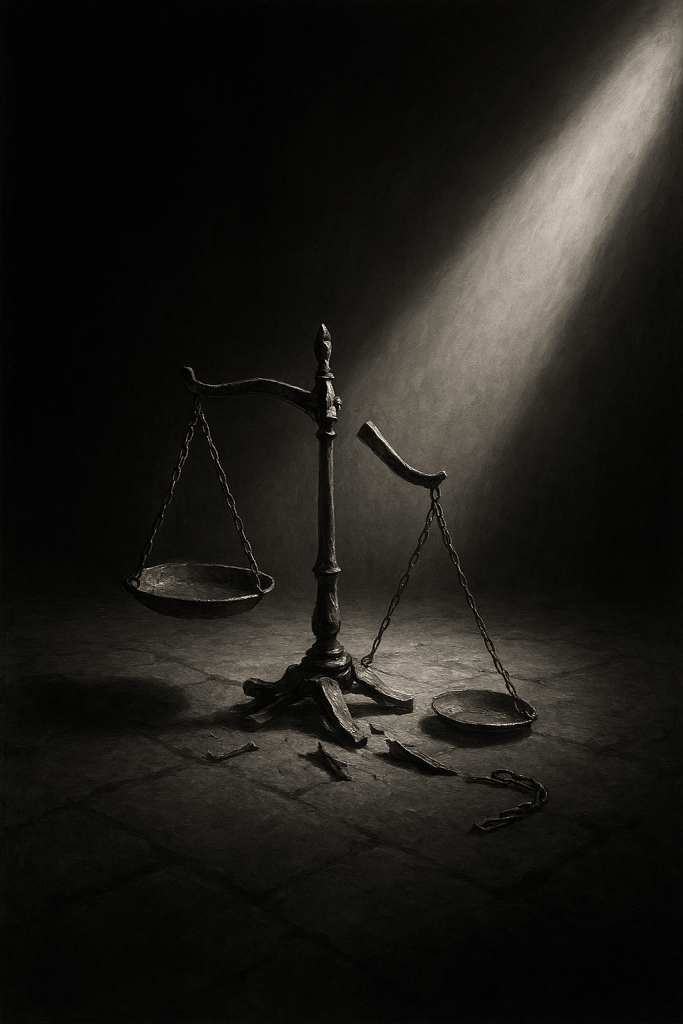
Less bad, is still not good
There can be no compromise in matters of conscience

Less bad, is still not good
There can be no compromise in matters of conscience
I’ve spent the past two days discussing the tendency of those that feel wrong to try and tear down those that seem right. The reason for this is that the very existence of the holy is a testament against the impure. The holy prove that moral living is possible, and that it is better, which means that the immoral are worse and deserving of blame.
This pattern is nothing new. To his friends Jesus foretold, “If the world hate you, ye know that it hated me before it hated you. If ye were of the world, the world would love his own: but because ye are not of the world, but I have chosen you out of the world, therefore the world hateth you,” (John 15:18-19).
To his enemies Jesus said, “Ye seek to kill me, because my word hath no place in you. Ye are of your father the devil, and the lusts of your father ye will do. He was a murderer from the beginning,” (John 8:37, 44).
The children of the devil seek to destroy Jesus and also hate those he has chosen. Thus, the impulse of the wicked to destroy the righteous is nothing more than an extension of the devil’s desire to destroy God.
This animosity isn’t just political, and it isn’t isolated to one instance. What we see in our private lives is but a fractal strand of a war that is cosmic and universal. There are branches of this struggle that are relatively low stakes, such as when the awkward child tries to tear down his more successful peer, but it is the same spirit behind it that would murder a God.
The immoral want to destroy the moral because evil wants to destroy good. Meanwhile the good, if they are truly good, emulate the God at their root and seek to redeem the wicked.
Just as these cosmic, eternal forces have fractal strands woven into our society, so too, there are strands woven into our own selves as well. There is an agent of evil within us that seeks to tear down our good parts, because those good parts remind us that there is a better version of us inside, and that we are not meeting our full potential. And there is that agent of good in us that seeks to redeem the evil part and raise it to its holy potential. As we learn to find the right solution within ourselves, we will learn how to find it in our society, and our society will join God in His solution for the entire universe.
We are all part of one cosmic ritual or another, and the outcome that we support in the eternities is echoed in the outcome we seek in ourselves.
Yesterday I spoke about how children who are socially insecure can try to tear down those who are confident, because they hold up a mirror to the insecure children’s flaws. But as the years go by, what might be nothing more than teenage angst, gradually evolves into something deeper. Even, something evil.
Most of us come into evil by simple selfishness. A neighbor is looking for help with some yardwork, and we discreetly make plans to be out of town that morning. Upon seeing a traffic lane slowing down, we might swerve into the next, cutting off the driver behind. We disparage the “other side” for their idiocy, enjoying the moral superiority that that brings. We want what they want, and we only deviate from our predetermined path when it serves our own interest.
And then, inevitably, that same selfishness leads to doing something objectively wrong. The commission of a mortal sin. Something truly damning, which far more than the teenage awkwardness discussed in yesterday’s post, is something that we tend to shrink from, to try and not face up to in our own heart.
And to soothe our conscience on the matter, we tell ourselves that everyone is “looking out for number one.” Everyone takes the advantage when it is presented to them. Everyone holds a grudge. Everyone is selfish. Everyone has a serious sin hidden inside. We become suspicious of those that appear to defy these universal assertions, assuming that the so-called good are really just hypocrites and liars, pretending to be holier-than-thou, but secretly just as selfish and compromised as the rest of us.
Which then makes it very difficult when someone shows an undeniable act of kindness. When someone is doing good, even when they think no one else is looking. When someone is giving, with no possibility of return. When someone forgives another, even though they have every right to demand vengeance. When someone openly confesses and renounces their sins.
Moments like these threaten the wicked, because it holds up a mirror, showing us that we don’t have to be the way that we are. That person was willing to forgive his enemy, so why don’t I? That person gave with true charity, so why don’t I? That person admitted his sins and forsook them, so why don’t I? These questions remind the sinners that we do what we do because we choose to, not because it was inevitable. The sinners see what we really are, and how what we still cling to is inexcusable. We see that we are deserving of hell.
The good people therefore become hateful to us for no other reason than that they are sincerely good. They become an unbearable burden. They are a threat to the illusion that everyone is guilty, so we’re no worse than anyone else. They are a threat because they show us that change is necessary, but we are still unwilling to change.
Then, the good people have to be crushed so that there is no longer a standard to be measured against. Society redefines morality, so that even thinking or believing or speaking “incorrectly” is now deemed violence. Then the destruction of the good is considered justified and even called right.
Making good choices has to be intentional
To make bad choices one can just be asleep at the wheel

Better than following a bad person is to follow a good one
Better than following a good person is to follow good itself
Every parent hopes that the world will be good to our children.
Certainly, we do what we can to shape the world in that direction, but there is only so much that we can do.
Far more effective, then, is to shape our children to be good to world, and then trust that reciprocity will see good reflected back to them.
22 And he made the robe of the ephod of woven work, all of blue.
23 And there was an hole in the midst of the robe, as the hole of an habergeon, with a band round about the hole, that it should not rend.
24 And they made upon the hems of the robe pomegranates of blue, and purple, and scarlet, and twined linen.
25 And they made bells of pure gold, and put the bells between the pomegranates upon the hem of the robe, round about between the pomegranates;
26 A bell and a pomegranate, a bell and a pomegranate, round about the hem of the robe to minister in; as the Lord commanded Moses.
27 And they made coats of fine linen of woven work for Aaron, and for his sons,
28 And a mitre of fine linen, and goodly bonnets of fine linen, and linen breeches of fine twined linen,
29 And a girdle of fine twined linen, and blue, and purple, and scarlet, of needlework; as the Lord commanded Moses.
30 And they made the plate of the holy crown of pure gold, and wrote upon it a writing, like to the engravings of a signet, Holiness to the Lord.
31 And they tied unto it a lace of blue, to fasten it on high upon the mitre; as the Lord commanded Moses.
Underneath the ephod was the blue robe, and upon the head was the mitre, and on the front of the mitre was the gold plate that said “Holiness to the Lord.” With this we conclude the final description of the creation of the tabernacle. Every item has been created, exactly as dictated by the Lord.
I feel that often when the Old Testament Israelites are spoken of, there is great emphasis on their stubbornness and faithlessness. Certainly, they had their moments. They murmured, they doubted, and they betrayed at various times, and even brought God to the point of contemplating their destruction. But they were approximately two million individuals in all, and clearly there was some good mixed in with the bad. If some of them were perpetually faithless and ungrateful, some of them were also perpetually trustworthy and obedient. Everything that we’ve read over the last four chapters has been a testament to that good portion. These chapters are a witness to the fact that there was leaven within the dough.

I always thought that there were just two sides, one of right, and one of wrong. I thought all the world was black-and-white.
My perception on that has shifted, but not to the cliché that it’s all just shades of gray. Rather, I now see it as black, and white, and black again. It isn’t just one side good and one side bad, it’s bad on this side and bad on that side, with one narrow strip of good down the middle.
This means you can’t just run full speed from the ledge on one side, because there’s soon a ledge on the other side as well. It truly is a “strait and narrow way,” with a steep slope on either side, and once you start down those slopes, gravity will make it very easy to roll all the way to the bottom.
Being aligned with good and with God is therefore a very careful and deliberate work. No one walks His line by accident. We have to constantly check ourselves and reevaluate our positions against revealed truth as we make our way forward.

I have frequently heard the argument that if we have an all-loving God, how are tragedies and disasters a part of this world? I have addressed this issue in part with previous posts, but today I wanted to point out a fundamental flaw in the argument itself.
Neil DeGrasse Tyson gave this argument in an interview where he said, “Every description of God that I’ve heard holds God to be all-powerful and all-good, and then I look around, and I see a tsunami that killed a quarter million people in Indonesia, an earthquake that killed a quarter million people in Haiti, and I see earthquakes, and tornadoes, and disease, childhood leukemia, and I see all of this and I say I do not see evidence of both of those being true simultaneously. If there is a God, the God is either not all-powerful or not all-good.”
I find it interesting that Tyson’s public persona is entirely based around having a scientific mind, yet his argument is entirely unscientific. He jumps to a conclusion that is not at all supported by the premises. Here are the premises that he establishes:
And from these he draws the conclusion that the last premise is incompatible with the first two. But as it stands, the statements of God’s character and the state of the world live in isolation from one another. There is a crucial premise missing, one that would establish what the relationship between God and the world even is!
This is the fundamental flaw in all of these criticisms. They speak of the nature of God, and the nature of the world, but never establish what one of those has to do with the other. It is quite a leap to say that if God is all-good that He is required to enforce only good things on the Earth of today. Where did that notion come from? Why can’t God be all-good and not puppeteering everything that plays out in humanity?
One thing that Tyson did not explicitly say, but which I believe is implied in his argument, is that the missing link between God’s goodness and the state of the earth is that God created the earth. If God is perfect, and the original author of our existence, then why isn’t that existence perfect also?
But even introducing this to the argument doesn’t make it any better. Because if one is going to question why a perfect God did not create a perfect world, the obvious answer is, “well, according to our records…He actually did.” In the first chapters of Genesis, we read that God created a world where everything was “good.” There was no death, no sickness, none of the great tragedies that so distress us today. Thus, the expectation actually fit the reality at the moment of creation. God did give us exactly the sort of world that we would have expected Him, too.
But states can change. And man, not God, chose to introduce sin into this world, corrupted its perfection, and gave birth to the fallen earth that we see all around us. This is all made clear in the first three chapters of the Christian canon, so it doesn’t make sense to state that the Christian conception of God does not account for the disparity between His goodness and the world’s evil.
If one does not believe in the biblical explanation, so be it, but don’t claim that there isn’t any explanation. Indeed, this is one of the unique and compelling aspects of Christianity, that it not only acknowledges the dual nature of our existence but also provides one of the clearest, most explicit explanations of that division’s origin.
Of course, one might still be troubled by the disparity between the professed perfection of the Christian God and the suffering in the world, and one might feel that if God really is all-powerful, then He ought to be able to reclaim that fallen world. And to that I say, brother, have I got some good news for you!
God is all good, but does that make Him all-merciful or all-just? He must be both, or else He would only be half-good. It should therefore come as no surprise that we see examples of both forgiveness and retribution in the Bible. Sometimes God shows mercy, perfectly. Sometimes He demands justice, perfectly.
When we stand before God’s throne in the next life, and He assigns us a judgment either to our damnation or exaltation, it will be a judgment that is perfect. In that day we will know that His decision is right, and we will not have any basis to say that He was too lenient or too strict.
There are even cases in the Bible where God showed an openness to both justice and mercy, as they were each apparently an appropriate outcome for the situation. Thus, we have the extending of Hezekiah’s life, the sparing of the Israelites after they made the golden calf, and the redemption of Nineveh. God was apparently inclined to have things go another way, but in His all-goodness could allow for a different path. Probably many of us are in that same middle area, where both God’s mercy and His justice could rightfully claim us. It is to our advantage to use this time to our advantage, to try and secure the side of God’s goodness that we desire.