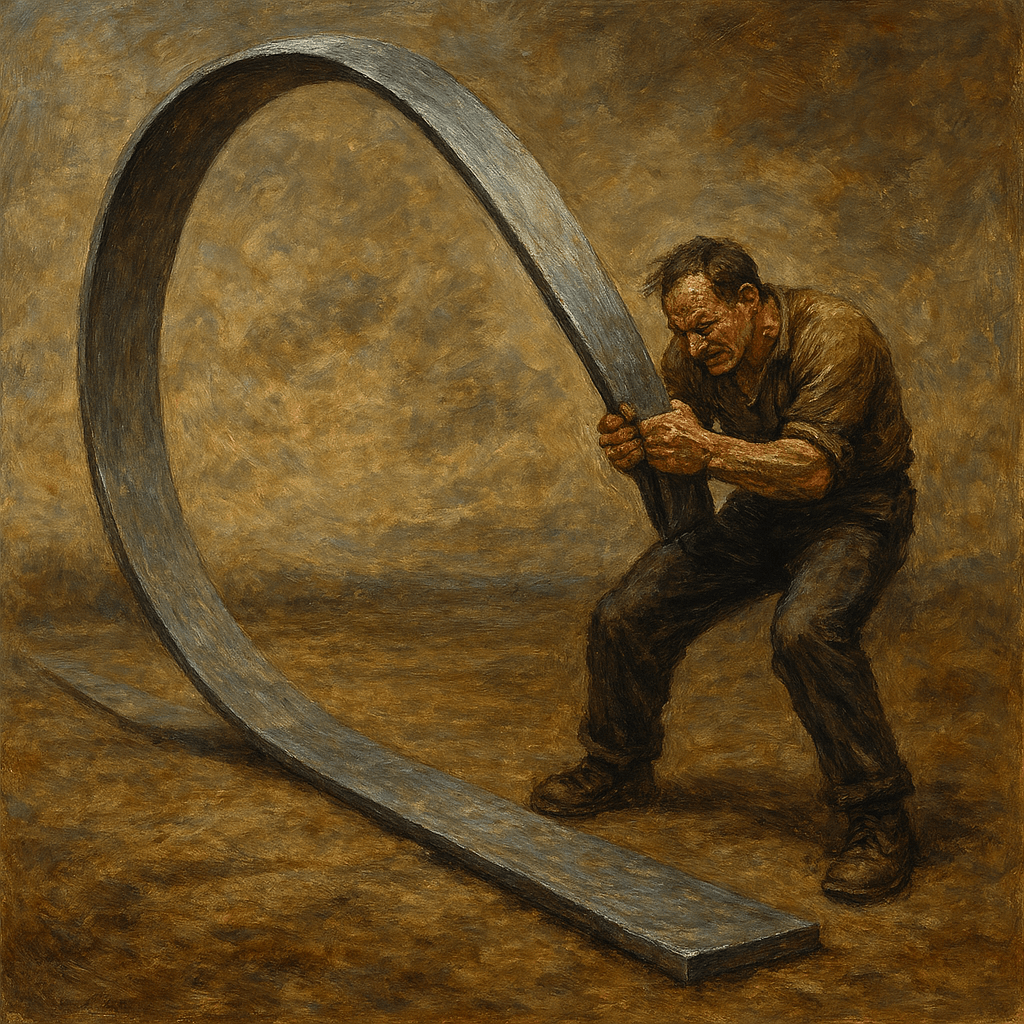
Man is mighty enough that he may bend God's creation
But it will always snap back
Man is mighty enough that he may bend God's creation
But it will always snap back
27 Whatsoever shall touch the flesh thereof shall be holy: and when there is sprinkled of the blood thereof upon any garment, thou shalt wash that whereon it was sprinkled in the holy place.

28 But the earthen vessel wherein it is sodden shall be broken: and if it be sodden in a brasen pot, it shall be both scoured, and rinsed in water.

29 All the males among the priests shall eat thereof: it is most holy.

30 And no sin offering, whereof any of the blood is brought into the tabernacle of the congregation to reconcile withal in the holy place, shall be eaten: it shall be burnt in the fire.
I discussed yesterday how the animal to be sacrificed not only stood in for the sinner but was also symbolic of purification as well. Today’s verses continue to make that dual meaning even clearer. It is a symbol from man of what is wrong, what he must give up, but it is also a symbol from God of what is right, what He gives to us out of mercy. How fitting a duality, given that it is in our broken and wrong places that so many of us truly discover the Lord.
Verse 28 emphasizes the purifying quality of the sacrificed animal in an interesting way. It talks about how if a clay pot held the meat at any point, it must be broken, whereas a brass pot could be reused, though it had to be scoured first. Some scholars have suggested that this scouring was not about removing impurities from the brass vessel, but to removing purity. The brass pot had to be reclaimed them from its exalted state to one of regular, earthly use, whereas the clay pot had to be broken was because its material was porous, thus the residue holiness couldn’t be scrubbed out.
That interpretation might be accurate, though I see another possibility as well. Perhaps the two different treatments were symbolic of the differing effects that God’s purification has on His children. Some people receive the purification of God as a condemnation because they are still united to their sin, thus the purifying process breaks them. It would make sense that cruder, “earthen” vessels would be used to symbolize that. Meanwhile, the other effect of God’s purification is that those who are already more aligned to Him survive and become improved by the experience. That is represented by the more durable, refined brass pot.
And, of course, this pattern continues fractally. Even inside the righteous soul that survives God’s purification, there is still the part that is broken and the part that is improved. Both exist within the same person. Part of us is shattered and discarded when we meet the Lord, but part of us finally comes into its own and shines.
24 And the Lord spake unto Moses, saying,

25 Speak unto Aaron and to his sons, saying, This is the law of the sin offering: In the place where the burnt offering is killed shall the sin offering be killed before the Lord: it is most holy.

26 The priest that offereth it for sin shall eat it: in the holy place shall it be eaten, in the court of the tabernacle of the congregation.
We gain a new detail on the sin offering in these verses. First, though, to recap all that we have learned of how the offering was performed so far, we first learned how the blood of the animal was smeared on the horns of the altar and the fat and kidneys were consumed by the flame. We elsewhere also heard that the skin, flesh, and dung of the animal was burned outside of the camp. And now, here for the first time, we also hear about a portion of the offering being eaten by the priest. In Leviticus 10 it will also be made explicitly clear that this was a part of the ritual for a common sin offering, and it will state there that the representation of this was that the priest was to bear the iniquity of the sinner.
However, the priest taking the burden for all that is wrong, is not the only symbol in this act. Notice how in today’s verse 25 it mentions that the slaughtered animal is also a vessel of purification, and tomorrow’s verses will go even more heavily into that theme.
This makes sense when we consider the ultimate sacrifice, Jesus Christ. On the one hand we are told, “Christ hath redeemed us from the curse of the law, being made a curse for us” (Galatians 3:13), which matches the idea of Christ taking the burden of every man’s evil, but at the same time, his innocence and purifying power are made clear when we are told, “he is brought as a lamb to the slaughter…with his stripes we are healed” (Isaiah 53:7, 5). He is both the condemned and the redeemer all at once, and so is the meat of this offering.
19 And the Lord spake unto Moses, saying,

20 This is the offering of Aaron and of his sons, which they shall offer unto the Lord in the day when he is anointed; the tenth part of an ephah of fine flour for a meat offering perpetual, half of it in the morning, and half thereof at night.

21 In a pan it shall be made with oil; and when it is baken, thou shalt bring it in: and the baken pieces of the meat offering shalt thou offer for a sweet savour unto the Lord.

22 And the priest of his sons that is anointed in his stead shall offer it: it is a statute for ever unto the Lord; it shall be wholly burnt.

23 For every meat offering for the priest shall be wholly burnt: it shall not be eaten.
In addition to the burnt offering of a lamb, once every night and once every morning, there was also to be a meat offering of flour every night and morning. The flour was to be baked first, then burned as a bread or a wafer until fully consumed.
We have already heard that when the meat offering was from a common Israelite, there was a portion given to the priests. But since the meat offering described here was from the priests themselves, there was no portion for them, and all of it was given to the Lord. There can be seen in this a hierarchy, a flow, moving upwards and ultimately finding its destination in God. Just as God is the originator of all things, He is the terminus of all things as well.
All of our creations stem from the first creation made by God. And all of our sacrifices ultimately find their rest in Him. We come and go as links in a chain. At the beginning of the chain is a post, and at the end of the chain is a post, and both posts are God.
16 And the remainder thereof shall Aaron and his sons eat: with unleavened bread shall it be eaten in the holy place; in the court of the tabernacle of the congregation they shall eat it.

17 It shall not be baken with leaven. I have given it unto them for their portion of my offerings made by fire; it is most holy, as is the sin offering, and as the trespass offering.

18 All the males among the children of Aaron shall eat of it. It shall be a statute for ever in your generations concerning the offerings of the Lord made by fire: every one that toucheth them shall be holy.
We have heard a few times already of the priests eating a portion of the offering. I have described this as God sharing His bounty with His servants, them being able to partake in the fruit of His kingdom. I do believe that is a main meaning of this symbol, but perhaps there are other representations we can find in it as well.
One thing that stands out this time is the specification that the meat offering had to be eaten in the holy place, meaning within the tabernacle courtyard. The priests had their own homes and families and lives outside of their ritual duties, but this offering was not meant for them to take home and eat there. It was not just provisions. The priests eating it was actually a part of the ritual itself. It was as much an obligation of the priests as it was a privilege. That which the offeror gave had to be consumed, whether by flame or by mouth, and the priest was responsible to ensure that that occurred.
Given that perspective, another representation in the priests eating of the meat offering emerges. Remember that this offering was a celebratory one, given as a show of gratitude and thanks for God’s blessings. That show of thanks had two destinations, one was purely to give glory and memorial to God, the other was to nourish and sustain God’s servants. We see in this dual consumption the proper channels for our abundance. If I am greatly increased by God in my life, I should return some of that back to Him, and some of it I should pay forward to my fellow man.
14 And this is the law of the meat offering: the sons of Aaron shall offer it before the Lord, before the altar.

15 And he shall take of it his handful, of the flour of the meat offering, and of the oil thereof, and all the frankincense which is upon the meat offering, and shall burn it upon the altar for a sweet savour, even the memorial of it, unto the Lord.
We now hear God describing more of the meat offering, this time not from the perspective of the person making the offering, but from the perspective of the priest who carried out the ritual. As we have already heard, the flour was to be mixed with flour and frankincense, then burned upon the altar. Verse 15 mentions that the purpose of burning the treated flour was to create a sweet savor, a pleasant aroma that would raise to the Lord. It is interesting to note that this scent would be “the memorial” of the offering. There once was something physical, the flour and the ointment. When they were burned, the physical thing was lost, but the aroma remained as a reminder of what once was.
This is an excellent allegory for memory and spirit. We have moments in our lives that are very real, very tangible and meaningful, but they only exist for a brief instant, then are relegated to the past. Afterwards, though, there still remains the memory of them. We no longer have the actual occurrence, but its spirit can continue on with us. Thus, this meat offering could serve as a reminder of this link between the physical and the spiritual world, a lesson that though things become unseen they can live on in another manner.
12 And the fire upon the altar shall be burning in it; it shall not be put out: and the priest shall burn wood on it every morning, and lay the burnt offering in order upon it; and he shall burn thereon the fat of the peace offerings.

13 The fire shall ever be burning upon the altar; it shall never go out.
Once again, we are reminded that this is meant to be a perpetual flame to the Lord, it’s light should always shine bright for all of Israel to see, probably flickering and diffused through the linen courtyard walls like a heavenly glow. Obviously, this perpetual flame is symbolic, but to properly appreciate its meanings, I think we have to acknowledge that this was not the flame of the Lord, this was the flame for the Lord.
The pillar of fire that would guide Israel in their journeys was the flame of the Lord, created and maintained by His own divine power. This fire upon the altar was created and maintained by the priests as an offering for the Lord. Thus, I would say it is not limited to representing God’s shining presence, there were other symbols for that. Arguably, it better represented our perpetual effort to reach and reconcile with God. It represented our need to make continual sacrifice to keep our fervor burning brightly. It represented the fact that our faith will go out without constant fuel.
Knowing that God will always be there for us is essential but knowing that we will always strive for Him is the next level of spiritual surety.
10 And the priest shall put on his linen garment, and his linen breeches shall he put upon his flesh, and take up the ashes which the fire hath consumed with the burnt offering on the altar, and he shall put them beside the altar.

11 And he shall put off his garments, and put on other garments, and carry forth the ashes without the camp unto a clean place.
The priest was to arise in the morning, put on the clothing of his office, and collect the ashes off the altar. Then he had to change his clothes and carry the ashes out of the camp and dispose of them. This seems unusual. Why two different sets of clothes for the same chore? The general understanding is that the priest could not interact with the holy altar without wearing the official clothes of his office, but also he could not leave the tabernacle while wearing those holy garments. Thus, he wore the holy garments for the part that involved the altar and then had to wear his everyday clothes for carrying the ashes out of the camp.
This, of course, is not to say that we are meant to be two-faced disciples, faithful and religious in church, then carnal and sinful when we leave. But there is a special gravity when we commune with the Almighty, which is absent in our other business. We should have a seriousness in our sacred works, and a levity in our mortal labor. The two parts are connected, and each affects how we show up for the other, but they are also distinct.
8 And the Lord spake unto Moses, saying,

9 Command Aaron and his sons, saying, This is the law of the burnt offering: It is the burnt offering, because of the burning upon the altar all night unto the morning, and the fire of the altar shall be burning in it.
Today begins a new section of ritual instructions. This part is related to the perpetual burnt offering that the priests were to offer through the whole night. At the close of the day, after the needs of the common Israelite had been seen to, the priests would make one more overnight burnt offering.
This is presumably a repeat of the command we already read in Exodus, in which a lamb was to be offered each night, and another lamb each morning. There are multiple meanings and symbols to be found in this practice. In my previous post on the subject, I noted how the perpetual offering can be seen as representing the path of the disciple, largely defined by its daily, quiet surrender to the Lord.
Another symbol is that even when the world would go dark, the perpetual flame of the Lord’s altar would still be burning, still providing a mark and a guide to God’s people. So, too, when the world becomes confused and apostate, the Spirit of the Lord can still guide us through the dark.
A third symbol is the sacrifice of a lamb closing one period of time and also ushering in the beginning of a new one. This seems to echo the change from the Old Testament to the New, where John the Baptist, the last Old Testament prophet, was slain at the close of one era, and Jesus was slain to usher in the next.

It is only when we are able to do what is right when we stand to lose the most that we gain full ownership of the virtue. At this point, no one can deny that we live and die by that truth. So long as the maintaining of our virtue is untested, it isn’t fully ours.
And so, if we are ever to truly own our virtues, each must be tested in the most trying of circumstances. God does not give these trials to hurt us; He gives them so that we can fully own something good.
 Spiritual Wanderings