If I seek a place where I feel content with everyone else, I will end up in a room alone
There are all manner of groups and organizations that start with the most positive of feelings, but which degrade and fall apart because its members find that given enough time and experience, they really don’t like each other at all! Varying perspectives become dividing mantras. Minor inconveniences become insurmountable obstacles. Gentle teasing becomes inexcusable offense.
And then a line is drawn in the sand, the party splits apart, and often each side tries to build a new version of the group, the way it was always “supposed” to be, but usually that new “utopia” collapses just as surely as the first.
Sooner or later, we must face the fact that we can never make the group that only has people we get along with. We can only make ourselves get along with the people that are in the group.
Let’s look at this another way. Consider if the following statement is true: Even if at times you’ve rubbed some people the wrong way, or said things at another’s expense, or championed principles that you later learned were false, you can still be forgiven of all these things and by God’s grace be redeemed to live in paradise. Is that statement true?
Well, if it is true for you, then it logically follows that it is also true for any person who has rubbed YOU the wrong way, or has said things at YOUR expense, or has disagreed with YOU for their false principles. This person can also be forgiven and receive God’s grace and be redeemed to live in paradise. Like the prodigal son’s brother, we are all going to see our Father welcome people that hurt or annoyed us into His kingdom, so if we want to live there, too, sooner or later we’re going to have to let those things go.
You can learn to get along or learn to be alone. What you can’t do is cut off anyone who upsets you and still be part of a community. Unity with others must come from within, and it must be unity with all.
There is a concept that has come up a few times in my previous series, including the last one. I have spoken to the matter in brief here and there, but now I want to consider it more fully. The concept is that living in the truth is the foundation for a full and happy life. Said another way, facing the facts as they really are is the only way to be truly free. Said a third way, only those who are willing to face the truth unflinchingly are ever truly alive.
This is a principle that is basic and fundamental to life. It is so foundational that sometimes it is difficult to really get a grasp on it. Axiomatic truths are, by definition, self-evident in their truthfulness, requiring no argument to prove them. That’s all well and good, but it means that if you then try to explain why an axiom is true you’re going to have a very hard time of it! Explanations tend to lead to circular logic, such as “living in truth is the foundation for a full life because…it just is!”
One way to come to full appreciation of these fundamental truths is to look at them in reverse. Fundamental truths are prerequisites for many other things in life, and by examining those things that are built upon foundational truth we obtain evidence that the underlying axiom really is true, for if it were not the things that we have observed could not be. We find that the fundamental truth is necessarily true, because it is necessary for it to be true for other observable things to be so.
Even so every good tree bringeth forth good fruit; but a corrupt tree bringeth forth evil fruit. A good tree cannot bring forth evil fruit, neither can a corrupt tree bring forth good fruit.... Wherefore by their fruits ye shall know them. -Matthew 7:17-18, 20
Jesus describes the same idea in these verses where he teaches that we may recognize that which was good by whether it brought about good or not. So if we want to know whether “a life founded upon the truth is joyful and free” is a true statement or not, then we merely have to look at those who live in harmony with this belief and see what sort of life they possess. I will begin my series today by doing exactly this. I will look at an example of people who are built upon this axiom, living their lives with the assumption that it is absolutely true. We may observe the reality of their lives, and infer whether they built upon a solid foundation or not.
The Happiest of People)
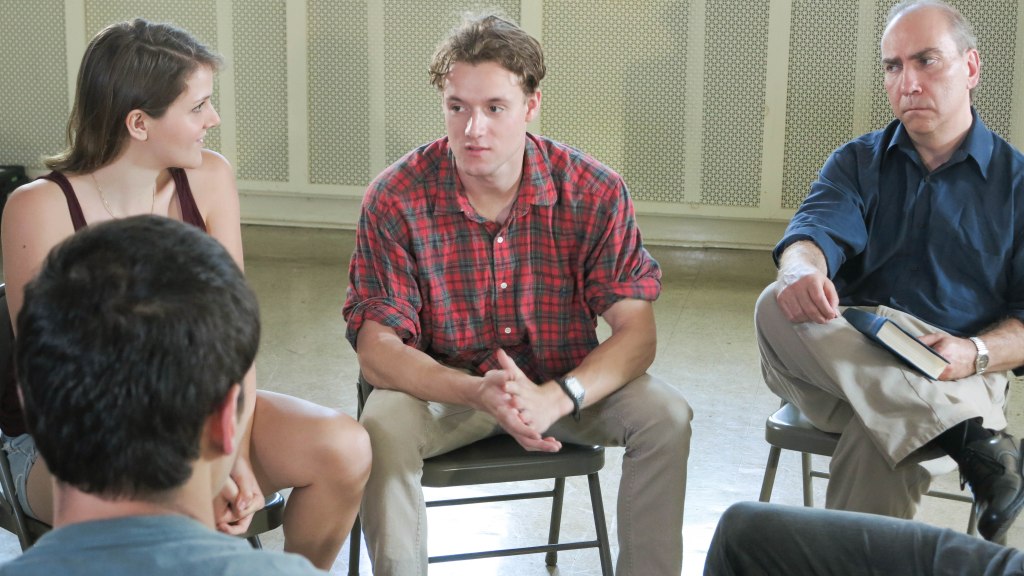
I have mentioned before how the addiction-recovery groups I have attended are singularly focused on living in harmony with truth. Any addict working a twelve-step program can tell you that one of its most fundamental tenets is that we take a fearless inventory of our lives, facing all of the unpleasant and difficult truths in our character. Where most people attempt to cherry-pick their best qualities and define themselves by those, addicts in recovery open the door to all of their qualities. We do not care if the description of us is pleasant, only that it is true.
And what comes about by this strict adherence to seeing things as they really are? For an answer, let me offer an anecdote that occurred to me personally. I was speaking with an ecclesiastical leader about my efforts to overcome my addictions, and my time spent in my recovery group. As soon as he heard that I was part of a twelve-step program he said to me, “you know, I’ve never been a part of such a program, but I have been a witness to its meetings and its members, and those are the most humble, most sincere people I have ever met.”
The reason why the twelve-step program has grown at such incredible rates since its inception is entirely due to the quality of the men and women one meets when they walk through the door. People see men and women who have not only gained freedom from the most terrible of vices, but who also live with a clearness and a joyfulness that simply isn’t to be found anywhere else. Furthermore, the fact that that light has remained consistent throughout the decades and continues to burn brightly in every new generation of members is a testament to the fact that the happy way of life was not due to some pre-existing condition in the first AA members, but is cultured in its members from the principles that they live by. If people had not seen throughout the years that these people had uncovered a superior way of life by their principles, then no one would have stayed and joined the crew, and it would have been a long-extinct experiment.
It was the evidence of this joyful peace that also drew me into the ranks of the twelve step program. It might seem a counter-intuitive thing to say, but I quickly recognized that I had never seen a happier, more satisfied, and more productive people, than these addicts who sincerely identified their miseries and their flaws. One would have thought that bringing out those heavy truths would have crushed them, but so far as I could see those weights, once surrendered, were being taken away, so that they could live free and unfettered. They attested that one had to truly see their shackles before they could receive the key to undo them. Though I was not then converted to the notion of living my life strictly in harmony with the truth, I was persuaded enough by what I saw to give it a try. My result has been much the same as theirs.
But you don’t have to take my word for it. Even if you don’t consider yourself an addict, go and visit a few of the local meetings in your area. See for yourself what manner of men and women these are, and what sort of lives they lead. Granted, every group has its own culture and its own level of sincerity about the work, but attend a few different ones and you will quickly see that there is a clear correlation between those that genuinely face the hard truths and those that live joyful and free.
For the last year I’ve been attending a 12-step group for lust and pornography addiction. Every couple weeks we will have a new attendee who feels embarrassed about being present. Quite frequently they’ll introduce themselves with something like “Hey, so…I don’t really know if I have an ‘addiction,’ per se, but I just figured I ought to come here and see if it feels like it might be beneficial for me…”
Let’s take a closer look at one of these individuals. We’ll make up one called Pete. Now Pete knows that his behavior isn’t what he wants it to be, but he’s uncomfortable with the notion that he is chronically or perpetually enslaved to that behavior. Pete’s willing to admit that he has a “problem,” but it seems a stretch to classify it as an addiction.
When Pete thinks of the word “addict” he imagines a grizzled man sleeping on a park bench, or a nervous kid hawking his mother’s jewelry in a back alley, or a young woman selling her body for drugs. He imagines people who are ruining themselves mind, body, and soul, who are completely out-of-control, who have severed all ties to anyone that used to love them. Those are all clearly addicts, but surely Peter, who goes to church, has a family, and pays his bills couldn’t be an addict…could he?
Choice vs Compulsion)
Another key element that keeps Pete from identifying as an addict is the matter of choice. An addict is defined by his inability to choose, he his compelled to act, even to his own destruction. But while Pete doesn’t like all of the things that he does, he still feels that it is a choice when he does them. His behavior is problematic, but he doesn’t believe it is out-of-control. He does these things because he wants to do them. Granted, he doesn’t always want to do them, sometimes he very much wishes that he didn’t do them at all, but sometimes he does want to do them and that’s when he “makes the choice” to do so. He’s not saying that that’s a good thing, but he does say that he isn’t being forced against his will.
One might ask Pete that if he still retains free choice in this area, then why doesn’t he make a firm and final decision that he isn’t going back to that behavior anymore? If at all possible, try to catch Pete when he is feeling a strong desire to act out and ask him then if he is still in control.
“Yes,” Pete answers us. “I really am in control. I can choose to do this, and I can choose not to. In fact, I think I’ll make both choices here and now. I’ll choose to go ahead and do this just one more time, and then I’ll choose that I’m done for good!”
“Could you choose to be done before this last time instead of after?”
“Of course…but I don’t want to. I want to choose to do it this one time for the last time, and then be done forever.”
“You say that you do not want to choose to stop just yet. In general, are you able to choose to do things that you do not want to?”
“Yes, of course. I choose to do unpleasant things when I have to all the time. I go to work when I don’t feel like it, I help my neighbor shovel his driveway, I skip the dessert line if I’ve had too much to eat. I can choose to do things that I don’t want.”
“Then choose to do this thing that you don’t want. Choose that the last time you acted out was the last time. Choose that you won’t act out again now even though you want to.”
“I…don’t want to.”
“But you have just said that you can, even if you don’t want to. You’ve already claimed that you are in control, but what does that even mean unless you can choose in spite of what you want? That’s what control means. So choose to stop now, even though you do not want to, and that is the only way to prove that you really are in control here.”
How Pete squirms! For as unsure and out-of-place as he felt at his first twelve-step meeting, he soon starts to realize that he’s just as crazy as all the “real” addicts there. Usually by a newcomer’s third or fourth meeting he’s willing to throw in the towel and admit that his “little problem” is actually his slave driver!
A Needed Perspective)
And frankly, that’s why we need to go to a twelve-step group. It provides just this sort of well-meaning confrontation which shows us our own inconsistency. The sooner we go to group, the sooner we feel pushed to give up our pet vice. The sooner we try to give up our vice, the sooner our illusion of self-control is dismantled. It is only when we try to resist against our vices that we feel the hooks they already have in us. We only ever felt we were in control because we had never tried to make a choice that went against the script.
I began this journey by considering the conundrum of the addict who hates his addiction but lives it even so. The addict possesses the physical capability to change his behavior, and sufficient desire to cease his behavior, yet finds himself falling into it again and again. The missing piece, as we have discussed, is that the addict lacks the mental willpower to translate his desires to his actions, at least when in the face of powerful temptation. His prefrontal cortex has been eroded, which is responsible for all his higher mental functions. When the need for another hit arises, all feelings and rationality are numbed into silence, leaving the addict a slave to his base impulses.
Many of us felt that we had plenty of character. There was a tremendous urge to cease forever. Yet we found it impossible. This is the baffling feature of alcoholism as we know it – this utter inability to leave it alone, no matter how great the necessity or the wish. - Alcoholics Anonymous: The Big Book
This conundrum has led many the addict to despair. He feels that at some point earlier in life he must have forfeited his last chance at salvation. By the time he became really serious about wanting to change, it was already too late, and now he believes that he is doomed to do the very things he despises most for the rest of his life. This demoralizes the addict, is almost certain to cause him to enter a deep depression, and can even make him suicidal.
While I would certainly never encourage any suicidal notions in any person, reaching this moment of despair does suggest that the addict has finally reached the point where he can be totally honest with himself. Because he’s right, he can’t win this battle. Only by accepting this soul-crushing defeat can he begin the path to victory.
Other Paths)
When one door closes, another opens
For most addicts, it is only the total failure of their attempts to control their lives that will finally humble them enough to hear alternative methods. Inherent in all of us is the desire to fix ourselves by ourselves, so we have to try at that for a very long time, and to absolutely ruinous results, before we will start to look outside for help. And it is in this shift outwards, though, that we can actually find the success that has eluded us for so long.
Quite probably the single method that has brought the most hopeless-case addicts to true healing has been the twelve-step program invented by the Alcoholics Anonymous organization, and this program is entirely predicated upon the notion that the addict, though powerless by himself, can find the power to overcome his addiction through the strength of God and the recovery group that he binds himself to. Relying upon others goes absolutely in the face of our desire to be autonomous and self-powerful, but, paradoxically, it is also the only thing that will ever allow us to regain out autonomy and self-power.
In the course of this study, we examined how the addict who reaches out to a fellow brother or sister when facing temptation is inviting a working rational mind to the situation. The addict who calls for help is having his mind assaulted and numbed by an active temptation, but the person that he calls probably is not. The helper can provide the calm reasoning to the distressed addict, talking them down off the ledge and back into rational ways of thinking.
We also considered how uniting together for this good purpose gives us access to Christ’s promise that “where two or more are gathered in my name, there am I with them” (Matthew 18:20). Coming together as a group for a holy cause is one of the surest ways I know of to tap into the strength and willpower of the divine. And, in my experience, that strength and willpower is far more than enough to overcome every temptation that we might face. “With man this is impossible, but with God all things are possible” (Matthew 19:26).
We also discussed personal practices that the addict can put in place to help shore up his defenses. These are in no way an alternative to calling upon the strength of our brothers and sisters and God, but an addendum to those resources.
The practices we described included recognizing and avoiding the sequence of events that typically precede our acting out. Often there are trigger events that come before the temptation, and much of our acting out can be avoided if we simply avoid the trigger event. Usually we are able to circumvent that trigger because our mind isn’t yet fogged over by temptation.
The other personal practice we discussed was finding the areas of life where our damaged prefrontal cortex and higher reasoning weren’t being entirely steamrolled by temptation. In those areas we make a conscious effort to act deliberately and conscientiously. I pointed out how when we deliberately do little things to improve our lives, even if they seem fairly inconsequential, we are exercising the regions of our brain needed to perform higher executive functions. Bit-by-bit we are increasing our willpower, mental strength, and conviction. Eventually we will have enough power to reclaim the fields taken by our addiction.
Hopelessness isn’t Hopeless)
Sometimes it isn’t the situation that is hopeless, it is the method that we are bringing to it. Each of us needs to give up on using the wrong tool so that we can start to use the right one.
If you have a genuine addiction, powering through on your own is doomed to failure, but that doesn’t mean that you are necessarily doomed to failure. After failing countless times over it is easy to become pessimistic and assume that nothing could ever work for you.
I’m here to give you the good news that this is not the case at all, though. You are not the first person to have felt this way, and you will not be the last person to find salvation even so. Leaving behind the methods that didn’t work, now embrace the methods that do. Learn to be shrewd in how you avoid temptation, build up strength of willpower through small wins, and tap into the strength of others and God.
Do these things and your mind will heal, your impulsive behaviors will fade, and self-control will return. You will become one of those of whom it has been said, “For the power is in them, wherein they are agents unto themselves” (Doctrine and Covenants 58:28).
I have seen it in myself and in numerous others. The brain can heal itself. Hope can be restored. The numbing forces can be numbed.
As I pointed out at the start of this post, the addict in the midst of despair can find himself entertaining thoughts of suicide. He is wrong to think he has no alternative but to end his life, however he is correct that a death of some sort must occur. That death, though, is the death of the ego. Only by denying himself, putting to death his pride and isolationism, can he be reborn through the baptism of fellowship in Christ. He must immerse himself in the brotherhood and sisterhood of fellow addicts in recovery, and when he does, he will feel Christ manifesting within himself. Then his new life truly begins.
I have been discussing ways that we can find the willpower to fight temptation, even when our brains have been damaged by our addictions. I have covered doing all that we can to avoid even encountering our temptations, but sooner or later they will find us even so, and then we must suddenly find strength and mental reasoning that we are incapable of providing for ourselves.
This immediately suggests that we must have a strength that is beyond our own. An external strength and reasoning that will slay the dragons that we fail to overcome by ourselves.
For where two or three are gathered together in my name, there am I in the midst of them. - Matthew 18:20

I can do all things through Christ which strengtheneth me - Philippians 4:13
These verses provide us a pattern for accessing just such an outer strength, a pattern that I have found most effective. In the first verse we are promised by Christ himself that when we gather together in his name, he will dwell among us. In the second verse we are told by Paul that Christ strengthens him to be able to do all things. Thus, gathering together invites Christ’s spirit, and Christ’s spirit lifts us to be able to do what we could not do on our own. This is a pattern that I have been able to make use of in my own life and I have come to value it greatly.
Group Strength)
The founders of Alcoholics Anonymous discovered that there was a special power when addicts came together as a group to lay down their burdens and encourage one another. A room full of individual failures could somehow churn out mass success. Ever since that realization, groups have sprung up all across the world and for all manner of different addiction recoveries. I, myself, regularly participate in a twelve-step group for pornography addiction, and I can attest that there really is a secret strength in numbers.
Mathematically, it doesn’t seem to make sense. As an analogy, imagine if our addiction was our debt and our resolve was our assets. Then an addict, by definition, is someone whose debt outweighs his assets, someone who is at a net negative. Now if you have ten such men, all with a net negative, and you combine them all together, what would you expect? Net negative of course! A negative plus a negative plus a negative plus a negative–and so on–can only result in a greater negative.
But, counter-intuitively, that’s just not how it works in practice. The men in my group bring all of their problems with them to the recovery group, yet somehow the group doesn’t feel weighed down by the shared burden. Instead, weight is collectively lifted up by the group and tossed aside.
The only conclusion that I can come to is that the scriptures cited above are true. When we gather together to do the holy work of refining our souls, Christ is there in our midst. We come with all our collective debts, but he has a wealth of assets, enough to compensate for all our shortcomings and more.
A Phone Call Away)
And this same strength can be called upon in moments of duress as well. We addicts have learned that we can recreate the spirit of the group with a simple phone call to another brother, right when we’re being faced by our temptation.
We might feel powerless in the face of the temptation when on our own. We might feel that we are doomed to give in. But if in that moment we can work up just enough resolve to make a phone call, then as soon as we start sharing our burden with a brother, that same unseen power starts rising within, enabling us to do the very thing we couldn’t just a few moments before.
In fact, we don’t even need to have decided to overcome our temptation when we first make the call. We can simply make the call without any commitment whether we will remain sober after we hang up or not. We only need to have the strength to dial the number, and then the strength to go the rest of the way will follow. If I can’t decide to be sober on my own, I can still decide to step out and get help. And when I chose to step out and get help, then I can decide to be sober, too.
The power that comes from reaching out to a fellow addict in the moment of temptation is twofold. On the one hand, we are currently having our mental willpower, our brain’s prefrontal cortex, overrun by our powerful temptation. Our mind isn’t working how it should, but in the fellow addict that we call there is still a properly functioning mind. Their prefrontal cortex isn’t currently being overrun like ours is. Thus, they are able to bring the higher reasoning and persuasion that our own mind cannot provide. Later, when they are the one being overrun by temptation and we are back to sure footing, then we are able to provide the same benefit to them.
The second power is, of course, the light of Christ that I have already been discussing. For when a brother reaches out to me to help, I really do feel that it is more than my own mental faculty that I am able to bring to bear on the matter. I have felt an external love and wisdom flow into me, helping me to say and share the things that will speak directly to the soul of my brother. And I have felt the exact same divine presence shared with me when I have called for help, too.
Growing Ranks)
I don’t know why the power of Christ comes to us in this way, but it just does. I have tried many times to pray in isolation for his power and I have been very disappointed in the results. On the other hand, I have never gone to a recovery group meeting without feeling Christ’s power overflowing me. I have never reached out to a brother in recovery without feeling the strength to do what I couldn’t before. It seems to me that this is just how he wants it. He wants me to reach out to others, and he gave his instructions in the verse from Matthew so that I would know that I needed to do it.
At this point I’ve discussed how we can find self-control through preventative measures, and how we can access the strength of Christ and a larger group. I have also explained how exercising our willpower in daily tasks can increase our resolve over time. This brings me to the end of all the techniques that I wanted to share with you. Tomorrow, we’ll review them all together. I’ll see you there.
Yesterday I discussed the use of statistics to predict how likely a person in recovery is to maintain sobriety. These sorts of statistics can be discouraging, as they often make it seem like the addict is unlikely to ever obtain lasting sobriety.
I made the case, however, that statistics have their time and place, but cannot be applied in every situation. They are useful for representing the level of uncertainty in the observer, but not for describing the actual state of the observed. Thus, a coin that is covered only exists in one state (heads or tails), but the uncertainty of the observer is divided between two (heads and tails).
Today I want to consider another fact of statistics which makes it unhelpful in determining what your personal future entails. That fact is that statistics are a tool for measuring groups, but not individuals.
The Sad Case of Sally Clark)
There is a tragic real-life example of how the misapplication of a broad statistic to a single individual is both in appropriate and dangerous. Sally Clark was an English woman who lost one son to SIDS (sudden infant death syndrome) in 1996, and then lost a second son as well in 1998. This was terrible enough, but then it was made worse when Clark was tried for murder. One SIDS death in the family was believable, but two?
As it turned out, there was no concrete evidence to show that Sally Clark had killed either of her two children, but the prosecution brought in Professor Sir Roy Meadow to describe the statistical probability that this mother would have lost two sons to the same rare cause.
Professor Meadow argued that the odds of such an occurrence would be 1 in 73 million, an event so improbable that it could be rejected as a virtual impossibility. Mathematically, he said, Sally Clark had to be a murderer. The jury was convinced, and Sally Clark was sentenced to life in prison.
Four years later, though, it was discovered that the lab reports on the deceased children had omitted clear evidence of the two sons’ deaths being due to natural causes. Clark’s conviction was overturned, and she was released. At this point, though, she had already slipped into a terrible depression, and died shortly thereafter of alcohol poisoning.
Professor Meadow’s application of statistics was torn apart by other mathematicians and statisticians. The numbers he arrived at were simplistic and faulty and he never considered calculating what the likelihood for a mother committing double infanticide is, about 4.5-to-9 times more unlikely than double-SIDS as it turns out! Perhaps most importantly, though, he had made the critical mistake of applying group statistics to an individual.
Consider this, if the odds of a double-SIDS family were genuinely 1 in 73 million, then that would mean for every 73 million mothers you would expect at least one to have lost two children to the phenomenon. 1 in 73 million does not mean that the event does not occur, it means that it does, and you will start seeing multiple occurrences once your population pool is large enough. 73 million is large, but it is not unfathomable for a population. It was inevitable that someone would show up with this situation at some point or another.
By Professor Meadow’s logic we could look at every mother on earth, one at a time, and for each individual conclude that it is too improbable to believe she has lost two children to SIDS. And thus, we would go through the entire population, believing none of them could have suffered that ordeal, when by Meadow’s own statistics there would have been over a hundred women who actually did.
It is the same with addiction recovery. Statistics can define the pattern for a group of addicts, as every group will inherently have a certain likelihood for certain behaviors. But when we apply those likelihoods to the individual we make the subtle, but damning mistake of saying that if something is improbable for everyone, then it is improbable for anyone.
Groups Within Groups)
Statistics can model the group, but they cannot model you. And they especially cannot model you when you consider that inside every group there are more specific subgroups, each with their own accompanying statistics.
By this I mean that most statistics on recovery cover a very broad spectrum of addicts. The odds of sobriety that they give tend to include individuals who have been working a 12-step program for twenty years, and individuals who showed up for the first time today. It includes those that have come of their own volition and those who came only because a judge ordered them to. Clearly not everyone in this broad group is as likely to remain sober as every other.
Every time you take the next step in recovery, you come into a new subgroup, which is represented by better and better odds. Maybe 1-in-10 of all addicts will stick with recovery, but just by returning for the second week you might now belong to a group with a 1-in-9.5 success rate. Do your “step 4 inventory” with another member of your program and you come into another subgroup with even higher levels of recovery. Earn your one-month chip and enter yet another higher-recovery subgroup.
Not to suggest that you are improving your own odds, only that the group statistics are converging more and more to who you actually are. Or at least they would be if the research were conducted down to such granular levels. But you don’t have to take my word for it. Start going to recovery programs for any sustained amount of time and you will quickly see that there is a clear correlation between amount of time working on recovery and length of sobriety.
You Are You)
Hearing discouraging statistics might make you feel like you don’t have a chance of recovery. But never forget that in order to even define the odds researchers must first find a number of successes. They couldn’t say 1-in-10, or 1-in-100, or 1-in-anything until they had found that 1. Never mind what the group pattern might be, the fact remains that there are people who do achieve sobriety, and whatever their methods to get there, it’s safe to assume that they weren’t putting too much stock in “what their odds” were. They got better because they got better. They weren’t 1 in a group, they were 1 in themself, and they decided for themself what that themself was going to be.
Governing your life by statistics is not only a misunderstanding of the science, but also a dangerous game of self-fulfilling prophecy, one that can ironically change the statistics on the subject. There is no statistics on you as an individual. There are statistics on the group, and they are useful for understanding the group, but the group is not you. The group can be documented, but to quote Lawrence of Arabia, for you as an individual “nothing is written.”





 Spiritual Wanderings