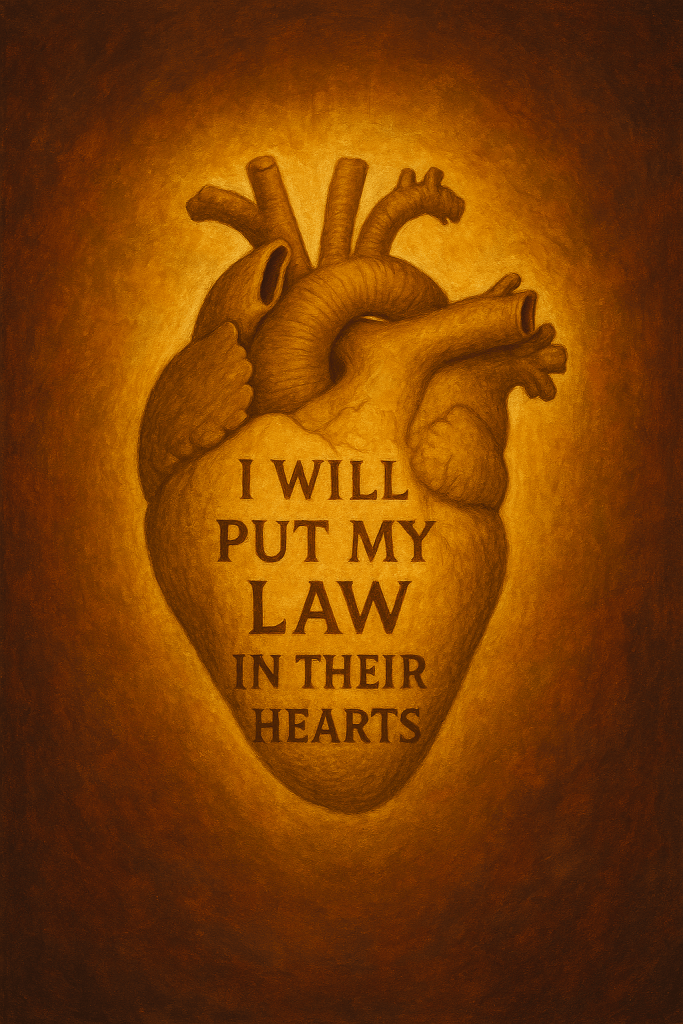
The laws of the land may be important
But the laws of the heart even more so
The laws of the land may be important
But the laws of the heart even more so

Changing behavior
Without changing the heart
Is building new structure
On a crumbling foundation

You will never be enough so long as you hold part back.
You have to give your whole heart to Him,
And then you’re already enough.

If you live every day with a level of physical comfort, security, wealth, and peace that almost no one in history has ever enjoyed, yet every day is filled with anger, anxiety, and despair, then perhaps it is time to consider that your hell comes from within.
29 The children of Israel brought a willing offering unto the Lord, every man and woman, whose heart made them willing to bring for all manner of work, which the Lord had commanded to be made by the hand of Moses.
Over the last three days we read how every common man and woman, and every ruler had the opportunity to combine their various talents and resources to the building of the temple. No one was compelled to, but anyone whose heart was so moved would have a way that they could volunteer for this great work.
I mentioned earlier that God would have had the omniscience to know whether His people would bring forth sufficiently to fulfill His vision, but also, He would have had access to their hearts, being able to whisper into those that were devoted to Him, inspiring them to bring what they had. Thus, even as the people brought what parts that they could, they were doing so with the Lord burning in their bosom.
This is an important theme in the Bible, that God not only sets the standard, but inspires and empowers the fulfillment of it. He calls us to righteousness, then works within our hearts to help us live so, as well as makes atonement for when we fall short. It is not just God reaching from one side and man from the other to meet in the middle, it is God reaching from both sides, and man joining in on one half of that.

Trying to follow God’s law without God’s heart is hell
33 And Moses went out of the city from Pharaoh, and spread abroad his hands unto the Lord: and the thunders and hail ceased, and the rain was not poured upon the earth.

34 And when Pharaoh saw that the rain and the hail and the thunders were ceased, he sinned yet more, and hardened his heart, he and his servants.

35 And the heart of Pharaoh was hardened, neither would he let the children of Israel go; as the Lord had spoken by Moses.
I’ve already discussed this, but I’ll point out once again that in verse 34 it sounds as though Pharaoh willfully hardened his heart, rather than that the Lord did it to him. Particularly notable to me is that he “sinned” in the hardening of his heart. We typically consider a sin as requiring an intentional, coherent decision to do wrong. We say that someone who is taken by a sudden insanity is not necessarily culpable for the terrible things that they do in that state, so if God had afflicted Pharaoh with a temporary madness that hardened his heart, it seems unlikely that this verse would say that Pharaoh had “sinned.” He would not be culpable anymore.
Also, we are told in these verses that Pharaoh’s servants hardened their hearts as well. But who are these servants, and why would their hardness of heart be relevant to the story? Based on some upcoming references to the same servants, it seems most likely that these were Pharaoh’s advisors and officers. Thus, as they similarly hardened their hearts, they were encouraging and bolstering Pharaoh in his defiance. If it were otherwise, then his continued provocation of the Lord might have put him in danger of rebellion or even assassination!
In some later verses Pharaoh will eventually will lose the support of his servants, but even then he will not surrender to their arguments or be subdued by them. That would have been a surrender of man to man, but the story of Pharaoh was to be one of surrender to God, and God alone!
13 And he hardened Pharaoh’s heart, that he hearkened not unto them; as the Lord had said.

14 And the Lord said unto Moses, Pharaoh’s heart is hardened, he refuseth to let the people go.
I have discussed previously these passages that say the Lord hardened Pharaoh’s heart. I will repeat here that I don’t believe it is accurate that God hardened Pharaoh’s heart, and if you would like more explanation why I feel that way, you can refer back to my original post.
I will just add one point to what I have already said before. The fact is that the biblical record is itself divided on whom, exactly, hardened Pharaoh’s heart, and so I feel that one of the interpretations must be discarded. Here in verse 13 it is clearly stated that God hardened Pharaoh’s heart, but at other times it explicitly state that Pharaoh is the one hardening his own heart. We will see this in Exodus 8:32 where it states, “and Pharaoh hardened his heart at this time also.” Note that the “also” suggests that not only was he the one that hardened his heart at the time of Exodus 8:32, but also at this previous instance as well.
I do not believe there is anything heretical in acknowledging that the Bible is a record compiled from many accounts, some of which disagree in particular details, and which cannot therefore all be entirely true. Of course extreme prudence and caution is to be taken when holding to one version compared to another, and in some cases it better to just say “whether it was just as this record states, or just that one states, I do not know, I accept the spirit of them both.”

The addict is a curious creature, utterly appalled at his inexcusable behavior, yet also in complete denial about it. Before acting out he minimizes the severity of the deed, reassuring himself that just this once won’t make a difference and he can quit whenever he wants. Immediately afterwards he experiences terrible self-loathing, promising himself that he will never do it again.
Now and again, during those shameful after-effects where he most strongly wishes to be free of his vice, the thought might occur to him that he needs to tell someone what is going on. If he is married, he might feel that he needs to tell his wife. If he is religious, he might feel that he needs to confess to a leader. If he has broken laws, he might feel that he needs to turn himself in to the police. If none of the above, there is still confession to those that have been hurt, professional therapists, or close friends. There is always someone that the addict could turn to…if they had the courage.
And it is this matter of courage where the addict struggles. For no sooner does the thought to confess rise up then it is forced right back down. He might fight the urge down through minimizing:
“Oh I don’t need to do anything as drastic as that! I just need to really try my best and I’ll be able to take care of it.”
Or he might come up with some reason why he can’t:
“I would tell my wife the truth…but it would break her. I just can’t put her through that pain, she doesn’t deserve it.”
Or, if he’s being more honest, he just isn’t willing to face the fear:
“If I tell, I’ll lose everyone and everything. I can’t lose my marriage. I can’t lose my kids. I can’t lose my church. I can’t lose my job. I can’t and won’t do it.”
This fear is the real reason why the addict doesn’t confess. If he could have solved it on his own, he would have done it by now, and he doesn’t protect anyone but himself by living under a false image. The only reason that stands up to scrutiny is that he isn’t willing to lose the things that he has.
Is that selfish? Yes, but it is also human nature. We are terrified of losing our surrounding structure and that’s not always a bad thing. A healthy dose of fear keeps us from doing things that jeopardize our lives and well-being. The problem is that the addict’s fear is keeping him in a behavior that is destroying all the things that he doesn’t want to lose anyway.
He isn’t present at work, he isn’t working on his faith, and he isn’t faithful in his marriage. The things he is afraid of losing he is slowly gutting of their original virtue until they become an unfulfilling career, a hollow faith, and a sham marriage. So, in his self-interest, he is ironically destroying his own self-interest.
Thus, when it comes to hiding one’s addiction, we can immediately comprehend its root. The desire to hide comes from within the addict. It comes from the fear of losing himself. But now contrast this with the recurring notion that keeps returning to the addict that he should confess. Where on earth does that thought come from?
If hiding is about self-preservation, exposing is suicidal! As we have shown, excessive self-preservation can erode what the addict already has, but exposing his secrets seems that it will surely blow it all away! What possible reason would an addict’s mind have to conjure up an idea that is so against himself?
And the answer is: none. Because it isn’t about intellectual reasons. Any addict who appraises the idea of confession will realize that it did not come with a reason, it came with a feeling. The idea did not come from their analyzing, rationalizing, efficiency-focused brain, it came from the heart. Might it destroy the addict? Yes, that is a distinct possibility. But it just feels right even so. It feels like it might be just the thing to save the aching soul. Why? The addict might not have any idea why, but it just feels true in their heart.
Thus, hiding is to preserve yourself, but confession is to save yourself.

 Spiritual Wanderings