Moral Growth and Decline

If we think that people hundreds of years ago had morally despicable views, and that now we have a better view of the truth, we ought to consider why. What beliefs and values did our forefathers foster that led them to become more moral, leading to where we are now?

And if we are now prying those beliefs and values from the public square, if we are rejecting the faith of the very people who made the world a better place, what do we expect to happen to our morality in the next hundred years?

A Pivotal Moment- The Death of God

Mankind Ascending)

In the late 19th century, Nietzsche boldly proclaimed the Death of God. The world had passed through its Enlightenment Era, scientific discoveries were breaking barrier after barrier, and industrialization would see a dramatic increase in the average wealth of the everyday citizen. With things becoming so self-manageable and positive, what need was there for God?

Even as he made this observation, Nietzsche’s words also showed extreme caution. He foresaw existential quagmires as people gave up their traditional morals and purpose. Would we be able to find a new source for motivation and decency, or would we be blessed all the way into a state of despondency and depravity?

As it turned out, humanity’s ascension was not without serious setback. There was a crippling depression, terrible world wars, organized crime waves, and continued racism. Did these serious problems dispel Nietzsche’s vision of a godless society? Actually, no. If anything, they seem to have hardened that vision in our cultural mind. So now mankind was ascendant, but also cynical, a most dangerous combination. As a whole, we still believed that we didn’t need God, but also a growing resentment against Him, one another, and all of creation.

Competition and Nihilism)

Though Nietzsche might have hoped that we would find some new unifying principle, we never did, and so shifted into a zero-sum game where every side seems to feel that they can advance only at the loss of the others. Significant portions of society have bought into the idea that everything is a struggle for power. This mindset pits poor against rich, women against men, and black against white.

If we are not all children of God, members of a universal family, then why not look out for our own interests and play for our own advantage? From this perspective, we have only to look at whoever was doing best at the turn of the century, and clearly those people were “winning,” so now everyone else needs to compete against them and grow by taking away from them.

So obsessed have we become by this game, that we have ignored the fact that no one even cares about the prize anymore. They want to win just so that they can say that they are winning, but they’re the most miserable “winners” the world has ever known. Not only have we not found a new unifying principle outside of God, but we also haven’t found a purpose outside of Him either. We say that all we want now is career, fame, and fun, but do those goals really sustain us?

Look at the end result of these worldly pursuits: incredible rates of depression, suicide, singleness, childlessness, abortion, obesity, drug abuse, alcohol abuse, media consumption, complacency, declining education, indifference, dearth of creativity, crime, and mass murder to name a few. So now we’re striving against each other to get at the top of the heap, but one has to stop and ask, what is even the point?!

A Current-Day Analysis)

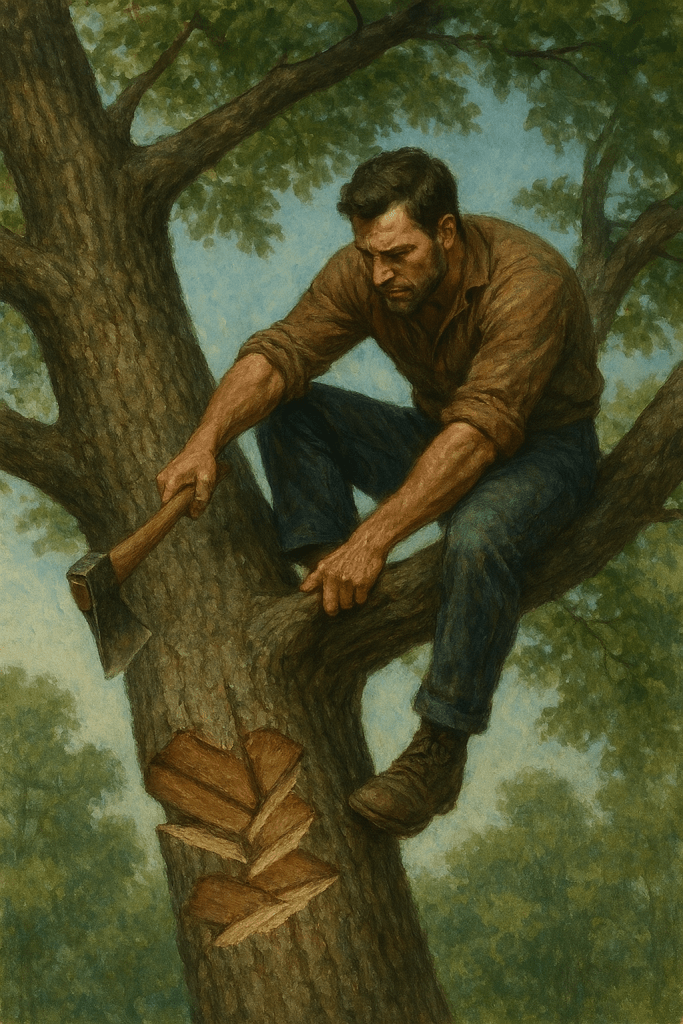
It is a most disturbing picture. Nietzsche correctly saw that humanity was entering a new era, but it did not turn out to be the utopia that so many hoped it would be. The dream has become a nightmare. Suddenly, old and “quaint” fables like the Tower of Babel and Icarus flying too close to the sun become incredibly relevant. We have ascended on high, but was to our ruin and not our salvation?

As I said in my previous post, the world seems to be shifting again, but I am undecided as to whether it is to something better or worse. Now that we have this deeper analysis of society in front of mind, we are ready to look at some of those changes in the proper context and can discuss what they do or don’t say about this deep underlying sickness.

The Richness of Scriptural Symbolism- A Modern Reenactment

My last post was about Jacob and Esau, and how they unwittingly reenacted something deep and eternal and fundamental to the destiny of us all. The hope of us all on judgment day was manifested in their little family drama. They were expressing a symbol of something that didn’t even know lived within them. In my last post I also promised that I had another example of this, a personal one, and today I will share that with you.

Passing on the Way)

This story takes place when I was twenty, serving as a missionary in the country of Guyana. My companion and I spent each day under the blistering Caribbean sun, meeting people on the street, sharing messages in homes, and helping run the affairs of the local branch. Our days were always very full, and one morning we were zipping along the streets on our bicycles, hurrying to our next appointment.

“Hello, Brother Ravi!” we waved as we zoomed past a member of the local congregation. He smiled and called out “good morning,” to us, then went back to slowly pulling himself along the road by his toes. Brother Ravi, you see, was in a wheelchair, too weak in the legs to stand, and too weak in the arms to push the wheels, so he was left to dangle his feet onto the dirt and gravel road, grip with his toes, and inch his way forward at a snail’s pace.

My companion and I turned down two more streets before suddenly we stopped and looked at one another.

“What are we doing?!” I said.

“Why didn’t we help him?!” he responded.

We immediately turned around and raced back to help Brother Ravi get home. As we approached, however, we found that someone else had already stepped in to do it. It was a man who looked extremely ragged. His hair was unkempt, his clothes were full of holes, and his legs wouldn’t bend at the knees. By putting his weight on the handles of the wheelchair, he barely managed to keep his balance, awkwardly shuffling down the street with Brother Ravi. Both the stranger and Brother Ravi were in good spirits, though, happily chatting to one another, with Brother Ravi giving directions to his home. It was clear from their conversation that this was their first meeting, the man was a stranger who stepped in simply because he saw a need.

Even though we were younger and more fit, it didn’t seem right for us to take over this stranger’s kind act of service. With a sense of guilt, my companion and I turned our bikes and continued on our way.

A Story from Long Ago)

It was only when reflecting on this experience that I realized we had reenacted a story that I’d already heard many times before. Brother Ravi, the stranger, and us two missionaries had all unwittingly taken part in the story of the Good Samaritan. Brother Ravi was the man in need on the side of the road, the stranger was obviously the Good Samaritan who went out of his way to help another, and my companion and I had played the unfortunate part of the priest and the Levite, two men specifically called to help those in need, but who had instead hurried on their way. We had abandoned our rightful duty, and it had fallen to another to fill that gap.

There is much that I have learned from that experience, but for now let us consider how the story of the Good Samaritan is full of symbols that manifest themselves in our lives, even without us realizing it at the time. As it turns out, humanity is full of examples of those who should help falling short, leaving strangers to take over the responsibility instead. I won’t go into the details on all of these, but you can see these themes among The Kindertransport, The Righteous Among Nations, and The White Helmets. These were all volunteers who stepped in to help when official aid was lacking or absent.

An important lesson from these symbols having so many applications is that we should never read these stories and say, “This is the one thing that that story is supposed to represent.” Because if it is a truly good symbol, it hasn’t finished representing all that it is meant to represent. There is no one, single, interpretation. Was Jesus’s story meant to symbolize the state of ancient Israel at the time? Yes. Was it also meant to represent me and my companion passing by Brother Ravi? Yes. And a thousand other instances of this pattern as well. It is a story that has played out through the past and will surely play out again in the future.

Scriptural Analysis- Exodus 12:40-42

40 Now the sojourning of the children of Israel, who dwelt in Egypt, was four hundred and thirty years.

41 And it came to pass at the end of the four hundred and thirty years, even the selfsame day it came to pass, that all the hosts of the Lord went out from the land of Egypt.

42 It is a night to be much observed unto the Lord for bringing them out from the land of Egypt: this is that night of the Lord to be observed of all the children of Israel in their generations.

In these verses we learn that the Israelites lived in Egypt for a total of 430 years. Of course, not all of that time was spent in servitude. There is an unspecific gap of time between when Jacob and his sons came into the land and when a later Pharaoh decided to subjugate the Israelite people. It seems likely that most of their time was spent in freedom, as they were not put under Egyptian oppression until they had grown to a mighty number, and the population growth would have started relatively slowly, becoming exponentially greater with each passing generation.

430 years was long enough to make all the stories of Abraham, Isaac, and Jacob, the great patriarchs, distant history to the current generation. Consider that 430 years before today’s date would have been 1593, which was the time period of William Shakespeare and Galileo Galilei. Shakespeare is as far removed to us as Jacob was to Moses. Not completely removed, still well known and with a clear line of connection in between, but removed still the same.

Thus, it was a new Israelite nation that emerged from Egypt, far different from the one that went in. This new Israelite nation was one that knew nothing of its forefathers’ land of inheritance. It was one that had become accustomed to living under another’s rule. It was one that had been surrounded by all manner of false gods and strange practices. But in spite of all this they were being called to reconnect with their foreordained place in the world.

To Live Freely: Part Eight

I am concluding the section of this study where I examine the ways that we set others upon false foundations and all the negative consequences that follow. I’ve considered individual cases thus far, but now I want to turn my scope broader. After all, one way to prove the invalidity of a proposition is to apply it on a universal scale and then see if it maintains its original appeal. With today’s post I will hold the philosophy of the “helpful lie” to this universally-applied metric and see what the result of it is.

Applied in Reverse)

Suppose a religion were to have as one of its tenets that all other religious persuasions ought to be suppressed or destroyed. Clearly things would not work out so well for the members of that same religion if everyone else adopted the same principle towards them! It is a self-destructive policy, because it cannot be applied in reverse without destroying the originator. On the other hand, a religion having a fundamental tenet that there should be religious freedom for all others would be itself benefited and protected if the same principle were applied back to it again.

So I say to the person that believes in using beneficial lies to protect other people, you would do well to consider how you would feel if this same principle was applied back towards yourself, and also universally to all other people. You might say that you are comfortable with people telling you the same sort of lies that you tell to others, but that isn’t a fair comparison. Your idea of what is okay to lie about is your own personal opinion, so to be consistent you would have to be accepting of other people using their own judgment as to what is appropriate to lie to you about. Also, you might feel you could trust the decisions of those who are equal to you in intelligence and morality, but that also isn’t a fair comparison. You are less intelligent and moral than some of those that you lie to, so you must consider how you would feel being at the mercy of those who are less intelligent and moral than you.

Does that sound like a comfortable proposition, being subjected to the false realities concocted by the basest and meanest of society, entirely according to their own opinion and judgment? I’m certain it does not!

When one supports themself in telling a “white lie,” they give all other people permission to do the same, and that’s really not a trend that ought to be being perpetuated. On the other hand, when one firmly decides to tell the truth, they revoke the right of all others to lie. If enough of us were to insist on truth-telling for ourselves, and renounce lying on the part of others, we would likely start to see a ripple of truthfulness throughout our society. Convictions, once held by enough people, influence even those who have not become totally committed to them. And even if we don’t reach the point of mass adoption, at least those who perpetuate honesty will be living in a accordance with a principle that is constructive, not destructive.

Lies Upon Lies)

But let us go back to this notion of lies being told at all levels of our society. I have already discussed in a previous post how a lie, by its definition, separates everyone that stands upon it from the ground level of life as it really is. Everyone who believes in the lie is now out on a ledge which might break under its own weight, particularly as more and more people take residence upon it.

And now, extend that with the realization that many people who are already founded upon a lie are also telling additional lies upon it. People are exponentially multiplying the confusion, carving out more and more from the true foundation, extending ledges out upon ledges, building their deceitful worlds without any knowledge of where the center of balance even is. At some point, we will have the straw that breaks society’s back, and all will crumble in violence and chaos.

And I’m not merely saying that from a theoretical perspective, I believe the notion is borne out by a simple examination of history. I feel that these compounded lies are the only way to explain such collective insanity as was seen at Auschwitz and the Gulag. The deceit might have seemed “harmless” enough at first, a simple mischaracterization of national pride or social inequity. But then that deluded premise was compounded with faulty reasoning for how to address the issue and aggressively expanded by the masses taking hold of the idea, until an entirely untenable reality was force upon millions, killing countless of innocents and eventually collapsing the entire experiment under its own weight.

The only system which is sure to be equal and fair to everyone, the only one that is sure to be founded on solid bedrock, is the one that stands firmly on the ground of the truth. That truth may be unpleasant, and without any simple solutions, but dealing with it directly is the only possible way to make genuine progress. All other strategies are temporary structures, at times very pretty, but all of them doomed to fall.

Scriptural Analysis- Genesis 21:32-34

32 Thus they made a covenant at Beer-sheba: then Abimelech rose up, and Phichol the chief captain of his host, and they returned into the land of the Philistines.

33 And Abraham planted a grove in Beer-sheba, and called there on the name of the Lord, the everlasting God.

34 And Abraham sojourned in the Philistines’ land many days.

Something we did not know until these verses is that Abimelech was king over the Philistine people. Obviously the Philistines will come to be one of the constant vexations to the people of Israel, but at this time their leader is friendly with the forefather of the entire Israelite nation.

I never realized before how the early records in Genesis take special care to detail the origin of nations that will become significant later on. For example we also learned how the Ammonites and Moabites came from the daughters of Lot, and they, too, will eventually be long-time enemies of the Israelites.

I had always assumed that when the Israelites were led out of Egypt the nations they warred against in Canaan were complete strangers to them. Evidently that viewpoint was incorrect, all these countries already had a history with each other.

Another interesting foreshadowing in these verses is that Abraham planted a grove to worship the Lord. Later on his descendants would keep the practice of worshipping in groves of trees, but they would be dedicated to pagan gods instead of the Lord. In today’s culture we have lost the connection between groves of trees and worship, but evidently it was a strong idea back in biblical times.

Scriptural Analysis- Genesis 10:25

25 And unto Eber were born two sons: the name of one was Peleg; for in his days was the earth divided; and his brother’s name was Joktan.

Genesis Chapter 10 is another genealogical chapter, giving the descendants of each of Noah’s children. And I find it very interesting this verse tucked away in the middle of it all, making a casual reference to the time when the earth was divided, which some have interpreted as meaning the supercontinent Pangaea splitting into the seven continents we know today.

Alternatively, it could also mean this was when humanity dispersed itself into different nations, after the confounding of the languages at the Tower of Babel, which we will soon read of. But in either case, what struck me about this verse was that many generations of humanity and hundreds of years are history are being flown by, with virtually no information of what transpired. The scriptures that we have, and also the history we books we have, only ever provide the smallest window into what was really going on in those ancient days.

Later books, such as those of the New Testament, take place in societies where we have a pretty good idea of what they were like. But the stories in Genesis we have little or no context behind. No wonder these tales take on such mythic proportions then, because we don’t even know how to properly conceptualize them.