An ideology predicated upon a lie is perhaps the most destructive force in the world. More than nuclear weapons, more than natural disasters, a false agenda that takes hold will fracture an entire society, kill millions of innocents, and leave the survivors in disarray.
The danger of a misaligned belief system is our innate understanding that suffering is justified for the greater good. Under normal conditions, this instinct is a wonderful good, a necessity for overcoming the evil of the world. Being able to stand up for what is right, no matter the cost, has seen the end of slavery, the birth of liberty, and the restoration of spiritual truth.
But now see how that virtue is twisted when applied to a false cause. Because the cause is false, meaning it is contrary to what is true and right, it will inevitably tear large gashes into society as it is pushed forward. But because it has already been decided to be the right thing to do, the painful consequences are excused as the necessary cost for progress. Thus, we gravely wound our society, and don’t even end up getting something good out of it!
An Example)
Perhaps the most recent example of this in western culture has been the feminist movement. First, the ideology was established by the twisting of a truth. It was correctly noted that men and women are created equal, sharing the same promise in Christ, exactly as taught by Paul:
There is neither Jew nor Greek, there is neither bond nor free, there is neither male nor female: for ye are all one in Christ Jesus. And if ye be Christ’s, then are ye Abraham’s seed, and heirs according to the promise.
Galatians 3:28-29
But then the metrics of equality were dragged down to earthly standards. First, the stations of men were inappropriately exalted. Leadership offices were seen as positions of power, not of service and obligation. The making of money and acquiring of fame became markers of success, rather than the creation and cultivation of the family.
Next, it became the agenda that women should be elevated to the same levels of power idolatry as men. It became the “greater good,” worthy of inflicting damage and suffering to achieve it. Ever since, we have paid the terrible costs of the family system being completely deconstructed, men and women competing as enemies to one another, the cratering of the birth rate, the collapse of civil society, and the murder of millions of unborn children! We have suffered all of this, and all to gain progress in a false agenda!
The Wrong Solution)
This is worse than short-term gains for long-term losses, for there aren’t even the short-term gains! What we should have done is re-established the notion of servant leadership demonstrated by our Savior, eschewed the temptations of fame and fortune, and preserved the cooperative union of men and women as intended by God.
Now things are twisted, hurting, and many more false beliefs have been sown in the cracks of our society. The potential for continued false agendas, which further push suffering and confusion on the world, is great. The path back to genuine truth and healing is growing smaller and harder by the day. If we are not at that point already, soon only an act of God will be able to get us back to what is right. Thank heaven that acts of God remain the one thing we can always rely on!
Great divisiveness in a culture tends to form ideologies with a naïve and overly-simplistic perception of evil. Festering hatred lures people into a mentality where they conceive of evil itself as propagating outward from “those people” over there. Strict ideologues believe that if they could just convert or destroy “those people,” then the evil would be gone, and society would be a perfect Utopia.
This narrow view of evil is a powerful tool for focusing and concentrating the passion of the ideologues. It progressively motivates them to disparage, dehumanize, and destroy their enemies. Mankind has fallen into the routine of dividing, declaring the other side to be the bastion of evil, and then destroying them for as long as we have a historical record. Yet if the problem of evil is so simple, then why has this pattern never succeeded in the eradication of evil? Why haven’t we finally killed it already? Why do we keep facing it in every generation?
The Christian View of Evil)
For an answer, let us consider the Christian conception of evil instead, taken directly from the words of the Bible.
And God saw that the wickedness of man was great in the earth, and that every imagination of the thoughts of his heart was only evil continually. -Genesis 6:5

There is nothing from without a man, that entering into him can defile him: but the things which come out of him, those are they that defile the man. -Mark 7:15

But every man is tempted, when he is drawn away of his own lust, and enticed. Then when lust hath conceived, it bringeth forth sin: and sin, when it is finished, bringeth forth death. -James 1:14-15

For the flesh lusteth against the Spirit, and the Spirit against the flesh: and these are contrary the one to the other: so that ye cannot do the things that ye would. -Galatians 5:17

As it is written, There is none righteous, no, not one: They are all gone out of the way, they are together become unprofitable; there is none that doeth good, no, not one. -Romans 3:10, 12
This view of evil is far more mature, nuanced, and difficult to solve. Instead of saying “evil comes from that group over there,” the Christian perspective maintains that “evil emanates from us all.” It is in me, in you, in everybody. Evil is a super-entity, one that pervades through all of us.
And yes, maybe certain ideologies have a deeper fealty to evil than others; perhaps some dark trains of thought really should be arrested and ceased; perhaps some collectives need to be disbanded; but the true Christian knows that even these efforts will not bring about the perfect Utopia. The true Christian knows that the eradication of “those people” is not the final solution to the problem of evil because even if we stamped all the evil out in one place, it would still seep out from within our own ranks. Eventual corruption is the rule of the world.
The Solution)
Obviously, this conception of evil is much more daunting to wrestle with. If evil will emerge anew in every heart, than what can be done to have victory over it?
Ultimately and universally, nothing.
God will have to claim the victory there because it will always be beyond us. However, on a more individual level, there is something we can do.
This Christian conception of evil, that it arises in every heart, is the very reason why Christianity has always taught that every man ought first and foremost to address his own personal evil before that of the world. That isn’t to say that we don’t concern ourselves with the greater evils of the world, or that we don’t give our energy to curtail it, but our primary concern is to first plug the well of evil in our very own heart. If all of us could just do that, could just get control of the darkness that is within, then that would be the greatest blow against evil we could ever achieve.
It may seem paradoxical, but the fact that evil is so universal means that it can only be remedied individually. It is up to all of us to each do our part.
And the eyes of them both were opened, and they knew that they were naked; and they sewed fig leaves together, and made themselves aprons. - Genesis 3:7
You will never know most of the people you meet.
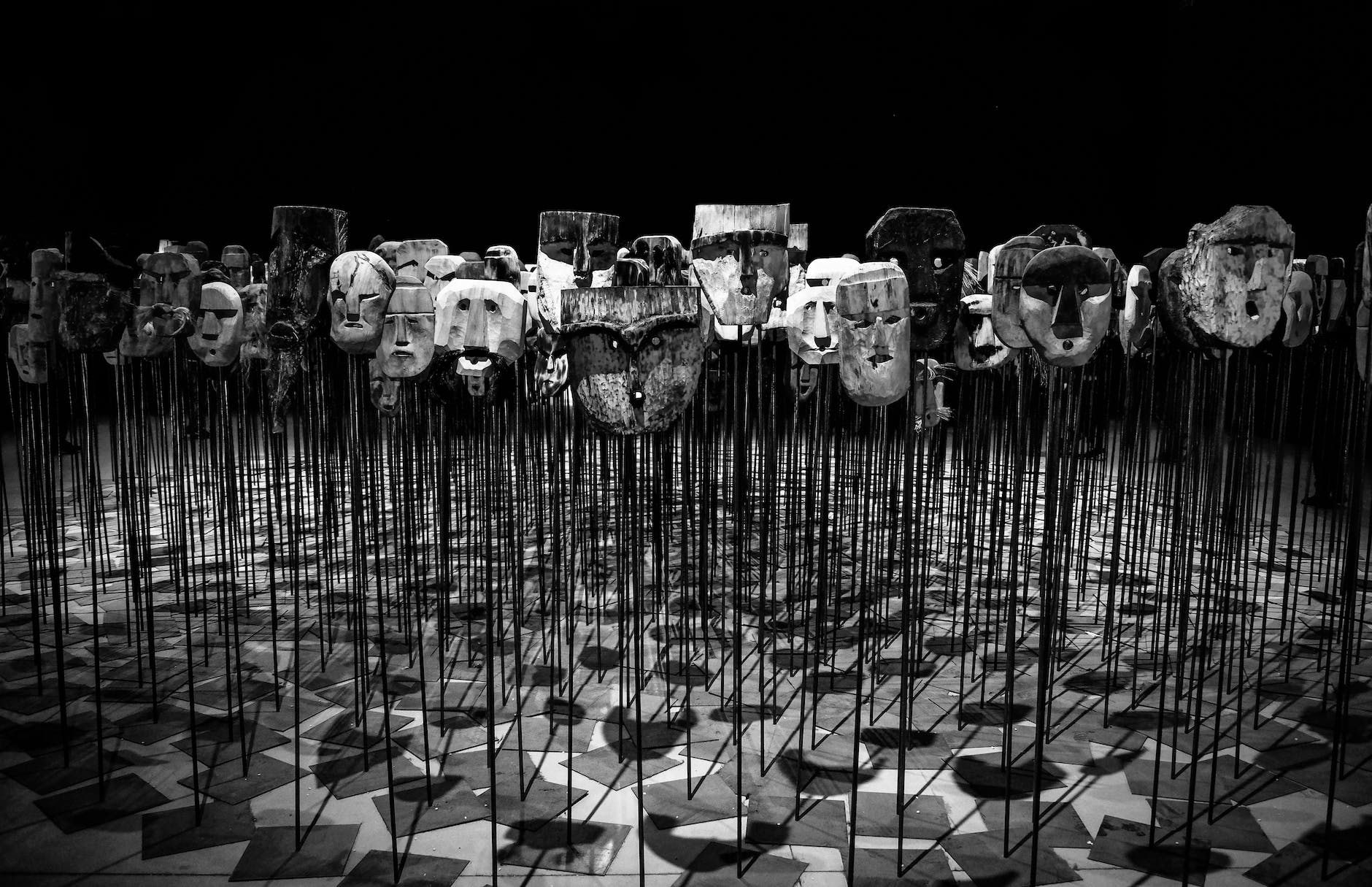
A strange sentiment perhaps, seemingly paradoxical, but it is completely true. Put another way, for most of the people in your life, you will never interact with the actual them, only with their mask. You will only ever know the surface-level, carefully-doctored, phony personality that they are making a conscious effort to project.
Like Adam and Eve, we make aprons. We hide who we really are behind a layer of fashion. A fashion that we hope will make us attractive to the people that we want to like us.
And this phenomenon hasn’t gone unnoticed. We so often complain about how fake everybody seems and how we crave relationships that are more real. But at the same time, we tend to downplay how much we’re playing the exact same game ourselves. Even criticizing the phoniness in others can itself be a social fashion.
Every way of a man is right in his own eyes - Proverbs 21:2

Or how wilt thou say to thy brother, Let me pull out the mote out of thine eye; and, behold, a beam is in thine own eye? - Matthew 7:4
The reason why so many of us don’t realize how much we are projecting our own façade is because we are the ones being fooled the most by it! We pretend to be a particular way for so long that we actually start to believe that is who we really are!
And then we must defend whatever principles and ideologies our delusion is based upon, as any challenge to them might tumble down our entire house of cards. This is what divides our culture into isolated echo chambers, where we surround ourselves with people that show the same façade we are trying to project, we become saturated with their dogma, and then we attack anyone whose façade is at odds with our own. We’ll pick apart all their flaws while ignoring our own, and the whole time we’ll believe that we are standing for what is right and virtuous. In reality, it is only self-preservation.
This cycle, unfortunately, can continue forever. All of our façades are fundamentally flawed in one way or another, and thus each is deserving of criticism, and thus there will always be an easy avenue to tear one another down. The only way to break out of this cycle is to finally admit that our façade is a façade and that it is beneath us.
Because the foolishness of God is wiser than men; and the weakness of God is stronger than men. - 1 Corinthians 1:25

And he looked up, and saw the rich men casting their gifts into the treasury. And he saw also a certain poor widow casting in thither two mites. - Luke 21:1-2
One of the greatest curses that could ever be wished upon someone is that their façade would be good enough and consistent enough for them to never have to challenge it. Continuing to identify with this superficial layer, believing that this who they really and truly are, will stunt any person’s growth. Most of us will never call it quits on our game of pretend until it completely and utterly fails us, so as long as we’re able to be somewhat happy, somewhat secure, and somewhat wealthy we will never have a reason to disrupt the status quo.
And what a terrible fate that would be, for it would forever keep us living in the lower echelons of existence. The wisest and strongest we could ever make ourselves is still superseded by the most simple and weak of God. The uneducated and frail woman who gave her two mites was living a more complete and joyful life than the learned and powerful rulers who made a great show of giving their riches. Authentic living, even of the humblest variety, trumps inauthentic living, even at its most extravagant.
Many the addict has learned to be grateful for their life-destroying vice, because hitting rock bottom was what finally brought them to drop their façade and start living with actual authenticity. To have not been destroyed might have meant to never truly live.
***
But what about for me personally? What has been my go-to façade, what are its strengths and weaknesses, and why wasn’t it enough to keep me content in life? The way I try to come across is extremely intelligent and incredibly nice. Let’s look at each of these qualities one at a time.
Intelligent)
I want people to know that I know things, and I will absolutely pretend to know more than I really do. I will also carefully avoid conversations that might reveal my ignorance in a particular area.
I work in a highly technical field, and when other people start throwing out jargon that I don’t know, I feel very uncomfortable about my ignorance. I try to glean enough context to give an intelligible response, all the while terrified of being found out as a fraud. My great hope is that I will be able to continue the illusion of knowing everything that I need to know and having many wise insights to offer.
Nice)
But I don’t want to be seen as too full of myself. I want to be recognized as smart, but not conceited. So, I also make myself into quite the people-pleaser. I defer on my own preferences and opinions, give everyone the benefit of the doubt, and never say a bad word about anyone.
I’m also very careful to do all of the things I’m supposed to be doing as a good person. I go to church, I pay my taxes, and I am never to be seen in a disreputable establishment! I want people to know that they can depend on me to be just the sort of guy that they think I am. The sort who quietly handles all his own struggles without being a bother to anyone.
Now obviously, not all of these qualities are bad things, and not all of them are totally fake. In some areas of life, I really am intelligent, and I really can be very kind. But I’ve taken these natural qualities and I’ve overinflated them. At some points I’ve embellished them with outright lies.
Some of these behaviors are outright unhealthy, such as always deferring my own preferences. Some of them are unhealthy simply because they are coming from an inauthentic place, such as when I listen closely to what someone else is saying and give a meaningful response, but only so they will know what a great guy I really am.
But if I genuinely do have some good qualities, why do I feel the need to exaggerate and pretend? We’ll get more into that as we continue this study, but the short answer is because my basic goodness was wounded at some point, and I concluded that it wasn’t good enough. I was smart, but not smart enough. I was thoughtful, but I wasn’t thoughtful enough. Someone told me I had failed to measure up and I had to do better.
Not only that, but hidden away, beneath my phony exterior, my vices were rapidly growing. The façade had to stretch to cover all the parts I didn’t want to be seen. The more secret shame I had, the more I had to shore it up with pretended goodness on the other side.
And this, of course, brings us to the next layer of the human soul: shame. When a person makes a decision to start living an authentic life, the first thing they usually bring to light is the naked shame that hides beneath the fancy costume. Tomorrow we will uncover this layer, but we will do so with kindness and understanding.


 Spiritual Wanderings