Scriptural Analysis- Leviticus 3:12-16

12 And if his offering be a goat, then he shall offer it before the Lord.

13 And he shall lay his hand upon the head of it, and kill it before the tabernacle of the congregation: and the sons of Aaron shall sprinkle the blood thereof upon the altar round about.

14 And he shall offer thereof his offering, even an offering made by fire unto the Lord; the fat that covereth the inwards, and all the fat that is upon the inwards,

15 And the two kidneys, and the fat that is upon them, which is by the flanks, and the caul above the liver, with the kidneys, it shall he take away.

16 And the priest shall burn them upon the altar: it is the food of the offering made by fire for a sweet savour: all the fat is the Lord’s.

We heard the process of offering cattle, and sheep, and now a goat. And the instructions for doing so have been essentially identical all the way through.

This sort of repetition and redundancy in the Bible is well-known and has even been the target of mockery. Why doesn’t the record just give the instructions once, and then say that it applies to all three animal types?

Perhaps it is because the sacrifices were individual, so the descriptions for them were also. There are many things that we do in life that are repetitive, yet we describe them in detail because they are also individual. When a child is born, we don’t just say, “yeah, the birth went like all the other birth stories you’ve ever heard.” No, we still share about the contractions, and the water breaking, and the drive to the hospital, and the delivery, because these moments, though common to many people, still occur to us on an individual level. And this child’s birth is not the same thing as that child’s birth. So, too, every animal that was slain at the altar was an individual process. Every time that a person has made an offering of their heart to the Lord, it is not the same thing as another person’s offering of the heart. Each of us walk a path that sounds like many others, but it is also a path that no one else has ever walked before.

SacrificeEligible oblationStepsExplanation
Peace OfferingCattle, Lamb, GoatGratitude for reconciliation
Animal is slainGiving up old life for one of unity with another
Fat burned on altarGiving up old plans, passions, and drives

Full table.

Taking Accountability- Conclusion

Big Problems)

In this little series of posts, it was my sole intention to act out the principle I had recently espoused, to put my behavior where my belief was. And so, in the aftermath of Charlie Kirk’s death I identified a way that I contributed to the culture that got him killed, and I took steps to change my behavior accordingly.

But that wasn’t all that came out of these posts. By going through this exercise, I was able to more fully flesh out some of the vague ideas that originally inspired my call for us to find our own personal responsibility in every ill that besets us.

I realized that a major reason for us all to seek out our own slice of responsibility is because that is the only way that the world will ever be healed. Some problems are just too big for some of us to solve it for everyone else. Everyone has to tackle the part that is directly in front of them.

We must not have the arrogance to think that we can divide ourselves into fixers and problems. We all have to see that we are each a fixer, and we are each a problem in and of ourselves. And so, we must take our fixer part and use it on our own problem part, and only by doing this individually can we heal collectively.

A Call Inward)

I invite all of us to start looking at the big problems of the world in this way. I suspect it will be best if we look at the deepest problems, things much more fundamental than politics or ideological divides. Let us consider the hate, the poverty, the deceit, the confusion, and the loneliness. For once, let us set aside who is most responsible for these issues, and just ask, “to what extent am I responsible?”

Is there something negative that we are doing that we could stop? Is there something positive that we should be doing that we are shirking? Can we truly say that we have a clean conscience? That we have contributed nothing to the problem? That we have done our part to contribute to the solution? Or is there room for improvement, room for taking the beam out of our own eyes, room to re-establish heaven in our little corner of the world?

Fundamental Error

Many feuds in our society today are a lost cause no matter which side of the debate you are on, because both positions are built on a false surface-level paradigm. To find true solutions we must first go deeper, identify the faulty paradigm, and dismiss it entirely.

For example, many of the most common disagreements in marriage, such as who gets their way between high- and low- sexual desire partners, the proper management of finances, and the conditions that justify getting divorced, are typically predicated on the misconception that even after the marriage union has occurred the individual is the supreme entity whose interests must be secured above all others.

People get married today, still believing that their individual happiness is what should be protected first, that their own interests must be sought most, and that their own preferences should drive their decisions. Then man and wife argue about how their individual egos are being bruised, how their individual desires aren’t being met, how the marriage isn’t justifying itself to them on an individual level. Whoever gets their way in such arguments, the answer is wrong, because this is not the paradigm that Jesus affirmed when he was tested by the Pharisees.

And he answered and said unto them, Have ye not read, that he which made them at the beginning made them male and female, And said, For this cause shall a man leave father and mother, and shall cleave to his wife: and they twain shall be one flesh?
Wherefore they are no more twain, but one flesh. What therefore God hath joined together, let not man put asunder.
-Matthew 19:4-6

Our Lord’s words shows that the correct view is that the man and the woman are “no more twain, but one.” They are supposed to subjugate the individual to the marriage, and protect that union’s happiness, seek its interests, and let its preferences drive their decisions.

So long as one holds onto the individual-supreme view, then any position they hold in every disagreement is wrong, and even the opposite positions are wrong, too. There are, therefore, no good options left, at least not until that person goes deeper inside and corrects their core paradigm.

Scriptural Analysis- Exodus 39:10-21

10 And they set in it four rows of stones: the first row was a sardius, a topaz, and a carbuncle: this was the first row.

11 And the second row, an emerald, a sapphire, and a diamond.

12 And the third row, a ligure, an agate, and an amethyst.

13 And the fourth row, a beryl, an onyx, and a jasper: they were inclosed in ouches of gold in their inclosings.

14 And the stones were according to the names of the children of Israel, twelve, according to their names, like the engravings of a signet, every one with his name, according to the twelve tribes.

15 And they made upon the breastplate chains at the ends, of wreathen work of pure gold.

16 And they made two ouches of gold, and two gold rings; and put the two rings in the two ends of the breastplate.

17 And they put the two wreathen chains of gold in the two rings on the ends of the breastplate.

18 And the two ends of the two wreathen chains they fastened in the two ouches, and put them on the shoulderpieces of the ephod, before it.

19 And they made two rings of gold, and put them on the two ends of the breastplate, upon the border of it, which was on the side of the ephod inward.

20 And they made two other golden rings, and put them on the two sides of the ephod underneath, toward the forepart of it, over against the other coupling thereof, above the curious girdle of the ephod.

21 And they did bind the breastplate by his rings unto the rings of the ephod with a lace of blue, that it might be above the curious girdle of the ephod, and that the breastplate might not be loosed from the ephod; as the Lord commanded Moses.

Today we hear of the 12 stones set upon the breastplate, and the golden chains that anchor it to the shoulders of the ephod, and the blue lace that anchors it to the side of the ephod.

The 12 stones are some of the most individual pieces in all the ornaments of the tabernacle. Each one would have to be shaped and engraved uniquely, just as each member of each tribe would receiving individual care at the hands of the priest.

As with the original description from God, these verses emphasize that the binding of the breastplate to the ephod was so that it “might not be loosed.” This has an obvious practical function, to keep the thing from swinging around and banging into the priest as he goes about his duties, but there is also a symbolism in it as well.

If the breastplate represents the twelve tribes of Israel, and the ephod is the garments of the Lord’s representative, then their tethering together can be seen as a spiritual injunction that the two parties must not drift apart. The people of Israel should see that they are always bound to the tabernacle, the rituals of the priests, and all that they represent. They must bind themselves to God’s commands as if by the strength of metal above and the pliability of lace below.

God’s Body: Introduction

I am currently reading through Paul’s letters to the churches in the ancient world with my family. We covered 1 Corinthians 12, where he speaks at length about the Body of Christ, and how we are all a part of it. This subject lingered in my mind, spinning off all manner of different tangents and realizations. I wanted to try and gather all of these separate notions and put them into some order, which is what I will endeavor to do with this series.

There will still be some stream-of-consciousness nature to the following posts, but I hope to progress from one point to another with a logical point of connection in between. I also hope to mostly progress in a linear way without curving back too much on previous topics.

If there is a central theme to this series, it will be the Body of God, and our relation to that body. “Body” is an interesting word, because it simultaneously means something that is specific and individual, such as “the body of a man,” but also something that is abstract, aggregate, and many, such as “the body politic.” I believe that the Body of God can be seen in both these lights, which my posts will explore.

Maintaining Hope in a Doomed World

A Vision of Destruction)

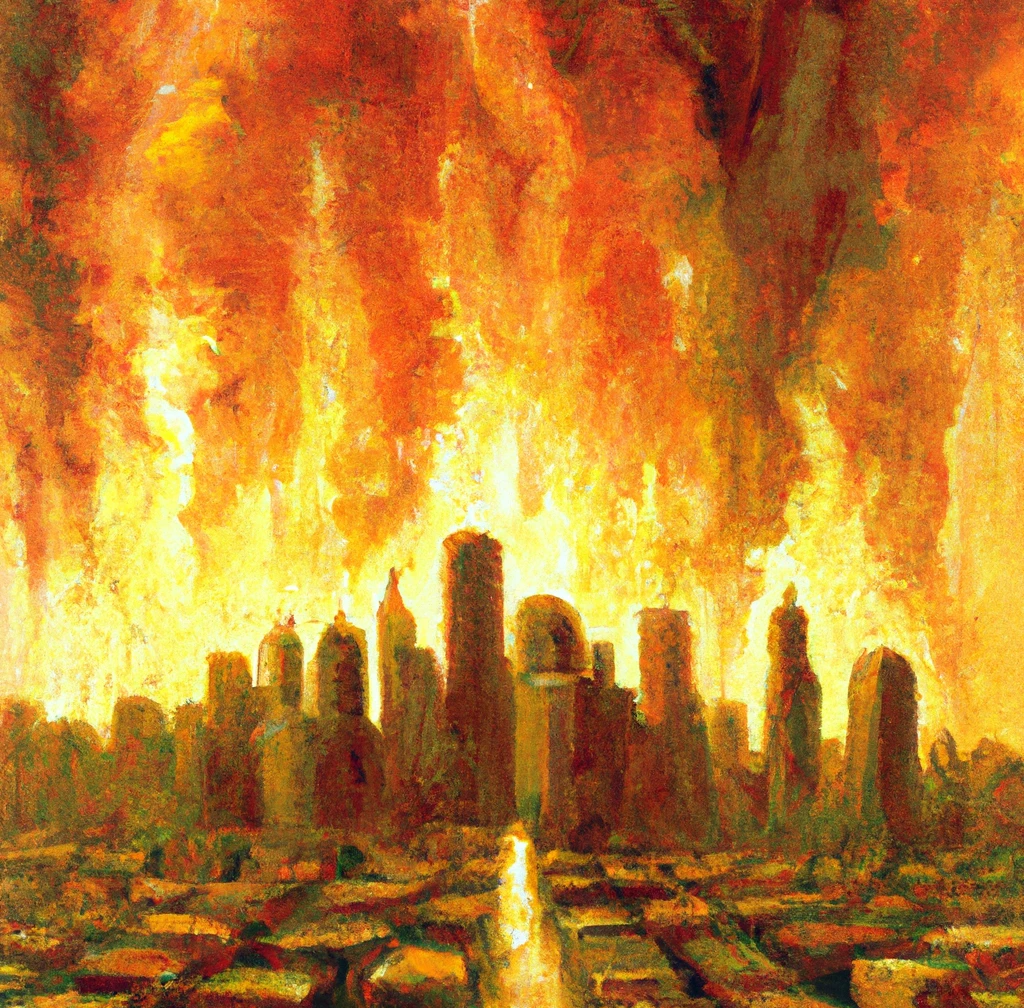
The Bible’s descriptions of the final days have struck fear into the hearts of many people. Even those who are otherwise unacquainted with the stories and messages of the Bible are still familiar with its visions of fire and brimstone raining down upon the world, destroying all the wicked, administering God’s judgment before the return of Christ. The passages also describe the terrible persecution that will first afflict the faithful, and that the world will ultimately reject the gospel message before they feel the wrath of heaven.

Given all this, it can be easy to feel pessimistic about ministry efforts in the world today. We’ve skipped ahead and read the end of the story and we already know that the world as a whole does not become convinced by the missionary efforts of the righteous. So why bother protesting evil? Why speak against the ways that society is moving towards its own destruction? The world is just going there anyway, so why not just separate yourself from it and live as a faithful hermit?

The Many and the One)

If, indeed, we are in the last days, there is a sort of logic to all those cynical, nihilistic questions. If we are fast approaching Armageddon, then no matter what we do the world is still doomed to fail, and so any effort on our part to save it are also doomed to fail.

But saving the world or abandoning it aren’t our only options.

Maintaining the light of hope and optimism, even in the midst of a world falling apart, only requires us to shift our perspective from the many to the one. I have made this point previously, that anyone who is focused on saving the whole world will be disappointed, but anyone who is focused on saving the individual may yet find success.

We could see ourselves as firefighters standing before a blazing building. Perhaps the fire has spread through too much of the structure to save it. Perhaps the whole thing is coming down no matter what we do. But what about the individuals that are trapped inside? There may yet be time to rush in and get as many of some of them as possible out to safety before it all comes crashing down!

Even if the earth is going to hell in a handbasket there is still a work for us to do, a challenge for us to meet, and a success for us to achieve. We can follow Christ’s admonition to stop fixating on the ninety-and-nine, and to go in search of the one, bringing it back with great rejoicing!

The fate of the world is already known, but the fate of you, your loved ones, and your neighbors still hangs in the balance.

Basis for Judgment: Summary

I’ve spent the last week-and-a-half exploring this concept of why we believe the things that we do, and which justifications for our moral alignment are reasonable and which ones are not. Today I’ll wrap things up by reviewing all of the things that I’ve covered.

Our Basis for Right and Wrong)

After contemplating the different foundations people set their judgment of right and wrong upon, I concluded that there were three main bases. A person judges what is right and wrong based on what God has said, or what society has said, or what he, himself has said.

I observed that people in our society have adopted a principle that they must listen to their own heart, determining their own right and wrong to live by. I also noted that usually what we think comes from our own self, has actually come from the society we live in. We tend to absorb the ideas we are surrounded by osmosis and then have those ideas come out of us word-for-word the same as we heard in the public square. Thus, most people end up basing their morals on what society has said, but they think they have based it upon themselves.

But neither individual whim or society’s favor are reliable bases for determining what is right or wrong. Both of them have too much variance and transformation to reflect any sort of objective, universal truth. What is “right” in society today was wrong yesterday, and likely will be wrong again in the future. A cursory glance at history shows us that it’s not as if society only improves, either. Sometimes it gets better, but sometimes it gets worse. Things have been brighter since the dark ages, but things were also brighter before them. Who is to say whether society today is at a local maxima or minima? We might think we know, but some future generation somewhere will surely disagree.

Sooner or later, any who believes that truth is defined by the individual or the society and pursues that logic to its end must come to the only possible conclusion: there actually is no absolute truth, no ideal, no sacred or unchanging standard by which our actions can be judged. Morality is transient and subjective, and any attempt to censure another person as being “wrong” is both hypocritical and vain.

The Proper Basis)

The only logical and consistent basis for moral judgment is God. Only a being that exists outside of the individual or society, one that is constant through all ages, one that is greater than the created world could lay down a law and a morality and a truth that would be consistent and objectively right.

Of course, the identity and exact opinion of that God would still be up for debate, but at least we would accept that truth could only come from some sort of theology. Of course, it would be important to acknowledge that whatever god was the true God, our knowledge of His universal law must transcend from heaven itself. It cannot simply be the idea of some man that this is what God must want, God Himself needs to have dictated it to some persons, and those persons need to have written it down as directed. Again, if such a thing were to occur, it would still be a matter of opinion as to which sacred book actually represents the mind of God, but at least we would accept that the truth could only be read out of the scripture He had given us.

And then, once we felt that we had identified that true scripture, from that true God, describing that universal truth that we are all beholden to, then all competing ideas and philosophies would have to be discarded. Never mind if your loved ones thought you were crazy, or your friends reviled you, or society persecuted you, or the great enemy destroyed you. Because, as we have established, none of those other voices have any foundation to stand upon as they oppose you. Let them think, say, and do what they will, their logic and methods are self-defeating, and all of them will crumble in time.

You, however, will have made yourself an acolyte of genuine truth, and having laid hold of it, you will be united with the only thing that is permanent, the only thing that can stay with you through all of life, and even into the world that lies beyond. Whether you be a Christian, a Jew, a Muslim, a Hindu, or any other believer of divinely-inspired words, hold to that inspired truth above all others, and your existence will surely work out better for you than chasing the ever-changing goalposts of society’s latest fad.

The Whole From the Parts

Individual notes might have a beautiful resonance, but if they stand alone they seem random and purposeless. It requires as an external composer who can arrange them in a sequence for them to have a greater function and beauty. Each note knows nothing of the greater song, yet each is essential to it.

So it is for the stars in the heavens. Individually each is beautiful, but if separated from the rest there are no constellations, no signs of the seasons, no greater whole in the heavens. The full picture only comes when all are taken as a whole, but the whole can only exist because of the individual contribution of each member.

And so it is also for us and the good that we do. We do not know the greater song, the greater sign that we are a part of. We try to live good lives, we try to help where we can, we try to make something beautiful, and each of our efforts are worthy in their own way, but they tend to be localized and short-lived. But if we could see how all of our small, random efforts were being combined and arranged alongside of one another, we would realize that a great author and composer has arranged us with purpose and intent, forming a crescendo, a constellation, a beautiful, greater whole.

Now and again, if we are lucky, we occasionally catch the smallest glimpse of the larger picture, just enough to convince us that there is a symphony and a shape formed through all of humanity. That greater whole surpasses each individual part, but it can only exist because of each individual. I am sure that when we pass over to the other side we will finally be able to appreciate the finished work at a distance, and we will find closure in knowing the vast beauty we were all a part of.

Scriptural Analysis- Genesis 26:1-5

1 And there was a famine in the land, beside the first famine that was in the days of Abraham. And Isaac went unto Abimelech king of the Philistines unto Gerar.

2 And the Lord appeared unto him, and said, Go not down into Egypt; dwell in the land which I shall tell thee of:

3 Sojourn in this land, and I will be with thee, and will bless thee; for unto thee, and unto thy seed, I will give all these countries, and I will perform the oath which I sware unto Abraham thy father;

4 And I will make thy seed to multiply as the stars of heaven, and will give unto thy seed all these countries; and in thy seed shall all the nations of the earth be blessed;

5 Because that Abraham obeyed my voice, and kept my charge, my commandments, my statutes, and my laws.

A famine occurred, much as it did for Abraham. Isaac had to set out from his home, much as did Abraham. He was led to the land of the Philistines, much as was Abraham. And along his way God promised him innumerable descendants and a great land for an inheritance, much as He had to Abraham.

But while Isaac’s story may heavily mirror Abraham’s in some parts, he still was not Abraham and he had his own, individual walk with God. That walk meant continuing the path that his father started, but he was covering new ground along his way. Some of the differences between his path and Abraham’s are how the matter of having posterity was resolved much more quickly for Isaac, he was not asked to sacrifice his son, and he was already well on his way to wealth from what he had inherited.

Many things appear to have been easier for Isaac than they were for Abraham, and perhaps that is why so little of his story is recorded in the Bible. He is the main character only for the rest of this chapter, and then the focus will shift to Jacob, his son. Isaac served his purpose of continuing the line and the promise, but greater advancement in the face of adversity would come during the next generation.

Scriptural Analysis- Genesis 6:8-9, 17-18

8 But Noah found grace in the eyes of the Lord.

9 These are the generations of Noah: Noah was a just man and perfect in his generations, and Noah walked with God.

17 And, behold, I, even I, do bring a flood of waters upon the earth, to destroy all flesh, wherein is the breath of life, from under heaven; and every thing that is in the earth shall die.

18 But with thee will I establish my covenant; and thou shalt come into the ark, thou, and thy sons, and thy wife, and thy sons’ wives with thee.

There was mass evil in the world, so universal and so extreme that God was set on washing the slate clean. But in all this crowd of corruption, God did not lose sight of one who was innocent.

The story of Noah is a very encouraging example of how God is perfectly aware of the individual, and the great lengths to which He will go to save that one. As humans we often struggle to be so individually conscious. We have limits of time and space, which is why our laws are usually applied universally, targeted towards the average, but ill-fitting to all manner of individual edge cases. God, though, can raise a flood over the entire world and still hold a single boat safe in the palm of His hand.