Grit vs Surrender- The Common Struggle

Moral Grit)

It is the common struggle of man to strive to be better, and to fall short more often than not. We have certain aspirations of personal character, some of them come from our religious upbringing, some from societal norms, and some that we have chosen just for ourselves. And though we might be truly convinced of the merit of these goals, our convictions still run into opposition in the form of laziness and sensuous pleasure.

There are those that see these struggles and wonder why anyone should even bother. They are disciples of hedonism and self-idolatry, who feel that the only reason needed to not change a behavior is to find personal pleasure in it. If it feels “good” then it is good, and any attempt to cease it is oppressive and restricting.

There are also those of a spiritual frame of mind who approach their moral struggles with a surprisingly similar view. Their main distinction is that they say keeping the commandments is worth it, that the rewards are greater than the personal pleasure surrendered, but they still see the entire enterprise as an exercise in self-oppression. They believe that they must flagellate themselves into obedience, psychologically if not physically.

Thus, there are many atheists and theists alike who see the developing of moral character as taking real grit and determination, forcing oneself to be better in spite of all contrary desires and temptations.

Another Way)

I would like to suggest that this isn’t the correct way for moral change to occur. It isn’t the way that God ever had in mind for us. I believe that Jesus was sincere when he said, “Come unto me, all ye that labour and are heavy laden, and I will give you rest. For my yoke is easy, and my burden is light” (Matthew 11:28, 30). Jesus isn’t saying his way is easy because we won’t require change, as the hedonist would have, but neither is he saying that that change will come through struggle and punishment, as the ascetic would have. Counter-intuitive as it sounds, Jesus is promising a life of absolutely radical transformation, and that it will occur easily and lightly.

Well, eventually easily and lightly. As we will discuss in this study, there is an initial moment that is, in fact, very hard. Following Jesus begins with a little death, a moment of deep, difficult, surrender. For both the hedonist and the ascetic, the reason that they have not found the easiness of Jesus’s path is that they have not gone through that surrender. Whether because they are an outsider who rejects the Lord outright, or because they are an insider who is still trying to achieve sainthood with pride intact. Either way, they haven’t gone through that little death and so change still looks hard and oppressive.

Thy Sins Are Forgiven

One of the most common phrases of Jesus’s ministry was “thy sins are forgiven thee.” When the paralytic man was lowered to him through the roof, Jesus first forgave the man’s sins, then healed his body. When the woman of many sins wept on his feet and anointed them with ointment, he also told her that her many sins were forgiven. The woman taken in adultery he did not directly forgive, but he did provide her a stay of execution and implored her to sin no more, implying that he was giving her time to seek the same forgiveness that the others had received.

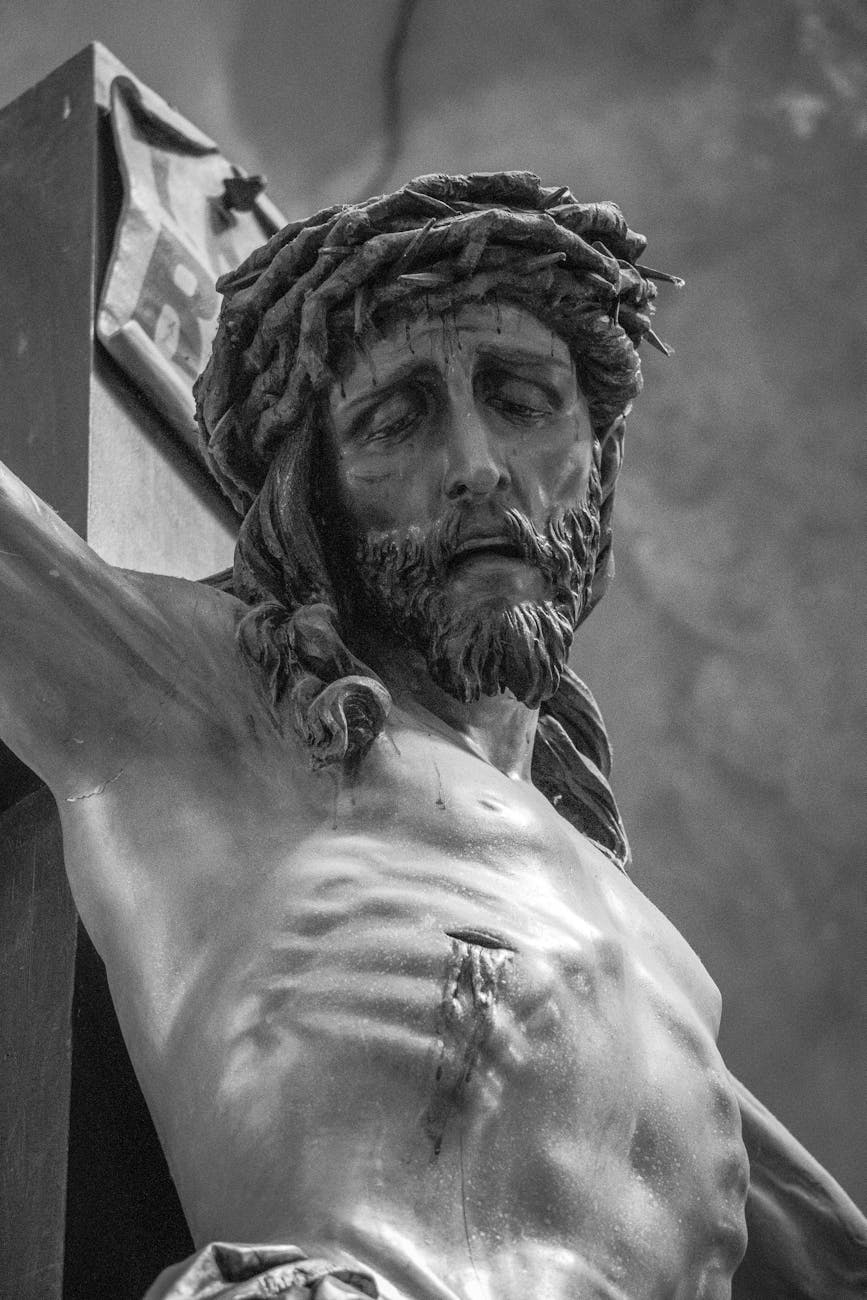
Even as he was dying on the cross, Jesus had two famous moments of forgiveness. He interceded for the Romans who were carrying out his execution, observing that they were acting without understanding. He also promised the repentant thief that the two of them would see each other in paradise, implicitly forgiving him of the very sins that the man was being put to death for.

These are nice moments to think on, times where Jesus gave the greatest gift that we can experience in this life. I can’t imagine reading these stories and not being moved with happiness and hope.

But I think it also worth noting the deep gravity behind them also. I think we should always remember that when Jesus said, “thy sins are forgiven thee,” that forgiveness did not pop out of nowhere. Yes, it was given freely, but it was not acquired freely. Every time Jesus uttered those words an implication followed, “thy sins are forgiven thee, because I will die for them.”

In Hebrews it states:

For where a testament is, there must also of necessity be the death of the testator.
For a testament is of force after men are dead: otherwise it is of no strength at all while the testator liveth.
Hebrews 9:16-17

Surely, part of the reason why the death of the testator, Jesus, was necessary, was because his New Testament would take the place of the death penalties in the Old Testament. Thus, when Jesus let the woman taken in adultery go free…it was only because he was going to be killed in her place. And in all the other cases where Jesus pronounced “thy sins are forgiven thee,” those were only words until he paid the price that would give them actual force. The wages of sin are death, and so forgiveness of sin could only be real after his death for them.

We rejoice whenever Jesus’s words of forgiveness, mercy, and healing come upon us, and well we should. We marvel at how freely we receive them, how they seem to come from out of nowhere. But in the midst of our joy, we should remember that the freeness of them is only an illusion from our perspective. In reality, with every word of forgiveness Jesus gives to us, he is agreeing to die for them also.

False Moral Dilemmas- Moral Inaction

Jesus’ Silence)

In my previous post I discussed how Jesus managed moral quandaries and snares that his enemies tried to set for him. Another example that I did not mention was how he would employ silence, rather than engaging in the problem at all. We see this in his trials before the Sanhedrin, Herod, and Pilate. With the Sanhedrin and Pilate, he did not speak until the time was right, or to correct their faulty framing. To Herod, a most wicked man, and the murderer of his cousin John, he never said any word at all.

From Jesus’s example, we see that sometimes the outside-the-box moral solution to a moral dilemma is to just not engage with it at all. When the entire framework of the problem is flawed, when the premise of the whole thing is set to entrap us, there always remains the option of moral non-engagement.

Unforced Errors)

I previously gave silent non-engagement as a solution to the supposed moral dilemma of Nazis at the door asking where the Jews are hiding. Once again, if there are no good options to engage in, you can just not engage. Sometimes inaction is the most moral choice that there is.

This is a critical thing to understand, as it breaks the last parts of the illusion that sometimes we must choose one evil or another. If there are truly no good options, just choose none of them at all. No situation or contrivance can ever force us to do anything. They cannot make us break conscience. We only ever do what we allow ourselves to do.

Of course, all of us will compromise ourselves at some point. We will all break conscience. But it is important to understand in those moments that we didn’t have to do that, we chose to. That’s something I’ll explore more with my next post.

False Moral Dilemmas- The Third Choice

The Need for Miracles)

In the last post we discussed so-called moral dilemmas present us with only bad choices, each a compromise of conscience, but if we are willing and creative enough to find it, there is typically another option that sidesteps the dilemma and allows us to keep on the straight and narrow. First, we have to move outside of the manufactured box that our tester has put us in, then see the full range of possible choices, and finally be willing to accept the consequences for sticking to what is right.

Indeed, a common theme all throughout the Bible is people who are faced with exactly these sorts of situations, who then have to step outside the bounds of their initial perception and rely on a miracle to accomplish good and retain their souls. Think of Lot, who saw his only choices as letting the wicked men of the city either rape his guests or his daughters, but who was then saved by angels. Think of Joseph who could either put Mary away in secret or have her stoned for adultery, but who then received a heavenly message to show him that she truly bore the son of God. Think of Solomon who had two women claiming to be the mother of the same child, with nothing in their testimony to show him whom to believe, but who was blessed with wisdom to find out the truth.

Moral dilemmas, and their outside-the-box solutions, are a key theme in the scriptures. When the righteous are faced with no-win scenarios, that’s when the hand of God becomes manifest to show them another way. Indeed, the entire point of the gospel is that it provides a surprise solution to a damned situation. Many of us will sin and earn the suffering of hell, while those that die in their innocence are still swallowed in the grave. No matter which path we take through this life, we’re damned, at least we were until a Savior presented us a miraculous alternative.

The Master of Third Options)

It comes as no surprise that Jesus, himself, was a master of resolving seeming no-win, moral dilemmas. I think more than any other figure in the Bible he was put to the test with contrived situations that tried to get him to compromise himself one way or another.

Think of when the Pharisees brought him the woman taken in adultery, and asked if he would uphold Moses’s law, which required the stoning of the woman. Would he deny the law? That would be heretical. Would he condemn her to death? That would go against his mission to forgive and to save. Jesus stepped outside of their trap, though, and said, “He that is without sin among you, let him first cast a stone at her.” In so doing, he touched their guilt and got them to slink away in shame.

But it’s not as though he was denying the justice of the law. Jesus was still worthy to stone her, but also, he was able to forgive her because he would take her stoning upon himself when he laid his life down as a ransom for the world. Thus, Jesus did not transgress justice, nor embrace condemnation. He found a third way to satisfy justice and make space for mercy.

Think also of when he was asked whether the people should pay taxes to their oppressor Caesar. On the one hand, he could say that yes, they were required to pay their taxes, which would offend the people. Or he could say no, that they should defy Caesar, which would make him an enemy of the state. Jesus, however, chose a third option. He showed the people that their entire framing was wrong. They were putting too much value in worldly currency, thinking that it amounted to anything of moral weight in the eyes of the Lord. He reminded them that worldly treasure and spiritual sacrifice were two separate things, one properly pertaining to the world and one to God. By helping to disentangle the two, and setting the spiritual as superior to the temporal, Jesus found a third path that both approved the paying of taxes while also diminishing its importance in the broader scheme of things.

The stories of Jesus and others in the Bible shows us that we may be given traps where it appears that there are no good solutions, but that if we have some ingenuity, or even some divine intervention, the moral way is still there for us. As Paul told the Corinthians, “With the temptation,” God will “also make a way to escape” (1 Corinthians 10:13).

Why Did Peter Deny Jesus?

This Easter season I’ve been thinking about Jesus’s final week, culminating in his crucifixion and resurrection. One point that has stood out to me is Peter’s behavior on the night of Jesus’s arrest. Let us look at two moments from that evening:

  1. When Jesus’s captors arrive in the Garden of Gethsemane, Peter boldly leaps forward and cuts the ear off of one of them. He does this, even though Jesus and the disciples were almost certainly outnumbered and under-armed. It seems that if Jesus had not intervened, Peter’s actions would likely have gotten himself killed.
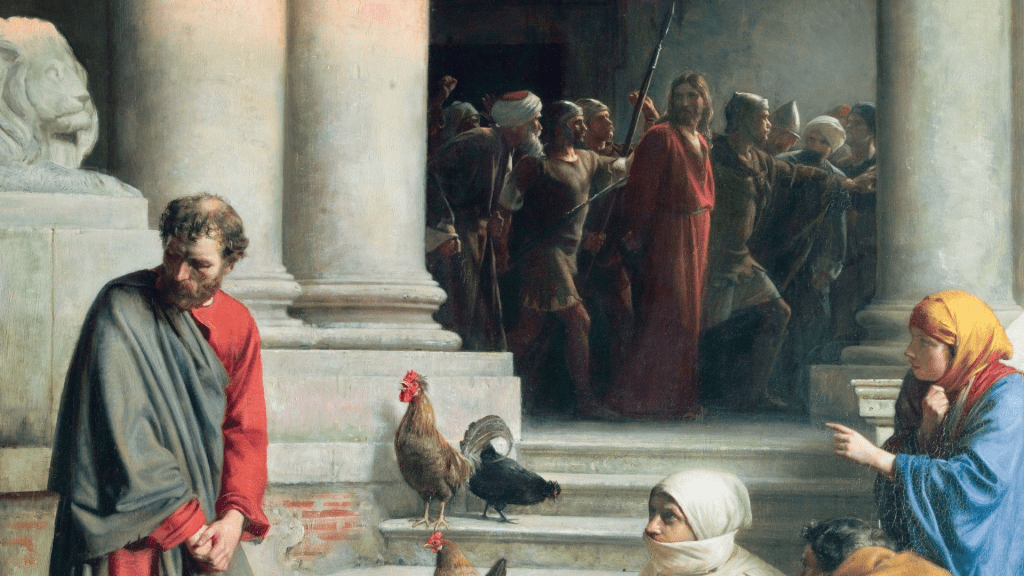
  2. After Jesus diffused the situation and surrendered to his arrest, Peter followed, waiting in the courtyard of where Jesus was being held. There he was recognized three times as one of Jesus’s followers, and each time denied it. It seems that he did this to preserve his life, to not get himself killed.

So why would Peter shrink from death in the latter case, but charge headlong toward it in the first?

I’ve always assumed that it was because Peter was acting in the heat of the moment in the first case. It may not have even crossed his mind that this could get him killed, he was just overcome with passion and acted without thinking. But during the arrest and the interrogation of Jesus, Peter had time for reality to set in, allowing him to truly feel the weight of the danger he was in, and his growing fear led him to lie.

That could certainly be the case, but as I’ve thought about it, I’ve realized that there could also be another explanation for his differing behaviors.

Another Theory)

Going back to the arrest at the Mount of Olives, what if Peter was actually fully aware that he was putting his life in jeopardy, and he was doing it deliberately? What if he was willing to sacrifice himself to give Jesus and the other disciples a chance to escape? If that were the case, then it must have been a great shock when Jesus instead rebuked him and peacefully submitted to the arrest. Jesus would have crushed the sacrifice he had been trying to make.

Now consider the second instance, where Peter lingered in the courtyard outside of Jesus’s interrogation and denied that he knew Jesus. In this case, there was no heroic rescue to be achieved by telling the truth. The only reason to admit that he was a follower of Jesus would be for the principle of the matter, to show that he would rather die than deny his master. Just because Peter might have been willing to die for some things, but not for others.

If this is the case, then Peter both proved great depth in his commitment, but also discovered even deeper depths that he was not yet ready for. He may have learned that his cause was not actually the same as Jesus’s, and that while he was prepared to die for his cause, he was not yet prepared to die for Jesus’s. He may have learned that it isn’t enough to be willing to give some sacrifice to the Lord, he needed to be willing to give the right sacrifice.

In either case, whether Peter’s initial fire cooled, or whether he was only willing to die for Jesus under certain circumstances, the tradition states that he did grow beyond his failing, that he did eventually die a martyr’s death, not on his own terms, but on the terms that were given him.

Is it Weak to be Meek?

“Blessed are the meek,” Jesus taught, “for they shall inherit the earth.” I have heard several Christians discuss this passage, and they often take time to explain that meekness should not be associated with weakness, as the two mean different things.

It is true that the words have different meanings and shouldn’t be used as synonyms, but obviously there is a reason why the two are often associated with one another. Meekness, as well as other submissive qualities like humility and obedience, are indeed traits that are often found among the weak. Young children come to mind in particular. They are small and lacking in power, so they are required to be meek and submissive, because the will of the adults is imposed on them whether they want it or not.

Then, as they grow, children gain their own power. Resisting the will of others, and even of imposing their own, become viable options. Having gained this power, most people never want to go back to that state of being beholden to others.

However, just because we have enough power to make our own rules for ourselves, doesn’t mean that we should. Jesus called on us “to become as little children,” and showed an example of giving up his will for that of the Father. Jesus wasn’t calling on us to become weak again, though. It was a call to become submissive even though we have our own strength. Unlike a child, meekness, humility, obedience, and submission become a choice for us now, rather than the default way of being. We are not weak, but we place our strength upon the altar and become as though we were weak, complying with the Lord’s will even when it differs from our own.

Now I have been saying that when we become adults, we finally possess our own power, but that’s only relatively speaking. When we get to the other side, I’m sure we will recognize how truly insignificant and powerless we were even as adults in the broader scheme of things. God gives us the illusion of control now so that the quality of our character can be tested before we would be conferred with any real power in the hereafter. Meekness, even in strength, is essential to using our strength correctly.

Scriptural Analysis- Exodus 29:19-21

19 And thou shalt take the other ram; and Aaron and his sons shall put their hands upon the head of the ram.

20 Then shalt thou kill the ram, and take of his blood, and put it upon the tip of the right ear of Aaron, and upon the tip of the right ear of his sons, and upon the thumb of their right hand, and upon the great toe of their right foot, and sprinkle the blood upon the altar round about.

21 And thou shalt take of the blood that is upon the altar, and of the anointing oil, and sprinkle it upon Aaron, and upon his garments, and upon his sons, and upon the garments of his sons with him: and he shall be hallowed, and his garments, and his sons, and his sons’ garments with him.

Now the second ram is sacrificed. This one is neither a sin offering nor a burnt offering, but something new. The first two sacrifices took the essence of the animal and gave them to God, whereas this one has its essence directed towards the priest. This time the blood is being placed upon the ear, thumb, and toe, and then mixed with oil and sprinkled all over them. In the following verses we will learn that the meat of the ram would also be given as a meal to the priests.

It seems clear that the first two sacrifices represented what man brought as an offering to God, and now we are starting to hear what God brings back as an offering to man. With the first two sacrifices we saw represented how man must give up his sins and dedicate his life to the Lord, and now in today’s verses we see a symbol of God sacrificing his own son, Jesus Christ, that his divine blood might purge away our sins and make us holy.

No man is sufficiently pure from his efforts alone, there must also be the touch of the divine to make him truly sanctified. The sacrifices that the man makes are simply to make himself a ready receptacle to the receiving of God’s spirit, which comes as an act of grace. This is therefore a covenant, a sacred bond that goes both directions between God and man, with expectations and requirements for each.

The Unknowable Author

Pure Creation)

John 1 tells us that in the beginning was the Word, which Word was apparently an animating and creating figure, by whom all created things were created. Of course, that would mean plants and animals and people, but even more fundamentally, if minerals and atoms and forces of nature are created things, then they were created by this Word also.

Thus, the Word would be neither mineral nor atomic nor natural, but instead an immaterial, uncreated being that has always been. The Word would have created all things, but not been made up of those things itself. It would have made this world, but would not be contained within this world. And the world, by measuring itself, would never find the Word, only clues that it existed somewhere “out there.”

The closest analogue that we have to this sort of creation is when a person composes a story, a song, or some other conceptual thing. The making of something physical like a bridge or a building would not be the same, because that requires using pre-created elements that are composed of the same sort of matter that we are. So, too, the physical book and the ink that forms the notes on the page are not the same, only the idea that is the story or the song itself. These are the things that are pure creations, things that are not made of the same stuff that we are, things that we exist entirely outside of. They are ours, they are of us, but they are also distinct from us.

The Author Becomes a Character)

However, John 1 goes on to tell us, “and the Word was made flesh.” Though the Word was uncreated, existing outside all the material universe, yet it entered into that universe. The author became a character within His own story, meeting and knowing the different protagonists and the antagonists, and influencing them along their way.

We once again have an analogue to this, for we also imbue our conceptual creations with the imprint of our own selves. For example, many authors will conceive of a story by imagining themselves in a particular situation, and then will write their own simulated words and thoughts and feelings within that context. The story itself is an idea, but the author, himself, is an idea within that idea. A love song will draw on the real-world longing and heartbreak of its composer, a conceptual reflection of the heart of the one that sings it. It has often been noted that all art is in some way an expression of its creator, which means the creator is recreated to some degree within it.

The Unknowableness of God)

But who could say that the imprint of the creator is the full creator? The story and the song capture only a single projected dimension of the creator. They do not capture the full person. They cannot. For once again, they are not made of the same stuff that the creator is made of. They cannot have his flesh, his blood, or his evolving states of mind after he first created them.

And so, too, it must be with the Word. For the Word was not a man, but the Word projected a single dimension of itself down into manhood. What we see in Jesus Christ does give us a glimpse at God, but it as flattened and narrow a view of God as the opinions and ideas in a story are a flattened and narrow view of their author.

You are right now receiving my ideas in this post, but think how much separation there is from these ideas to the actual, full me. Think of how much you still do not know about who and what and how I am. How insufficient these words would be to recreate me in the flesh. And then consider that these flat, limited ideas are to me as Jesus Christ is to God.

Thus, if you ever feel that you lack a full conception of God, is it any wonder why? We may know abstractly that He is our creator and that He is good and that He is worthy of our obedience, but none of us can really know Him at all, and we never will in this mortal life. The magnitude of God’s being is beyond incomprehensible. It could not be told in all the space and time of this entire universe because, after all, this entire universe is but an idea within His mind.

Remembering Our Own Goodness

Sometimes we pine in the wilderness of our sin and shame, crying for some act of God to show us that we are still loved, even in spite of our wickedness. And, in some cases, maybe that really is what we need. But sometimes, in those situations, what we really need is to know that we can still love, even in spite of our wickedness.

I discovered this for myself recently, when I felt shut in a small room where I could not feel God’s light, even though all my past experiences told me that He still cared for and wanted me. As I prayed for Him to come and find me, I felt instead the urge to start singing. I was guided to a hymn I had never heard before, My Jesus, I Love Thee, and as I sang my redeclaration of love to my savior I felt my cold heart come back to life.

Knowing that God loves us is good, and is the first great testimony that we all require. But after that, the next great testimony is to know that there is an eternal goodness within us that we cannot kill. We need to remember our own spark of divinity, and have faith in ourselves to be better again. We need to learn, as I did that dark day turned bright, that even in the depths of our greatest shame we still have the ability to exclaim, “if ever I loved thee, my Jesus, ’tis now.”

The Impasse of Release and Guilt: Part Three

In my last two posts I have described two parts of a paradox in addiction recovery. Part one was that we have the greatest success when we do not ruminate on our failures, but simply let them go. Part two was that the addict who breaks beautiful things and hurts loved ones feels it is too flippant to just let those things go. It seems necessary that the addict should be devastated about his failure for some time.

Thus, the addict finds himself caught between the surrender of guilt that would give him the best chance of recovery, and the sense of justice that demands he pays for what he has done. Thankfully, there is a third element that comes to bridge this terrible gulf, to provide a ladder from the darkness to the light.

The Need for a Savior)

At the core of the addict saying that it is right and appropriate to feel devastated for his failures is a recognition that he has broken a moral crime, and so justice ought to be carried out on him. But once we recognize that this is a matter of paying the price for a moral crime, Jesus Christ steps into the picture. The whole point of Jesus Christ is that he, himself, paid the price for these crimes so that we wouldn’t have to.

If I responded to my most shameful acts with nothing more than a “yeah, that happened, but moving on…” then yes, that would be too flippant. But there’s nothing flippant about saying “My best friend died for what I did, so that I could go free.” If anything, that adds even greater gravity and weight to the situation, while also justifying me in letting go of my shame and moving on.

Yes, it is appropriate to be devastated about the seriously wrong things that we do, but Christ offers to feel that devastation for us. When we take him up on that offer, and surrender the weight to him, then it is entirely appropriate for us to get right back in the saddle and try again.

I think this is why having a Higher Power, and more specifically a Savior, is essential to recovery, because when I don’t account for the fact that someone paid for the price for me, I get stuck at an impasse between parts one and two. I need this final part to bridge the gap and bring it all home. It allows me to live as if I had never done anything wrong, while also not minimizing the very real wrong that I really did do. Bringing Christ into the recovery allows us to exchange our worst for his best, and thus the captive may go free.