I began this study simply to explain why I don’t like statements like, “action is better than knowledge.” While I saw some validity to that statement, I felt it obscured the fact that these two components of faith actually have a symbiotic relationship with one another, each requiring the other to properly exist. In the course of this study, I tried to clarify and express my own position, which ended up leading me to an even deeper understanding of the subject, as any good study should. Here are the three levels of depth that I identified in the relationship between these two components:
Knowledge is fulfilled when we put it into genuine practice, and genuine practice is dependent upon us first gaining knowledge. Ultimately, all of our faithful actions have their roots in revelations of true knowledge given by God.
Practice leads back to greater knowledge. It turns out that knowledge to practice is not a one-way street. The two exist in a cycle. Small actions are inspired by small knowledge, and they yield a testimony of greater knowledge, inspiring greater actions.
Knowledge is the conceptual seed that only becomes part of physical reality through our practice of it. We are moved when we learn key concepts, such as mercy, but at this point that concept is only metaphysical. It is as we put that concept into practice, by actually extending mercy to another who has wronged us, that the metaphysical becomes a living reality in the world.
Essential, Thus Equal)
Thus, can we truly say that knowledge is inferior to practice? They are inseparably linked to one another, each performing a different but complementary role, neither existing without the other. Can we say that the conceptual is more important than reality, or that reality is more important than the conceptual? Both are essential, neither exists without the other.
Of course, when we look at a specific individual, we can probably identify some knowledge which he has not allowed to bloom as practice in his daily life, and in that case, yes, it would be better for him if he let his knowledge become truly alive through action. But that is a statement of how the person becomes better, not a measure of practice being more essential than knowledge.
Like anyone else, I am such a person who has unfulfilled knowledge in me. Having the knowledge isn’t the problem, the problem is that I have held it back, obstructed it from its destination. I pray that I learn to take some of my life, and give it to those ideals, so that the ideals become truly alive through me.
Two posts ago I spoke about the apparent limitless potential of knowledge to cause change in the lives of individuals and the world. Of course, while knowledge can be the catalyst for action it is not the action itself.
This is tied to an interesting phenomenon that has puzzled man for thousands of years. Many have noted how something that is merely conceptual can become something manifest in reality. It is a pattern that we observe, and know that this connection clearly exists, but we don’t actually understand how it works. The theologian, the philosopher, the biologist, and the physicist, none of them have found out the mystery of this connection.
Why do mathematical truths, purely conceptual, play out in physical reality? How do concepts in the mind become come out as words from our mouths? And how does mere knowledge become action? In all these examples and more, we see that the metaphysical world can manipulate and change the physical, but it does so by a secret method that God has not deemed fit to reveal.
Metaphysical Origins)
My purpose in pointing this out is to show that if knowledge is merely conceptual, and we have a common pattern of the conceptual somehow being translated into manifest reality, then that supports my initial claim that knowledge precedes action and then action begets new knowledge. For that is the common pattern that we see between the immaterial and material states of man. The artist has a creative vision, and builds the monument, and then the monument inspires a creative vision in the mind of its beholder.
To gain knowledge is to expand our immaterial domain, which increases our ability to perform in the real world. But note that the expansion of knowledge only increases the ability to perform. It is possible to gain much knowledge and never translate it into action, in which case it is wasted. But when we do see greater action, it must come from a place of greater knowledge.
I want to take a moment to make clear that when I advocate for the gaining of knowledge, I do not merely mean acquiring trivial facts. Knowledge can take more than one form. To hear a revelation of a specific truth is one form of knowledge, one that is factual. To be moved emotionally by a kind act is another form of knowledge, one that is experiential. Thus, a person who knows little in the way of “facts” may still possess a great reserve of “understanding,” and from that have the immaterial knowledge to give tremendous action.
I mentioned in the first post of this series that there is a pattern of possessing knowledge of a first order, putting that knowledge into practice, then obtaining knowledge of a second order. Put in theological terms, there is first knowledge that gives man faith. It isn’t perfect, but it is enough to make him step out and take some sort of action. He does what he feels God requires of him. When he does, he sees the hand of God delivering the victory, and now his incomplete knowledge is replaced with a sure testimony, which is knowledge of the second order.
This pattern repeats over and over throughout the scriptures. Let us look at just a few examples of it.
An Honest Father)
In the gospels, there is the story of a father who brought to Jesus his son that was under the cruel control of an evil spirit. The man pleaded with Jesus to heal his son, to which Christ replied, “If thou canst believe, all things are possible to him that believeth.” The man, in pure honesty replied, “Lord, I believe; help thou mine unbelief” (Mark 9:24).
Clearly this man had knowledge or faith, of a type, but it wasn’t perfect, and he knew it. Still, it was enough to lead him to act, to seek out Jesus, and next we read how Jesus did, in fact, heal the man’s son, presumably also fulfilling the man’s request to “help his unbelief” and replace it with something surer. Because the man acted on partial knowledge, a miracle occurred, and fuller knowledge took its place.
Peter’s First Steps)
We also have the example of one of Peter’s defining moments. The story begins with the apostles in a boat, seeing Jesus approaching them, walking upon the water. As a witness to this miracle, Peter is filled with the confidence to ask Jesus if he may come join him on the water. Jesus’s one word response was “Come,” and Peter stepped out onto the water. Miraculously, even though Peter was not the Son of God, the water held him up, just as it did for Jesus.
So, Peter was a witness to something that gave him faith, and that faith led him to act, and that act would have removed all doubt in his mind that all things were possible through their Lord and Master, even mastery of the elements.
Gideon’s Army)
Going back to the Old Testament, there was a time where the Israelites had given themselves over to idolatry and were grave danger from an approaching army of the Midianites. God spoke to a faithful man of Manasseh, Gideon, calling on him to restore the people to their former obedience and liberty. Gideon believed God’s message, but like the father in our first story, there was clearly also a part of him that still held to unbelief. He laid out an offering before the Lord, and after it was consumed by a miraculous fire, he gained the confidence to go and tear down the false idols of his people.
But that wasn’t the end of it. The Midianite army was still approaching, an innumerable host, and Gideon still needed to take his small band of warriors to fight them. Once again, Gideon asked for two signs, laying out a fleece of wool, and one day asking that God would put dew upon the wool and not any of the ground, and then the next night asking that God would put dew on the ground but not any on the wool. After the Lord obliged to both requests, Gideon took his army, whittled it down according to God’s commands, and miraculously confused the Midianite army into destroying themselves.
So, Gideon was given one sign, providing him enough faith to carry out one bold deed. Then the confidence of that deed, combined with two more signs, gave him the faith to carry out an even bolder deed for the Lord. Knowledge led to action, action led to greater knowledge, greater knowledge led to greater action, and we can clearly see a cyclical pattern.
How the Lord Works)
Think also of Abraham being given a son in his old age, providing him the confidence to then give that son up on the altar. Also, in the Book of Mormon, the Brother of Jared gained knowledge of God’s power through multiple miracles before the Lord tasked him with finding a divine solution of his own, the fulfillment of which resulted in seeing the finger of the Lord.
There are many examples of this pattern of knowledge-action-greater knowledge, so many that it seems that there is a fundamental principle in it, a template for how the Lord works with people to lead them to greater and greater things. First, He gives us a sign, providing just enough knowledge of Him and His ways to be emboldened to action. Then, when we do act, even in our imperfect knowledge, the surer testimony replaces the weaker knowledge, and the cycle continues. Thus, knowledge and action go hand-in-hand in the plans of the Lord. We are not meant to be led by just one or the other, we must iterate across both to become the spiritual giants we were born to be.
In my first post I suggested that most of our spiritual practice grows naturally from first having a seed of spiritual knowledge. On the most basic level, God provides us revelations, and we adjust our behavior in response. What is that, if not receiving knowledge, and then putting it into practice?
Just how deep of a change can be made to human practice by a revelation of knowledge? Is there a limit to the potential power that can be bundled inside of a revealed truth? Let’s consider that question by examining the most impactful revelation that was ever made to man.
Knowledge that Transforms)
When Paul wrote to the Colossians, he spoke of a deep, cosmic mystery that had just been revealed to the world with tremendous effect:
Even the mystery which hath been hid from ages and from generations, but now is made manifest to his saints: To whom God would make known what is the riches of the glory of this mystery among the Gentiles; which is Christ in you, the hope of glory:
Whom we preach, warning every man, and teaching every man in all wisdom; that we may present every man perfect in Christ Jesus: Whereunto I also labour, striving according to his working, which worketh in me mightily.
-Colossians 1:26-27
The great mystery that Paul shares in these verses is that Christ lives within each one of us. This was a radical notion that completely shifted the common perspective of a God that lived external and separate from man. The idea that part of our very soul is shared with our creator’s is very extreme and would be deeply heretical if it wasn’t true!
Paul further explains that it is this revelation that led him and so many other disciples to dedicate their whole lives to spreading the gospel. Paul, of course, had made a complete 180 from his previous life, and now he and many other disciples were solely focused on this work because the truth was still “working in them mightily.”
Any honest historian, even one who is not a follower of Jesus, will attest to the fact that the Christian movement is one of the most important and influential forces in the human story. It is hard to think of anything else that has altered the course of nations, wars, and society like Christianity has. Its power to transform is unmatched, and I agree with Paul that this power of transformation has at its root that one core revelation that God lives within us.
Given this, I cannot put any limit on the potential power of revealed knowledge. Notice that I say potential power, much like how a heavy weight raised to a high height has only potential energy, not kinetic energy. Knowledge has the potential for change, but it still requires a choice to act on it, just as the elevated weight requires an action to push it free. When these things happen, potential becomes realized, and there is no theoretical limit to how great that energy could be!
I have often heard that spiritual practice is more important than spiritual knowledge. Just knowing that you should do good to your fellow man doesn’t do anything to make the world better, you have to actually live that principle in your daily life.
There is something true in this sentiment, but it isn’t as though these two types of testimony live in isolation from one another. Knowledge of the first order precedes practice, and knowledge of the second order follows practice. I’ll explain that further in the course of this study, but for now my point is simply that there is a cyclical relationship between knowledge and practice, and practice typically only occurs because we first gained some sort of knowledge.
Thus, there actually is no “knowledge vs practice.” While I see some merit in describing practice as better than knowledge, I fear that portraying them in this opposing light may create the illusion that we can have practice without any knowledge and perhaps should aspire to that. I believe it would create a clearer picture in our minds if we were to instead say that “knowledge is incomplete without practice.” This, I feel, communicates that practice is a continuation of what began with knowledge, a further step along the same path.
Now, just like practice cements what was previously only knowledge, examples can cement what was previously only theory. I’ve already given the theory, so now I will grow from it with specific examples in scripture. Hopefully those will make clear anything that is still murky from what we have discussed today.
We’ve all heard the admonition to reflect on “what would Jesus do” and then conduct ourselves in the same manner. This advice brings up the question, though, of how do we know what Jesus would really do in our particular situation? In some cases he showed compassion and reservation, such as when he spared the woman caught in adultery. At other times he showed judgment and passion, such as when he turned the tables of the money-changers in the temple. How can we really know which way he would deal with each situation, or even the things he would do that don’t even occur naturally to our minds?
Anticipating the behavior of another person typically requires a deep and intimate knowledge of that person. This is something else we are encouraged to develop: a personal and intimate relationship with Jesus. We are told that we ought to know his personality, his manner, his attitude. But once again, how do we do that when he isn’t here in the flesh?
Of course, we can glean some of Christ’s personality and pattern of behavior from the Biblical account, and we might gain further insights through personal, spiritual experiences, but there is also a third way that is perhaps the most reliable method of them all. Jesus told his disciples: “I am the light of the world: he that followeth me shall not walk in darkness, but shall have the light of life” (John 8:12). Paul later confirmed to the Corinthians that he had sensed this light of Christ shining within him: “For God, who commanded the light to shine out of darkness, hath shined in our hearts, to give the light of the knowledge of the glory of God in the face of Jesus Christ” (2 Corinthians 4:6). This light of Christ is in all of us, even in those who have not yet accepted Christ. It is the conscience that always persuades us to do what is right. And this conscience is the key to learning who he is.
When we feel our conscience whisper in our hearts and we follow its counsel, we are at the same time both learning the nature of Jesus Christ and also doing what he would do. The conscience is telling us how he would behave in this instance, and as we do the same we feel his emotions and desires come alive in our own hearts. Thus, the prick of the conscience is an invitation to actually be Christ for a moment, and we are educated to his nature from within our very own selves!
Of course, this is also why following our conscience typically feels so strange and unnatural to us. It almost always means setting aside our own personality and choices, and stepping into an entirely different personality and pattern of behavior. This is a hard thing to do, but the more we practice it the more natural it becomes. Bit-by-bit we will be transformed from our old nature into Christ’s, taking on his attitude and likeness until we become his true representative. Thus, we can come to a deeper and more intimate knowledge of Christ than any other person. We will know him even as ourselves, because we will ourselves be as him.
If you truly want to know who Christ is, the tool to do so is already there in your heart. Practice bending yourself to the light he has put in you, and you will become a foremost expert on who the man really is. And then, everyone who sees you will also see the image of their Savior, and learn of him by you.
Once, the knowledge and understanding one might attain in life was dependent on the status of their birth. Today, it is readily available to all…though so, too, is distraction. Thus, today, ignorance is a choice.
I’ve spent several days discussing why we should not deceive others, even when we say we are doing it for their own good. After yesterday’s post I thought I was finished with the matter, but some more thoughts have occurred to me that I would like to get down. Today I want to call out how improbable it is that our lies can be harmless in the long run, and tomorrow I will look at the matter from a more global scale.
The Arrogance of a Lie)
When we lie, we concoct a world that is in some way different from the real one. Most of us think we will get away with a “little, white lie” because we think we are concocting a world that is virtually indistinguishable from the real one. We believe that the person we deceive will still continue along the general path of reality, just with an imperceptible tint slightly coloring their view.
But that is a supremely arrogant assumption. If telling such a lie were even possible, it could only be done by having a perfect understanding of our subject and their context in life. We would have to know what they already know and believe so that our lie would not have any unintended side effects. For example, if our lie was about another person, we would want to know what our subject already thought and felt about that person in great detail, so that our deceit wouldn’t warp the relationship in any way.
We would also require a comprehensive view of our subject’s situation in life to know if our lie, seemingly harmless by itself, might unravel in terrible ways when combined with other factors. Not only this, but we would also need to be prophetic, anticipating all future states that our subject would be in, so that our lie would not become harmful in future situations.
And finally, if this is to be at all moral, we must also know that our subject, if made aware of this intended deception, would willingly choose to have it administered to them. Obviously we cannot ask them that, but we have to somehow know for certain that this is what they would choose. For even if you did believe that it was genuinely good for this person to be deceived, everyone should still have the right to embrace hard truths if that is what they choose.
Of course, none of us know all of these things when we set out to deceive another. As such, we are not at all sure whether telling them this lie is good for them or not. If we could be honest about our deceit, we would admit that it really isn’t about doing what is best for them at all. It is about what is doing what is best for ourselves. We are trying to moderate and manage another person’s experiences in a way that is more pleasant for us to deal with. It is, put simply, entirely selfish.
Gambling)
When we tell another person a lie, what we are really doing is gambling with their safety and their happiness. We are putting their heart on the line, rolling the dice, and hoping for our desired outcome. We hope that we won’t hurt the other person, we tell ourselves that that won’t happen, but we create the very real possibility that it might happen. That is our exposure, that is what is on the table to lose, and we are deliberately making a decision to accept that. And what’s more, with every lie we are stacking the odds higher and higher against the person’s happiness, but most of us still continue rolling the dice for as long as we possibly can.
Gambling with just money is morally questionable enough, certainly there can never be any justification for doing so with another person’s heart. No matter what sort of justification you might have for your lie, it should be abundantly clear that it is still immoral. Even if the odds of success were far in our favor, it would still be fundamentally immoral.
As I’ve explained above, we have nowhere near the perspective or the intelligence for even half decent odds of success. It’s impossible to know what the chances really are, but in my experience, virtually every lie gets undone eventually. The house always wins sooner or later, but we’re stupid and arrogant enough to think that we’re the ones in charge. We are totally, unjustifiably confident, and so much so that we’re betting with the most valuable commodity that we can. Is there any more obvious a recipe for failure?
I have explained the necessity of adhering to physical truths in the field of aviation. In order to overcome the forces of gravity and air resistance, great minds had to search out the realities of the physical world and build machines that would act in accordance with them. Today I’d like to consider another example of this in the world of logic. This time we won’t just consider the usefulness of truth, though, but also the chaos of untruth.
There is a concept in mathematics called propositional and predicate logic. In this system, propositions are statements of truth, such as George is Abe’s father, Steven is George’s father, and Marcus is not Abe’s brother. These are simple facts that contain a single piece of valid information. Then there are predicates, which are rules for how these propositions can be combined to reveal entirely new truths. For example, we might have a predicate that if A is the father of B, and B is the father of C, then A is the grandfather of C. Given our initial propositions, we can derive that George is Abe’s Grandfather, a fact that wasn’t in the original set of information.
This might not seem that useful, but once we expand our set of propositions and predicates to thousands of items there are literally millions of implied facts that a computer can derive from, something that our brains simply don’t have the capacity to process. Our modern-day databases are built upon this system of logic, allowing a large dataset to have its parts combined in a multitude of ways, revealing hidden patterns and trends, secrets and truths that were hiding in plain sight.
Let’s build expand on our example of a family tree to see this process more clearly. Suppose we have the following propositions and predicates (feel free to skim over these):
Propositions:
#1 George is Abe's Father
#2 Susan is George's wife
#3 Penny is Susan's daughter
#4 Penny is Abe's sibling
#5 Helen is George's sister
#6 Gabe is Marcus's father
#7 Steven is Marcus's maternal grandfather
#8 Agnes is Helen's mother
#9 Steven is Agnes's husband
#10 Howard is Susan's father
#11 Jill is Susan's mother

Predicates:
#1 If A is the father/mother of B, and B is the father of C, A is the grandfather of C
#2 If A is the father/mother of B, and B is the mother of C, A is the grandmother of C
#3 If B is a parent of A, and C is the husband/wife of B, then C is also a parent of A
#4 If A is the father/mother of B, and C is the other parent of B, then A is the mother/father
#5 If A is the father of B, and C is the mother of C, then A is B's husband and B is A's wife
#6 If A is the child of B, and C is the child of B, then A and C are siblings
#7 If A is the maternal grandfather of B, and B's mother is C, then A is the father of B
#8 If A is the sister of B, and B is the parent of C, A is the aunt of C
#9 If A is the child of B, and B is the aunt/uncle of C, A is C's cousin
#10 A cousin is not a sibling
#11 A mother is not a father
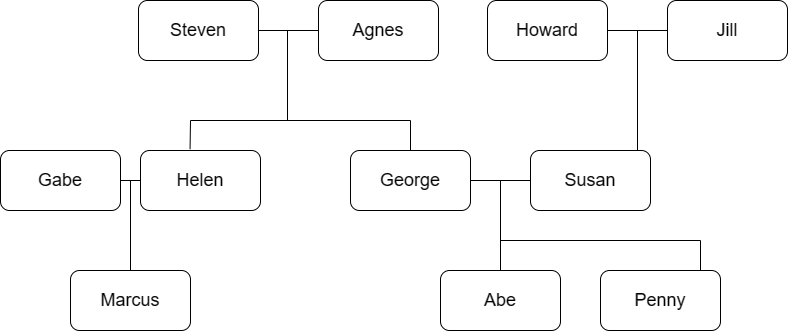
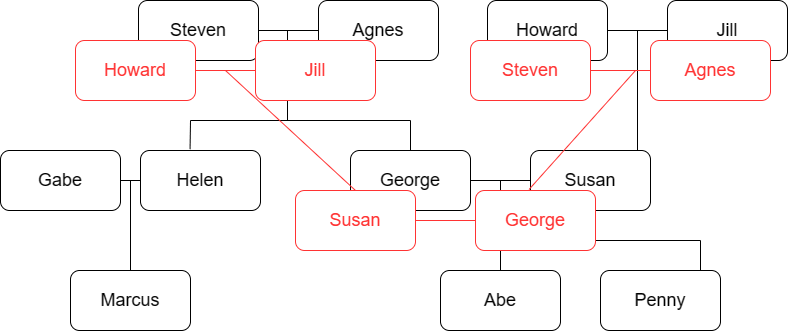
Given this setup, we could piece together the following family tree:
This tree is a visual representation of all the separate facts we get by combining all of our initial information. We can ask our system any number of questions, even ones that go beyond the scope of the original data set, and it can derive answers for them. It will answer yes, no, or uncertain, and so long as our propositions and predicates are all correct, then we can know that any derived answer is also correct. This data is a source of truth because it is based on logically sound principles.
A Twist)
But what if all of our propositions and predicates are all correct…except one? What if among all the truth facts and rules we include just one falsehood? It might occur to you that this would tarnish our confidence in the system, because there would always be a possibility that the answer it gave to us was that one lie. But actually, the effect is far, far worse. It has been proven that introducing just one logical falsehood into a system such as this will make any possible lie seem true. It won’t just be one lie that comes out of the system, it will be all lies. That might seem improbable, but allow me to illustrate.
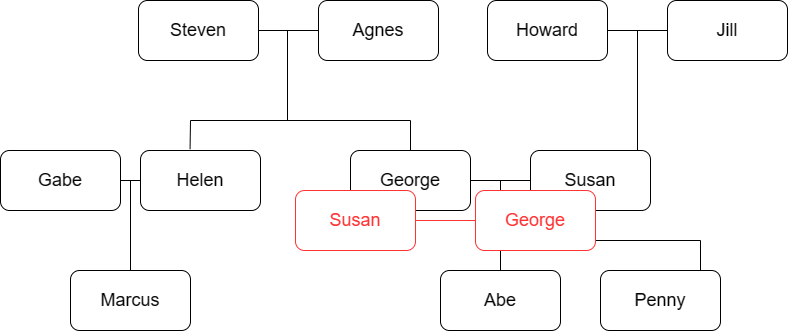
To the system up above I will introduce one logical falsehood. Given the previously established rules, it is impossible for this to be the case, but I am going to enter it as a fact even so:
Susan is Abe's father
This statement is completely contrary to the logic of Predicate #11, but we add it to our system regardless. This creates a logical contradiction, and now let us look at all the new falsehoods we are able to infer from it. By Predicate #4 we can infer that since since Susan is Abe’s father, then Abe’s other parent, George, must be his mother.
Of course, we previously had derived that Steven and Agnes were Abe’s paternal grandparents, because they are George’s parents. But now that we know that George is Abe’s mother, then they must also be his maternal grandparents. By the same token, Howard and Jill are now no longer only Abe’s maternal grandparents but also his paternal.
Of course, now that we know that Howard is Abe’s paternal grandfather we can combine that with the already-known fact that Agnes is his paternal grandmother, and we can now infer that they are married together, something we never knew before! And by the same token, Steven and Jill are now also married together. Thus all the grandparents are intermarried in some sort of free-love commune! This does have the unfortunate effect of making George and Susan, Abe’s parents, siblings to one another in addition to still being husband and wife! Furthermore, since Abe’s parents are also siblings, then his sister Penny is also his cousin because her mother is the sister of Abe’s father (and her father is the brother of Abe’s mother).
But we aren’t even really going yet! We still haven’t invoked the powers of NOT and ELIMINATION. First let’s consider the NOT. Predicate #10 stated that a cousin is NOT a sibling, and Predicate #11 that a mother is NOT a father. So, since we just proved that Penny is Abe’s cousin, then she is NOT his sibling. Of course, she also is his sibling, since Proposition #4 explicitly says so. Thus, she is his sibling, and she is not. These are both totally valid answers in the eyes of our data set. And Abe’s parents George is his father and Susan is his mother, but also, they are not. And his grandparents are his grandparents, but also, they are not.
And now that we’ve shown that we can prove that the exact same relationship can and cannot exist simultaneously, by ELIMATION we can also prove that every relationship can and cannot exist. So, from the initial data set we know that Abe has a sibling. But who is it? Well, we can go through each member of his family and prove that they are not that sibling. So, let’s do that for every family member except one, Steven, and now we know, by process of elimination, that Steven must be the one who is Abe’s sibling. And by the same process we can prove by process of elimination that it is Agnes, and Howard, and Gabe, and Helen, and George, and Susan, and Marcus. And by the same process they are all his father, and all his mother, and all his aunt, and all his uncle, and all his cousin, and all his grandfather, and all his grandmother.
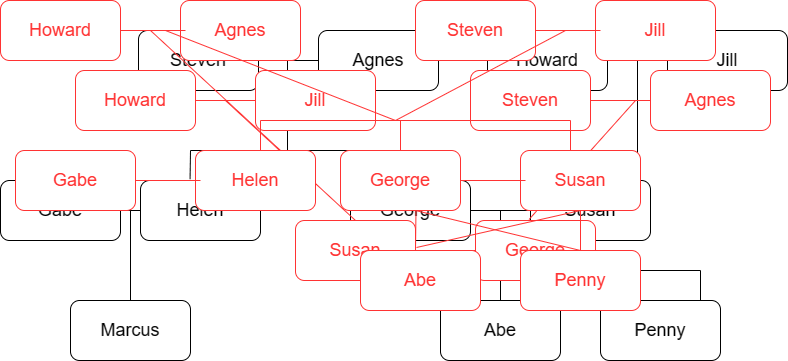
I’m not going to try to show the family tree at this point, because it is simply all names connected to all other names in every possible way. But also…all names connected to none of the others. Every statement is true. Every statement is false.
Our data set was useful at one point. It was full of true statements, and it could be used to infer many other true statements. But now, after a single lie the entire thing has been corrupted. The only answer it has to provide are “yes, no, maybe, I don’t know…I guess it depends on how you look at it.” It has lost all confidence and isn’t useful for anything.
And sure, this is a rigorous and mathematical system, which is particularly prone to collapsing at the slightest instability. The system in our minds is far more nuanced, able to continue functioning with illogical assumptions and idiosyncrasies…but only to an extent. The same principle does apply to us to at least some degree. Adopt the wrong belief and suddenly every other concrete conviction starts to be undermined by it. People start going through logical acrobatics to try and make incompatible beliefs fit together, corrupting all that was once good and losing the certainty they once had. We cannot accept a lie without somewhat losing our grip on all truth.



 Spiritual Wanderings