The frustration and suffering in our lives is directly proportional to the lies that we have come to believe. Complicating matters is that the lies are woven into our society before we were even born, becoming so indoctrinated in us that we can’t even see them for what they are half the time.
The word of God is therefore an essential standard. Whenever we read an eternal principle in the scriptures that seems uncomfortable to our modern sensibilities, we have just identified a lie that rests at our foundation. That is the area where our conception of Truth has been twisted, and we will find greater peace only as we correct that perversion.
So, what do you see as “problematic” in the scriptures? That men and women are meant to function in different roles? That divorce should be virtually unheard of? That fornication, homosexuality, and every other sexual deviance is abominable? That we should not provide preferential treatment to one group over another? That sometimes God declares war? That sin makes us deserving of death? That Christ is the only path to salvation? That spiritual freedom is more important than physical liberty? That all of our possessions and life decisions properly belong to the Lord?
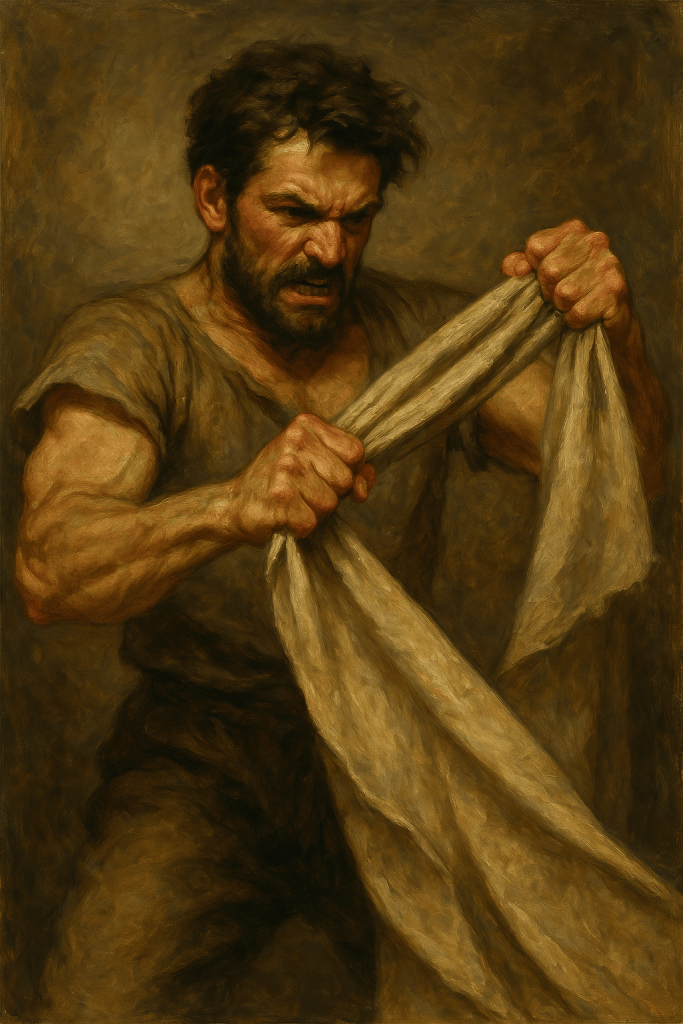
If we see any of these tenets in need of “being fixed,” then we live in a “truth” that is actually a lie. We will forever be frustrated because we are trying to twist the fabric of reality against itself, which is doomed to failure. True reality will not tear. It will snap back and tear us instead. And when that happens it is actually an act of mercy, as each of us needs to be broken before we can rebuild ourselves on the actual Truth.
16 Thou shalt not bear false witness against thy neighbour.
The penultimate commandment is that we do not bear false witness towards our neighbor. Bearing “false witness” applies in a formal, legalistic sense, meaning that we must not falsely testify against someone before a court. It also applies in a more informal, social sense, meaning that we must not tells rumors and gossip, tearing down the reputation of another on spurious claims.
Of course, this commandment is specifically decrying “false” claims. It is not saying that we must never sue for justice when our neighbor has genuinely wronged us, nor that we cannot give genuine cautions against the real and perverse behaviors of a neighbor. This commandment assumes that there is such a thing as the “truth,” and that we are to align ourselves to it. We may never know the entire truth of another person, but we do know when we are concocting a lie about them, and that is what is forbidden.
There are two ways to live falsely. The first is to take a false principle and insist that it is actually the truth. No amount of stubbornly insisting that our way is right will ever make it so, and we will grind our souls against the wheel of truth until we relent, or until it breaks us.
The second way to live a falsehood is to believe the actual, genuine truth, but to be insincere in our following of it. This might be due to being well-taught in our youth, but never gaining the fire and conviction of true conversion. We act in the manner of truth, but it comes out forced and unnatural.
Both sorts of false living require true conversion. Each person in these ways must become aligned to the truth at their core. At that point they will flow with the power of life instead of trudging upstream against it or floundering broadside to it.
Our own self is the primary victim when we lie. First, we do something against our conscience, then we lie about what we did, which gives the message that our fake, external image is of greater value than the true self. This wounds us. We cannot be so dismissive of a part of ourselves without that part hitting us back later on. A war begins within.
Heavy waves of guilt come from one side, telling us that we must tell the truth and stop denying who we truly are, but from the other side comes stifling and suffocation, applying greater and greater pressure on the conscience to deny the truth and accept the fiction. And with all the guilt and the suffocating, we are only hurting our own self in between.
We cannot have peace if we are at war, we cannot have wholeness if we are broken in two. If we are ever to stop beating ourselves the war must end, which means that one side or the other must surrender. And when we come to realize this fact, then we must come to realize another: the conscience cannot surrender. The true, authentic voice will never be killed because it is simply our natural, resting state. It exists because we did what we did, and made of ourselves what we made of ourselves, and there is no way to undo those facts. To live a lie without frustrating and twisting ourselves is fundamentally impossible, because part of ourselves is inseparably tied to unchangeable reality. The only surrender that we really can make is to surrender the lie. Surrender the phony public image. Surrender to the truth.
There is a common saying: “do as I say, not as I do.” One typically gives it when exposed as not living what they preach. I must admit I feel a twinge of guilt every time I tell my children not to eat sweets before their dinner…but then I violate that rule myself all the time. It’s not that I don’t believe what I’m telling my kids, it’s just that I’m not as disciplined as I ought to be.
Of course, there is a great honesty in being able to admit that we aren’t living how we know we should. Being aware of this gap between our convictions and our behaviors is, in the conscientious person, the first step to closing that distance. One who is sincerely trying to rectify this inconsistency is acknowledging that they are not currently built upon the truth, but they are in the process of moving towards it.
If, on the other hand, we recognize the gap between our behavior and what is right, but we aren’t troubled enough by that difference to try and change, then we are living without integrity. We are pointing at the flaw in our foundation and saying, “I’m okay to live with that.” We are establishing for ourselves a hierarchy where the conscience is made inferior to our current level of comfort.
Which is, of course, is another character flaw. In fact, it is a more fundamental flaw than the one that we started with. As bad as any other shortcoming might be, even more damning than it is unwillingness to change. This is the one crack in our foundation that prevents all other cracks from being patched. One might notice a logical conundrum here: if one has the flaw of being unwilling to change, how can one change themself to stop being that way? Is their situation totally hopeless? Thankfully not! We have to remember that we are divine souls, not machines. Our flaws are not irreversibly programmed into us. We have the ability to choose the very things we have never been willing to choose before. Not only that, but we also have the capacity to be redeemed by divine intervention, having changes made in us by God that we did not have the power to make ourselves.
Progress, not Perfection)
Compare the mantra of “do as I say, not as I do,” to the oft-told story of Gandhi and sugar. It is said that a woman came to Gandhi, asking him to tell her son that he should cut sugar out of his diet. Gandhi agreed, but first asked the woman to leave with her son and come back a number of weeks later. The woman did so, and in the second meeting Gandhi gave the desired counsel to the son. The woman was grateful, but asked Gandhi why he couldn’t have just had the talk with her son when she came the first time. His response was that he could not tell the son to stop eating sugar, because at that time he was still eating sugar, too!
This story, whether true or not, illustrates the principle of choosing to change oneself rather than be a hypocrite. This isn’t to say that we must all be perfect before we can advocate for what is true, but at the very least it should be expected that we are actually, genuinely trying to do the things we counsel to others.
This is what we aspire to: genuine trying. As it says in the Alcoholics Anonymous Big Book: “No one among us has been able to maintain anything like perfect adherence to these principles… We claim spiritual progress, not spiritual perfection.” Those that sincerely try to live in accordance with their conscience will all fall short, but because their intentions are sincerely aligned with the truth, they are still in harmony with it. If we try to play our notes at our sincere best, even if we occasionally get some of them wrong we are still part of the music.
Yesterday I shared the story of the rich, young ruler and Jesus. It is an example of how our Maker is able to reveal to us exactly who we really are, all of the happy truths about ourselves, and all of the difficult truths as well. I suggested that sometimes we need that outside help to know what’s really going on inside of us, because there seems to be a subconscious part inside that frustrates our efforts to figure that out. I suggested that one reason why that inner part hides the truth might be because it believes we won’t take those issues on even if we know what they are. It would rather leave us dissatisfied, but blissfully ignorant, than to have us live in full exposure to our most basic flaws.
But this isn’t the only sort of deception that happens within ourselves. When I was living my pornography addiction, I knew full well what I was doing and why it was wrong. I was not deceived about myself, but I did deceive the world. I did everything in my power to conceal this secret shame. I hated to even be around when the topic of pornography was discussed, yet I would behave as though I was fervently committed in renouncing its evil. Why did I play this charade? Why did I feel like it would absolutely kill me to say “I do this behavior that I am ashamed of?” Why am I now able to discuss it openly and not feel such a terrible terror at being exposed?
I’ve given this some thought, and I’ve settled on what I think is a key difference between where I am now and where I was then. The reason I couldn’t talk about the hard realities of my life earlier was because I hadn’t yet been forgiven.
Coming Clean)
For someone who was terrified of ever talking about my addiction, I suddenly found myself doing it a very good deal all at once. As soon as I decided to come clean to my wife I realized that I also needed to speak with an ecclesiastical leader. Once I spoke with my ecclesiastical leader he told me that I needed to meet with a recommended therapist. After the first meeting with my therapist he convinced me to enroll in an addiction recovery program and have weekly meetings with a group of other men in recovery.
Over and over and over I was relating to people all that I had been secretly doing for years. Even in these safe places I felt very distressed about this. After I made my confessions I would wake up each day in absolute shock for what I had done. I felt like I was still asleep, stuck in a bad dream, hoping that I would yet wake up and realize I hadn’t done this terrible thing!
Again, I’d like to draw your attention to the story I shared yesterday of Jesus and the rich, young ruler. After Jesus exposed the man’s love for wealth we are told that the man went away “grieving” (Mark 10:22). He was emotionally distressed to have his weakness revealed, and that was exactly how I felt. Clearly I was a long way from my situation today, where I can speak candidly about my personal demons with complete strangers online in a blog post!
When I consider what experiences helped me to shift my feelings, I have two memories come to mind. One was the moment where I was accepted back into full fellowship with my church and was able to partake of its communion. The other was during a spiritual retreat in the mountains where I felt God express His love and approval of me on an extremely fundamental level. Together those two experiences represented my transition from being condemned by my sins to being forgiven of them.
After those experiences I could speak more freely and openly about my wrongs because…well…they just didn’t matter any more. Certainly I don’t make light of them, or minimize the harm that they caused, but frankly they just aren’t my burden to carry any longer. Christ took them from me, and now they are his to deal with.
Losing the Burden)
When we feel like we would rather die than reveal our worst secrets, that is an indication that we are still unforgiven. We feel the full weight of guilt, of unworthiness, of despair. We live a lie because we know that the truth will damn us. The rich, young ruler wasn’t ready to have his flaw resolved, so he remained damned by it, unforgiven, and he left Jesus in a state of grief. I don’t believe his story had to end that way, though. When we take the step of telling the truth and admitting that it damns us, we open the door to being saved from that destruction by the Savior. Instead of being consumed, we find ourselves forgiven. The rich, young ruler could have confessed that Jesus saw him rightly, and that this flaw would damn him, and then he could have asked for to be healed, just as the blind and the lame had done. I believe that Christ would have done it, and the man would have been made free. Then he wouldn’t have to sorrow, he would be able to tell of his experience and his transformation freely and with joy.
In my last post I spoke about how many of us believe that the right and proper way to live is in accordance with the truth, yet at the same time we lie to everyone, including ourselves, about all the wrongs that we do. We are each a person divided, feeling the truth in our heart, transgressing it in our bodies, and refusing to acknowledge the gap in our minds.
Quite frankly, we avoid the hard truths on such a regular basis that we typically don’t even notice that we do it. The fabrications we soothe ourselves with are so practiced and so regular that they don’t even register. Thus, we might examine the general state of our life and admit that something feels off, that it seems we must be living under some self-delusion, but genuinely have no idea what that delusion even is. How can we make a change if we cannot name what the change that we need to make is?
This idea of knowing the name of our hidden, inner truths has its roots in many ancient cultures. There has long been a notion that if you know the true name of an entity, then you could gain power over it. I have seen for myself that there really is something to this. Sometimes the entire battle has been simply to correctly label the problem that I’m struggling with. Other times, it is only the first battle in the war of a lifetime. In either case, it is always the first step towards overcoming that part of my self.
So how do we identify the real, sometimes unpleasant truths lurking inside?
In many cases we we are so close to the issues that we can’t see them clearly, and we need to be shown them from an outside perspective. That might mean having a deeply earnest conversation with a trusted family member or friend. It might mean soliciting the professional insights of a qualified therapist. Certainly it means getting on our knees and asking our Maker to reveal ourselves to us.
The Great Physician)
Let us never forget that this is one of Christ’s essential roles. During his sojourn on Earth he demonstrated his ability to diagnose the state of a person’s soul. He was able to reveal people to themselves, to cut straight to the heart and show them the truth plainly. Let us consider one example of this, the story of Christ and the rich, young ruler (Mark 10:17-22)
And when he was gone forth into the way, there came one running, and kneeled to him, and asked him, Good Master, what shall I do that I may inherit eternal life?
And Jesus said unto him, Why callest thou me good? there is none good but one, that is, God. Thou knowest the commandments, Do not commit adultery, Do not kill, Do not steal, Do not bear false witness, Defraud not, Honour thy father and mother.
And he answered and said unto him, Master, all these have I observed from my youth.
At first Jesus gives the man a general answer, listing out all the basic things that everyone is instructed to do. But the man is sincere and earnest and he wants more than this. He does all of these things already, he always has, still he questions what he must do to inherit eternal life.
We aren’t told explicitly the young man’s inner thoughts, but I cannot help but wonder if he was much like the sort of person I described above: knowing that something was off, but not knowing what. Perhaps he could tell in his heart that there was something lacking within him, some difficult truth about himself that he had not identified, and he needed the help of the Master to know what it was.
Then Jesus beholding him loved him, and said unto him, One thing thou lackest: go thy way, sell whatsoever thou hast, and give to the poor, and thou shalt have treasure in heaven: and come, take up the cross, and follow me.
And he was sad at that saying, and went away grieved: for he had great possessions.
Jesus respects the man’s earnestness by finally giving him the real answer. The young man was indeed obedient and faithful, but Jesus reveals to him the fundamental flaw still at his core was his love of wealth. That dependency on the worldly things was what still stood between him and God. Clearly it was an accurate diagnosis, too, for the man made no attempt to dispute the matter, nor to correct his attitude. He had been seen–really seen–what was inside and he was distressed by what was revealed.
I do believe that one of the reasons we conceal our hard truths from ourselves is because we know that we won’t deal with the problem if we open the door to it. Part of us has decided that it is better to be forever agitated by “something” feeling off inside, but not knowing what it is, than to know what the problem is and be crushed by our inability or unwillingness to do anything about it.
The secret-keeper inside of us says, “Yes, you are a slave. But you’re not ready to risk everything for a rebellion, so why should I show you who your master is? Better that you just go home and try to forget everything about this.”
I have spent the past while examining the principle of truthfulness in broad strokes. I have explored why it is a moral ideal, and why it is beneficial to society as a whole. But people are brought into alignment with truth on an individual basis, and one of the first truths that we must resolve ourselves to is the truth of who we are. Given that, I am going to shift gears with the rest of this series to examine truth within the self.
And the fact is, probably very few readers had any disagreement with my thesis at the beginning of this series. You probably agreed that only a life founded on truth is truly free. This is the sort of statement that we hear and nod along to without a second thought. Something inside of us just intuitively knows that this is the case.
And yet…if we get truly honest, none of us live in accordance with this principle perfectly, and few of us even try. We say that embracing the hard truths is essential for a stable and thriving life, but then we shirk those hard truths at every turn. We preach principles that we do not abide by and renounce the very behaviors that we do. Lying, cheating, and stealing, though we aver it is wrong to lie, cheat, and steal. We try to hide these shameful behaviors from the world. We try to hide them from ourselves, looking for a distraction any time our conscience tries to show us what we are doing. And then, when a light does manage to shine upon our wrongs we make excuses, brushing them off as inconsequential or permitted due to our circumstance. In short, we are hypocrites all!
The Part That Resonates)
So why do we so readily agree with the statement that we should all live in truth?! Why do we have such an immediate agreement to something in principle, but then a reluctance to agree with it in our practice? I see this phenomenon as the clearest evidence that people are divided beings. Every individual has two parts hidden within, and though they belong to the same person, those parts don’t agree with one another at all.
I feel this dual nature is what Paul was speaking to when he famously wrote “For that which I do I allow not: for what I would, that do I not; but what I hate, that do I” (Romans 7:15). There is a very real part of us that recognizes and responds to truth. That part is most manifest when we hear a nugget of pure wisdom and we intuitively know that it is right, not even requiring any sort of proof. That part of us just knows what is true and it wants to live in harmony with that truth.
But then there is another part that doesn’t fully believe in this concept. Part of us believes that even if truth is the fundamental foundation of the world as a whole, that it can still cheat that system. It thinks that it can fool the world into giving us what we want.
Of course, these two sides are at complete odds to one another. On the one hand we believe that adherence to the truth is the principle by which we obtain all that we desire, on the other hand we also think we can get what we want by trespassing that very same principle.
Getting Curious)
The part of you that thinks you can prosper by denying your conscience doesn’t like to be examined. When asked why we do the things that we know are wrong, why we advocate for behaviors but then don’t follow them, we tend to squirm beneath the light and try to wriggle away.
But if you are ever to overcome these baser instincts, you’ve got to start taking them head-on. An excellent first step would be to acknowledge that you do exactly the hypocritical sort of behavior that we’ve been examining, and then meditate as to why you do it. Without judgment, ask yourself “why do I think truth is fundamental to happiness, but still shirk from the truth in these certain areas of my life?” At some point we must all contemplate why we do the things that we do. At some point we have got to own up to our inconsistencies. For simply acknowledging our own untruthfulness is the first step towards becoming truthful.








 Spiritual Wanderings