Whenever people decide to push a social, political, or spiritual movement, they justify the changes that they seek by making certain truth claims. They try to get the world to accept that their core premises are true, or better yet get people to realize that they already agree with those premises. And then, if the premises are true, then the logical response must be to make the proposed social changes.
Every movement, whether its premises are true or not, depends on convincing people of them. Thus, the successful movements are the ones that identify what core premises most immediately lead to their desired outcomes and communicate them in a concise, memorable, and convincing way. When a movement is successful, the premise that was taught then becomes part of the societal fabric. It is now an assumed truth, an axiom for ethical and correct behavior, and future generations will be raised to trust it implicitly.
Unintended Consequences)
But that’s where these movements can start to unravel. The original evangelists of the movement may have only wanted to effect one, specific change, but the rising generations will always take things to their full logical conclusion. They will look at the premise and say, “well if this is true, and it justifies this first step, then surely it justifies the second and the third as well.” And so, they push the matter further than the original evangelists ever intended. Indeed, it is not uncommon for earlier-wave members of a movement to express shock and dismay at what their cause has become in the hands of the later generations. Some of them even express regret for having started the movement at all.
This is a pattern that should give us all pause as we consider the changes that we would wish to see in the world and the methods by which we would achieve them. Every one of us ought to give special consideration to the premises that precede those changes, and what their full potential effect could be, and whether they are even true to begin with.
Tomorrow we’ll look at a specific example of one movement that has gone off the rails, the premise that was indoctrinated in society to make it a success, and why that premise logically led to the unintended consequences we see today.
I have frequently heard the argument that if we have an all-loving God, how are tragedies and disasters a part of this world? I have addressed this issue in part with previous posts, but today I wanted to point out a fundamental flaw in the argument itself.
Neil DeGrasse Tyson gave this argument in an interview where he said, “Every description of God that I’ve heard holds God to be all-powerful and all-good, and then I look around, and I see a tsunami that killed a quarter million people in Indonesia, an earthquake that killed a quarter million people in Haiti, and I see earthquakes, and tornadoes, and disease, childhood leukemia, and I see all of this and I say I do not see evidence of both of those being true simultaneously. If there is a God, the God is either not all-powerful or not all-good.”
I find it interesting that Tyson’s public persona is entirely based around having a scientific mind, yet his argument is entirely unscientific. He jumps to a conclusion that is not at all supported by the premises. Here are the premises that he establishes:
God is all-powerful
God is all-good
???
There is great tragedy in this world
And from these he draws the conclusion that the last premise is incompatible with the first two. But as it stands, the statements of God’s character and the state of the world live in isolation from one another. There is a crucial premise missing, one that would establish what the relationship between God and the world even is!
This is the fundamental flaw in all of these criticisms. They speak of the nature of God, and the nature of the world, but never establish what one of those has to do with the other. It is quite a leap to say that if God is all-good that He is required to enforce only good things on the Earth of today. Where did that notion come from? Why can’t God be all-good and not puppeteering everything that plays out in humanity?
The Perfect Earth)
One thing that Tyson did not explicitly say, but which I believe is implied in his argument, is that the missing link between God’s goodness and the state of the earth is that God created the earth. If God is perfect, and the original author of our existence, then why isn’t that existence perfect also?
But even introducing this to the argument doesn’t make it any better. Because if one is going to question why a perfect God did not create a perfect world, the obvious answer is, “well, according to our records…He actually did.” In the first chapters of Genesis, we read that God created a world where everything was “good.” There was no death, no sickness, none of the great tragedies that so distress us today. Thus, the expectation actually fit the reality at the moment of creation. God did give us exactly the sort of world that we would have expected Him, too.
But states can change. And man, not God, chose to introduce sin into this world, corrupted its perfection, and gave birth to the fallen earth that we see all around us. This is all made clear in the first three chapters of the Christian canon, so it doesn’t make sense to state that the Christian conception of God does not account for the disparity between His goodness and the world’s evil.
If one does not believe in the biblical explanation, so be it, but don’t claim that there isn’t any explanation. Indeed, this is one of the unique and compelling aspects of Christianity, that it not only acknowledges the dual nature of our existence but also provides one of the clearest, most explicit explanations of that division’s origin.
Of course, one might still be troubled by the disparity between the professed perfection of the Christian God and the suffering in the world, and one might feel that if God really is all-powerful, then He ought to be able to reclaim that fallen world. And to that I say, brother, have I got some good news for you!
I have spent the past several days reviewing the common defenses that are made for God having commanded the Israelites to destroy the Canaanite nations. I found some of the arguments more compelling than others. However, even the ones that had strong points were not so convincing that I lost all discomfort for these passages. I find what remains for me is a sense that God was justified to have commanded these actions, but I still wish He wouldn’t have. The more that I delve into the details, the more I realize that the problem isn’t in the details.
I think this is a common mistake when raising and addressing issues related to God. We are dealing with a matter of spiritual unrest and are trying to resolve it in intellectual terms. We too often assume that our feelings are invalid if we cannot express it as a logical argument. Therefore, the critic will experience negative feelings towards these verses and will give logical arguments against them. The defender of these verses will respond in kind by providing logical rebuttals. Even if those rebuttals are sound, they will do nothing to convince the critic, because the logic wasn’t where the problem began. It isn’t the critic’s mind that needs to be converted, it is the heart.
Thus, my response to all of the defenses that we have covered thus far is, “yes, you have some good points, and maybe it all makes sense in my head…but I still just feel sad about it.” In my next post I will try to take a different approach to addressing these concerns. I think it is time we took the matter to a higher level of consciousness. I wish to make an appeal, not the to mind, but to the Spirit. We will see how that goes tomorrow.
As I observe all of the angry discourse in our society today, I am left with a sense that we are much too certain of ourselves.
If the other side is wrong, we are certain that then we must be right, even though in most cases that is not necessarily so.
We are certain that we know causation, when all that has been demonstrated is correlation.
In the domains of definite uncertainty, where neither God nor science has spoken, we are nonetheless certain that our opinion is ultimately right.
I do believe that some things we can be certain of, and should be certain of, and should live with passionate conviction to those certainties. But I think that those are only a few, core things, and we should be nuanced enough to call all the rest a hunch, a belief, and an assumption.
Yesterday I spoke of the physical-materialist theory of determinism, which maintains that all of our behaviors and “choices” are actually predetermined programming. The stimuli to our senses come from an environment that we cannot control, and our reactions to those stimuli are dictated by the preset mapping of the synapses within our brains.
Input + Function = Output, and because the Input and the Function are controlled, so is the Output.
Free will and control are only illusions that arise from the fact that the environment and the brain mapping are so complex that we cannot predict the outcomes before they occur. But just because we mortals can’t predict those outcomes, doesn’t mean that they aren’t predestined. The things that we do are simply the things that we were always going to do.
Moral License)
If this theory is true, though, then I cannot be responsible for anything that I do. I might feel as though I make my own choices, that I wrestle between decisions, but that’s simply my computer-brain evaluating between two programmed priorities, until it finally settles on the option that its biological algorithms were pre-weighted towards. I was always going to come to the conclusion that I was going to come to, and I am no more responsible for coming to that conclusion than a domino is guilty of falling when pushed.
Thus, if I decide to kill another person, there was no alternative to that outcome. There was no option for me to have chosen otherwise. I might have chosen differently if I had been born to a different environment, or if I had a different composition of the brain, but the function and the parameters were already set, and so I simply had to give the only possible output: murder.
And if I were to go around proselyting for this worldview, and the logic of it were to incite a person to decide there was no morality and that he truly was permitted to do anything and none of it would be his fault, and if he were to then go out and planted bombs that killed hundreds of innocent schoolchildren, well it couldn’t be helped because his mind was already such as to take the input of my words and derive those predestined conclusions. And it couldn’t be helped that I inspired him to do those things, because I was also predestined to make those arguments. And though it may appear to the outside world that I had influence and he had choice, even though everything in our natural perception and experience screams at us that such is the case, it would all be a lie and an illusion. The creation of that terrible, bloody would have been necessary and unavoidable.
Common Sense)
The horrifying conclusions of determinism are reason enough to reject it, but even more important than the unacceptable nature of its ends is the fact that it defies so much of our common sense that we have to conclude it isn’t true. Like I said in the last paragraph, everything in our natural perception and reason tells us that we actually do choose what we do, and that the evil are guilty, and that people can decide whether to live as good or evil.
Determinism asks for an even greater level of blind faith than any system of religious morality. It not only asks us to trust its claims, but to do so against all of our perception and reason. It asks us to deny the apparent and obvious reality to accept an unprovable and theoretical one. Everything natural and instinctive about us protests that is a lie, and that would explain why its ends are so horrific and destructive. A reality based upon a lie can only end in obliteration, for a lie is the inversion of reality.
Over the past two postsI have discussed God as a basis for our fundamental human rights, and also the natural biology of our species for a basis as well. I have explained that I believe in both foundations, but unlike a materialist/humanist, I am convinced that having the natural biology of our species as the only foundation for our rights is insufficient. In my last post I explained why, showing how from the materialist/humanist view, rights would only be an illusion invented by the species that benefits from them. We would say that humans should have a right to life, simply because if they don’t they would cease to exist, so murder is a self-destroying principle.
So long as our rights are tied only to the biology of our race, it is possible to create logical exceptions to them. I gave two examples:
We could say that we are not the same race as other humans, and we only need to observe the rights of our own race, and not of others.
We could say that even if the rights should be enforced by society at large, if we violate them and conceal it from society, there is no other authority that we must answer to.
Today we will consider how having our rights also based in God resolves these issues.
A New Equation)
In my previous post I gave an equation that showed the cyclical, self-contained logic of rights when based upon the natural biology of our species. I said that if we call humanity “X,” and the basic human rights “Y,” then we can say:
Y is essential for X So X must secure Y
Now let us consider how that equation changes if we assume that God has given us our rights. We will represent God in our equation as “Z.”
Z states that Y is essential for X So Z must secure Y for X
The rights (Y) are tethered to man (X) by God (Z). It may not seem like much of a difference, but this small alteration has massive ramifications. Introducing Z now makes X and Y reside in Z, not in each other. We no longer have a circular, isolated interdependency. The relationship between X and Y no longer collapses once we are outside of their context. Y is no longer a relative need of X, which nothing outside of X is obligated to fulfill.
Through this God-centric view, human rights are now just as universal and unchanging as mathematical truths. Just as how the Pythagorean Theorem will always be a true mathematical expression, the statement that “life and liberty are necessities for all people” will always be a true, moral principle. Even if there were no people around to observe it, the Pythagorean Theorem would still be a universal maxim between the sides of right-triangles, maintained in God, independent of man. In just the same way, even if humanity were to go extinct, it would still be a maxim in God that life and liberty are good for people and nothing would change that.
The Answer to the Problems)
Now, even if a group of people declared themselves to be a different race they would still have to answer to God if they violated the rights of other races. If individuals violated the rights of one another, and concealed it from the larger species, they would still have to answer to God. They would have to answer to God because it is He, not merely “other people,” who demand these rights for all. He demands them, and He enacts His will to see that they are secured.
And from the Christian perspective, that is exactly what has transpired throughout history. Yes, there have been long periods of various rights being violated by entire nations and individual souls, but over the years the idea of basic human rights has emerged, and in more developed countries has been applied to all, and of it has been done under the justification that “it is God’s will.”
Conclusion)
There is nothing wrong in observing the ways that our biological nature compels us to seek what is best for one another, to enshrine rules of conduct between all people, to sacrifice our own interests for the greater good. Recognizing these logical, natural realities can certainly be further evidence to help convince all people to live in moral, ethical ways.
The problem is when we try to weaponize the existence of this biological nature against the divine basis for our rights. There are those that use a new moral perspective to beat away at the very foundation that all our moral principles rest upon! How strange, when it was the perspective that God was the author of our morals that led us to implement the freedoms and rights that we have in the first place. Trying to remove that perspective is a regression, one likely to take us back to the darkest epochs humanity has ever seen, with the vast majority of the population living under all manner of oppression and suffering.
If we destroy the one, best moral grounding we have ever had, and give the next generations a flawed moral grounding instead, they will carry it to conclusions that we would never dare. And when they do, who will the sufferers take their appeal to then? The God that we abandoned?
In yesterday’s post we talked about God as a basis for our fundamental human rights, and also a more materialist/biological basis for them. I made the point that it is a false choice that we have to believe in only one basis or the other. We can conclude that our rights are made manifest both in the personhood of God and in the inherent nature of the human species.
I would go further, though, and say that not only can these rights be simultaneously rooted in both sources, but they need to be. The materialist/humanist may say that since the same rights can be found in our biological nature we don’t need God for our morals to exist, but that simply isn’t true. If our rights are secured in our biological nature exclusively, it is insufficient. Those rights would then be inherently weak and artificial. Today we will explore why.
Circular Dependency)
Let us quickly summarize how the materialist/humanist view might describe the origin of our rights. In essence, we are members of the human race, and the human race’s survival and flourishing depend on certain qualities for its members. For example, “life” is a quality that is essential to humanity’s survival, and “liberty” is a quality that is essential to humanity’s flourishing. Thus, “life” and “liberty” are basic human rights because they are necessary to the experience of being a human.
We can describe this as a simple equation. If we call humanity “X,” and the preservation of life “Y,” then we can say:
Y is essential for X So X must secure Y And if X didn’t have Y, then there would be no X to require Y So X is also essential to Y
And perhaps the failing is starting to become evident. Y is a basic human right only because X requires it, and it also only exists as a concept because X does. The link between people and their rights is therefore circular, and rights only exist within the context of people themselves. Rights therefore have no recognition outside the orbit of people, they are not anchored in anything deeper than ourselves. If we say our rights come from some sort of “natural law,” it can only be natural within the scope of people, but no further. To the universe at large, there is no difference whether a rock is thrown into the sea, or a person. Nature doesn’t care whether these so-called rights of “life” or “liberty” are meted out to a species. The universe allows drones whose sole purpose is to serve the queen (no liberty), and it allows species to go extinct entirely (no life).
Now why is this a problem?
Removing Rights on a Large Scale)
The fact that the rights only exist within the context of humanity means that they are essentially made up, a mirage caused by the distortion of being a human. Yes, they might be important rights for people, but there is no deeper, more grounded basis for them. As such, it is easy to logically get around the authority of those rights.
Suppose that there was a subset of people that started to see themselves separate from the rest of all other people. In our above equation, they do not see themselves as “X,” they see themselves as “W.” W would then exist outside of the equation that X requires Y, and Y requires X. Therefore, it may be necessary for X to uphold Y, but there is no reason why W must uphold Y also.
And this is not just a theory. This exact behavior has happened a multitude of times throughout history. Perhaps most famously, it happened when Nazi Germany declared themselves an Aryan race, separate from the race of humanity, and therefore morally justified in torturing and killing other races as needed. And from the materialist/humanist view, this atrocity is entirely logical. Why would the Aryan have any more obligation to observe the rights of Jews, than the Jews would have any obligation to observe the rights of cattle?
And Nazi Germany was no exception. It has been the rule in all the world for thousands of years that one nation, upon defeating another, would enslave the defeated people, all because they were not part of the conquering identity. Humanity is constantly splintering itself into different collectives, viewing their group as more real, more elevated, more “human” than the others. Once you do that, then there is no reason not to enslave, or murder, or violate any rights of any outsider, because they are not the same humanity that you are, and their rights are local only to them, and your rights are local only to you.
Removing Rights on a Small Scale)
It doesn’t have to be so broad as an entire people seeing themselves as fundamentally distinct from another people, either. This separation of self from the species happens on a much more individual level.
Suppose I really do see myself as a member of the global humanity, and I really do believe that every other person and group of people also belongs to the global humanity, and I really do believe that we, as a collective, need to maintain certain rights for the betterment of us all. Could I not still carve out exceptions for myself, while still maintaining the rights for the broader humanity? I agree that X should not violate Y in general, but couldn’t I, a lower-case “x,” violate Y on a small scale? After all, poison is in opposition to the nature of a person’s life, and yet many will partake of alcohol, slightly poisoning themselves, and so long as that poison is kept beneath a certain threshold the person will still live. And in nature there are species where some of the adults will kill their own young, which is obviously in direct opposition to the continuance of that species, but if enough of the young do survive then the species can still go on.
So why can’t I permit myself to violate a human right on an individual level? Especially when it causes greater life and flourishing in me, personally? Maybe the victim of my theft will have a diminished quality of life, but mine will be increased, and so the population overall remains level. And if I kill my neighbor, what of it? So long as we don’t all kill our neighbors, the neighbor’s loss will have negligible effects on the whole.
I can even agree that society should prosecute and punish those that thwart its general human rights, that they are justified in condemning me if they catch me. But if they do not catch me, then there is no other authority that I have to answer to. Because, once again, I have violated a right that applies only to humanity, and if humanity cannot punish me for it, then there is no larger, universal law that I have to answer to.
This is why the materialist/humanist worldview by itself is insufficient. By its cyclical, self-contained nature it is easy to start making exceptions to it, creating entities that are outside of the humanity-rights circle. This view of people and their rights, taken to its logical conclusion, is nothing short of horror!
Tomorrow we will see why adding God as another basis for our rights answers all of these limitations, though, and how it does so in a way that cannot be broken.
I have explained the necessity of adhering to physical truths in the field of aviation. In order to overcome the forces of gravity and air resistance, great minds had to search out the realities of the physical world and build machines that would act in accordance with them. Today I’d like to consider another example of this in the world of logic. This time we won’t just consider the usefulness of truth, though, but also the chaos of untruth.
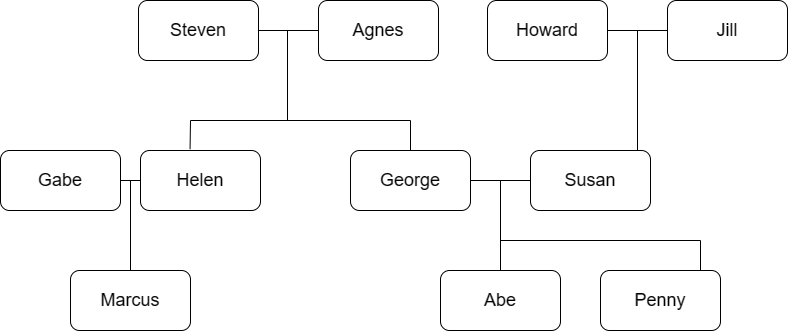
There is a concept in mathematics called propositional and predicate logic. In this system, propositions are statements of truth, such as George is Abe’s father, Steven is George’s father, and Marcus is not Abe’s brother. These are simple facts that contain a single piece of valid information. Then there are predicates, which are rules for how these propositions can be combined to reveal entirely new truths. For example, we might have a predicate that if A is the father of B, and B is the father of C, then A is the grandfather of C. Given our initial propositions, we can derive that George is Abe’s Grandfather, a fact that wasn’t in the original set of information.
This might not seem that useful, but once we expand our set of propositions and predicates to thousands of items there are literally millions of implied facts that a computer can derive from, something that our brains simply don’t have the capacity to process. Our modern-day databases are built upon this system of logic, allowing a large dataset to have its parts combined in a multitude of ways, revealing hidden patterns and trends, secrets and truths that were hiding in plain sight.
Let’s build expand on our example of a family tree to see this process more clearly. Suppose we have the following propositions and predicates (feel free to skim over these):
Propositions:
#1 George is Abe's Father
#2 Susan is George's wife
#3 Penny is Susan's daughter
#4 Penny is Abe's sibling
#5 Helen is George's sister
#6 Gabe is Marcus's father
#7 Steven is Marcus's maternal grandfather
#8 Agnes is Helen's mother
#9 Steven is Agnes's husband
#10 Howard is Susan's father
#11 Jill is Susan's mother

Predicates:
#1 If A is the father/mother of B, and B is the father of C, A is the grandfather of C
#2 If A is the father/mother of B, and B is the mother of C, A is the grandmother of C
#3 If B is a parent of A, and C is the husband/wife of B, then C is also a parent of A
#4 If A is the father/mother of B, and C is the other parent of B, then A is the mother/father
#5 If A is the father of B, and C is the mother of C, then A is B's husband and B is A's wife
#6 If A is the child of B, and C is the child of B, then A and C are siblings
#7 If A is the maternal grandfather of B, and B's mother is C, then A is the father of B
#8 If A is the sister of B, and B is the parent of C, A is the aunt of C
#9 If A is the child of B, and B is the aunt/uncle of C, A is C's cousin
#10 A cousin is not a sibling
#11 A mother is not a father
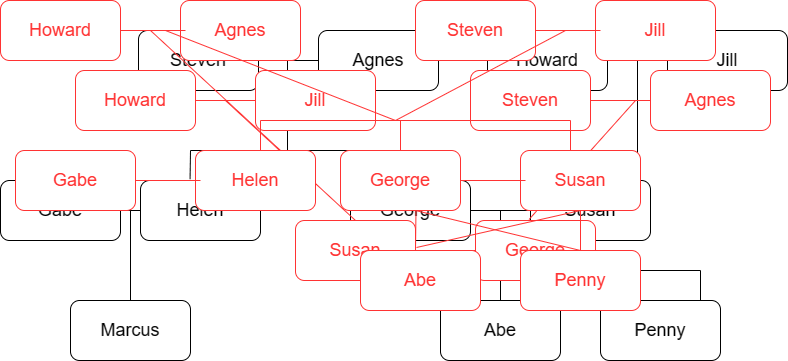
Given this setup, we could piece together the following family tree:
This tree is a visual representation of all the separate facts we get by combining all of our initial information. We can ask our system any number of questions, even ones that go beyond the scope of the original data set, and it can derive answers for them. It will answer yes, no, or uncertain, and so long as our propositions and predicates are all correct, then we can know that any derived answer is also correct. This data is a source of truth because it is based on logically sound principles.
A Twist)
But what if all of our propositions and predicates are all correct…except one? What if among all the truth facts and rules we include just one falsehood? It might occur to you that this would tarnish our confidence in the system, because there would always be a possibility that the answer it gave to us was that one lie. But actually, the effect is far, far worse. It has been proven that introducing just one logical falsehood into a system such as this will make any possible lie seem true. It won’t just be one lie that comes out of the system, it will be all lies. That might seem improbable, but allow me to illustrate.
To the system up above I will introduce one logical falsehood. Given the previously established rules, it is impossible for this to be the case, but I am going to enter it as a fact even so:
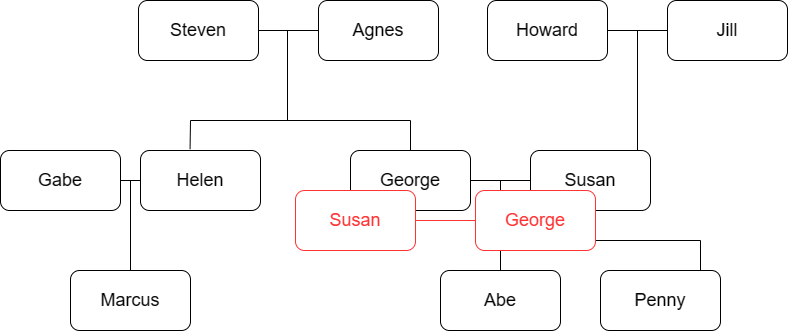
Susan is Abe's father
This statement is completely contrary to the logic of Predicate #11, but we add it to our system regardless. This creates a logical contradiction, and now let us look at all the new falsehoods we are able to infer from it. By Predicate #4 we can infer that since since Susan is Abe’s father, then Abe’s other parent, George, must be his mother.
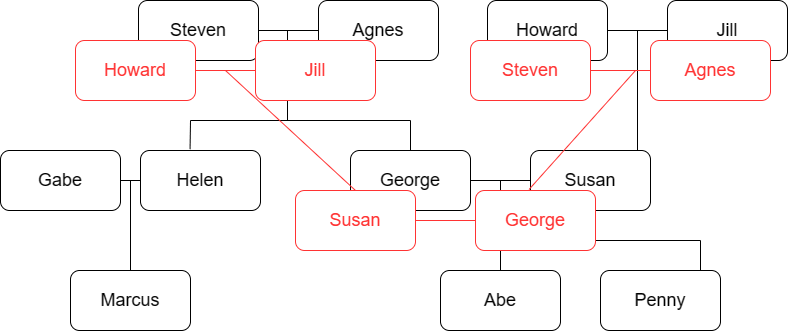
Of course, we previously had derived that Steven and Agnes were Abe’s paternal grandparents, because they are George’s parents. But now that we know that George is Abe’s mother, then they must also be his maternal grandparents. By the same token, Howard and Jill are now no longer only Abe’s maternal grandparents but also his paternal.
Of course, now that we know that Howard is Abe’s paternal grandfather we can combine that with the already-known fact that Agnes is his paternal grandmother, and we can now infer that they are married together, something we never knew before! And by the same token, Steven and Jill are now also married together. Thus all the grandparents are intermarried in some sort of free-love commune! This does have the unfortunate effect of making George and Susan, Abe’s parents, siblings to one another in addition to still being husband and wife! Furthermore, since Abe’s parents are also siblings, then his sister Penny is also his cousin because her mother is the sister of Abe’s father (and her father is the brother of Abe’s mother).
But we aren’t even really going yet! We still haven’t invoked the powers of NOT and ELIMINATION. First let’s consider the NOT. Predicate #10 stated that a cousin is NOT a sibling, and Predicate #11 that a mother is NOT a father. So, since we just proved that Penny is Abe’s cousin, then she is NOT his sibling. Of course, she also is his sibling, since Proposition #4 explicitly says so. Thus, she is his sibling, and she is not. These are both totally valid answers in the eyes of our data set. And Abe’s parents George is his father and Susan is his mother, but also, they are not. And his grandparents are his grandparents, but also, they are not.
And now that we’ve shown that we can prove that the exact same relationship can and cannot exist simultaneously, by ELIMATION we can also prove that every relationship can and cannot exist. So, from the initial data set we know that Abe has a sibling. But who is it? Well, we can go through each member of his family and prove that they are not that sibling. So, let’s do that for every family member except one, Steven, and now we know, by process of elimination, that Steven must be the one who is Abe’s sibling. And by the same process we can prove by process of elimination that it is Agnes, and Howard, and Gabe, and Helen, and George, and Susan, and Marcus. And by the same process they are all his father, and all his mother, and all his aunt, and all his uncle, and all his cousin, and all his grandfather, and all his grandmother.
I’m not going to try to show the family tree at this point, because it is simply all names connected to all other names in every possible way. But also…all names connected to none of the others. Every statement is true. Every statement is false.
Our data set was useful at one point. It was full of true statements, and it could be used to infer many other true statements. But now, after a single lie the entire thing has been corrupted. The only answer it has to provide are “yes, no, maybe, I don’t know…I guess it depends on how you look at it.” It has lost all confidence and isn’t useful for anything.
And sure, this is a rigorous and mathematical system, which is particularly prone to collapsing at the slightest instability. The system in our minds is far more nuanced, able to continue functioning with illogical assumptions and idiosyncrasies…but only to an extent. The same principle does apply to us to at least some degree. Adopt the wrong belief and suddenly every other concrete conviction starts to be undermined by it. People start going through logical acrobatics to try and make incompatible beliefs fit together, corrupting all that was once good and losing the certainty they once had. We cannot accept a lie without somewhat losing our grip on all truth.
There is a concept that has come up a few times in my previous series, including the last one. I have spoken to the matter in brief here and there, but now I want to consider it more fully. The concept is that living in the truth is the foundation for a full and happy life. Said another way, facing the facts as they really are is the only way to be truly free. Said a third way, only those who are willing to face the truth unflinchingly are ever truly alive.
This is a principle that is basic and fundamental to life. It is so foundational that sometimes it is difficult to really get a grasp on it. Axiomatic truths are, by definition, self-evident in their truthfulness, requiring no argument to prove them. That’s all well and good, but it means that if you then try to explain why an axiom is true you’re going to have a very hard time of it! Explanations tend to lead to circular logic, such as “living in truth is the foundation for a full life because…it just is!”
One way to come to full appreciation of these fundamental truths is to look at them in reverse. Fundamental truths are prerequisites for many other things in life, and by examining those things that are built upon foundational truth we obtain evidence that the underlying axiom really is true, for if it were not the things that we have observed could not be. We find that the fundamental truth is necessarily true, because it is necessary for it to be true for other observable things to be so.
Even so every good tree bringeth forth good fruit; but a corrupt tree bringeth forth evil fruit. A good tree cannot bring forth evil fruit, neither can a corrupt tree bring forth good fruit.... Wherefore by their fruits ye shall know them. -Matthew 7:17-18, 20
Jesus describes the same idea in these verses where he teaches that we may recognize that which was good by whether it brought about good or not. So if we want to know whether “a life founded upon the truth is joyful and free” is a true statement or not, then we merely have to look at those who live in harmony with this belief and see what sort of life they possess. I will begin my series today by doing exactly this. I will look at an example of people who are built upon this axiom, living their lives with the assumption that it is absolutely true. We may observe the reality of their lives, and infer whether they built upon a solid foundation or not.
The Happiest of People)
I have mentioned before how the addiction-recovery groups I have attended are singularly focused on living in harmony with truth. Any addict working a twelve-step program can tell you that one of its most fundamental tenets is that we take a fearless inventory of our lives, facing all of the unpleasant and difficult truths in our character. Where most people attempt to cherry-pick their best qualities and define themselves by those, addicts in recovery open the door to all of their qualities. We do not care if the description of us is pleasant, only that it is true.
And what comes about by this strict adherence to seeing things as they really are? For an answer, let me offer an anecdote that occurred to me personally. I was speaking with an ecclesiastical leader about my efforts to overcome my addictions, and my time spent in my recovery group. As soon as he heard that I was part of a twelve-step program he said to me, “you know, I’ve never been a part of such a program, but I have been a witness to its meetings and its members, and those are the most humble, most sincere people I have ever met.”
The reason why the twelve-step program has grown at such incredible rates since its inception is entirely due to the quality of the men and women one meets when they walk through the door. People see men and women who have not only gained freedom from the most terrible of vices, but who also live with a clearness and a joyfulness that simply isn’t to be found anywhere else. Furthermore, the fact that that light has remained consistent throughout the decades and continues to burn brightly in every new generation of members is a testament to the fact that the happy way of life was not due to some pre-existing condition in the first AA members, but is cultured in its members from the principles that they live by. If people had not seen throughout the years that these people had uncovered a superior way of life by their principles, then no one would have stayed and joined the crew, and it would have been a long-extinct experiment.
It was the evidence of this joyful peace that also drew me into the ranks of the twelve step program. It might seem a counter-intuitive thing to say, but I quickly recognized that I had never seen a happier, more satisfied, and more productive people, than these addicts who sincerely identified their miseries and their flaws. One would have thought that bringing out those heavy truths would have crushed them, but so far as I could see those weights, once surrendered, were being taken away, so that they could live free and unfettered. They attested that one had to truly see their shackles before they could receive the key to undo them. Though I was not then converted to the notion of living my life strictly in harmony with the truth, I was persuaded enough by what I saw to give it a try. My result has been much the same as theirs.
But you don’t have to take my word for it. Even if you don’t consider yourself an addict, go and visit a few of the local meetings in your area. See for yourself what manner of men and women these are, and what sort of lives they lead. Granted, every group has its own culture and its own level of sincerity about the work, but attend a few different ones and you will quickly see that there is a clear correlation between those that genuinely face the hard truths and those that live joyful and free.
Every way of a man is right in his own eyes: but the Lord pondereth the hearts.
COMMENTARY
Every way of a man is right in his own eyes: but the Lord pondereth the hearts Yesterday we considered the fact that those of us with obscured vision still believe that we see the truth perfectly. It is easy to make the assumption that if other people have wrong views, and our views are different from them, then our views must inherently be right. But that is a logical fallacy. How then, when our perspective is genuinely clear and correct, do we even know that it is so? How are we to know when we see the truth that we even are doing so? That is a whole other topic of study worth exploring. For now, though, I’ll settle with the second half of the verse I’ve quoted. We will know that we have finally the right perspective when it is not our own perspective anymore, but His.




 Spiritual Wanderings