
Changing behavior
Without changing the heart
Is building new structure
On a crumbling foundation
Changing behavior
Without changing the heart
Is building new structure
On a crumbling foundation
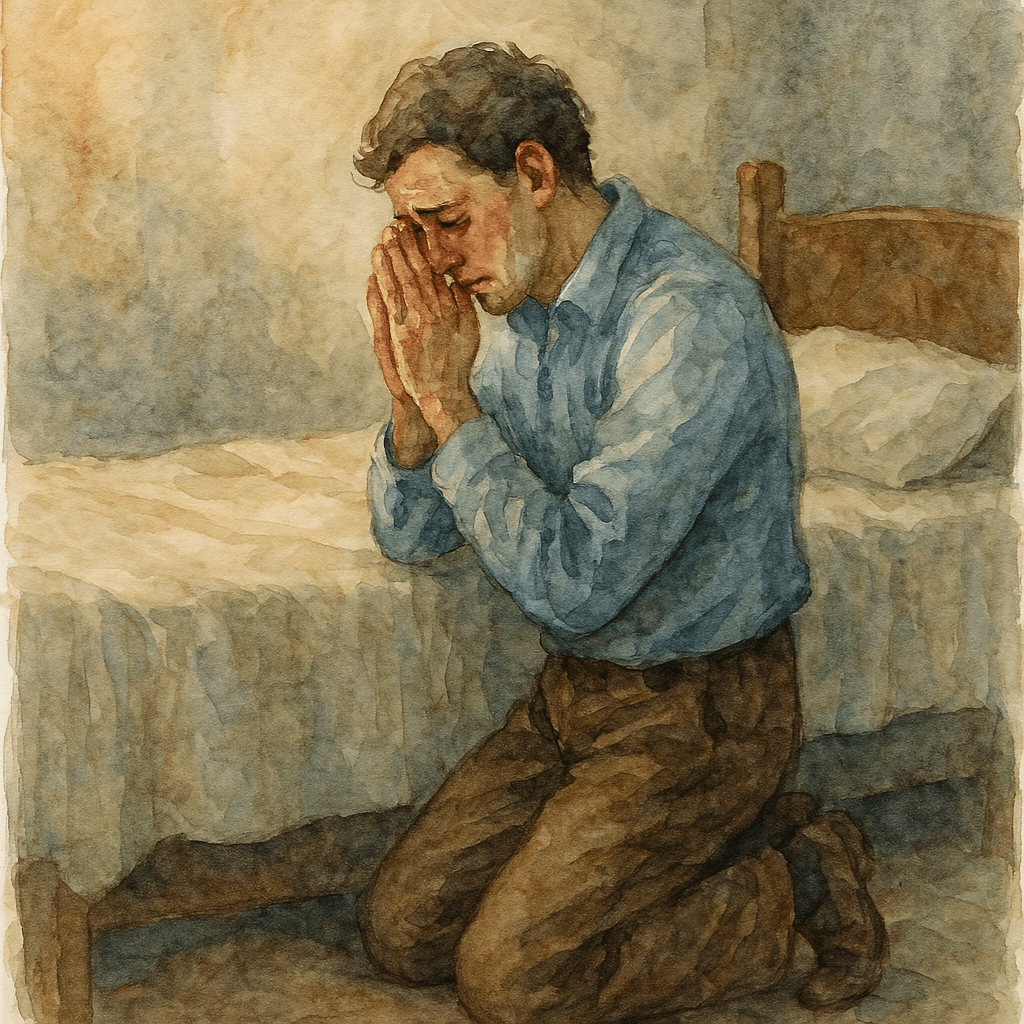
Those that say they will not follow God’s commandments until they are convinced that He is real overlook the fact that even the truly faithful regularly struggle to keep His commandments also. Even a strong belief in God’s reality does not suddenly cause us to swallow our appetites and live as perfect saints.
Indeed, it is our struggle with our moral behavior that leads so many of us to believe in God in the first place. Our belief in Him begins as we let go of our misplaced belief in ourselves. We try to change our hearts on our own, we consistently fail, we lose all trust in our own power, throw our last hope on a God that we are not sure of, and then experience a miracle as He changes what we never could.
Thus, the cynic’s disbelief of the Almighty and dismissal of the commandments is not due to having not explored God enough, but due to having not explored his own heart enough.
Ambitions are good for life
But it is not good
If life is for the ambitions
6 And thou shalt set the altar of the burnt offering before the door of the tabernacle of the tent of the congregation.

7 And thou shalt set the laver between the tent of the congregation and the altar, and shalt put water therein.

8 And thou shalt set up the court round about, and hang up the hanging at the court gate.
We now read the order in which the courtyard is to be erected. First the sacrificial altar, then the washing basin, and finally the courtyard walls and gate. With that, all of the elements would be properly in place, though not yet anointed and ready for use.
One thing that stands out to me is that the sacrificial altar is to be placed in line with the door of the tabernacle. Not off to one side, or at a bit of an angle, but directly on the path to it. The symbolism clearly being that there is no approaching the sacred inner places without first making a sacrifice. It might seem easier if we could obtain God’s full glory before we gave up our beasts of the flesh that hold us back, but that simply isn’t how it works. The offering must come first, the presence of God must come after. For this very reason, God remains inaccessible to any who try to reverse the order and say they will only make sacrifice after they first witness God’s presence.
But for those that do make offering, the washing presents itself next. The washing comes because of the sacrifice. We are made holy and clean, and now we are ready to enter God’s glory. That is the order, and it cannot be short-circuited or rearranged. We come by that path, or we don’t come at all.
10 And he made the table of shittim wood: two cubits was the length thereof, and a cubit the breadth thereof, and a cubit and a half the height thereof:

11 And he overlaid it with pure gold, and made thereunto a crown of gold round about.

12 Also he made thereunto a border of an handbreadth round about; and made a crown of gold for the border thereof round about.

13 And he cast for it four rings of gold, and put the rings upon the four corners that were in the four feet thereof.

14 Over against the border were the rings, the places for the staves to bear the table.

15 And he made the staves of shittim wood, and overlaid them with gold, to bear the table.

16 And he made the vessels which were upon the table, his dishes, and his spoons, and his bowls, and his covers to cover withal, of pure gold.
Today covers the creation of the table of shewbread. Reading these verses, I had the thought occur to me that this whole account must be a summary of the entire work done, not necessarily a sequential log of what order all that work was accomplished in. It seems most likely that several instruments for the tabernacle were being worked on simultaneously. One man could be turning shittim wood into boards, another man could be fitting those into the structure of the table, another man could be carving the staves, and a fourth man could be making the golden dishes. And, simultaneously, even more men working on the ark, the candlestick, the laver, etc.
God often leaves those sorts of logistics to the individual. Sometimes He might give a specific process to follow, but often He only mandates an end result, a clear vision of what one needs to accomplish, and then man must determine his own methodology to divide that labor and bring the vision to reality.
34 And the Lord said unto Moses, Take unto thee sweet spices, stacte, and onycha, and galbanum; these sweet spices with pure frankincense: of each shall there be a like weight:

35 And thou shalt make it a perfume, a confection after the art of the apothecary, tempered together, pure and holy:

36 And thou shalt beat some of it very small, and put of it before the testimony in the tabernacle of the congregation, where I will meet with thee: it shall be unto you most holy.

37 And as for the perfume which thou shalt make, ye shall not make to yourselves according to the composition thereof: it shall be unto thee holy for the Lord.

38 Whosoever shall make like unto that, to smell thereto, shall even be cut off from his people.
In addition to the anointing oil, which was already quite fragrant, God also gave the recipe for a perfume. None of the ingredients for the perfume were the same as for the oil, so I would it assume it had a completely different scent profile. It is interesting to note the presence of myrrh in the anointing oil and frankincense in the perfume. Obviously, there was also gold overlaying everything in the tabernacle. Thus, all three of the gifts that the wise men would bring to Jesus thousands of years later were also present in the ancient Israelite tabernacle.
As with the anointing oil, there is a solemn command that no one else is to take the recipe and reproduce it. In fact, God goes so far as to say they are not to make anything that smells like it, even if made from different ingredients. I think there is a lesson here of not dressing up non-spiritual things with the scent of spiritualism. I live in a culture with a strong religious base, and it has always bothered me when individuals have tried to use that religion as a leverage for worldly interests. I have seen this when individuals try to market their personal business, when they advocate for a favored political party, even when justifying their sins. They try to give these things a spiritual air, but as we learn from today’s verses, things that are temporal should not be perfumed as if they were sacred.
One final note: while it is called “perfume” in these verses, the underlying Hebrew word is the same that was translated as “incense” in the verses describing what would be burned upon the incense altar. Thus, it would seem that this is the recipe for the incense that was to be burned morning and evening for a perpetual offering to the Lord.
31 And thou shalt speak unto the children of Israel, saying, This shall be an holy anointing oil unto me throughout your generations.

32 Upon man’s flesh shall it not be poured, neither shall ye make any other like it, after the composition of it: it is holy, and it shall be holy unto you.

33 Whosoever compoundeth any like it, or whosoever putteth any of it upon a stranger, shall even be cut off from his people.
The usage of the holy anointing oil was to be exclusive to the tabernacle. It wasn’t a complicated recipe, so anyone could have recreated it, but that would result in exile. And it was to never be applied to a non-Israelite.
The path to discipleship is open to all, and was so among the ancient Israelites, but these things have to be done in the proper order. Acceptance into the fold of the church and forgiveness for sin are the first steps, and they must be taken before all of the sacraments that follow. So, too, an ancient Canaanite would first have to observe the Passover, join the Israelite nation, and bring sacrifice to the tabernacle to enjoy the blessings of those anointed vessels.
This anointing oil was also not to be placed directly upon the flesh either. The priests would be anointed by it, but so far we have only heard of that being done by sprinkling it over their clothes. There is also a historical idea of anointing oil being applied to the head, but perhaps a few drops on the hair would not be considered as being applied to the flesh.
5 And thou shalt take the garments, and put upon Aaron the coat, and the robe of the ephod, and the ephod, and the breastplate, and gird him with the curious girdle of the ephod:

6 And thou shalt put the mitre upon his head, and put the holy crown upon the mitre.

7 Then shalt thou take the anointing oil, and pour it upon his head, and anoint him.

8 And thou shalt bring his sons, and put coats upon them.

9 And thou shalt gird them with girdles, Aaron and his sons, and put the bonnets on them: and the priest’s office shall be theirs for a perpetual statute: and thou shalt consecrate Aaron and his sons.
We hear how the clothes we heard of last chapter are placed upon the priests, and these verses appear to give the correct order in which articles would be put on. First the coat as the bottom layer, then the robe and the ephod. Next the breastplate would be secured to the front, and all the layers would be fastened by the girdle. The mitre would be placed upon the head, and finally the golden plate inscribed with HOLINESS TO THE LORD would be tied to the mitre as a holy crown.
There was a proper order to getting dressed, just as there would be a proper order to every ritual performed at the tabernacle. The priest would have to dress himself correctly each morning to be ready to conduct himself rightly in his duties. Just as every article of clothing needed to be applied in its proper time and place, so must the affairs of our lives be properly ordered and timed as well.
Verse 7 also mentions the anointing with oil, which is the touch of the divine to complete the adornment of the priests. They would put themselves in order, then God would enrobe them in His spirit to be fully ready.
As I read through the rest of the process, I will treat it as a symbol for all of us in our approach to the Lord. The first step, as we have already seen, is to set ourselves in order and clean up our act as best we can. Just for following our conscience in this way, God will make His spirit rest upon us, like the anointing of oil. So prepared, we will be ready to progress further towards Him.
27 And he came near, and kissed him: and he smelled the smell of his raiment, and blessed him, and said, See, the smell of my son is as the smell of a field which the Lord hath blessed:

28 Therefore God give thee of the dew of heaven, and the fatness of the earth, and plenty of corn and wine:

29 Let people serve thee, and nations bow down to thee: be lord over thy brethren, and let thy mother’s sons bow down to thee: cursed be every one that curseth thee, and blessed be he that blesseth thee.
Yesterday I mentioned that Jacob, and Esau’s charade was of little importance, for God was sure to do what He already intended to do regardless of their antics.
And this is further reinforced in today’s verses. Notice that the blessing that Isaac pronounces upon Jacob was never meant for Esau to begin with. In the blessing Isaac said for Jacob to “be lord over thy brethren, and let thy mother’s sons bow down to thee,” and this was exactly what God had already prophesied for Jacob when he was still in his mother’s womb.
There was no way that this was the blessing that was ever meant for Esau. Not so long as Isaac was giving a proper blessing, one where he only was a mouthpiece for what God intended to say. If Isaac had blessed Esau first, he would have still had to give him the same blessing that Esau ended up receiving anyway, if he had blessed Jacob second, he would still have had to give Jacob the same blessing that he gave him now.
 Spiritual Wanderings