Faith vs Works- What About Those that Can’t?

The Paradox)

We’ve already spent a good while discussing salvation, and whether it comes by faith or works. In the last post, I encouraged us to accept each of the different messages in scripture, even if they initially seem contradictory to us. I said we should accept that Jesus meant it when he declared that belief and baptism were necessary to be saved and also believe it when Paul said that salvation is purely by grace through faith. By accepting both positions, we allow space for God to explain how this works. So long as we reject one side for the other, we shut ourselves off from the revelation of how God bridges the gap between.

So let us accept the primacy of both faith and works and be comfortable in the paradox that we find there. Jesus said that baptism was one of the steps necessary for salvation, and so we accept it, but he also said that “God sent not his Son into the world to condemn the world; but that the world through him might be saved.” Such a plan of universal salvation sounds wonderful, but how can that work when the majority of God’s children, billions and billions of souls, have lived and died without ever knowing the name of Jesus, and never having the opportunity to be baptized in his name? Did Jesus come to save the world, or to create conditions that would exclude it?

We do not want to dismiss Jesus’s command to be baptized, but neither do we want to dismiss his claim of universal reclamation. Is it possible that God has ordinances that are necessary for salvation, and that those who died without those ordinances could still be saved?

The Solution)

There is in my LDS theology, and apparently in the practices of the early Christians, a practice of performing the ordinances of salvation for the dead, including baptism. Not as a way of forcing those that have gone before into Christian faith, but with the understanding that the individual soul may freely accept or reject the ordinance according to the alignment of their heart.

I know that suggesting this solution might be controversial outside of the LDS faith, but the practice is explicitly spoken approvingly of by Paul:

Else what shall they do which are baptized for the dead, if the dead rise not at all? why are they then baptized for the dead?
-1 Corinthians 15:29

Problems Resolved)

This theology of proxy ordinances resolves the issue that we raised just prior, explaining how baptism can be required for salvation but also how those who died without access to it can still be part of Christ’s universal invitation to salvation, but that is not all. This theology also answers the very debate that we began this study with: faith vs works.

By accepting the practice of baptisms for the dead, we can see why Paul speaks so emphatically about the sufficiency of faith alone. We can now understand that if a person conforms their heart and will to the Almighty, then that is what is absolutely essential in this life, because then they can accept the ordinances of salvation in the next one. If a man spends his life cultivating a believing and submissive spirit but dies without knowing Jesus or without being able to perform all the necessary ordinances, it is alright. He got his heart right, and Christ and his church will take care of the rest.

Some works and ordinances are still required for salvation, but those that accept Jesus in true faith can rest comfortable in the knowledge that whether they die tomorrow or in eighty years, God has made a way for all those necessary works to all be accomplished. We have no more argument of faith vs works, we see the false dichotomy for what it is, and we are able to fully embrace the primacy of both.

Now I realize that not all of my readers may be able or willing to accept this doctrine of baptisms for the dead. If that is you, no worries. I would still urge you to keep a mind open to finding some way in which the scriptures can all be satisfied, both the ones that suggest that faith is the key to salvation, and also the ones that say certain ordinances are necessary also. Do not accept arguments that ask you to reject half of the scriptures on the matter, or which require you to twist their interpretation in unnatural ways. Let your beliefs follow the natural interpretation of God’s word, and not the other way around.

Anyway, this is where I will conclude the study. I hope, if nothing else, it has opened up some new questions and new considerations for you. May God lead you to reject the false dichotomy of faith vs works, and to embrace both as beautiful and essential parts in His plan for mankind.


Unrealized Potential

Unspent things have no value
Dollars, thoughts, effort
They are only potential until they are given away

Life itself is only idleness
Until it is offered for something greater
It finds it value in being sacrificed

Grit vs Surrender- Autonomous or Not?

The Mixed Man)

Yesterday I shared about my personal struggle with addiction, and how I only found liberation as I surrendered my will to God, taking the steps that He set before me and not my own. Then, true healing and freedom blessed my life, but I want to be very clear that it did not, and never could have, come about in the way that I wanted it to. I had to do things that I didn’t want to do, but that God chose for me.

This points to an interesting paradox in the gospel. Autonomy is essential to God’s plans for us. Right from the beginning, God created a man and a woman who were designed with the capacity to make their own choices, and He even gave them a tree to exercise their choice one way or the other.

“But of the tree of the knowledge of good and evil, thou shalt not eat of it, nevertheless, thou mayest choose for thyself, for it is given unto thee,” (Moses 3:17).

If God did not mean for man to make his own choices, God never would have set things up this way.

But also, part of God’s plan is that man should surrender his will. Thus, we are all meant to have the ability to choose our own path, but to then give it up to the Father.

“Submit yourselves therefore to God,” (James 4:7).

“I beseech you therefore, brethren, by the mercies of God, that ye present your bodies a living sacrifice, holy, acceptable unto God, which is your reasonable service,” (Romans 12:1).

The Ultimate Example)

Notice how Jesus followed this pattern perfectly. His autonomy was supreme and no one else had any power over him:

“I lay down my life. No man taketh it from me, but I lay it down of myself. I have power to lay it down, and I have power to take it again,” (John 10:18).

Of course, when it actually came time to lay down his life, Jesus’s own will, his autonomy, pulled him from it. It was his desire that “this cup would pass from him.” Even so, he surrendered that autonomy, declaring to his Father, “not as I will, but as thou wilt,” (Matthew 26:39).

Tomorrow let us think some more about what this means for us personally. We will consider questions such as, how do so many of us, even Christians who fully believe the message of the Bible, fall into this false belief that we can satisfy God while holding onto our autonomy? And what does it look like to truly surrender to the will of the Lord?

Scriptural Analysis- Exodus 34:4-7

4 And he hewed two tables of stone like unto the first; and Moses rose up early in the morning, and went up unto mount Sinai, as the Lord had commanded him, and took in his hand the two tables of stone.

5 And the Lord descended in the cloud, and stood with him there, and proclaimed the name of the Lord.

6 And the Lord passed by before him, and proclaimed, The Lord, The Lord God, merciful and gracious, longsuffering, and abundant in goodness and truth,

7 Keeping mercy for thousands, forgiving iniquity and transgression and sin, and that will by no means clear the guilty; visiting the iniquity of the fathers upon the children, and upon the children’s children, unto the third and to the fourth generation.

Moses brings two new tables into Mount Sinai as instructed. The Lord passes before him, and while we do not hear about Moses being covered in the cleft of the rock by the hand of the Lord, presumably that transpires as described in the previous chapter.

It seems particularly appropriate that the Lord’s introduction, beginning in verse 6, particularly focuses on His patterns of justice and mercy, given that those are the qualities being weighed in His meeting with Moses today. Moses and the Lord are here to sanctify their agreement for Israel to be restored to God’s good graces, to be transferred from God’s justice to His mercy.

Verse 7 might initially sound contradictory to some. Is God merciful or does He dole out punishment? Will He forgive iniquity or refuse to clear the guilty? But I believe that is the whole point of this passage, to highlight that God does both. He is perfect justice, and He is perfect mercy. But isn’t that impossible? Aren’t those two mutually exclusive, at least in regard to any individual infraction? To man, perhaps so, but not to God.

These may sound like strange riddles, assertions with no basis, but the delight of the gospel is to take seeming paradoxes like these and beautifully resolve them. This particular riddle finds its answer in the person Jesus Christ.

But he was wounded for our transgressions, he was bruised for our iniquities: the chastisement of our peace was upon him; and with his stripes we are healed. All we like sheep have gone astray; we have turned every one to his own way; and the Lord hath laid on him the iniquity of us all. 
-Isaiah 53:5-6

Does God dole out justice for transgression or provide undeserved mercy. Both. The justice is met in Christ, and the mercy comes through Christ to all of us. The two natures of God’s judgment described in today’s verses are entirely accurate.

A Blessed Curse

Only those that are most dedicated to evil are destroyed by God. For all the rest of us, even when He curses us, it is a curse designed to teach and even save us. The very tribulation that we think will ruin us, ends up being the vehicle for our salvation. It feels like a death, but it holds the seed of life. Thus, by His grace, even God’s curses are blessings.

The Paradoxical Gospel

One of the most intriguing elements of the gospel is its reliance upon seeming paradoxes. The only way to save your life is to lose it. Christ overcame the world by letting himself be defeated by it. We only find the strength to overcome our vices when we admit defeat and surrender to Jesus. We are saved by grace, but that salvation is then evidenced by our works. In our relationships with our fellow man we are supposed to return good for evil.

It is a fascinating concept, and perhaps one day I will do a more in-depth study as to why this pattern of paradox is so prevalent in the gospel. One reason that is apparent to me now, however, is that it allows God to hide His path in plain sight. Consider the last example in the above paragraph, which is that we are to return good for evil. Jesus was absolutely clear on this point. Here are his words in Matthew 5:44:

But I say to you, love your enemies, bless those who curse you, do good to those who hate you, and pray for those who spitefully use you and persecute you.

Returning kindness for cruelty goes against our human nature. It seems completely illogical. It only seems consistent that we would do good to those that do us good, and evil to those that do us evil. In the spirit of fairness, we would at least need to hurt our enemies just as much as they hurt us, and then perhaps we could build a new, more positive relationship since we were back on even ground.

But that isn’t what Christ commands us. He commands us to love even while we are the one at a disadvantage. It isn’t logical and it isn’t natural, but it is a surefire way to experience a slice of heaven here on earth. Genuinely forgiving an enemy brings a buoyancy and cheerfulness to the heart that defies all reason. And so, the evil suffered was actually the potential for good, a beautiful blessing in disguise.

And this is no secret. All of these counter-intuitive, paradoxical behaviors that unlock the greatest joy have already been laid out before us. The proliferation of the Christian gospel has made it so that all of us know that turning the other cheek will make us walk hand-in-hand with God. We all know the way, but few there be that take it because it requires us to go against our own nature and embrace the paradox.

This combination of free knowledge, but paradoxical requirement means that no one will join God by accident, but everyone that sincerely wants to join God may do so. It is an ingenious solution that allows God to save every soul that really wants it.

Scriptural Analysis- Exodus 23:9

9 Also thou shalt not oppress a stranger: for ye know the heart of a stranger, seeing ye were strangers in the land of Egypt.

God had already commanded the Israelites not to vex or oppress any foreigner living among them, but now He repeats that directive a second time, and once again the reason given is that the Israelites had themselves been strangers in a strange land, and so they knew the heart of those that lived such a life.

This is an interesting logic, a sort of divine paradox, to say that because the Israelites were themselves oppressed when they were the foreigners, that they therefore must not oppress any foreigners themselves. Our human tendency is far more inclined towards “since you did it to me, I get to do it to you.”

Recall that when Israel departed Egypt a mixed multitude went up with them, which means foreigners in their midst. These may have been other slave nations that had served under Egypt, but it may also have been some of the Egyptians themselves. Furthermore, after they entered the Promised Land some immigrants of their own enemies would come live among them, such as Ruth who came from Moab. Thus, when God says to not oppress the stranger, He is including strangers that came from lands that were directly hostile to Israel. It would be absolutely natural to let their anger against those enemies loose upon the immigrants that came from them, but God required His people to take the higher road, to return kindness for offense.

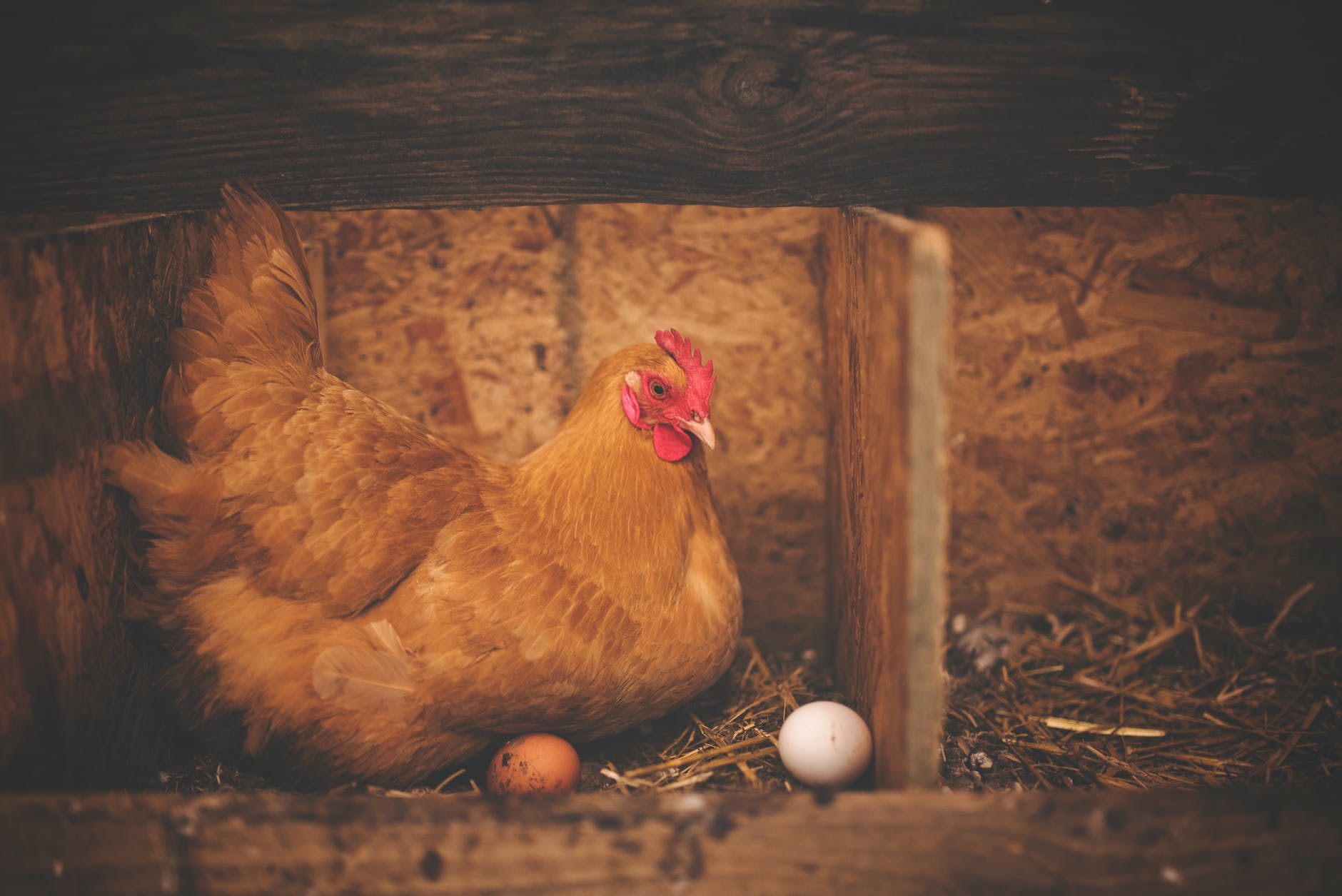
The Chicken or the Egg?

The Paradox)

We’ve all heard the classic dilemma, “which came first, the chicken or the egg?” Most people merely see this as an amusing puzzle, and quickly discard it as having no suitable answer.

But really, it is a very serious question, one that was posed by Aristotle himself over 2,400 years ago! The fact that we are still talking about it to this day, and still shrug it off without any clear explanation is a very alarming fact!

Now, to the creationist, the question really isn’t that troubling. If God created the Earth, the atmosphere, the seasons, and the universe as we know it, is it really any stretch to say that He could have architected the egg-bearing chicken also? And whether He did that with an egg or a mature fowl doesn’t really matter, He could have begun with either without any paradox.

But the materialist throws out the idea of an omnipotent creator, and puts in His place the forces of undirected, spontaneous evolution. Darwinism states that neither the chicken nor the egg came first, but a single-celled organism which, through a lengthy process of mutation and natural selection, developed into the species that we now call the chicken.

And I might concede that this would be a possibility, if we could agree that the evolution would have to have been a tool purposefully directed by the hands of an intelligent creator. But if one insists that this evolution occurred totally at random, which is the position of modern science, well that’s just plain ridiculous.

The Requirements)

Again, the proposal is that the chicken would have had to originate as some sort of single-celled organism, one which reproduced by dividing itself in half, but eventually it evolved into a creature that reproduced itself via a fertilized egg. This would mean that at some point in between there would have been a creature that still reproduced asexually, but which was also gradually developing sexual organs. Organs that eventually were able to produce and lay an egg, but initially this egg would not yet have been functional.

This means that the pre-chicken was expending energy and effort, giving up nutrients of its own body, subjecting itself to a more vulnerable state, all to produce something that was—for the time being—useless. And again, this might be acceptable if some Higher Power was requiring the life form to undergo this process, but it according to the laws of natural selection, this would mean that the species had a detrimental mutation which would have led to its extinction, not to its flourishing. This unnecessarily-handicapped pre-chicken simply would have been overrun by all the other variants that weren’t wasting energy laying undeveloped eggs.

And that’s just the matter of the chicken and the egg. But by itself, a female chicken still cannot produce a fertilized egg. Just as the species would have had to evolve from a replicating cell into a chicken that had embryonic and adult stages, it also would have had to evolve itself into male and female forms also. Thus it had go from being sexless to having sexed versions, but at least for a time those two halves would still have been reproducing asexually until they evolved into full sexual maturity. That means that there would now be two separate strands of random mutation, each evolving separately from one another, but somehow also in perfect tandem, developing in complementary ways, remaining compatible with one another once they both reached full sexual capability.

A Valid Question)

So as it turns out, the childhood question of “which came first, the chicken or the egg?” is actually a very weighty matter. It has all manner of scientific and metaphysical implications. 2,400 years later it still pokes holes in the most airtight theories of man and leaves us either with a stronger belief in our divine creator, or else a greater confusion of this inscrutable world.

To Live Freely: Part Seventeen

I began this study with a simple objective: to make the case that the only way to live was to live in truth. Right from the beginning I understood that this concept was so fundamental that it would defy definition. It is axiomatic, something that is most often just assumed to be true, unprovable by conventional methods. I tried to make my case even so, approaching the subject in all manner of different ways. It has been a fruitful, if eclectic, enterprise. Not only am I more convinced of the soundness of this principle, I better understand why it is such a difficult thing to prove objectively.

I will help illustrate this as I gave my final observations. Here is the first half of the conclusion to all that I have found.

Realms of Truth)

One of the key things I came to realize through this study was the various realms of truth that we encounter in life. I found myself debating around three separate categories of truth at different times. Each of these categories had different levels of tangibility and effect, yet I observed that each seemed to follow the same pattern. Let us consider them each, one at a time.

First, there is the physical truth. This is the truth of our perceivable, material world. Scientists have long understood that our world is composed of systems and procedures, each reliable and consistent. There are clear rules that govern physics, chemistry, and geology. These rules can be directly observed and measured; that is how we know that they exist. They are true, and they are always true. What is more, these physical truths exist separately from our individual selves. We interact with the physical world, we cause certain of its rules to play out, we harness its systems for our own benefit, but we do not define or override its rules. For all the self-will we possess, we can only employ it within the confines of its laws. The physical truths simply are what they are, and even if all of us ceased to exist and there was no one left to recognize these truths, we are certain that they would continue regardless.

Secondly, there is the truth of a society. This truth is the state that we social beings exist within. It is comprised of all our individual selves, and the relationships that exist between us. It is the sum total of all our thoughts, feelings, words and beliefs, both within ourselves and towards each other. We cannot examine this social state as directly as we can the physical world, but logically we know that it must exist and have a true definition. For we all know that we have our own, personal state of being, and so the amalgamation of all our states must be a real state as well. Our experiences also suggests that this super-state moves by certain patterns and rules. There seem to be certain laws about how individuals, relationships, and societies grow and evolve, and philosophers and psychologists have spent countless years gleaning what nuggets of truth they can from these systems. Interestingly, while these patterns must emerge from us directly, we remain individually ignorant of how we contribute to them. We are like the particles of dust that fall in the physical world, our movements seeming to be individual and arbitrary when examined up close, but when taken as a whole, we see that the mass is subject to forces that underpin the whole. Thus, as with the physical world, the truth of this realm seems to emerge from something greater than the individual. It belongs to the species as a whole, yet it is clearly enmeshed in us as well.

Finally, we have the moral truth. This truth is defined by the laws of how we should govern ourselves. It is the principles that we should hold to, the ways that we can direct our efforts and our attention to harmonize with the thing that we call “good.” This truth is the most mystifying of them all. We cannot see it or measure it. We cannot graph its movements. All of us try to obscure it with our own agendas and selfish desires. And yet, in spite of all this confusion and denial, there still remains the universal conviction that moral truth is a reality. Every civilization has always believed in some form of it. Though we cannot see it, we can feel it. Like the two other realms of truth, we sense that it originates from somewhere outside of ourselves, and we believe in it so concretely that we are sure what is right would remain right, even if there was no one left to practice it. Also, though the moral truth originates outside of ourselves, it is inseparably integrated inside of us as well. It pulls at us, we interact with it, and it even emerges from out of us.

The Need to Follow)

To some degree, we all perceive and accept each of these realms of truth. We all have a basic understanding of the laws of nature, the laws of society, and the laws of morality. We know that we should live in harmony with each of them. We know that there are certain things we just shouldn’t do, because they will cause physical pain, or social rejection, or be immoral. We know that there are other things that we should do, because they will increase our safety and be the most direct means to achieving what we desire. In the physical world, the positive benefits of conducting ourselves according to the laws of gravity can be explicitly observed. In the social world, the benefits of doing to others what we would like to have done to ourselves can be implicitly inferred. In the spiritual world, the benefits of sacrifice to our higher power are intuitively believed.

And yet, in spite of all this knowledge, and inference, and belief, we still try to violate these truths repeatedly! We risk injury just to save a few seconds of time, we try to fool others into giving us what we want, and we try to satiate our base desires when we think God isn’t looking. And even after we are hurt for our defiance of truth, we will still test its limits again and again. There is a part of us that is converted to the truth on a conceptual level, but somewhere between that part and the carrying out of our actions there is another part that is not converted, and it overrides our better senses.

We know the truth, but we are not, ourselves, entirely truthful. As mentioned above, these truths all emanate from outside of ourselves, and so they are foreign objects to us. But at the same time, they also are integrated in our individual existence, and so they are our very own selves as well. This is a strange paradox, and because of it, mankind has ever been a creature perplexed.

I have something to say about what I have learned of how this incongruity is resolved, but I’ve run out of time. I shall take it up tomorrow. See you then.