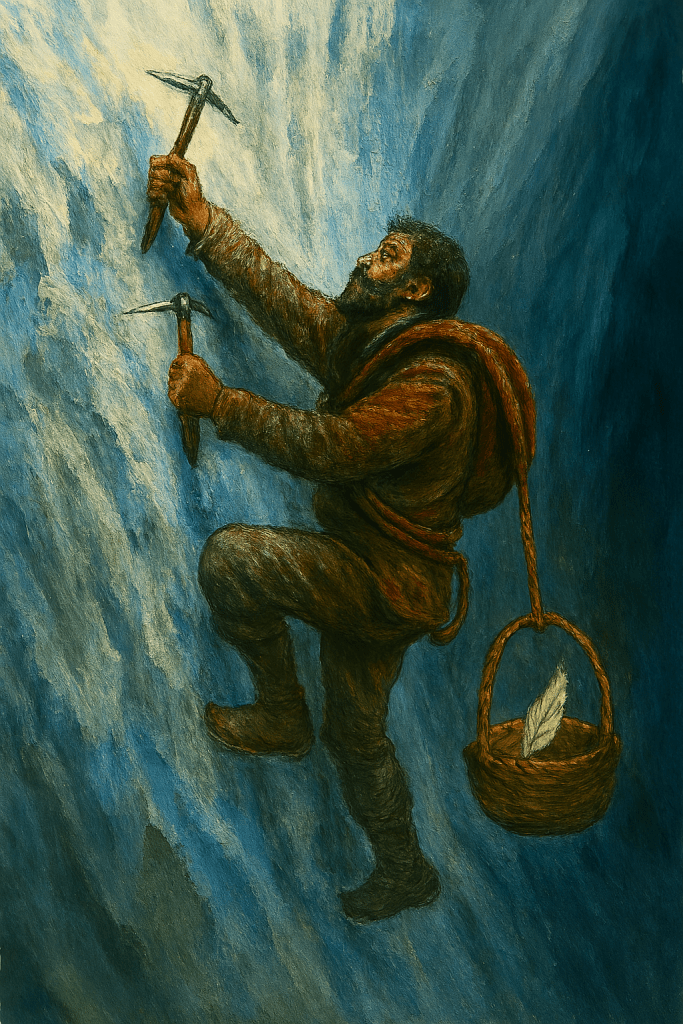
The Greatness of the Task

Sometimes, it isn’t the greatness of the task that you do
It’s the greatness of the opposition you overcame to do it

Views of a Building

Some might look at the foundation of the building and say:

“Look, it’s forced to sit there beneath everything else, subservient and in the dirt! That’s a fact that it is under everything else, you can’t deny it! That’s wrong, and we have to change it. We have to pull the foundation above the level of the ground, even put it at the top of the building!”

Of course, doing that would make the entire thing topple.

Some look at the foundation of the building and say:

“No, it is supporting the entire building! It’s really the most important part of it all! Better than all the rest. We should all aspire to be steady foundations like that.”

Both views have a claim to some fact, and by that each assumes that they are in the right and are incredulous at anyone with a different perspective. “I see a fact,” they say, “and that means that I am right.” But narrow-minded facts lacking context can lead us astray, just as surely as total ignorance.

There is also a third group of people, who are able to back up and take in a fuller perspective. They might say:

“Foundation, top floor, elevator shafts, facade…they are all building. They all serve an essential and beautiful purpose. The foundation is good, the first floor is good, and the top floor is good. They are different, but that is by design. No part is better, no part is worse, they’re just different. A foundation without a top is useless. A top without a foundation is ruinous. So, appreciate them for what they are and embrace them all.”

Look Higher

All too often we limit our perspective when trying to remedy’s society’s ills. We see what appears to be immediately wrong around us and we try to implement what we see as the immediate solution to that problem. But this is like staring down at our feet while hiking on a trail. We may find the path of least resistance, but it may very well lead us off the edge of a cliff!

To navigate uncertain terrain, you must raise your view and fix it upon your ultimate destination. Only by focusing on our highest ideals, even the standard of heaven, can we make the right societal changes, both in the short and long term.
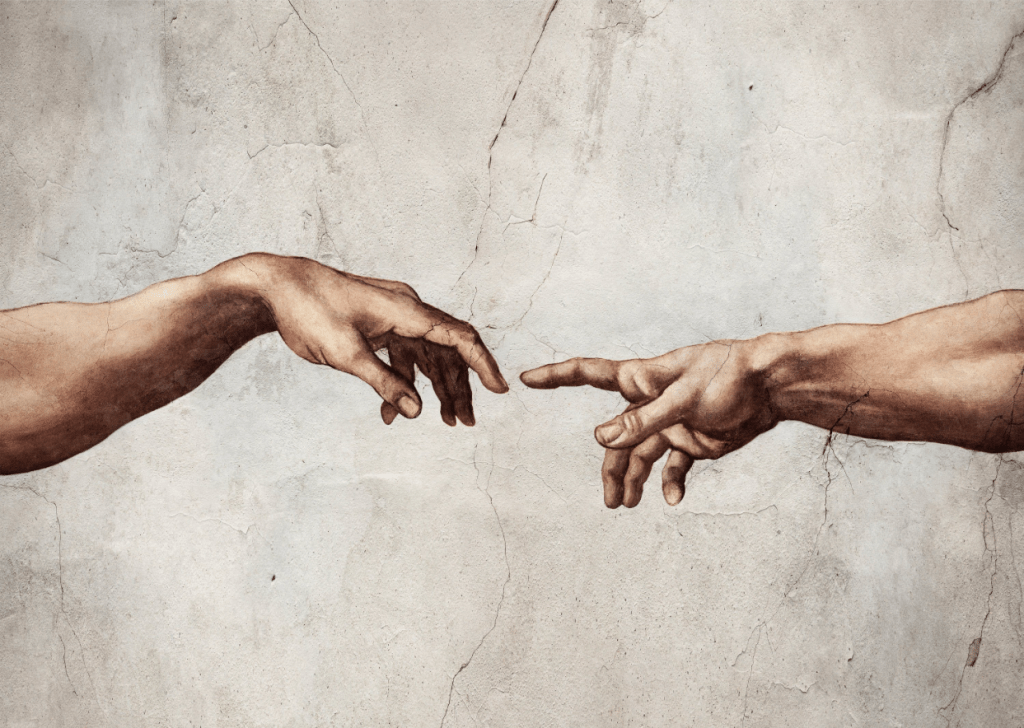
God Reaching for God

God is the standard to strive for, but He is also the activating agent that makes the striving possible. God lives outside of us, but also part of Him lives inside of us. Thus, it is God that reaches for God and God that raises God, and we simply are pulled along by the part of Him that is inside us.

Hell Within

If you live every day with a level of physical comfort, security, wealth, and peace that almost no one in history has ever enjoyed, yet every day is filled with anger, anxiety, and despair, then perhaps it is time to consider that your hell comes from within.

If God Can Do Anything

Because I believe that God can do anything, I believe that He can make any desired miracle come true for me! But even more impressive, because He can do anything, He can also make things work out without the miracle. Indeed, it requires less faith to believe that God can change the world to match my heart, than to believe that God can change my heart to survive in spite of the world.

Believe in the bigger God. Believe in the God who can make you whole, with or without the thing you most desire.

The Christian Conception of Evil

A Shallow View of Evil)

Great divisiveness in a culture tends to form ideologies with a naïve and overly-simplistic perception of evil. Festering hatred lures people into a mentality where they conceive of evil itself as propagating outward from “those people” over there. Strict ideologues believe that if they could just convert or destroy “those people,” then the evil would be gone, and society would be a perfect Utopia.

This narrow view of evil is a powerful tool for focusing and concentrating the passion of the ideologues. It progressively motivates them to disparage, dehumanize, and destroy their enemies. Mankind has fallen into the routine of dividing, declaring the other side to be the bastion of evil, and then destroying them for as long as we have a historical record. Yet if the problem of evil is so simple, then why has this pattern never succeeded in the eradication of evil? Why haven’t we finally killed it already? Why do we keep facing it in every generation?

The Christian View of Evil)

For an answer, let us consider the Christian conception of evil instead, taken directly from the words of the Bible.

And God saw that the wickedness of man was great in the earth, and that every imagination of the thoughts of his heart was only evil continually. -Genesis 6:5

There is nothing from without a man, that entering into him can defile him: but the things which come out of him, those are they that defile the man. -Mark 7:15

But every man is tempted, when he is drawn away of his own lust, and enticed. Then when lust hath conceived, it bringeth forth sin: and sin, when it is finished, bringeth forth death. -James 1:14-15

For the flesh lusteth against the Spirit, and the Spirit against the flesh: and these are contrary the one to the other: so that ye cannot do the things that ye would. -Galatians 5:17

As it is written, There is none righteous, no, not one: They are all gone out of the way, they are together become unprofitable; there is none that doeth good, no, not one. -Romans 3:10, 12

This view of evil is far more mature, nuanced, and difficult to solve. Instead of saying “evil comes from that group over there,” the Christian perspective maintains that “evil emanates from us all.” It is in me, in you, in everybody. Evil is a super-entity, one that pervades through all of us.

And yes, maybe certain ideologies have a deeper fealty to evil than others; perhaps some dark trains of thought really should be arrested and ceased; perhaps some collectives need to be disbanded; but the true Christian knows that even these efforts will not bring about the perfect Utopia. The true Christian knows that the eradication of “those people” is not the final solution to the problem of evil because even if we stamped all the evil out in one place, it would still seep out from within our own ranks. Eventual corruption is the rule of the world.

The Solution)

Obviously, this conception of evil is much more daunting to wrestle with. If evil will emerge anew in every heart, than what can be done to have victory over it?

Ultimately and universally, nothing.

God will have to claim the victory there because it will always be beyond us. However, on a more individual level, there is something we can do.

This Christian conception of evil, that it arises in every heart, is the very reason why Christianity has always taught that every man ought first and foremost to address his own personal evil before that of the world. That isn’t to say that we don’t concern ourselves with the greater evils of the world, or that we don’t give our energy to curtail it, but our primary concern is to first plug the well of evil in our very own heart. If all of us could just do that, could just get control of the darkness that is within, then that would be the greatest blow against evil we could ever achieve.

It may seem paradoxical, but the fact that evil is so universal means that it can only be remedied individually. It is up to all of us to each do our part.

True Freedom

True freedom is not having your chains removed, it is realizing they were never there in the first place.

A God of Vengeance

God’s Devastation of Egypt)

In my scripture studies I have been making my way through the early chapters of Exodus, in which we read the story of God sending His plagues against the people of Egypt, afflicting them until finally they let the Israelites go. Recently I noted how these chapters show the side of God that is a God of vengeance. It has stood out to me a great deal just how vicious God’s breaking of Pharaoh and the Egyptians was.

God began the whole affair by summoning forth the blood of the innocent Israelite babes thrown into the river, symbolizing that He was about to require the same blood of the Egyptian people. He then procedurally and strategically took from the Egyptians their comfort, their health, their wealth, their sacred animals, and their safety. He announced that He had propped the entire nation up for the express purpose of beating it down in the sight of all the world. When finally He brought His death upon them, He made sure to take someone from each and every household, ensuring that all of the Egyptians had their hearts broken in the very same night.

One cannot seriously meditate on this story without being moved by the absolute devastation God inflicted upon those people. And more meaningful than the size of the devastation was just how methodical and purposeful it all was. God really knew just how, where, and when to intimidate, to apply pressure, and to break.

A Guilty Heart)

Personally, seeing this view of God does not disturb me. I have always understood and been comfortable with the view that God is to be trusted by the righteous, but feared by the wicked. I know that God endeavors to save the sinner, for He saved me. But before my time of repentance He stood against me and afflicted me, and never did I resent Him for that. I have come to see that the nature of my sins is that they inevitably lead to hurting others, especially those that I love most, and in those moments I am absolutely deserving of God’s judgment and punishment.

Granted, God hasn’t visited me with so great of curses as He did the Egyptians, but neither have I killed thousands of innocent babes as they did. I know that some people struggle with the magnitude of God’s punishments in the Old Testament, but when I read the accounts that are given I do not see that He did anything that was unwarranted. Yes, He smote Sodom and Gomorrah, and Egypt, and the various nations who possessed the land of Canaan, but we also know that they were given to all manner of cruelty and perversion. Many of them worshipped pagan gods which demanded horrifying and barbaric practices, such as the sacrifice of living children!

A Lost Perspective)

The fact is, if we struggle to understand the good in a God who uses great power in attacking the wicked and defending the righteous, it is only because we live a life that is so safe and secure that we cannot fathom the horrors of darkness that God has historically stood against.

In general, as a people today we have no firsthand knowledge of what it is like to live without a powerful government to protect us, or to spend our entire life as a slave to another, or to have no welfare support if we become sick or injured, or to be surrounded by a culture that doesn’t believe in the basic dignity of every person, or to be at the mercy of wild animals and natural elements, or to have the necessity of doing hard labor all day just to have enough food and shelter to survive, or to be constantly be at risk of being slaughtered by a roaming army. Some of the most unfortunate among us might encounter just one or two of these daily realities of ancient life, but overall we are left only to our imaginations of how such an existence must have been.

When one is as vulnerable, persecuted, and afraid as the ancient Israelites then, and only then, can one truly judge whether God’s mighty hand against the Egyptians was a good thing or not.

Scriptural Analysis- Exodus 2:12

12 And he looked this way and that way, and when he saw that there was no man, he slew the Egyptian, and hid him in the sand.

I already covered this verse with yesterday’s post, but as I was researching other commentaries I discovered a different read on it that I thought deserved some individual attention. When I first read the verse I only interpreted the phrase “he saw that there was no man,” as meaning Moses was checking for any other Egyptian guards who might witness and report his actions to the Pharaoh. However another interpretation that others have considered is that he was checking for any Israelite who was going to rise to the occasion and save their persecuted brother.

It could be that this verse is describing Moses coming to the realization that there was a void of leadership among the Israelite people. Perhaps he was realizing that they needed someone to fight in their behalf, and if no one else was going to fill that role then he would. This, of course, is another trait of great leaders. They do not elect themselves to greatness, rather they see a people in need, but none of them willing to stand up and do what needs to be done, and so the leader takes that responsibility out of necessity.

So which is it? Was Moses looking side-to-side out of caution, ensuring that he wouldn’t be caught, or was he merely looking to see if anyone else would help, and finding no one took the mantle upon himself? Frankly, I cannot tell, and in the greater scheme of things it probably doesn’t matter, but both interpretations do offer interesting possibilities for Moses’s development of character.