14 And this is the law of the meat offering: the sons of Aaron shall offer it before the Lord, before the altar.

15 And he shall take of it his handful, of the flour of the meat offering, and of the oil thereof, and all the frankincense which is upon the meat offering, and shall burn it upon the altar for a sweet savour, even the memorial of it, unto the Lord.
We now hear God describing more of the meat offering, this time not from the perspective of the person making the offering, but from the perspective of the priest who carried out the ritual. As we have already heard, the flour was to be mixed with flour and frankincense, then burned upon the altar. Verse 15 mentions that the purpose of burning the treated flour was to create a sweet savor, a pleasant aroma that would raise to the Lord. It is interesting to note that this scent would be “the memorial” of the offering. There once was something physical, the flour and the ointment. When they were burned, the physical thing was lost, but the aroma remained as a reminder of what once was.
This is an excellent allegory for memory and spirit. We have moments in our lives that are very real, very tangible and meaningful, but they only exist for a brief instant, then are relegated to the past. Afterwards, though, there still remains the memory of them. We no longer have the actual occurrence, but its spirit can continue on with us. Thus, this meat offering could serve as a reminder of this link between the physical and the spiritual world, a lesson that though things become unseen they can live on in another manner.
Thus far I have emphasized why God would not want to manifest Himself to our physical senses as a way to win our belief in Him. I have pointed out how doing so can reinforce undesirable trends, such as an unwillingness to take a leap of faith or having an over-reliance on sensuous knowledge. These are important realities to understand and accept, as they discourage us from becoming, in the words of Jesus, “an evil and adulterous generation that seeks for a sign,” (Matthew 12:39).
All that being said, this series would not be complete if I did not acknowledge the fact that there are times where God manifests Himself in some miraculous way, and that this has had the fact of converting unbelievers.
One example of this is Elijah calling fire down from heaven to consume an offering, causing the Israelites that had strayed to Baal to cry out, “The Lord, he is the God; the Lord, he is the God.” There was also the day of Pentecost, where the disciples of Jesus spoke in tongues, every man hearing them in their own language, ultimately leading to 3,000 being baptized. There was also the earthquake that rent the doors of the prison where Paul and Silas were being held, leading their jailer to plead for salvation.
Thus, it is undeniable that sometimes God does show His power in incredible miracles, and that it does have the effect of converting unbelievers into His disciples. Given that, why is this not a common occurrence to everyone? Why can we not all count on it in our own lives?
Quieter Means)
Thus far in the series I have given some reason as to reasons why God would not resort to miracles as a general rule, but I do have to acknowledge that these are just speculation. There is no verified scripture that I know of which provides the definitive answer from God. Maybe the souls of those who did receive miracles were uniquely fitted for receiving those signs, maybe God only uses miracles to accelerate initial growth of his people but then relies on more natural means afterward, maybe there are cosmic balances to be considered as to when to show a miracle or not. I simply do not know.
What I do know, though, is that there is a vastly predominant pattern of disciples coming to their faith without miracles. Jesus, when he appeared to doubting Thomas, declared, “because thou hast seen me, thou hast believed: blessed are they that have not seen, and yet have believed,” (John 20:29). This passage makes clear that while some have believed because of what they were privileged to see, there will be many others who must believe without seeing.
For every tale of a miracle-based testimony, we have countless smaller and simpler accounts as well. Think of the Ethiopian eunuch who was converted simply by having Philip expound the scriptures to him (Acts 8:27-38). There is also Lydia of Thyatira who was convinced only by hearing the teaching of Paul (Acts 16:14-15). Think of Ruth, who converted due to her loyalty to her mother-in-law (Ruth 1:16-17). Or the people of Nineveh, who converted from Jonah’s preaching, even though they never witnessed his encounter with the big fish (Jonah 3). Think of Rahab, who saved the spies of Israel and joined their people, only by hearing the testimony of what the Lord had done in Egypt (Joshua 2). There were the Bereans, who compared Paul’s teachings to the words of the Bible to obtain their conviction (Acts 17:10-12). Think also of Simeon and Anna, who recognized the infant Jesus as their Lord, not by any thunderous sign, but simply by having cultivated a spiritual attunement in their hearts (Luke 2:25-38).
Yes, God can change people by miracles, but for whatever reasons, He usually does not. Far more commonly, He only relies upon spiritual, transcendent witnesses, which we will only secure if we open our hearts and seek them. God does not come to us on our terms; we come to Him on His.
Yesterday I spoke about those who require a sign before they will believe in God or consider changing their lifestyles to fit His commandments. Today I want to point out that God does not just want us to believe in Him, He wants us to come to belief in the right way.
As any teacher knows, it is not enough for a student to have the right answer, but to come by it honestly. If all the teacher wanted was perfect grades, then the best method would be to show the children how to find the answers in the back of the book. Obviously, what is actually wanted is for the child to find the right answer through work and understanding.
It is the same for God. The disbeliever who calls for a sign is trying to peek at the back of the book. He assumes that if God wanted him to believe, then God should take the easiest, most direct route in convincing him. And yes, God does want him to believe, but like the teacher, God knows that belief is only helpful when the child comes to it through work and understanding.
The Flattening of God)
When those that seek signs describe what they want from God, it is manifestations that are perceived by the mortal senses. Writing in the heavens, a booming voice, an earthly visit…these are all things that would convince through sight, hearing, or touch.
Right away, I can see a problem with this. We are already a lopsided people. We rely on our physical senses so much more than our spiritual ones. There are many who only observe the world sensuously. Who doubt that there even is a spiritual domain. Who believe that knowledge can only be obtained by inquiry of the physical senses. If God were to flatten His presentation into this physical domain, it would only reinforce that lopsided view. It would reward us for being overly sensuous. It would affirm that this temporal domain is the only one that matters.
But God exists on so much more than just the temporal domain. He is transcendent and spiritual, and He wants us to meet Him on those planes. He wants to reward us for exercising our spiritual intuition. He wants us to feel Him in our hearts without ever seeing Him with our eyes. He wants us to learn that a spiritual connection is even more real and intimate than a physical one. So yes, God wants us to believe, but He wants us to find that belief in a way that sets us on a journey of rich spiritual discovery.
Two posts ago I spoke about the apparent limitless potential of knowledge to cause change in the lives of individuals and the world. Of course, while knowledge can be the catalyst for action it is not the action itself.
This is tied to an interesting phenomenon that has puzzled man for thousands of years. Many have noted how something that is merely conceptual can become something manifest in reality. It is a pattern that we observe, and know that this connection clearly exists, but we don’t actually understand how it works. The theologian, the philosopher, the biologist, and the physicist, none of them have found out the mystery of this connection.
Why do mathematical truths, purely conceptual, play out in physical reality? How do concepts in the mind become come out as words from our mouths? And how does mere knowledge become action? In all these examples and more, we see that the metaphysical world can manipulate and change the physical, but it does so by a secret method that God has not deemed fit to reveal.
Metaphysical Origins)
My purpose in pointing this out is to show that if knowledge is merely conceptual, and we have a common pattern of the conceptual somehow being translated into manifest reality, then that supports my initial claim that knowledge precedes action and then action begets new knowledge. For that is the common pattern that we see between the immaterial and material states of man. The artist has a creative vision, and builds the monument, and then the monument inspires a creative vision in the mind of its beholder.
To gain knowledge is to expand our immaterial domain, which increases our ability to perform in the real world. But note that the expansion of knowledge only increases the ability to perform. It is possible to gain much knowledge and never translate it into action, in which case it is wasted. But when we do see greater action, it must come from a place of greater knowledge.
I want to take a moment to make clear that when I advocate for the gaining of knowledge, I do not merely mean acquiring trivial facts. Knowledge can take more than one form. To hear a revelation of a specific truth is one form of knowledge, one that is factual. To be moved emotionally by a kind act is another form of knowledge, one that is experiential. Thus, a person who knows little in the way of “facts” may still possess a great reserve of “understanding,” and from that have the immaterial knowledge to give tremendous action.
At first glance, Genesis Chapter 38 seems like a strange anomaly in the Biblical record. It interrupts the narrative of Joseph right after he is sold into Egypt to tell the sordid tale of Judah’s family. Its plot unfolds like a trashy soap opera, culminating in Judah’s own daughter-in-law seducing him and conceiving twins. Once the chapter ends, we are whisked back to the main story of Joseph, just in time to hear about his experience in Potiphar’s house.
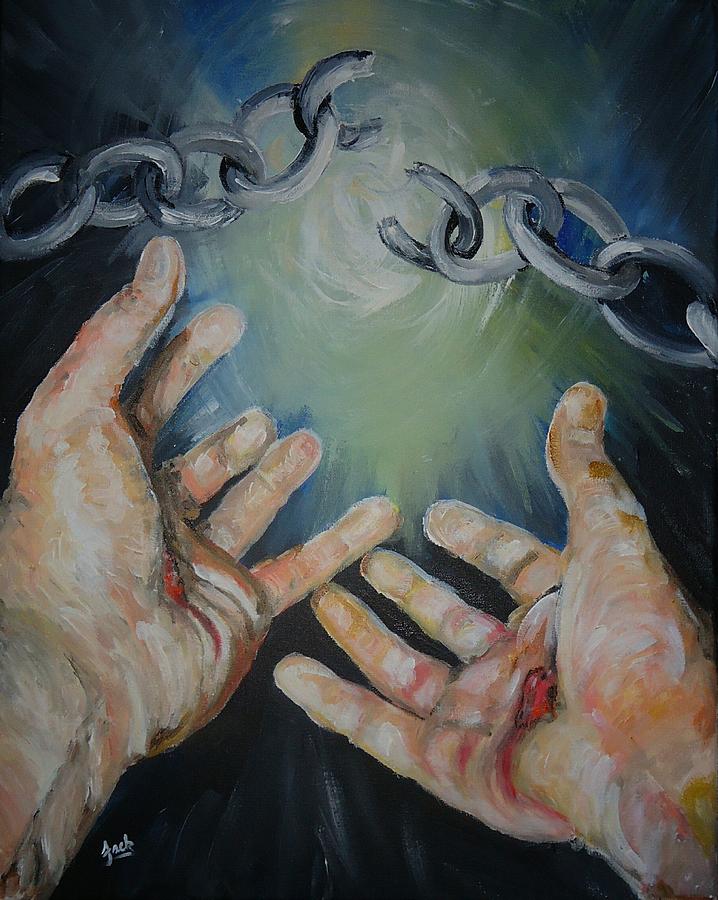
Genesis Chapter 38 only makes sense when it is viewed in the context of that broader narrative involving Joseph. I do not think it is a coincidence that it is placed right after Joseph is cast into slavery, and right before he rejects the advances of Potiphar’s wife and is cast further down into prison. His narrative and Judah’s provide a perfect contrast. On the one hand, Judah is physically free, but a slave to his immorality. On the other hand, Joseph is physically captive, but still the master of his own soul. Thus, the record is presenting two kinds of freedom and two kinds of slavery, and implicitly asking the reader, “which of these is truly free?” The correct answer, of course, is that Joseph is truly free, for though he is a slave an in prison, he is free in his inmost parts, while Judah is not.
Of course, the story is not presenting physical captivity as a good thing, mankind is meant to strive for all layers of freedom, but if a man wishes to be truly free, he must at the very least be the master of his own self. Any man who does not have moral control over his own appetites is fundamentally a slave, no matter the rest of his situation.
A Modern Misfocus)
Today, in our western culture, we have a great commotion of perceived shackles and demands for freedom. On the one hand, the white male is accused of still reaping the benefits of historical slavery and patriarchy, enjoying a higher freedom than women or most other races. On the other hand, we hear of blue-collar workers, predominantly white males, sick of being society’s punching bag for decades, sick of having their strings pulled by society’s elites. And then there are conspiracy theories that even those elites are for the most part powerless, their votes and influence bought and paid for by blackmail and bribery, shadowy corporations directing things from behind the scenes.
Everyone, it seems, isn’t as liberated as they would hope to be, and the majority of public discourse is set on the pursuit of freeing one class or another. It is an obsession that I believe our ancestors would find laughable, given that we are the freest people that the world has ever known. We are fighting over the slimmest margins of injustice, many of which are imagined, and we show no appreciation for the fact that our ancestors gave everything for just a fraction of the liberty that we now enjoy. Without devolving into complete lawless anarchy, we are about as free as it is humanly possible to be.
Or, at least, we are free physically. Spiritually and morally, though? We are a society that is absolutely enslaved to our appetites, to our devices, to our distractions, to our immorality, to our self-justification, to our anger and pride. We are simultaneously one of the freest and most enslaved people the world has ever known; and our focus for liberation is in completely the wrong area.
To Be Truly Free)
Perhaps we are so obsessed with our perceived injustices because our spirit accurately identifies that something is holding us down, but our heavy-lidded eyes can’t see past the physical to realize it is our lack of moral will. We settle on the assumption that it must be a physical shackle simply because we lack the imagination or the courage to consider a spiritual one. We are, therefore, a modern-day Sisyphus, doomed to an eternal effort that never achieves anything.
If we truly cared to be free, the great commotion of our time would be one of spiritual ministry. We would seek to convict the world of its sin as an act of kindness, waking up all to their true taskmaster, and the true liberation from it. We would strive as a community to abandon our shrines of distraction and learn how to rise to a collective moral mastery.
I began this study with a simple objective: to make the case that the only way to live was to live in truth. Right from the beginning I understood that this concept was so fundamental that it would defy definition. It is axiomatic, something that is most often just assumed to be true, unprovable by conventional methods. I tried to make my case even so, approaching the subject in all manner of different ways. It has been a fruitful, if eclectic, enterprise. Not only am I more convinced of the soundness of this principle, I better understand why it is such a difficult thing to prove objectively.
I will help illustrate this as I gave my final observations. Here is the first half of the conclusion to all that I have found.
Realms of Truth)
One of the key things I came to realize through this study was the various realms of truth that we encounter in life. I found myself debating around three separate categories of truth at different times. Each of these categories had different levels of tangibility and effect, yet I observed that each seemed to follow the same pattern. Let us consider them each, one at a time.
First, there is the physical truth. This is the truth of our perceivable, material world. Scientists have long understood that our world is composed of systems and procedures, each reliable and consistent. There are clear rules that govern physics, chemistry, and geology. These rules can be directly observed and measured; that is how we know that they exist. They are true, and they are always true. What is more, these physical truths exist separately from our individual selves. We interact with the physical world, we cause certain of its rules to play out, we harness its systems for our own benefit, but we do not define or override its rules. For all the self-will we possess, we can only employ it within the confines of its laws. The physical truths simply are what they are, and even if all of us ceased to exist and there was no one left to recognize these truths, we are certain that they would continue regardless.
Secondly, there is the truth of a society. This truth is the state that we social beings exist within. It is comprised of all our individual selves, and the relationships that exist between us. It is the sum total of all our thoughts, feelings, words and beliefs, both within ourselves and towards each other. We cannot examine this social state as directly as we can the physical world, but logically we know that it must exist and have a true definition. For we all know that we have our own, personal state of being, and so the amalgamation of all our states must be a real state as well. Our experiences also suggests that this super-state moves by certain patterns and rules. There seem to be certain laws about how individuals, relationships, and societies grow and evolve, and philosophers and psychologists have spent countless years gleaning what nuggets of truth they can from these systems. Interestingly, while these patterns must emerge from us directly, we remain individually ignorant of how we contribute to them. We are like the particles of dust that fall in the physical world, our movements seeming to be individual and arbitrary when examined up close, but when taken as a whole, we see that the mass is subject to forces that underpin the whole. Thus, as with the physical world, the truth of this realm seems to emerge from something greater than the individual. It belongs to the species as a whole, yet it is clearly enmeshed in us as well.
Finally, we have the moral truth. This truth is defined by the laws of how we should govern ourselves. It is the principles that we should hold to, the ways that we can direct our efforts and our attention to harmonize with the thing that we call “good.” This truth is the most mystifying of them all. We cannot see it or measure it. We cannot graph its movements. All of us try to obscure it with our own agendas and selfish desires. And yet, in spite of all this confusion and denial, there still remains the universal conviction that moral truth is a reality. Every civilization has always believed in some form of it. Though we cannot see it, we can feel it. Like the two other realms of truth, we sense that it originates from somewhere outside of ourselves, and we believe in it so concretely that we are sure what is right would remain right, even if there was no one left to practice it. Also, though the moral truth originates outside of ourselves, it is inseparably integrated inside of us as well. It pulls at us, we interact with it, and it even emerges from out of us.
The Need to Follow)
To some degree, we all perceive and accept each of these realms of truth. We all have a basic understanding of the laws of nature, the laws of society, and the laws of morality. We know that we should live in harmony with each of them. We know that there are certain things we just shouldn’t do, because they will cause physical pain, or social rejection, or be immoral. We know that there are other things that we should do, because they will increase our safety and be the most direct means to achieving what we desire. In the physical world, the positive benefits of conducting ourselves according to the laws of gravity can be explicitly observed. In the social world, the benefits of doing to others what we would like to have done to ourselves can be implicitly inferred. In the spiritual world, the benefits of sacrifice to our higher power are intuitively believed.
And yet, in spite of all this knowledge, and inference, and belief, we still try to violate these truths repeatedly! We risk injury just to save a few seconds of time, we try to fool others into giving us what we want, and we try to satiate our base desires when we think God isn’t looking. And even after we are hurt for our defiance of truth, we will still test its limits again and again. There is a part of us that is converted to the truth on a conceptual level, but somewhere between that part and the carrying out of our actions there is another part that is not converted, and it overrides our better senses.
We know the truth, but we are not, ourselves, entirely truthful. As mentioned above, these truths all emanate from outside of ourselves, and so they are foreign objects to us. But at the same time, they also are integrated in our individual existence, and so they are our very own selves as well. This is a strange paradox, and because of it, mankind has ever been a creature perplexed.
I have something to say about what I have learned of how this incongruity is resolved, but I’ve run out of time. I shall take it up tomorrow. See you then.
21 So went the present over before him: and himself lodged that night in the company.

22 And he rose up that night, and took his two wives, and his two womenservants, and his eleven sons, and passed over the ford Jabbok.

23 And he took them, and sent them over the brook, and sent over that he had.

24 And Jacob was left alone; and there wrestled a man with him until the breaking of the day.

25 And when he saw that he prevailed not against him, he touched the hollow of his thigh; and the hollow of Jacob’s thigh was out of joint, as he wrestled with him.
The night before Jacob met with his brother he sent all the company over a brook, but he remained behind to wrestle with his feelings in solitude. And what a wrestle it became, going far beyond struggling in prayer, for a physical man appeared and literally strove with Jacob! Honestly, I think it might have done Jacob good to have a sparring partner that he could get out all his frustration and fear with. Fear and trauma do not only lodge themselves in the heart and in the mind, but also in the body, and sometimes physical exertion can be the best therapy for processing those deep emotions.
I also see in this story a clear representation of Jesus atoning for our sins in the Garden of Gethsemane. There, too, he poured his heart out to his father, and also he began to strive in the flesh, bleeding from every pore, and also an angel appeared, though this one was to strengthen him in the struggle. And in both Jacob and Jesus’s case the result was triumph and salvation. In Jacob’s case for himself and his family, in Jesus’s case for all mankind.
Then Jesus called his disciples unto him, and said, I have compassion on the multitude, because they continue with me now three days, and have nothing to eat: and I will not send them away fasting, lest they faint in the way. And Jesus saith unto them, How many loaves have ye? And they said, Seven, and a few little fishes. And he commanded the multitude to sit down on the ground. And he took the seven loaves and the fishes, and gave thanks, and brake them, and gave to his disciples, and the disciples to the multitude. And they did all eat, and were filled: and they took up of the broken meat that was left seven baskets full.
COMMENTARY
I have compassion on the multitude, because they continue with me now three days, and have nothing to eat: and I will not send them away fasting, lest they faint in the way And he took the seven loaves and the fishes, and gave to the multitude. And they did all eat, and were filled Yesterday I shared about a spiritual retreat where my heart reached its saturation point and had difficulty absorbing any more of God’s love. Spiritual connection is fulfilling, but at the same time it can also be emotionally and physically draining. And while we seek to “bridle passions” and “master the flesh,” we are not meant to become ascetics, ignoring or abusing our physical forms. Jesus showed a great attentiveness to the capacity of the multitude gathered around him. They came to be spiritually fed and they received that. But the long duration had left them faint and he was sensitive to their need for physical revival, too. It is a good thing to fast, to make physical sacrifices to embolden the spirit, to seek out spiritual experiences that fill us to the limit on a regular basis. But there is wisdom in resting after we have been filled and letting that rapture settle within us.

 Spiritual Wanderings