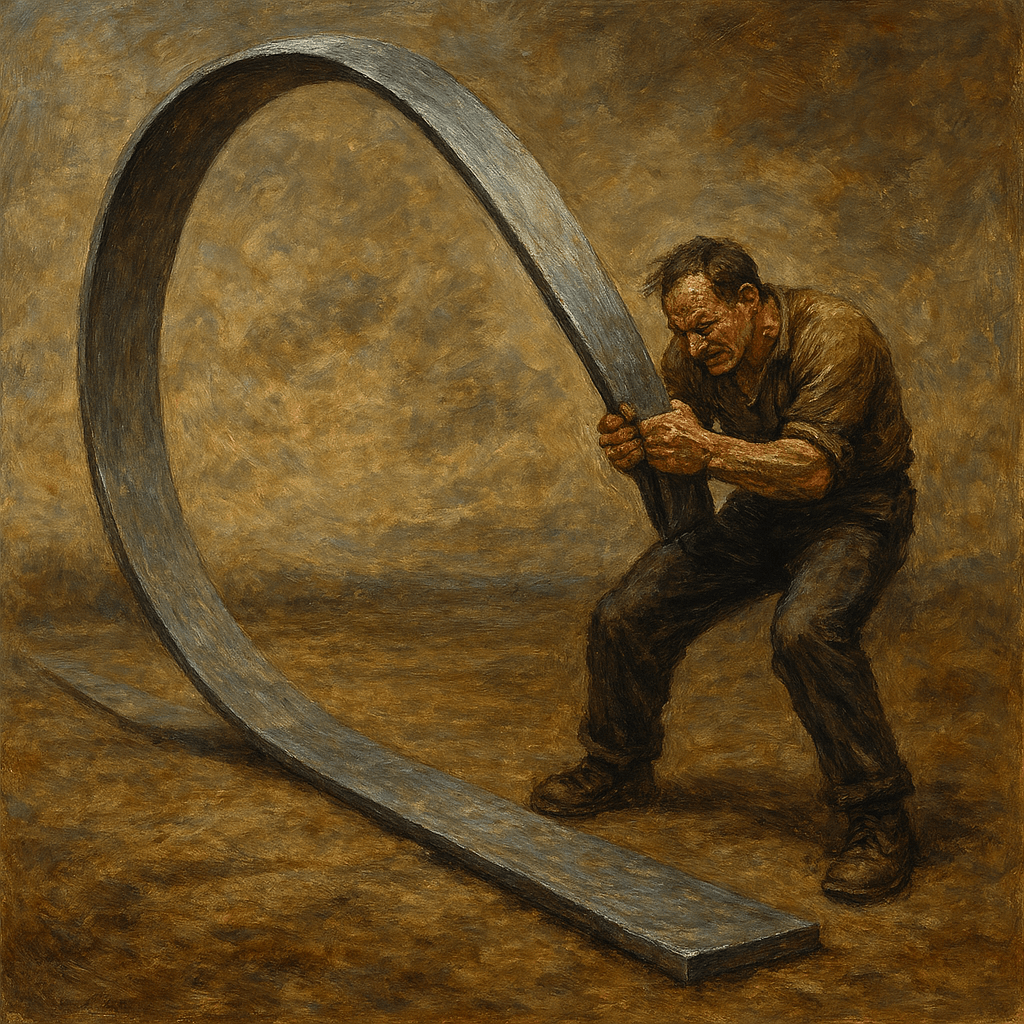
Man is mighty enough that he may bend God's creation
But it will always snap back
Man is mighty enough that he may bend God's creation
But it will always snap back
Over the course of this series I have examined the notion of our voices being powerful, looking through the lenses of historical observation and scriptural example. Key takeaways that have emerged are that yes, our voices our truly powerful, but there are some very important caveats and concerns related to them. Specifically, we identified the three following issues:
Combining the first two points together, we see that there can be incredible power in keeping people mindless, making them drones repeating the same incantations over and over in unison. This is exactly how the most incredible acts of evil have been accomplished.
But surely that is not the only form of unity available. Every now and then, in brief and isolated moments, we get a glimpse of what happens when voices remain distinct, authentic, and self-authored, yet unite over shared ideals. On a larger scale, we have examples of this in the growth of the early Christian church, in the founding of America, and in the healing of the Alcoholics Anonymous program. These are only a few examples. There are other, smaller ones that occur all throughout the world.
True utopia will only occur when all the world is in such a state of individual synergy. Only when people have universally found their true selves, through God, and use their unique voices to progress the unified heavenly vision will we attain the ultimate potential of mankind. We can only imagine what incredible leaps and bounds we will make then. It will be an uncompromised advancement such as we have never seen before.
We have discussed different aspects of the power in the human voice. As shown in the last post, when different voices are combined together the power grows exponentially. There are even scriptural examples of this, such as when the shout of the Israelites broke down the walls of Jericho. That is very impressive, but whether it is a good or a bad thing depends on which side of the wall you are on.
As we saw in the last post, the compounded power of universal communication has led to the most tremendous advances in technology, which have included many things that are good for mankind. But at the same time, we have also increased our methods of self-destruction. Historically that has involved the creation of artillery shells, nuclear bombs, and the ability to hack a nation’s infrastructure systems. Today we are seeing all-new threats, such as individuals becoming displaced by robotics and AI and social media dividing us into deeply entrenched factions. Our ability to divide and destroy has always grown in lockstep with our ability to create.
The scary thing is just how far our compounded power extends. Just as one Israelite shouting at a time would never bring down the walls of Jericho and one man working at a time would never build the Golden Gate Bridge, so too our weapons of destruction surpass any individual reach. Once these looming threats start to tip over, it will be well beyond anyone’s power to right them before they come crashing down on our heads.
And this danger was already known thousands and thousands of years ago. It was recorded for our own education, but we did not heed it. In the book of Genesis, Chapter 11, we read:
And the whole earth was of one language, and of one speech.... And they said, Go to, let us build us a city and a tower, whose top may reach unto heaven; and let us make us a name, lest we be scattered abroad upon the face of the whole earth.
There was one language, and one people, and they spoke with one voice, desiring to build a tower all the way to heaven. While the scriptural account does not get explicit in their ultimate intentions, tradition has assumed it was to for a direct assault on heaven. Whether literally or symbolically, their effort was to make something so great that it could dethrone God.
Breaking from the hand of your own creator is logically the greatest act of self-destruction that anyone could ever do. Thus, it was an act of mercy and preservation when God broke their tower, and made them unable to combine their voices, and scattered them across the world. Yes, it made them weaker, but it also limited their ability to destroy themselves.
Today, we have progressively broken down those barriers. We have rediscovered each other, learned one another’s language, and found ways to combine our voices as one. We are much the same now as the people who built the tower of babel, and we seem to quickly be approaching another act of hubris and self-destruction.
Of course, every vision of paradise does necessitate all the people united as one, but it assumes that mankind has learned to let go of his tendency for self-destruction, so that he may unite without danger. That certainly has not happened today, so the danger of our united voices is very, very real.
I wanted to start my analysis of the human voice by considering some of the physical aspects of it. Let us consider the case of speed and reach in the human body. If I were to ask what the fastest way for a man to propel something forward is, and to the greatest distance, you might think it would be by a kick, or a throw. Baseball pitchers can hurl a ball at 100 miles per hour, and cricket players have hurled a ball by hand 420 feet!
Let’s even suppose that we allow the person to use a simple tool, though no external source of power. Golfers have been known send a ball hundreds of yards, at speeds as high as 200 miles per hour!
But none of that would be the right answer. For the fastest, furthest cast, we do not look to the arms or the legs, we must look to the lungs. It is the human shout that is able to carry farther, and travel faster, than any other human-powered method. Under ideal conditions, some shouts have been reported to travel 10 miles, and the sound propagates at a speed of over 700 miles per hour. And what of the volume? When we shout, we physically vibrate the surrounding air particles in every direction, commanding the vibrations of over 100 billion cubic meters!
The human voice is therefore not only metaphorically powerful, but also physically magnificent as well. There is no other way that we can project farther, faster, and over a greater volume when using only the power of the body. But of course, this is not the only domain where the voice dominates. Tomorrow we will examine how being able to talk to one another and share ideas is the most important driver of all our technology and invention. I’ll see you then.
The expression, “the power of your voice,” is used so overused and misused, that I couldn’t help but cringe as I wrote it as the title to this series. Most of the time that we hear it the message is trite and vapid, meant to flatter the listener and assign them an unspecific power. All of that being said, there actually is some real truth to the expression, and it seems sinister that the phrase has been appropriated so as to hide the real depth of it.
I recently made a small post about how rare it is for a person to be their true, genuine self. More often we meet people who are empty puppets, parroting the ideas and beliefs of others. This same pattern continues with the use of our voice. Most of us use our speech to merely regurgitate words that are entirely unoriginal. In fact, the very people who tell us not to forget the power of our voice are usually the ones who are also telling us what to use it to say. We are expected to adopt their cause and priorities, then use the power of our voices to spread them. That isn’t empowering to the individual, only to the one giving orders.
Thus, most people don’t really have a voice; they are only an extension of someone else’s, a speaker to an activist’s microphone. Most people have not delved deep enough into themselves to find out who they really are. They haven’t found their true substance, and so they have nothing real to speak from. So yes, a person’s voice has power, but it isn’t their voice until they are a real person.
Over the next few days, I will try to delve a little deeper into the power of one’s voice, providing a clear basis for why I think the statement is actually true. I will also acknowledge biblical warnings of the danger in that power, and how we should be careful of it. I will begin tomorrow by examining the physical and literal power in the human voice. See you then!
In my first post I suggested that most of our spiritual practice grows naturally from first having a seed of spiritual knowledge. On the most basic level, God provides us revelations, and we adjust our behavior in response. What is that, if not receiving knowledge, and then putting it into practice?
Just how deep of a change can be made to human practice by a revelation of knowledge? Is there a limit to the potential power that can be bundled inside of a revealed truth? Let’s consider that question by examining the most impactful revelation that was ever made to man.
When Paul wrote to the Colossians, he spoke of a deep, cosmic mystery that had just been revealed to the world with tremendous effect:
Even the mystery which hath been hid from ages and from generations, but now is made manifest to his saints: To whom God would make known what is the riches of the glory of this mystery among the Gentiles; which is Christ in you, the hope of glory:
Whom we preach, warning every man, and teaching every man in all wisdom; that we may present every man perfect in Christ Jesus: Whereunto I also labour, striving according to his working, which worketh in me mightily.
-Colossians 1:26-27
The great mystery that Paul shares in these verses is that Christ lives within each one of us. This was a radical notion that completely shifted the common perspective of a God that lived external and separate from man. The idea that part of our very soul is shared with our creator’s is very extreme and would be deeply heretical if it wasn’t true!
Paul further explains that it is this revelation that led him and so many other disciples to dedicate their whole lives to spreading the gospel. Paul, of course, had made a complete 180 from his previous life, and now he and many other disciples were solely focused on this work because the truth was still “working in them mightily.”
Any honest historian, even one who is not a follower of Jesus, will attest to the fact that the Christian movement is one of the most important and influential forces in the human story. It is hard to think of anything else that has altered the course of nations, wars, and society like Christianity has. Its power to transform is unmatched, and I agree with Paul that this power of transformation has at its root that one core revelation that God lives within us.
Given this, I cannot put any limit on the potential power of revealed knowledge. Notice that I say potential power, much like how a heavy weight raised to a high height has only potential energy, not kinetic energy. Knowledge has the potential for change, but it still requires a choice to act on it, just as the elevated weight requires an action to push it free. When these things happen, potential becomes realized, and there is no theoretical limit to how great that energy could be!
“Blessed are the meek,” Jesus taught, “for they shall inherit the earth.” I have heard several Christians discuss this passage, and they often take time to explain that meekness should not be associated with weakness, as the two mean different things.
It is true that the words have different meanings and shouldn’t be used as synonyms, but obviously there is a reason why the two are often associated with one another. Meekness, as well as other submissive qualities like humility and obedience, are indeed traits that are often found among the weak. Young children come to mind in particular. They are small and lacking in power, so they are required to be meek and submissive, because the will of the adults is imposed on them whether they want it or not.
Then, as they grow, children gain their own power. Resisting the will of others, and even of imposing their own, become viable options. Having gained this power, most people never want to go back to that state of being beholden to others.
However, just because we have enough power to make our own rules for ourselves, doesn’t mean that we should. Jesus called on us “to become as little children,” and showed an example of giving up his will for that of the Father. Jesus wasn’t calling on us to become weak again, though. It was a call to become submissive even though we have our own strength. Unlike a child, meekness, humility, obedience, and submission become a choice for us now, rather than the default way of being. We are not weak, but we place our strength upon the altar and become as though we were weak, complying with the Lord’s will even when it differs from our own.
Now I have been saying that when we become adults, we finally possess our own power, but that’s only relatively speaking. When we get to the other side, I’m sure we will recognize how truly insignificant and powerless we were even as adults in the broader scheme of things. God gives us the illusion of control now so that the quality of our character can be tested before we would be conferred with any real power in the hereafter. Meekness, even in strength, is essential to using our strength correctly.
45 And I will dwell among the children of Israel, and will be their God.

46 And they shall know that I am the Lord their God, that brought them forth out of the land of Egypt, that I may dwell among them: I am the Lord their God.
To conclude this chapter God makes the very special promise that He will dwell with the Israelites, a constant presence in the midst of them. God will not only be some outer concept, but their own neighbor, living in a house that the community had prepared for Him, somewhere that they could go and visit throughout the year.
God further promises that the people will know that He is, indeed, their God, even the same one that brought them out of Egypt with such tremendous power and miracles. That seems to suggest that they will see such power and wonders coming from the tabernacle that they will be able to identify the presence there as the same that had been within the pillar of smoke and fire. We will hear how this promise is fulfilled at the very end of Exodus, in chapter 40.
This brings us to the end of the preparations for the priests. There yet remains two more furnishings for use in the tabernacle, however. We will hear the details of them in the next chapter.
18 And all the people saw the thunderings, and the lightnings, and the noise of the trumpet, and the mountain smoking: and when the people saw it, they removed, and stood afar off.

19 And they said unto Moses, Speak thou with us, and we will hear: but let not God speak with us, lest we die.
Today’s verses seem to go back before Moses ascended the mountain and received the ten commandments, the first moment the noise and power of the Lord was made manifest upon the mountain. These verses seem to take place in-between, or just after, Exodus 19:19 and Exodus 19:25.
In this account it is apparent how great of a fear came upon the people, and how they desired not to draw near to or speak with the Lord, for fear that they would die under the power of His word. To be clear, we have not heard of any threatening word or action from the Lord in this moment, His power has been restricted to the mountain, not invading into their camp. So the Israelites fear of God is not based on any malice, but because His glory and power is too great for them to bear.
There are those today who make light of God, openly mocking Him and portraying Him as a bumbling fool. It is safe that no one who does this has actually glimpsed the true Lord of Heaven and Earth. No one would dare to speak irreverently if they had seen and known the terrible majesty of His purifying glory. One day, all of us will witness that tremendous glory, and when we do it is said that even the kings and the mighty will beg the “mountains and rocks, to fall on us, and hide us from the face of him that sitteth on the throne!” (Revelations 6:16). Like the Israelites, we will be in terrible fear, and we would then desire a representative, even a mediator, to be able to stand before God in our place.
16 And it came to pass on the third day in the morning, that there were thunders and lightnings, and a thick cloud upon the mount, and the voice of the trumpet exceeding loud; so that all the people that was in the camp trembled.

17 And Moses brought forth the people out of the camp to meet with God; and they stood at the nether part of the mount.

18 And mount Sinai was altogether on a smoke, because the Lord descended upon it in fire: and the smoke thereof ascended as the smoke of a furnace, and the whole mount quaked greatly.

19 And when the voice of the trumpet sounded long, and waxed louder and louder, Moses spake, and God answered him by a voice.
All of Israel had been prepared, and now the miracle rolled down from heaven to the earth. Thunder, lightning, thick clouds, and the sounding of an unseen trumpet! Then, as the people gathered at the foot of the mountain, smoke, fire, quaking, an even louder trumpet. And finally, after all of that, the voice of God!
There is another passage of scripture that sounds very similar to this, which is when we are given the account of Elijah hearing the voice of the Lord in 1 Kings 19:11-12:
And a great and strong wind rent the mountains, and brake in pieces the rocks before the LORD; but the LORD was not in the wind: and after the wind an earthquake; but the LORD was not in the earthquake: And after the earthquake a fire; but the LORD was not in the fire: and after the fire a still small voice.
Wind, and earthquake, and fire, and finally a voice. However that later account is both similar and dissimilar to the one here in Exodus. While the 1 Kings account mentions a parade of dramatic forces of nature, it says God is not in any of them, while the elements presented here in Exodus seem to be directly heralding the Lord. Also, the account in 1 Kings describes a “still small voice,” whereas one would think the voice in Exodus was booming and loud, much like the trumpets that had sounded, so that all the camp would hear it.
I believe that both accounts give us half the picture of God. The fact that God lives in our hearts and is able to speak to us in a still, small voice does not mean He isn’t also the master of heaven and earth, appearing in great glory. There is both an outer manifestation and an inner manifestation of the Lord, but they are both one and the same God. Probably most of us are far more acquainted with the quiet, inner Lord who lives in our hearts, but we look forward to the day when we can meet (and survive!) an encounter with the outer Lord in all His majesty!
 Spiritual Wanderings