As a traditional Christian, I have been challenged about how I can follow Jesus’s admonition to love everyone, and also be opposed to certain lifestyles, particularly those under the LGBT umbrella. I’d like to take a couple posts to address this matter. Sometimes I feel these questions are posed in good faith, and sometimes not, but in both cases, I believe the inquirer deserves for me to have ordered my thoughts and feelings into a coherent and genuine answer.
To start things off for today, I do have to point out why I say that sometimes these questions are not asked in good faith. I believe that many of the people asking these questions don’t actually believe that disapproval precludes love. We all have people that are very close to us, that engage in something that we think is hurtful, that we wish they felt differently on, that we fundamentally disagree with them about. Whether it be politics, or self-destructive behavior, or mannerisms, we all see flaws in other people, even the ones we love most. Yes, differences of opinion can become a source of hostility, and sour love in a relationship, but we all know that it doesn’t have to be that way. We can both love a person and disagree with parts of them.
Of course, it is true that I could profess to be a Christian and also have a deep hate and resentment for everyone in the LGBT community. That is a possibility, but it is not a foregone conclusion. It is also possible that I can both love and disagree.
Narrow Questions)
I do also find it interesting that I only ever get these questions related to people living an LGBT lifestyle. As a traditional Christian, there are many other lifestyle choices that I am also opposed to, yet no one ever asks me why I “don’t love them.” For example, I’m just as opposed to fornication, adultery, and most forms of divorce. Why not challenge me as to whether I can still love a person who cheated on his spouse or who got a divorce because he just wasn’t feeling it anymore?
From what I have observed, it seems that the love of Christians is only brought into question on LGBT matters because that movement is unique in its requirement for total acceptance. The fact that these questions only come up in such narrow contexts suggests more about the views of the people that ask them than they say about me and my views.
I think it’s also worth noting that among all the behaviors that I renounce as a Christian are ones that I struggle with also! I have spoken at some length on this blog about my addiction to pornography, which I absolutely condemn as one of the greatest evils of our day. I have always known that it is wrong, and every time that I’ve engaged with it I’ve felt deep shame, but also each time I strive to fall back in love with the Son of God that still lives inside of me. Thus, on questions of whether I can disapprove of behavior but still love the individual, my practice begins with myself.
I have explained the necessity of adhering to physical truths in the field of aviation. In order to overcome the forces of gravity and air resistance, great minds had to search out the realities of the physical world and build machines that would act in accordance with them. Today I’d like to consider another example of this in the world of logic. This time we won’t just consider the usefulness of truth, though, but also the chaos of untruth.
There is a concept in mathematics called propositional and predicate logic. In this system, propositions are statements of truth, such as George is Abe’s father, Steven is George’s father, and Marcus is not Abe’s brother. These are simple facts that contain a single piece of valid information. Then there are predicates, which are rules for how these propositions can be combined to reveal entirely new truths. For example, we might have a predicate that if A is the father of B, and B is the father of C, then A is the grandfather of C. Given our initial propositions, we can derive that George is Abe’s Grandfather, a fact that wasn’t in the original set of information.
This might not seem that useful, but once we expand our set of propositions and predicates to thousands of items there are literally millions of implied facts that a computer can derive from, something that our brains simply don’t have the capacity to process. Our modern-day databases are built upon this system of logic, allowing a large dataset to have its parts combined in a multitude of ways, revealing hidden patterns and trends, secrets and truths that were hiding in plain sight.
Let’s build expand on our example of a family tree to see this process more clearly. Suppose we have the following propositions and predicates (feel free to skim over these):
Propositions:
#1 George is Abe's Father
#2 Susan is George's wife
#3 Penny is Susan's daughter
#4 Penny is Abe's sibling
#5 Helen is George's sister
#6 Gabe is Marcus's father
#7 Steven is Marcus's maternal grandfather
#8 Agnes is Helen's mother
#9 Steven is Agnes's husband
#10 Howard is Susan's father
#11 Jill is Susan's mother

Predicates:
#1 If A is the father/mother of B, and B is the father of C, A is the grandfather of C
#2 If A is the father/mother of B, and B is the mother of C, A is the grandmother of C
#3 If B is a parent of A, and C is the husband/wife of B, then C is also a parent of A
#4 If A is the father/mother of B, and C is the other parent of B, then A is the mother/father
#5 If A is the father of B, and C is the mother of C, then A is B's husband and B is A's wife
#6 If A is the child of B, and C is the child of B, then A and C are siblings
#7 If A is the maternal grandfather of B, and B's mother is C, then A is the father of B
#8 If A is the sister of B, and B is the parent of C, A is the aunt of C
#9 If A is the child of B, and B is the aunt/uncle of C, A is C's cousin
#10 A cousin is not a sibling
#11 A mother is not a father
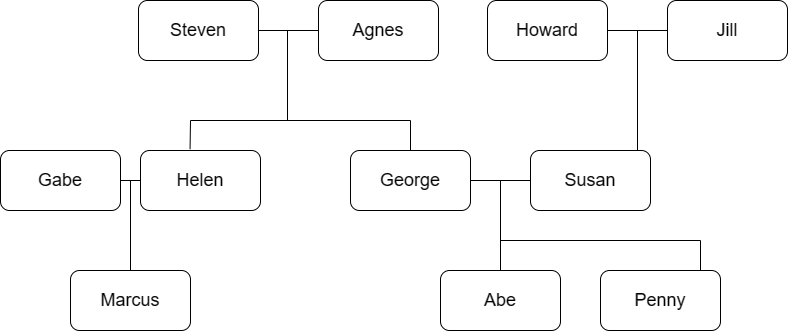
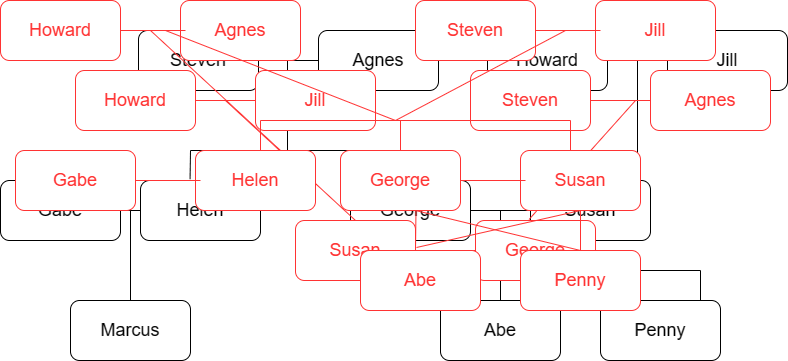
Given this setup, we could piece together the following family tree:
This tree is a visual representation of all the separate facts we get by combining all of our initial information. We can ask our system any number of questions, even ones that go beyond the scope of the original data set, and it can derive answers for them. It will answer yes, no, or uncertain, and so long as our propositions and predicates are all correct, then we can know that any derived answer is also correct. This data is a source of truth because it is based on logically sound principles.
A Twist)
But what if all of our propositions and predicates are all correct…except one? What if among all the truth facts and rules we include just one falsehood? It might occur to you that this would tarnish our confidence in the system, because there would always be a possibility that the answer it gave to us was that one lie. But actually, the effect is far, far worse. It has been proven that introducing just one logical falsehood into a system such as this will make any possible lie seem true. It won’t just be one lie that comes out of the system, it will be all lies. That might seem improbable, but allow me to illustrate.
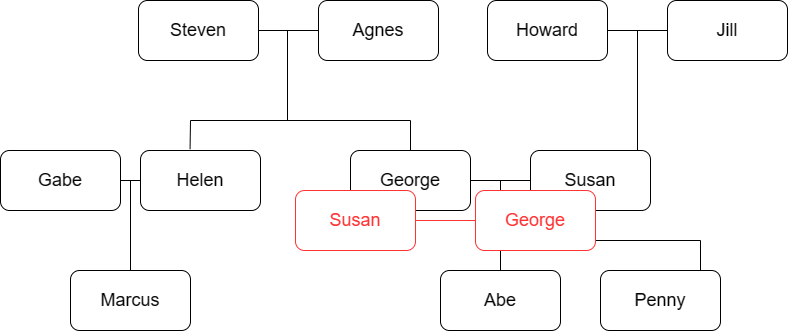
To the system up above I will introduce one logical falsehood. Given the previously established rules, it is impossible for this to be the case, but I am going to enter it as a fact even so:
Susan is Abe's father
This statement is completely contrary to the logic of Predicate #11, but we add it to our system regardless. This creates a logical contradiction, and now let us look at all the new falsehoods we are able to infer from it. By Predicate #4 we can infer that since since Susan is Abe’s father, then Abe’s other parent, George, must be his mother.
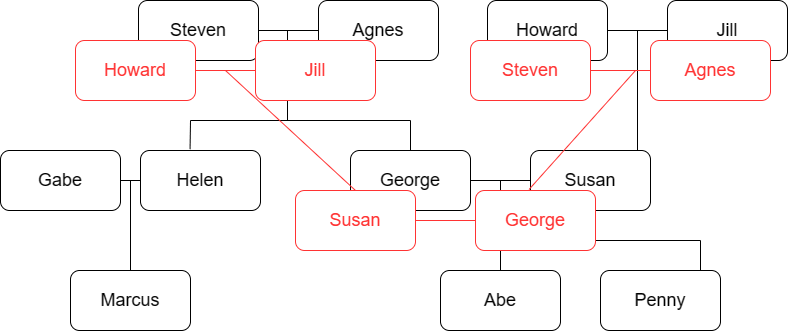
Of course, we previously had derived that Steven and Agnes were Abe’s paternal grandparents, because they are George’s parents. But now that we know that George is Abe’s mother, then they must also be his maternal grandparents. By the same token, Howard and Jill are now no longer only Abe’s maternal grandparents but also his paternal.
Of course, now that we know that Howard is Abe’s paternal grandfather we can combine that with the already-known fact that Agnes is his paternal grandmother, and we can now infer that they are married together, something we never knew before! And by the same token, Steven and Jill are now also married together. Thus all the grandparents are intermarried in some sort of free-love commune! This does have the unfortunate effect of making George and Susan, Abe’s parents, siblings to one another in addition to still being husband and wife! Furthermore, since Abe’s parents are also siblings, then his sister Penny is also his cousin because her mother is the sister of Abe’s father (and her father is the brother of Abe’s mother).
But we aren’t even really going yet! We still haven’t invoked the powers of NOT and ELIMINATION. First let’s consider the NOT. Predicate #10 stated that a cousin is NOT a sibling, and Predicate #11 that a mother is NOT a father. So, since we just proved that Penny is Abe’s cousin, then she is NOT his sibling. Of course, she also is his sibling, since Proposition #4 explicitly says so. Thus, she is his sibling, and she is not. These are both totally valid answers in the eyes of our data set. And Abe’s parents George is his father and Susan is his mother, but also, they are not. And his grandparents are his grandparents, but also, they are not.
And now that we’ve shown that we can prove that the exact same relationship can and cannot exist simultaneously, by ELIMATION we can also prove that every relationship can and cannot exist. So, from the initial data set we know that Abe has a sibling. But who is it? Well, we can go through each member of his family and prove that they are not that sibling. So, let’s do that for every family member except one, Steven, and now we know, by process of elimination, that Steven must be the one who is Abe’s sibling. And by the same process we can prove by process of elimination that it is Agnes, and Howard, and Gabe, and Helen, and George, and Susan, and Marcus. And by the same process they are all his father, and all his mother, and all his aunt, and all his uncle, and all his cousin, and all his grandfather, and all his grandmother.
I’m not going to try to show the family tree at this point, because it is simply all names connected to all other names in every possible way. But also…all names connected to none of the others. Every statement is true. Every statement is false.
Our data set was useful at one point. It was full of true statements, and it could be used to infer many other true statements. But now, after a single lie the entire thing has been corrupted. The only answer it has to provide are “yes, no, maybe, I don’t know…I guess it depends on how you look at it.” It has lost all confidence and isn’t useful for anything.
And sure, this is a rigorous and mathematical system, which is particularly prone to collapsing at the slightest instability. The system in our minds is far more nuanced, able to continue functioning with illogical assumptions and idiosyncrasies…but only to an extent. The same principle does apply to us to at least some degree. Adopt the wrong belief and suddenly every other concrete conviction starts to be undermined by it. People start going through logical acrobatics to try and make incompatible beliefs fit together, corrupting all that was once good and losing the certainty they once had. We cannot accept a lie without somewhat losing our grip on all truth.
At the start of this study, I talked about the lies we tell ourselves about why we cannot reveal the truth to others. Today let’s tear these falsehoods down and see how they keep us a prisoner.
First, let’s consider the idea that “I just need to really try my best and I’ll be able to beat this on my own.” I told myself this story for many years, until finally I had to accept that if I really could take care of my problem by myself, I would have done it by now.
I will always be able to point at my efforts and say that they weren’t good enough to make the desired change, but if I just try harder next time, then it will be enough. There will never be a time where I can’t make that argument, because the only way to prove it wrong is to make the perfect effort and still have it fail. But since I am not perfect, I will never make the perfect effort, so I will never have the empirical proof to discredit the theory.
But at some point, I just had to step back and see that I was running in a hamster wheel. Theories are only as good as the results that you get from them. And if this one has only resulted in me remaining in the same place with no change, then clearly it isn’t a good theory. I had to accept that this wasn’t a philosophy for improvement, it was a philosophy for remaining right in the same place. It was a pernicious sophistry that enabled me to continue my addiction and never get any actual results.
The Shining Knight)
The other reason I had for not telling the truth was the image I was trying to preserve. I felt that I couldn’t let down my wife and kids, my church and neighbors, my friends and coworkers. I knew that bringing forward the truth would send shockwaves through the lives of those that were closest to me, and it would break many of their hearts. I told myself that I didn’t have a right to put these good people through that pain. If I couldn’t save myself, at least I could endure my damnation quietly and let everyone else go unscathed.
Except that I couldn’t do even that! Not all addictions show their destructive effects so obviously, but all of them, without exception, damage lives and relationships. Some do it in sudden, decimating blows, others erode and disintegrate the soul over time, but all of them leave a life that is hollow and broken.
Through great effort I was able to hide the damage and convinced myself and others that we were all doing fine, and I maintained this image for a very, very long time. On the surface I appeared perfectly fine, with everything still held together, but I could not escape the sense of my soul caving in.
I knew that every relationship that appeared happy and fulfilled on the outside was, in fact, predicated upon a lie, and therefore hollow. My wife thought she loved me, my friends thought they respected me, but they didn’t know the genuine me so how could they really? They loved and respected a façade because I hadn’t even given them the chance to decide what they thought of the real me. So, there were no authentic relationships in my life. The ties I was afraid of severing weren’t really there to begin with. All the things I was afraid to lose I’d never even had in the first place.
My Story)
I kept my addiction a secret, and I rationalized doing so by telling myself that I would fix it by myself. I felt that I couldn’t break the “knight in shining armor” image that my family and friends had of me. My plan was to overcome my lust and pornography addiction on my own, and then, many years later, tell my family of my past with the reassurance that at this point in life I really was the person that they had always believed me to be. It was a plan as doomed to failure as it was dismissive of the feelings and autonomy of those around me.
When I was twenty-six, I realized that I had been addicted to lust in some form or another for twenty years, and I had been living a lie in my marriage for over five. At this point, I had to admit that I just wasn’t getting any better on my own. I had tried, I had really, really tried, but it simply was not working, and to continue saying that after twenty years of failure it was now about to start working was insanity.
Nor could I continue to believe that I was preserving relationships by living the lie. Things had been difficult for my wife and I for a while, and I knew the reasons why, but she was confused in the dark. She didn’t know why I was detached and unable to be fully present, she didn’t know why I was struggling to focus at work and had lost my job, she didn’t know why I was so absorbed with my selfish interests and constantly depressed. She didn’t know what the reason behind any of this was, but it was taking its toll on me and her and the relationship even so.
And so, on one particularly strained day, it finally occurred to me that I was destroying the marriage whether I told my wife the truth or not. I wasn’t saving anything by hiding the harmful things I had done; I was just dragging out the destruction in a more torturous manner.
Finally, I didn’t want to do this to my wife anymore, or to myself, or to the marriage. Finally, I accepted that even if telling the truth meant destroying everything in my life it would still be better than what was happening now. At that moment, the greatest kindness I could do to my loved ones would be to stop stringing them along and give them a chance to make what they still could out of the rest of their lives. It was the greatest kindness I could do for myself as well.
So, I confessed. I wrote a letter while my wife was away, admitting to what had been going on behind her back. I left it just inside the entrance of our home, and then I got in my car and drove as far away as I could. I knew I had to get far enough during this rare moment of commitment, so that I wouldn’t be able to turn around and get back to the house and hide the letter before she had already seen it.
And then, just like that, I wasn’t lying anymore. Just like that I was living in the truth. Perhaps it was an ugly truth, but it was the truth. And not one day since have I regretted that decision. The future was made uncertain, my relationships were made tenuous, but I never once questioned whether it was worth it.
As it turned out, after some rocky periods everything stabilized. My wife and I rekindled our marriage, I regained my children’s trust, I kept my new job, and I came back into the good graces of my church. But even if I hadn’t, I can truly and honestly say it would have been a small price to pay for the regaining of my soul.

 Spiritual Wanderings