Yesterday I mentioned that most people are only socially converted to their beliefs. They gradually, through osmosis, adopt the faith, the principles, and the paradigms that their society repeats to them. Perhaps even more importantly, they adopt the limitations that come with society’s beliefs.
When we hear a falsehood repeated enough times, it goes from sounding strange and offensive to familiar and comfortable. And when our mind becomes aligned with any principle, true or false, it establishes boundaries to reject any competing notions.
The Emperor’s New Clothes)
One of the great allegories for our day is the story of The Emperor’s New Clothes. It’s widely recognized as a lesson on peer pressure and vanity, but there is another important detail in it that we must not miss: the people are duped into participating in the grand lie because they have boundaries set on their minds to keep them from seeing that it is a lie.
Remember, the yarn that is spun by the swindling tailors is that the fabric can be seen only by those who are worthy. After the first servants and counselors confirm that they do see the clothing, bounds start to be laid on everyone else’s thinking. Everyone just assumes that if they cannot see what the others do, then it must be because they are unworthy. They have had blinders put on them by the social pressure of others’ claims, such that they cannot even consider the possibility that everyone else is lying. The notion doesn’t even cross their minds.
This lie by the tailors is particularly effective because it preys upon the insecurities of the villagers. “Impostor syndrome” is a common sensation that falls upon us all. None of us are so clever or so good as we would like to be, nor so much as most of us pretend to be. Everyone feels a fraud inside, and so not seeing the Emperor’s clothes, and by extension being told that they were unworthy, only confirmed what the villagers had already suspected about themselves and they didn’t even try looking for other options.
This is why it is a young boy, still innocent and with no self doubts, who is finally be able to see through the charade. The idea that he would be unworthy was the notion that could not cross his mind, and so he was able to rightly see the truth of the matter. And when he did, it was not only the king who had his nakedness exposed. Every villager now knew that his neighbor was full of self-doubt and shame, and would absolutely lie to hide it.
I am going to pause my analysis of Exodus for eight posts, so that I may cover a topic that's been weighing on my mind recently. Today I will begin my discussion on what we ought to align ourselves to in life, and the dangers that follow when we are misaligned.
***
There are a considerable number of Christians who become distressed and divided between the commandments of God and the principles they have been taught by society. Once these two sets of voices were nearly enough aligned that one could blend them with only moderate twisting of the self. Today, they are more firmly at odds to one other, creating an impossible divide, and a person feels they must choose one or the other.
The Unrealized Influence)
Given the choice between the commandments of God and the principles of the world, many end up hearkening to the world, but do so under the assumption that they are listening to their own inner voice. This is a defining characteristic of our world today: that everyone must be “true to themselves,” choosing “what they know in their heart to be right.” And while there is a wisdom to this thinking in theory, one has to acknowledge that most of the convictions that come out of us did not actually originate from within our hearts at all.
We are highly social creatures, and we gain our perspectives and beliefs from our surroundings, subtly and invisibly, by osmosis. We might be surrounded by voices that stress principles we do not originally agree with, but over time, without recognizing why or how, we will start to hear the same arguments coming out from inside of us. We are convinced and converted without ever realizing it.
The Pull of a Culture)
I saw this firsthand when I was a missionary in the West Indies. I visited many countries and districts. Some were primarily Christian, some primarily Hindu, and some primarily Muslim. A common phrase in each area was “born an X, die an X,” where X was the predominant religion in that region.
But the saying wasn’t true. I know this because when I transferred to other areas, I would find people who had moved there from the same place that I had left, and usually they had given up their old religion to adopt the new one that surrounded them. And this went in every direction. Hindus to Christians, Christians to Muslims, Muslims to Hindus, etc. The locals that never moved were firmly convinced that they could never change their beliefs, but the evidence suggests that their stalwartness was most often due to their environment more than their personal convictions.
And this doesn’t just have to do with religion. Travel to different places and you will see that attitudes coalesce from the community towards science, education, politics, justice, lifestyle choices, and every other domain that people have opinions on. Spend long enough in these places and you might find yourself starting to think the same way, too.
The fact that one can move to a different environment and change their beliefs does not condemn the original value system, nor elevate the new one, it merely shows that most people are socially converted only. Yet they say to themselves, “I’m just listening to my own heart.” In truth, what they are listening to is what their heart has been constrained to believe by their culture.
I have spent quite a while examining different reasons for why one should live in accordance with the truth, and I have been calling out the ways that we try to excuse ourselves from doing so. Hopefully each one of us will be convinced at some point that we must live in harmony with fundamental truth, aligning ourselves to the universal good.
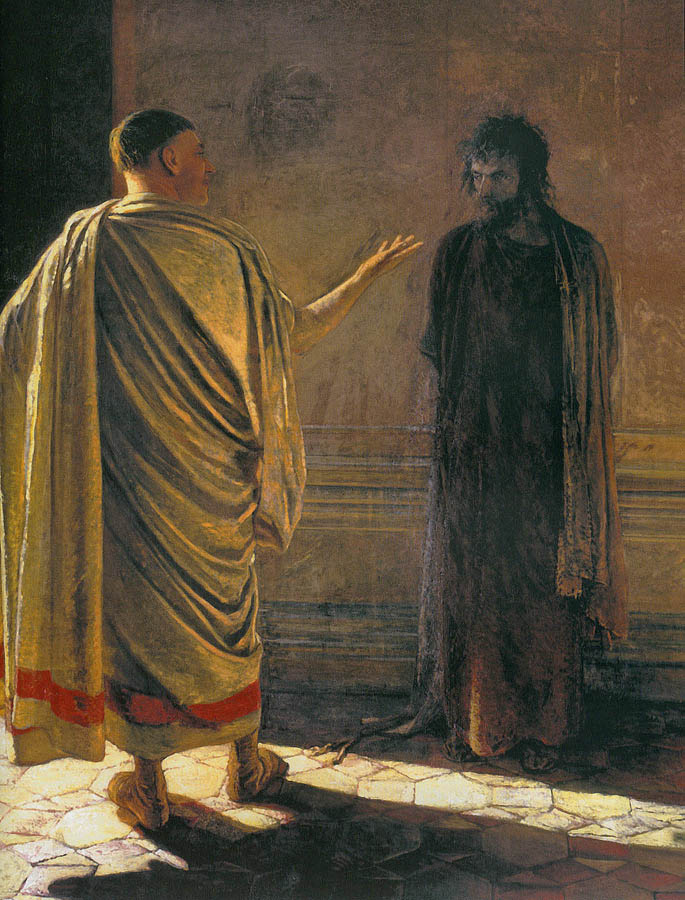
But, even if we do come to this conviction, we may find a new question that takes its place. It is the same question that Pilate famously posed to Christ: “What is truth?” It seems that the answer to that should be obvious, but any serious examination on the matter will soon uncover a few issues. Most particularly, we will likely find it difficult to distinguish what is THE TRUTH from merely “my truth.”
Consider that many of us hold different principles inside of us that we identify with the truth. Two men confronted by the same injustice might be stirred by their conscience to two different actions. One of them might feel called to meekly endure the offense, remaining patient and longsuffering. On the other hand, the other man might feel compelled to stand up for what is right and challenge the oppressor. Frankly, neither of these reactions feels fundamentally wrong to me. Perhaps towards less severe injustices the passive response seems more fitting, and towards grievous injustices the bold response, but there is a great deal of overlap where either seem entirely appropriate, and I would not call any person wrong for behaving one way or the other. But at the same time, in a single person each response is mutually exclusive to the other. So which way is actually correct?
Furthermore, two men acting in sincere accordance with their conscience is one thing, but what about the issue of us misidentifying our wants with our conscience? I’m sure we can all call out social movements that claim to be based in truth and conscience, but which are clearly just justification for selfish and immoral practices. Making matters even more complicated, while sometimes we know in our hearts that we are being dishonest, most often we really do delude ourselves into thinking that our own personal wants just happen to align with what is cosmically right. How can I recognize what is actually true, and what is just me trying to get my own way?
A Point of Reference)
Both of the issues that I have presented are a result of defining the truth locally. If each person is let alone to define their “own truth,” then there will be as many distinct truths as there are people. We will probably each settle on some genuine pieces of conscience, but also much that is colored by personality or selfish desire. Aligning ourselves with “our truth” will therefore disappoint us, both on a personal and universal level. On the personal level, it will disappoint us because we will come out looking very much the same as who we already are. We will not have any sense of transcendence, of having been called up and made into something new and better. On the universal level, we will never have unity and common purpose. We will remain entrenched in embittered battles against one another, everyone convinced of their own rightness above all others.
If this enterprise of humanity is to move forward, then there absolutely has to be some underlying, fundamental truth established outside of all of us that we can each defer to. There has to be an external truth that is real and consistent, so that we may all come into union when we separately align ourselves to it. If the truth is defined by a person, or if it is shifting in its nature, then we will never find harmony with either conscience or community.
If, however, we do settle upon a universal truth that exists outside of us all, then both of the issues mentioned above are resolved. Now we have a standard that all other “self-truths” can be compared against. Selfish desires, misinterpreted as truth, are immediately recognized as such and discarded. Also, in the example of the two men choosing differently, but according to their genuine conscience, it is possible that the universal truth is broad enough to harmonize with both decisions. While the universal truth will certainly never contradict itself, it does seem reasonable to me that it could allow some range of individual, moral choice within its domain.
Is it any wonder, then, that the bedrock of every civilization has been religion? Be it the Bible, or the Quran, or the Torah, or the Bhagavad Gita, or the words of Buddha, each culture has composed itself around words that are said to have descended from on high. They might have come through the mouths of prophets and sages, but they are not interpreted as the words of those prophets and sages. They are understood to be the words of the external, of the divine, of God in some form or another.
Cultures that detach themselves from sacred truth do not remain cultures for long. As a society they break apart and become an anarchy. As individuals they become stunted and cease to improve their situation. They lag behind the rest of the world, both technologically and ethically, and they are soon destroyed by the whims of the world.
So, going back to our idea that only the life founded upon the truth is free, even after we accept this fact we still have to identify what the truth really is. And in order to do this, we’re going to have to find a source outside of ourselves, and outside of any other person. At some point we’re going to have to find God and discover THE TRUTH for ourselves. Choosing to found ourselves upon the truth is therefore no mere decision that we make once in our current place and then have the matter resolved. Choosing to be founded upon the truth means deciding to go on a great journey. It is a quest of exploration, discovery, and refinement, and it will last us the rest of our lives and then some!
It is said that if you want to maintain a friendship you should never discuss religion. We might be able endure differences of opinion in sports and clothing brands, but we won’t tolerate conversations about the things that really matter.
Obviously this timidity to discuss spiritual matters has to do with their inherently sacred nature. We all feel a heightened sensitivity about things which are sacred. These parts are closer to our heart, and therefore a callous word is much more likely to wound our feelings. There is also the tendency to feel judged whenever someone else believes that what we do is a moral wrong.
But I don’t believe the solution should be to cut off communication there. I believe spiritual feelings can be conveyed in a way that is sensitive and loving. I believe that sometimes we need to testify of what we know is right, even if it will be perceived as offensive by the those that we are speaking to. I also believe that there is room to examine one’s intention in how they speak, and room to examine one’s intention in how they listen. With this study I would like to consider exactly those points. How can we share testimony, champion good, and call to repentance in a way that God approves of? How can we hear the opinions of others and receive or reject it as appropriate?
I have already studied a similar topic before, one where I considered how we can remain respectful in our differences of spiritual opinion. But I want to give special attention in this study for those moments where we need to share a spiritual truth that others may fight difficult to hear. I want to focus on both sides of that moment, the giving and the receiving.
In the meantime, I would love to hear about your own experiences in this matter. Have you ever tried to share something out of love, but had it received as if out of hate? Have you ever felt muzzled when trying to champion that which is good? Have you ever felt that you must say what you had to say, no matter how it would be received?
When I was nineteen I served a mission for my church, proselyting the gospel in the Caribbean. There was a great diversity of religious opinion where I served. Hinduism was most prevalent, but Christianity and Islam were not far behind. A healthy dose of Rastafari as well, and numerous smaller theologies sprinkled on top, to say nothing of the many different sects within each larger religion-umbrella.
Because of the nature of my work there, I entered into many theological discussions with members of other churches, some of them positive and some of them not. I met more than one person who was angry at me for “being wrong,” and who would seek very aggressively to convince me of that wrongness.
And while those experiences left a strong distaste in my mouth, I have actually come to agree with some of the points they made, but many years after and not because of their hostile approach. For example, only recently I came to the realization that I misunderstood grace. I said I believed in it, but I was still trying to win my own salvation. This was something that others were able to see amiss in me, but their antagonistic methods only delayed my willingness to see the truth of the matter. I wasn’t convinced until much later, when I met others who genuinely cared for me, and as a friend helped me to see more clearly.
I’m glad to say that I also had very positive experiences with members of different faiths on my mission. In particular I remember a long conversation with a Hindu Pujari (temple priest) in his home, where he patiently explained all the concepts of their religion that I had questions about. He helped me to see the misunderstanding I had on concepts like reincarnation, nirvana, and karma.
Now I did not convert to Hinduism, but I did open myself to seeing the very real good that this religion and culture has to offer the world. For example, the emphasis that it gives to connecting with one’s physical self and caring for it; this is something that many of us Christians have a lot to learn about. I have even added the practice of yoga into my life because of the good I have seen it bring me.
Indeed, whenever I meet a soul that is intent upon being a friend, and not merely a corrector, I have found something to learn from them. No matter their religion, philosophy, or personal beliefs, no matter how many other things they think that I disagree with, there is always still something for a friend to teach.
At the end of my last study it came up how the Atonement of Jesus Christ was performed to fulfill the laws of our fallen world, while also enabling a new law, one of grace and salvation. The scriptures say a very great deal about law, and speak to a sense of system and procedure in divinity.
But at the same time, structured religion is becoming less and less popular today. People seek ways to be “spiritual not religious,” and refute the idea of a God who has terms and conditions. I do understand the reason for this, it is a very difficult thing (perhaps impossible) to not project all the limitations and flaws of our mortal laws and governments on the divine. Because we see how our attempts at structure are so flawed, we struggle to imagine what a perfect structure could be like.
But that does not mean that the perfect structure does not exist. Rather than trying to excuse ourselves from God’s law (because we cannot conceive of it properly) we should broaden our perspectives to better glimpse it. And the more we do glimpse it properly, the less hesitation we will have in being subject to it.
With this study I would like to consider what different laws are described in the scriptures and what their purposes are. I would like to consider why we need law, and why God uses this form for leading His children. Finally I would like to examine how the implementation of divine law does not preclude a divine Father being able to have a personal (and personalized) connection with each child.
I would be curious to hear how you have been able to resolve the rigidity of divine law with the warmth of paternal love. What differences are most significant to you between the Old Testament law and that of the New Testament? What reasons do you believe are behind those differences? What do you think perfect law looks like when perfectly understood?
Then saith the woman of Samaria unto him, How is it that thou, being a Jew, askest drink of me, which am a woman of Samaria? for the Jews have no dealings with the Samaritans. Jesus answered and said unto her, If thou knewest the gift of God, and who it is that saith to thee, Give me to drink; thou wouldest have asked of him, and he would have given thee living water. The woman saith unto him, Sir, I perceive that thou art a prophet. Our fathers worshipped in this mountain; and ye say, that in Jerusalem is the place where men ought to worship. Jesus saith unto her, Woman, believe me, the hour cometh, when ye shall neither in this mountain, nor yet at Jerusalem, worship the Father. But the hour cometh, and now is, when the true worshippers shall worship the Father in spirit and in truth: for the Father seeketh such to worship him.
COMMENTARY
For the Jews have no dealings with the Samaritans The Father seeketh such to worship him When Jesus attempted to travel through Samaria, they denied him entrance into their village. His disciples then asked him if they should call down fire to destroy that nation and he rebuked them for such a suggestion (Luke 9:51-56). In the encounter between Jesus and the Samaritan woman, we see that Jesus still retains thoughtful concern for these children, and looks forward to a day that the boundaries between them can be broken. He makes clear that the Father still seeks for people like her to share in the riches of heaven. I am convinced that the highest courts of heaven will be populated by Christians and Jews and Muslims and Hindus and Buddhists, and all other manner of sincere seekers for truth. If we try our best, but are somewhat misaligned, our trying is not going to be discounted because of it. Let us never forget, that in the end, “the LORD looketh on the heart” (1 Samuel 16:7).
For one believeth that he may eat all things: another, who is weak, eateth herbs. Let not him that eateth despise him that eateth not; and let not him which eateth not judge him that eateth: for God hath received him. One man esteemeth one day above another: another esteemeth every day alike. Let every man be fully persuaded in his own mind. I know, and am persuaded by the Lord Jesus, that there is nothing unclean of itself: but to him that esteemeth any thing to be unclean, to him it is unclean. But if thy brother be grieved with thy meat, now walkest thou not charitably. Destroy not him with thy meat, for whom Christ died.
COMMENTARY
Let not him that eateth despise him that eateth not; and let not him which eateth not judge him that eateth One man esteemeth one day above another: another esteemeth every day alike. Let every man be fully persuaded in his own mind. Any moral code is going to stipulate some actions as being worthy and others as unworthy. This is not only true of the moral codes within organized religion, even a rubric as vague as “what’s currently trending in society” still advocates for certain behaviors over others. Of course, different moral codes will disagree with one another as to which actions are worthy and which are not. Proponents of these different moral beliefs often waste a lot of time arguing their points to those that do not even subscribe to the same tenets. Because each side values entirely different criteria, the vast majority of these debates are completely pointless, destined to generate aggravation, not understanding. Why don’t we take Paul’s advice? Let us maintain the code we truly believe in, and let others do the same. We do not have to demand that everyone else agree with us, only that they be sincere in their own morals.
But if thy brother be grieved with thy meat, now walkest thou not charitably. Destroy not him with thy meat, for whom Christ died. Tolerating another’s beliefs is good, but we can also take it a step further. Paul points out that we can take special care to not step on that which is sacred to others. Even if we don’t agree with all of their restrictions, we can govern ourselves by them while in their presence. One does not even need to be religious do this, only socially polite. Those with vices still often put their cigarette out around non-smokers, choose jokes that don’t offend any present demographic, and avoid swearing around children. Paul isn’t trying to tell us to be disingenuous, he simply wants us to be courteous.
Finally, brethren, whatsoever things are true, whatsoever things are honest, whatsoever things are just, whatsoever things are pure, whatsoever things are lovely, whatsoever things are of good report; if there be any virtue, and if there be any praise, think on these things.
We claim the privilege of worshiping Almighty God according to the dictates of our own conscience, and allow all men the same privilege, let them worship how, where, or what they may.
Therefore all things whatsoever ye would that men should do to you, do ye even so to them: for this is the law and the prophets.
COMMENTARY
If there be any virtue, and if there be any praise, think on these things Allow all men the same privilege, let them worship how, where, or what they may I have spent some time advocating for holding to your sincere beliefs, while also allowing all others the same privilege. So long as a religion genuinely improves the morality and spirituality of its patrons, then it should be recognized as a worthy vessel for good. Perhaps you see some ideologies that are flawed, but which are still accomplishing far more good than harm. Would you want to risk destroying the 90% that is good, just to expunge the 10% that is flawed?
Therefore all things whatsoever ye would that men should do to you, do ye even so to them Of course not all ideologies really are 90% good. I do not claim that all beliefs are valid. I have no patience for ideologies that call for the eradication of human life, and declare war on a specific demographic. Creeds like these are logically self-defeating. One way to tell truth from error is whether the principle destroys itself when held in the hands of another. Consider religious intolerance. To wish to destroy another religious sect is to support a principle that would destroy you if held in the hands of another. Thus the notion is crushed under its own weight. I also reject those that use spiritual trappings for predatory or manipulative purposes. There are ministries that promise blessings and healings…but only if one calls in and provides their credit card number.
In the end, I believe there is much that is good in this world, more good than we often realize. And I believe every source of good should be supported and celebrated. But I also believe that one must be cautious, for while many things are good, certainly not all things are.
By this shall all men know that ye are my disciples, if ye have love one to another.
So we, being many, are one body in Christ, and every one members one of another.
And he came to Capernaum: and being in the house he asked them, What was it that ye disputed among yourselves by the way? But they held their peace: for by the way they had disputed among themselves, who should be the greatest. And he sat down, and called the twelve, and saith unto them, If any man desire to be first, the same shall be last of all, and servant of all.
COMMENTARY
By this shall all men know that ye are my disciples, if ye have love one to another So we, being many, are one body in Christ I believe Christians sometimes believe that the body of Christ refers to their particular sect only, and not to any of the others. But why can it not be referring to all Christians? Christ, himself, gave the definition for being one of his followers, and he did not say it was by being only a Catholic, or only a Lutheran, or only a Mormon. He said “men know that ye are my disciples, if ye have love one to another.” So if I have love for a Methodist and a Jehovah’s Witness, then what am I? A disciple of Christ. And if a Protestant and a Presbyterian have love for me, then what are they? Disciples of Christ. And if we do not have love for one another, then what are we? Not disciples.
They had disputed among themselves, who should be the greatest And he saith unto them, If any man desire to be first, the same shall be last of all I believe many Christians also have a mistaken fantasy that when Christ comes again he will point to their church and say “This. This was the right one, and all the rest of you are wrong.” In essence, we, like the disciples of old, are hoping that Jesus will choose us as the greatest above all others. But Jesus cautions us that desires to be the greatest debase us to the lowest. Let us suppose that your own religion teaches the absolute truth and mine is somewhat amiss. Yes, when Jesus comes He would need to then correct all of the misconceptions that I hold. But I am certain that he would not do this by wagging his finger and telling me just how wrong I am. Rather he would accept that I am striving for rightness, and lovingly show me how to be even more so. It would be like a servant washing the feet of the disciples that still have a little dirt on them.


 Spiritual Wanderings