18 And he went out from Pharaoh, and entreated the Lord.

19 And the Lord turned a mighty strong west wind, which took away the locusts, and cast them into the Red sea; there remained not one locust in all the coasts of Egypt.
Just as an east wind had brought the locusts into the land, a west wind took them out. This wind would have come from the Africa mainland, and evidently it blew across Egypt and into the Red Sea.
Once again, the effect of this healing is as absolute as the plague had been. In the time of affliction we were told that the locusts consumed “all the fruit of the trees…and there remained not any green thing.” So, too, here we are told there “remained not one locust.” God is able to take and give in absolute measure.
I can’t help but wonder what it was like for the Egyptians to see all the locusts blown away and witness the nakedness and barrenness of their land revealed underneath. This image of exposed desolation reminds me of Adam and Eve with their fig-leaf aprons, covering their shame from God, only to have Him see right through them. When we sin, our good fruit is withered and we are left with a shameful desolation that we typically go to great lengths to hide, but when a west wind blows our humiliation is uncovered, much to our embarrassment, but this can also be the first step to true repentance if we will allow it.
I’ve spent the last three days saying that we need to be able to talk about the difficult issues of our day without being afraid of one another. Yes, we should be respectful and considerate, but that doesn’t mean we have to neuter our communication. If we feel strongly about something, we should be able to express our convictions with emphasis, but without becoming hostile. We also need to encourage others to know that we can listen to their differing opinions without demonizing them. We should be able to let them know that even if we strongly disagree, we can still view them as a brother or a sister and a friend.
And in that spirit, I think it is only fair that I should lay my own cards on the table. I’ve always avoided being explicit in my political and social leanings, partly because I didn’t want to offend anyone, and partly because I didn’t want to invite unpleasant reactions. But now I feel that those fears are the exact things that are preventing us from having these important conversations in our society. Furthermore, I would imagine several of you have already made assumptions about my positions and perspectives, and if your assumptions are off the mark I wouldn’t want to feel that I am deceiving you.
If my convictions are different from what you expected, if they contradict the image you had built up of me through my prior posts, if they challenge your own perspectives, then hopefully this will help to illustrate my point that even those of differing opinions can still be of value. I expect plenty of my readers will have different feelings on several of the subjects I am about to list out, and I want to make clear that I don’t begrudge any of you who feel differently being here and remaining a part of this community. All are welcome to come here, even if they disagree, so long as they speak with respect.
My Convictions)
I am a traditional conservative.
In matters related to family and society, I believe that marriage is to be between a man and a woman, and that for the good of our children and society, sexual relations should be reserved for that marriage. I believe that both parents should be equally committed to whatever children they conceive. I believe that this return to basic family values would in-and-of-itself eradicate the vast majority of every social ill we see. I believe that the transgender movement is in opposition to basic truth and should be dismissed as such. I believe that pornography is merely another form of prostitution, that it is incredibly harmful to both the individuals who create it and those who consume it, and it should be prohibited. I believe that men and women each face their own unique challenges, and each deserves equal attention. I believe that the life that begins at conception is sacred and should absolutely be protected.
In matters of race and immigration, I am opposed to any notion of white superiority, but I am equally opposed to any notion of white inferiority. I believe that all races should be treated equally and fairly, that none are fundamentally more worthy or more problematic than the other, and none of them should receive special treatment nor restriction. I am proud that my country, the United States of America, has long had the defining virtue of being a haven for the refugee, the migrant, and the poor. Protocol and process are necessary here to prevent abuse of generosity, but I am anxious that we do not lose sight of this noble quality that has so long defined us.
In matters of crime, I believe that criminals should face justice for their wrongs, even up to capital punishment in the most extreme cases. For those who are incarcerated, every effort should be made to reform and educate those individuals, for their own betterment as well as that of society. I believe that we should resist the normalization of both recreational and illegal drugs.
I also believe that we need to take care of our planet, our environment, and the miraculous species God has given to us, but that we should do so in manners and degrees that do not force the poorest to remain in deprivation. I also believe that there are forces trying to undo our religious liberty, to silence specific statements of faith, and that this effort undermines the foundation of our society and must be resisted.
Conclusion)
There. I think that covers all the main “hot topics,” and there’s enough opinions there that just about everyone should be able to find something they disagree with! You’ve already had time with this blog to get to know my heart, so does where I stand on these issues align with what you thought of me? If not, are we still going to be able to be friends and explore spirituality and truth together? For the sake of my faith in humanity, I certainly hope so!
In my last post I spoke about how many of us believe that the right and proper way to live is in accordance with the truth, yet at the same time we lie to everyone, including ourselves, about all the wrongs that we do. We are each a person divided, feeling the truth in our heart, transgressing it in our bodies, and refusing to acknowledge the gap in our minds.
Quite frankly, we avoid the hard truths on such a regular basis that we typically don’t even notice that we do it. The fabrications we soothe ourselves with are so practiced and so regular that they don’t even register. Thus, we might examine the general state of our life and admit that something feels off, that it seems we must be living under some self-delusion, but genuinely have no idea what that delusion even is. How can we make a change if we cannot name what the change that we need to make is?
This idea of knowing the name of our hidden, inner truths has its roots in many ancient cultures. There has long been a notion that if you know the true name of an entity, then you could gain power over it. I have seen for myself that there really is something to this. Sometimes the entire battle has been simply to correctly label the problem that I’m struggling with. Other times, it is only the first battle in the war of a lifetime. In either case, it is always the first step towards overcoming that part of my self.
So how do we identify the real, sometimes unpleasant truths lurking inside?
In many cases we we are so close to the issues that we can’t see them clearly, and we need to be shown them from an outside perspective. That might mean having a deeply earnest conversation with a trusted family member or friend. It might mean soliciting the professional insights of a qualified therapist. Certainly it means getting on our knees and asking our Maker to reveal ourselves to us.
The Great Physician)
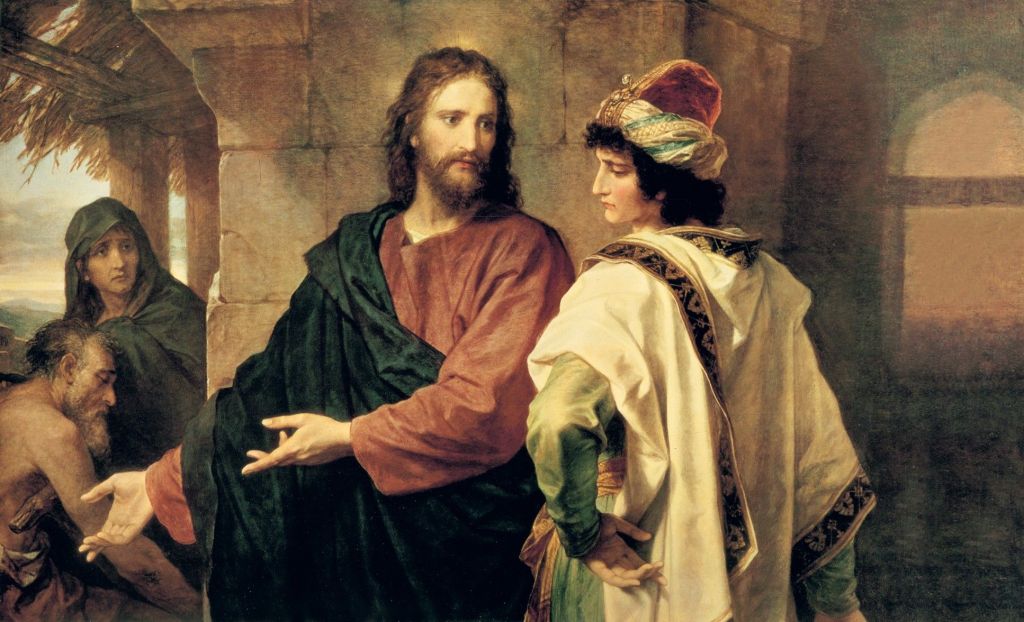
Let us never forget that this is one of Christ’s essential roles. During his sojourn on Earth he demonstrated his ability to diagnose the state of a person’s soul. He was able to reveal people to themselves, to cut straight to the heart and show them the truth plainly. Let us consider one example of this, the story of Christ and the rich, young ruler (Mark 10:17-22)
And when he was gone forth into the way, there came one running, and kneeled to him, and asked him, Good Master, what shall I do that I may inherit eternal life?
And Jesus said unto him, Why callest thou me good? there is none good but one, that is, God. Thou knowest the commandments, Do not commit adultery, Do not kill, Do not steal, Do not bear false witness, Defraud not, Honour thy father and mother.
And he answered and said unto him, Master, all these have I observed from my youth.
At first Jesus gives the man a general answer, listing out all the basic things that everyone is instructed to do. But the man is sincere and earnest and he wants more than this. He does all of these things already, he always has, still he questions what he must do to inherit eternal life.
We aren’t told explicitly the young man’s inner thoughts, but I cannot help but wonder if he was much like the sort of person I described above: knowing that something was off, but not knowing what. Perhaps he could tell in his heart that there was something lacking within him, some difficult truth about himself that he had not identified, and he needed the help of the Master to know what it was.
Then Jesus beholding him loved him, and said unto him, One thing thou lackest: go thy way, sell whatsoever thou hast, and give to the poor, and thou shalt have treasure in heaven: and come, take up the cross, and follow me.
And he was sad at that saying, and went away grieved: for he had great possessions.
Jesus respects the man’s earnestness by finally giving him the real answer. The young man was indeed obedient and faithful, but Jesus reveals to him the fundamental flaw still at his core was his love of wealth. That dependency on the worldly things was what still stood between him and God. Clearly it was an accurate diagnosis, too, for the man made no attempt to dispute the matter, nor to correct his attitude. He had been seen–really seen–what was inside and he was distressed by what was revealed.
I do believe that one of the reasons we conceal our hard truths from ourselves is because we know that we won’t deal with the problem if we open the door to it. Part of us has decided that it is better to be forever agitated by “something” feeling off inside, but not knowing what it is, than to know what the problem is and be crushed by our inability or unwillingness to do anything about it.
The secret-keeper inside of us says, “Yes, you are a slave. But you’re not ready to risk everything for a rebellion, so why should I show you who your master is? Better that you just go home and try to forget everything about this.”
1 Then Joseph could not refrain himself before all them that stood by him; and he cried, Cause every man to go out from me. And there stood no man with him, while Joseph made himself known unto his brethren.

2 And he wept aloud: and the Egyptians and the house of Pharaoh heard.

3 And Joseph said unto his brethren, I am Joseph; doth my father yet live? And his brethren could not answer him; for they were troubled at his presence.
I wonder how Joseph originally intended to reveal himself to his brothers. Perhaps if they had been willing to abandon Benjamin he never would have, except to his younger brother after they had left? Or maybe if they had tried to walk away, he would have revealed himself then and shut all the older brothers in prison?
In either case, whatever plans he did or did not have, it would seem everything was upended when he couldn’t hold his composure together any longer, and he calls for everyone to leave the room except his brothers.
There, alone with the rest of Jacob’s sons he takes off the mask. All this time they have known him only as the Egyptian prince Zaphnath-paaneah, but now he reclaims his true identity. “I am Joseph!” Then, though his brothers have already told him that Jacob still lives, he asks for confirmation of it one more time. This time he does not ask “does your father still live” but “does my father.”
The brothers, for their part, remain in stunned silence. When one holds a secret, it is a relatively small thing to them to uncover the truth of it. But to the one that has the secret revealed, it can be a major paradigm shift, a sense of one’s entire reality spinning to a new alignment. Thus, before any further conversation can continue, Joseph will first need to coax his brothers into accepting that their long-lost brother has returned to them again.
Peter answered and said unto him, Though all men shall be offended because of thee, yet will I never be offended. Jesus said unto him, Verily I say unto thee, That this night, before the cock crow, thou shalt deny me thrice.
And I say also unto thee, That thou art Peter, and upon this rock I will build my church; and the gates of hell shall not prevail against it.
COMMENTARY
Jesus said unto him, This night, before the cock crow, thou shalt deny me thrice Thou art Peter, and upon this rock I will build my church; and the gates of hell shall not prevail against it Previously I shared how Peter thought he was ready to die for Jesus, but when his moment to prove it came, he was found lacking. Clearly he had misjudged himself. Today I reflected back on that story, and I realized that there was another lesson to be found within it. Yes, Peter misjudged himself in that moment, but Jesus saw him rightly. After his failure, Peter became understandably discouraged, and following Jesus’s burial he returned to his old lifestyle as a fisherman. Perhaps that was all he felt he was cut out for anymore. But if so, then once again he was misjudging himself. For even before Jesus had rightly predicted Peter’s failure, he had also rightly predicted his eventual triumph. In fact, it was Jesus who gave him the name Peter, which means “rock,” and testified that this disciple would become the foundation of strength for the gospel moving forward. And Jesus was right. I suspect that many of us, like Peter, are both weaker and stronger than we think. Our Heavenly Father and our Elder Brother truly know us better than we know ourselves. Jesus revealed Peter’s true nature to him, and he is ready to also reveal yourself to you. You only have to be ready to receive it.
But the Lord said unto him, Go thy way: for he is a chosen vessel unto me, to bear my name before the Gentiles, and kings, and the children of Israel.
Ye have not chosen me, but I have chosen you, and ordained you, that ye should go and bring forth fruit, and that your fruit should remain: that whatsoever ye shall ask of the Father in my name, he may give it you.
COMMENTARY
For he is a chosen vessel unto me Ye have not chosen me, but I have chosen you Saul set out for Damascus with the express purpose of imprisoning the Saints. Who could have believed that he would instead be called to carry the Lord’s gospel to the Gentiles? Clearly neither Ananias nor Saul did, to them that notion seemed ridiculous. Yet that was exactly the purpose for which Saul was chosen. Who could have assumed that a lowly fisherman would become the head of Christ’s church? And yet that was who was chosen. The key factor in both of these examples is who was doing the choosing. Not Saul, not Ananias, not Peter, and not any other man. Only God. If you are concerned because you do not know what purpose God has for you, do not worry. It isn’t some puzzle that you have to solve, and it isn’t a revelation that you have to disclose to yourself. Our purposes are given to us, they are something that only God can reveal. All you have to do is make yourself a willing receptacle for that.

 Spiritual Wanderings