The Richness of Scriptural Symbolism- Static Images

Throughout this series we have looked at symbols in their most complex forms and gradually introduced simpler and simpler forms. We started with lived-out moments that reenact something bigger, then moved on to carefully constructed parables, and most recently we looked at brief dream sequences which stripped away context and story to provide concentrated symbolic scenes.

There is, of course, an even simpler form of symbols and it is probably the first form that comes to mind when we heard the word. It is symbols as single, static images. These are things like the Christian Cross, the Star of David, or the Scales of Justice.

An argument could certainly be made that the more fundamental a symbol is, the more applications and representations it will hold. This would mean that these single static images will often have the most interpretations of all.

In today’s post we will take a look at two examples of this type of symbol and consider the sorts of things that they might stand for. I should first note, though, that while both of these symbols are religious, neither is divinely established in any religious text. There is no scripture that says that these specific symbols should be part of the iconography of the Jewish or Christian people, so let us not assume that these symbols are necessarily under God’s authorship.

The Star of David)
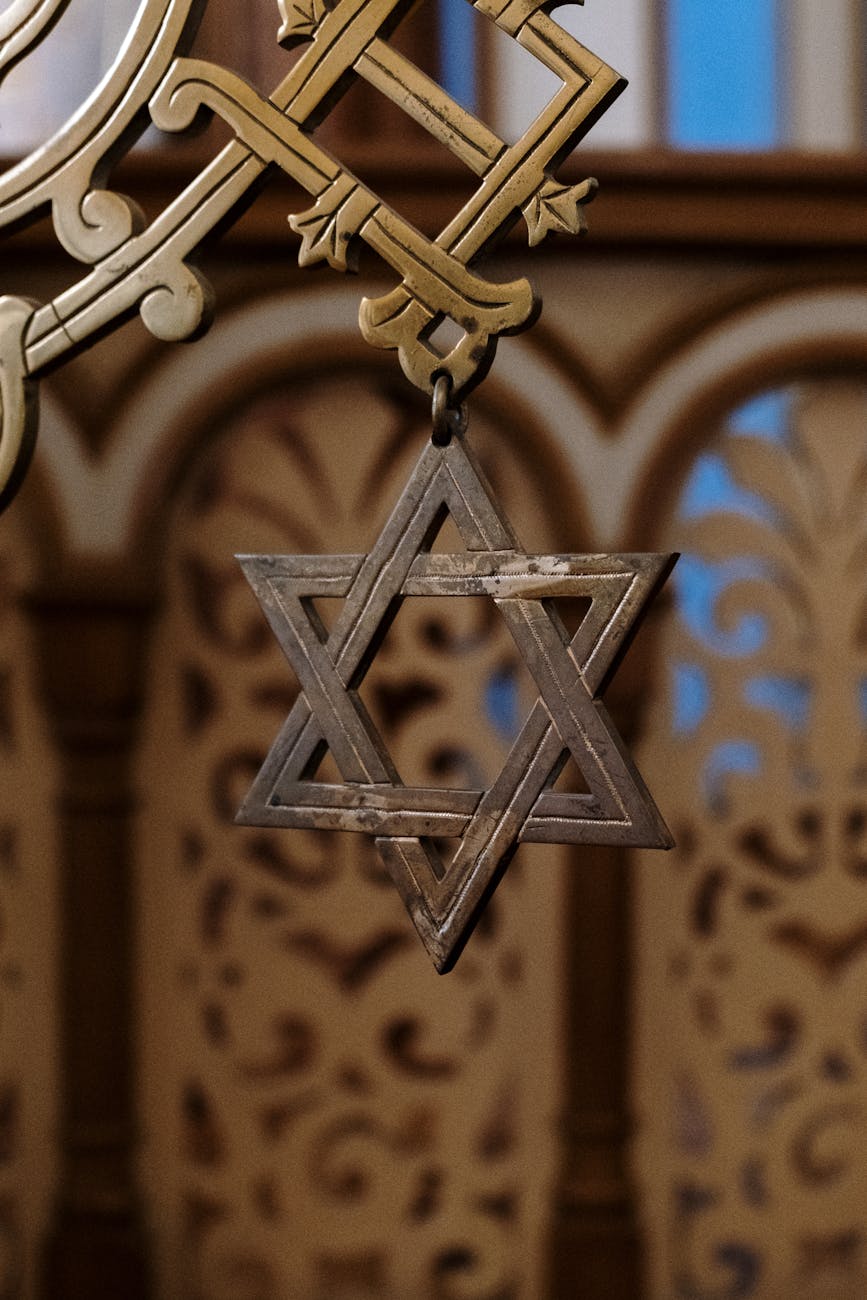
The first symbol we will consider is the Star of David. This six-pointed star has long been a symbol of the Jewish faith and is even the central element in the flag of Israel. Perhaps the first representation that we see in it is the fact that it is a star, or a sun, thus something that provides light and guidance, or which can be a marker to guide us along our way.

We also notice that there is one large hexagon in the middle, surrounded by six small triangles that extend from its sides. This could be seen as God in the center, with all other creations gathered in observation of Him. It even brings to mind Joseph’s dream of standing in the midst of his brethren as they bowed to him.

Of course, one can also see the shapes of two equilateral triangles, one upright and one inverted, offset and overlapping. With this view in mind, we can see one triangle as God descending downward and the other as mankind extending upward, the overlap being where the two come into union with one another. To the Jew, that place of union could be seen as the Law or the temple, while to the Christian it would be Christ.

The Christian Cross)
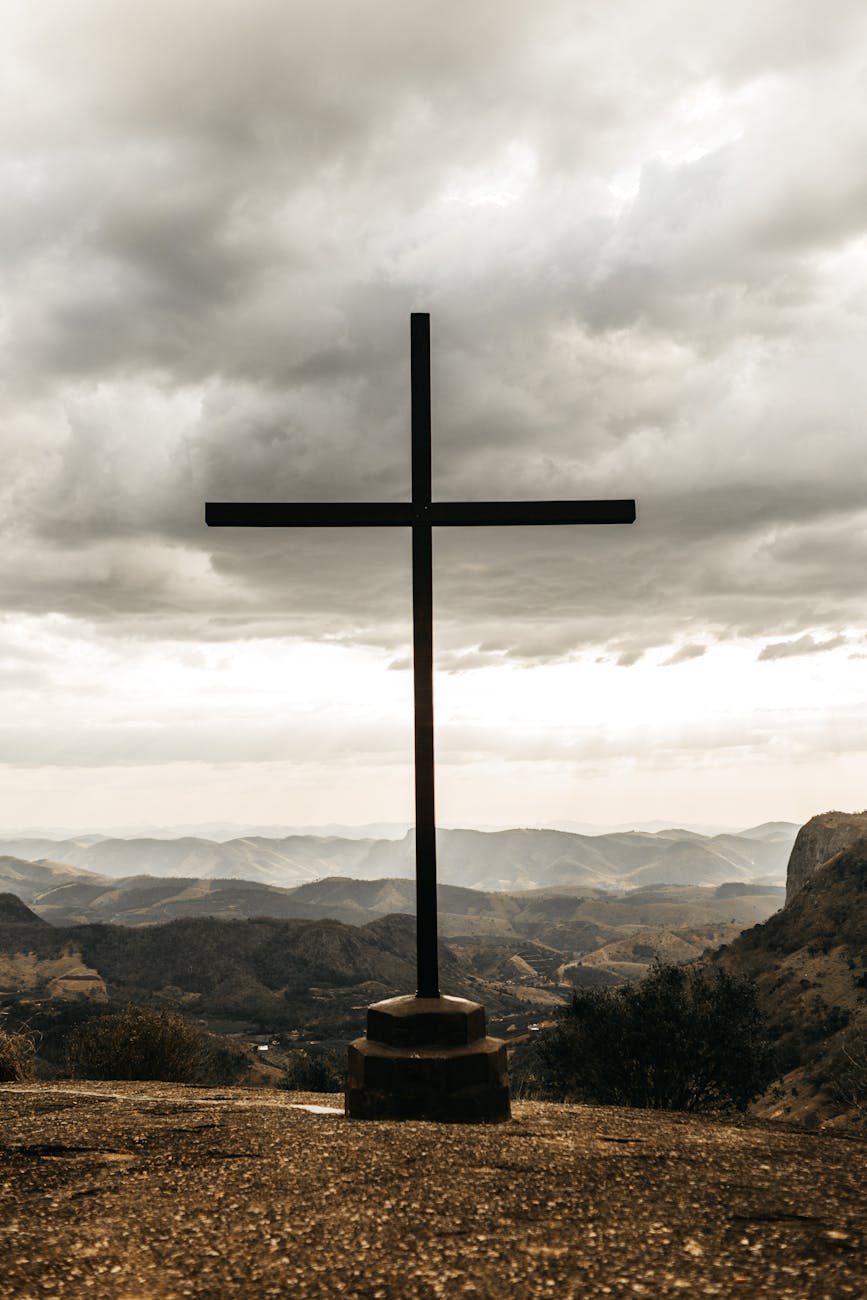
The Christian Cross must be one of the simplest symbols ever made: two lines crossing at right angles. Of course, it immediately invokes memories of the crucifixion of Jesus Christ. When considering that application, it becomes simultaneously a symbol of man’s greatest cruelty and God’s greatest mercy, an interesting paradox.

The vertical line of the cross can also be seen to stand for God, while the horizontal line stands for the earth, or the horizon. The point of juncture in the middle then has a similar meaning to the overlapping triangles in the Star of David: the place where heaven meets earth, meaning the church or Jesus.

With our modern system of world coordination, the crossing lines can also be seen as a longitude and a latitude, suggesting the ability to pinpoint where we stand spiritually, or suggesting a guided destination for where we need to go.

Summary)

We could go on quite a bit lot longer in our analysis of each symbol. Hopefully this has been enough to establish that their simplicity does not make their applications few. Rather, it is the inverse. Because they are such a basic representation of something so fundamental, their applications are virtually infinite. They are literal signs, pointing the way to much, much more

The Way That Things Are- 1 Corinthians 1:18-20, 25

For the preaching of the cross is to them that perish foolishness; but unto us which are saved it is the power of God.
For it is written, I will destroy the wisdom of the wise, and will bring to nothing the understanding of the prudent.
Where is the wise? where is the scribe? where is the disputer of this world? hath not God made foolish the wisdom of this world?
Because the foolishness of God is wiser than men; and the weakness of God is stronger than men.

COMMENTARY

For the preaching of the cross is to them that perish foolishness; but unto us which are saved it is the power of God
Those that discredit faith proclaim that to follow God is naive. And, if God did not exist, they would be right. For if God were not real, then none of the things promised in His name would be true. And if people believe in something which is false, then truly that is foolishness. Indeed, that is a very succinct definition for the word.

Because the foolishness of God is wiser than men
For the preaching of the cross unto us which are saved it is the power of God
But what becomes of this “foolishness of God,” if it so happens to be true? Is it naive to be a follower, if following these precepts actually redeems our hearts and heals our souls? Those of us which are saved attest that the preaching from the cross is not foolishness, but verifiable truth.
And what is the seeing of truth if not wisdom? This is a very succinct definition for that word as well. In the end, it does not matter how elaborate and complex a cynical statement is. If it is wrong, then it is foolish, no matter how intricate it might be. And it does not matter how simple and unvarnished a statement of faith is. So long as it is true, so long as it describes things as they really are, then it is wisdom.

What Sort of Disciple Are You?- 2 Kings 5:10-13

And Elisha sent a messenger unto him, saying, Go and wash in Jordan seven times, and thy flesh shall come again to thee, and thou shalt be clean.
But Naaman was wroth, and went away, and said, Behold, I thought, He will surely come out to me, and stand, and call on the name of the Lord his God, and strike his hand over the place, and recover the leper.
Are not Abana and Pharpar, rivers of Damascus, better than all the waters of Israel? may I not wash in them, and be clean? So he turned and went away in a rage.
And his servants came near, and spake unto him, and said, My father, if the prophet had bid thee do some great thing, wouldest thou not have done it? how much rather then, when he saith to thee, Wash, and be clean?

COMMENTARY

My father, if the prophet had bid thee do some great thing, wouldest thou not have done it?
Yesterday we examined Peter, who felt he was ready to lay down his life for Jesus, but stumbled when the actual danger arose. Peter had something in common with Naaman: both believed that they were ready to undertake some “great thing,” and openly invited a test of their resolve. Where their paths diverge is that Peter was actually invited to risk his life, whereas Naaman was only asked to do something small and basic.
Peter fell short of the great sacrifice, but even Naaman almost failed to do the small and simple thing! The fact that he was almost tripped up by the little thing makes me suspect that he, like Peter, may not have been as ready for the greater sacrifice that he thought he was. I once had a missionary who firmly avowed that he would gladly die for Christ’s gospel. At the time I couldn’t help thinking “but you and I are struggling with even the basic missionary rules right now, so why would either of us be ready for a sacrifice like that?”
I love the scene from the Karate Kid, where Daniel expresses his frustration at his teacher. He came to him to learn martial arts, but instead he has been assigned many menial chores. He does not yet realize that it is in the small, repetitive tasks that the reflexes of a warrior are being developed within him.
It is easy to view scripture study, prayer, acts of service, and obedience to the commandments as meaningless chores, things which have no bearing on one’s ability to undertake great spiritual causes. But in truth these practices are absolutely essential and fundamental, the little things that make all the difference.