Scriptural Analysis- Exodus 20:3

3 Thou shalt have no other gods before me.

I mentioned yesterday that the divide between commandments one and two can be easily missed. Today we will look at just the first commandment, and tomorrow the second, and we will seek to understand the difference between them.

The first commandment is actually very brief, captured entirely in a single verse. In my Western civilization, which was founded upon Judeo-Christian theology, the idea of other gods is strange and bizarre. From my youth I have understood there to only be one God, and so devotion to any others sounds totally illogical.

For the Israelites fresh out of the land of Egypt, though, it was a different matter. They had been surrounded by the likes of Horus and Ra, and they were on their way to Canaan where they would encounter the likes of Baal and Ashtaroth. The people would be tempted, and too-often fully seduced, by these false gods. They would abandon the God who had created, called, and redeemed them.

Today we might not so clearly personify our false gods, but that doesn’t mean that we don’t have them. If we think a false god as the supreme authority in our life, the thing whose demands trump all other contradictory voices, then I would say today we have false gods of The Self, Science, and Ideology. The Self when we abandon all principles and virtues simply because we want to satisfy our own selfish interests. Science when we treat it as an opinionated entity that has dethroned God. Ideology when we are more dedicated to the rules of our chosen group than to fundamental truth.

It’s not as if there isn’t value in the self, or in science, or in some ideologies, but to have anything that is our supreme authority, our god that we defer to, even above the Lord who created the heavens and the earth, is an exercise of evil.

We also worship a false god when we worship a misconstrued idea of who God is. When we see God as the punishing oppressor who has unrealistic expectations for our spiritual growth, that is not really God. When we see Him as the over-indulgent, permissive grandfather who doesn’t care whatever we do, that is not really God. In both of these cases, and any other gross misrepresentation of the Lord, we are worshipping a false god.

Scriptural Analysis- Exodus 20:1-2

1 And God spake all these words, saying,

2 I am the Lord thy God, which have brought thee out of the land of Egypt, out of the house of bondage.

We now come to one of the most famous passages in all of the Bible: the laying down of the ten commandments. Interestingly, God does not Himself refer to these as “the Ten Commandments.” That title is not spoken out loud by either God or Moses, but was written out by a scribe in Exodus 34:28. As such, in the following verses we will see that the commandments are not explicitly numbered, they don’t all receive equal explanation, and the point where the first commandment ends and the second begins can sometimes be confusing to detect. Regardless, I will proceed through them one at a time, giving each a discussion on their meaning, significance, and application.

Before that, though, we have this introduction from the Lord. He prefaces these core commandments with the declaration that “I am the Lord thy God.” These aren’t the words of Moses, they aren’t the opinions of any man, they are the mandate of the divine.

God continues with His introduction, reminding the Israelites that He is the one that “brought thee out of the land of Egypt, out of the house of bondage.” They were prisoners and He freed them when no one else could. He hadn’t come only to free them from the Egyptians, though, but also from their own vices and frailties. These commandments would be a continuation of His freeing, ensuring that the weak and the naive would not be left to the mercy of the murderer, the thief, or the false accuser.

In short, the Israelites had been freed for a purpose, and it was so that they could submit themselves to their true and benevolent Master, whose commandments these were.

Rights and Materialism: Part Three

Thus Far)

Over the past two postsI have discussed God as a basis for our fundamental human rights, and also the natural biology of our species for a basis as well. I have explained that I believe in both foundations, but unlike a materialist/humanist, I am convinced that having the natural biology of our species as the only foundation for our rights is insufficient. In my last post I explained why, showing how from the materialist/humanist view, rights would only be an illusion invented by the species that benefits from them. We would say that humans should have a right to life, simply because if they don’t they would cease to exist, so murder is a self-destroying principle.

So long as our rights are tied only to the biology of our race, it is possible to create logical exceptions to them. I gave two examples:

  1. We could say that we are not the same race as other humans, and we only need to observe the rights of our own race, and not of others.
  2. We could say that even if the rights should be enforced by society at large, if we violate them and conceal it from society, there is no other authority that we must answer to.

Today we will consider how having our rights also based in God resolves these issues.

A New Equation)

In my previous post I gave an equation that showed the cyclical, self-contained logic of rights when based upon the natural biology of our species. I said that if we call humanity “X,” and the basic human rights “Y,” then we can say:

Y is essential for X
So X must secure Y

Now let us consider how that equation changes if we assume that God has given us our rights. We will represent God in our equation as “Z.”

Z states that Y is essential for X
So Z must secure Y for X

The rights (Y) are tethered to man (X) by God (Z). It may not seem like much of a difference, but this small alteration has massive ramifications. Introducing Z now makes X and Y reside in Z, not in each other. We no longer have a circular, isolated interdependency. The relationship between X and Y no longer collapses once we are outside of their context. Y is no longer a relative need of X, which nothing outside of X is obligated to fulfill.

Through this God-centric view, human rights are now just as universal and unchanging as mathematical truths. Just as how the Pythagorean Theorem will always be a true mathematical expression, the statement that “life and liberty are necessities for all people” will always be a true, moral principle. Even if there were no people around to observe it, the Pythagorean Theorem would still be a universal maxim between the sides of right-triangles, maintained in God, independent of man. In just the same way, even if humanity were to go extinct, it would still be a maxim in God that life and liberty are good for people and nothing would change that.

The Answer to the Problems)

Now, even if a group of people declared themselves to be a different race they would still have to answer to God if they violated the rights of other races. If individuals violated the rights of one another, and concealed it from the larger species, they would still have to answer to God. They would have to answer to God because it is He, not merely “other people,” who demand these rights for all. He demands them, and He enacts His will to see that they are secured.

And from the Christian perspective, that is exactly what has transpired throughout history. Yes, there have been long periods of various rights being violated by entire nations and individual souls, but over the years the idea of basic human rights has emerged, and in more developed countries has been applied to all, and of it has been done under the justification that “it is God’s will.”

Conclusion)

There is nothing wrong in observing the ways that our biological nature compels us to seek what is best for one another, to enshrine rules of conduct between all people, to sacrifice our own interests for the greater good. Recognizing these logical, natural realities can certainly be further evidence to help convince all people to live in moral, ethical ways.

The problem is when we try to weaponize the existence of this biological nature against the divine basis for our rights. There are those that use a new moral perspective to beat away at the very foundation that all our moral principles rest upon! How strange, when it was the perspective that God was the author of our morals that led us to implement the freedoms and rights that we have in the first place. Trying to remove that perspective is a regression, one likely to take us back to the darkest epochs humanity has ever seen, with the vast majority of the population living under all manner of oppression and suffering.

If we destroy the one, best moral grounding we have ever had, and give the next generations a flawed moral grounding instead, they will carry it to conclusions that we would never dare. And when they do, who will the sufferers take their appeal to then? The God that we abandoned?

Rights and Materialism: Part Two

In yesterday’s post we talked about God as a basis for our fundamental human rights, and also a more materialist/biological basis for them. I made the point that it is a false choice that we have to believe in only one basis or the other. We can conclude that our rights are made manifest both in the personhood of God and in the inherent nature of the human species.

I would go further, though, and say that not only can these rights be simultaneously rooted in both sources, but they need to be. The materialist/humanist may say that since the same rights can be found in our biological nature we don’t need God for our morals to exist, but that simply isn’t true. If our rights are secured in our biological nature exclusively, it is insufficient. Those rights would then be inherently weak and artificial. Today we will explore why.

Circular Dependency)

Let us quickly summarize how the materialist/humanist view might describe the origin of our rights. In essence, we are members of the human race, and the human race’s survival and flourishing depend on certain qualities for its members. For example, “life” is a quality that is essential to humanity’s survival, and “liberty” is a quality that is essential to humanity’s flourishing. Thus, “life” and “liberty” are basic human rights because they are necessary to the experience of being a human.

We can describe this as a simple equation. If we call humanity “X,” and the preservation of life “Y,” then we can say:

Y is essential for X
So X must secure Y
And if X didn’t have Y, then there would be no X to require Y
So X is also essential to Y

And perhaps the failing is starting to become evident. Y is a basic human right only because X requires it, and it also only exists as a concept because X does. The link between people and their rights is therefore circular, and rights only exist within the context of people themselves. Rights therefore have no recognition outside the orbit of people, they are not anchored in anything deeper than ourselves. If we say our rights come from some sort of “natural law,” it can only be natural within the scope of people, but no further. To the universe at large, there is no difference whether a rock is thrown into the sea, or a person. Nature doesn’t care whether these so-called rights of “life” or “liberty” are meted out to a species. The universe allows drones whose sole purpose is to serve the queen (no liberty), and it allows species to go extinct entirely (no life).

Now why is this a problem?

Removing Rights on a Large Scale)

The fact that the rights only exist within the context of humanity means that they are essentially made up, a mirage caused by the distortion of being a human. Yes, they might be important rights for people, but there is no deeper, more grounded basis for them. As such, it is easy to logically get around the authority of those rights.

Suppose that there was a subset of people that started to see themselves separate from the rest of all other people. In our above equation, they do not see themselves as “X,” they see themselves as “W.” W would then exist outside of the equation that X requires Y, and Y requires X. Therefore, it may be necessary for X to uphold Y, but there is no reason why W must uphold Y also.

And this is not just a theory. This exact behavior has happened a multitude of times throughout history. Perhaps most famously, it happened when Nazi Germany declared themselves an Aryan race, separate from the race of humanity, and therefore morally justified in torturing and killing other races as needed. And from the materialist/humanist view, this atrocity is entirely logical. Why would the Aryan have any more obligation to observe the rights of Jews, than the Jews would have any obligation to observe the rights of cattle?

And Nazi Germany was no exception. It has been the rule in all the world for thousands of years that one nation, upon defeating another, would enslave the defeated people, all because they were not part of the conquering identity. Humanity is constantly splintering itself into different collectives, viewing their group as more real, more elevated, more “human” than the others. Once you do that, then there is no reason not to enslave, or murder, or violate any rights of any outsider, because they are not the same humanity that you are, and their rights are local only to them, and your rights are local only to you.

Removing Rights on a Small Scale)

It doesn’t have to be so broad as an entire people seeing themselves as fundamentally distinct from another people, either. This separation of self from the species happens on a much more individual level.

Suppose I really do see myself as a member of the global humanity, and I really do believe that every other person and group of people also belongs to the global humanity, and I really do believe that we, as a collective, need to maintain certain rights for the betterment of us all. Could I not still carve out exceptions for myself, while still maintaining the rights for the broader humanity? I agree that X should not violate Y in general, but couldn’t I, a lower-case “x,” violate Y on a small scale? After all, poison is in opposition to the nature of a person’s life, and yet many will partake of alcohol, slightly poisoning themselves, and so long as that poison is kept beneath a certain threshold the person will still live. And in nature there are species where some of the adults will kill their own young, which is obviously in direct opposition to the continuance of that species, but if enough of the young do survive then the species can still go on.

So why can’t I permit myself to violate a human right on an individual level? Especially when it causes greater life and flourishing in me, personally? Maybe the victim of my theft will have a diminished quality of life, but mine will be increased, and so the population overall remains level. And if I kill my neighbor, what of it? So long as we don’t all kill our neighbors, the neighbor’s loss will have negligible effects on the whole.

I can even agree that society should prosecute and punish those that thwart its general human rights, that they are justified in condemning me if they catch me. But if they do not catch me, then there is no other authority that I have to answer to. Because, once again, I have violated a right that applies only to humanity, and if humanity cannot punish me for it, then there is no larger, universal law that I have to answer to.

This is why the materialist/humanist worldview by itself is insufficient. By its cyclical, self-contained nature it is easy to start making exceptions to it, creating entities that are outside of the humanity-rights circle. This view of people and their rights, taken to its logical conclusion, is nothing short of horror!

Tomorrow we will see why adding God as another basis for our rights answers all of these limitations, though, and how it does so in a way that cannot be broken.

Rights and Materialism: Part One

The Origin of Our Rights)

A society and a government often define morals based off of the “rights” of its citizens. If an action violates another person’s rights, then that action is considered immoral and faces legal or social repercussions. If something has no rights, then nothing that you inflict upon it can be immoral. Throwing a rock off a ship into the ocean is not immoral, because the rock had no rights, but throwing a person off the ship into the ocean is immoral, because the person has a right to life and bodily autonomy!

This, of course, raises the question of where do our rights come from, and how do we know what they are? In our western civilization, rights have traditionally been seen as endowed by our Creator. It was understood that God made man, and gave commandments that spelled out the rights that God gave to man. Man has a right to life, because God said “thou shalt not kill.” Man has a right to his property, because God said “thou shalt not steal.” And so on.

Alternative Basis for Rights)

Of course, not everyone believes in God, and not everyone agrees with the rights described in scripture. They therefore have the burden of providing another basis for our rights, and another method for knowing what those rights would be.

A person with a materialist, humanist worldview might argue that we do not need the dictates of God to identify basic human rights. They might observe that certain behaviors and states are necessary for the survival and flourishing of the species. Since we are members of this species, we should consider those behaviors and states to be natural rights, as to do otherwise would be paradoxical to our being.

And I would not disagree with such an observation. There are, indeed, certain biological realities that suggest the proper sort of behaviors between people. Members of the same species killing one another is obviously detrimental to the whole, so that leads us to the same “thou shalt not kill” that was also given on Mount Sinai. Furthermore, the historical record has shown that the greatest advancement and achievement of the human race has been motivated by people who had a claim to their own property and labor, and so we can again arrive at “thou shalt not steal.”

More Than One Basis)

But I, as a Christian, do not see this as an either/or situation. The fact that we can arrive at many of the same core human rights by biological examination and intelligent reasoning does not mean that God and His dictates do not also exist. Indeed, I see these as two parts of one testimony, supporting and reinforcing one another.

And, we do need both. The materialist-humanist may think that since we have the biological basis we do not need another basis in God, but this could not be further from the truth. I will explain why this is the case in tomorrow’s post.

Tended Towards Ruin

A Heavy Loss)

There was a project that I once loved very much. It was a program oriented towards connecting men with God, helping them to bring their hearts back into His light. It was small and local, humble and unpolished, but it did truly miraculous things in the lives of those who attended it. Lately, though, I’ve found myself struggling to recognize that same institution from what it has become today. At some point, after about ten years of operation, the institution became a for-profit organization, and changes started being made for the betterment of the bottom line, not for the betterment of the men it served. Several of the original founders quit, due to personal disagreement with this new direction.

This has been a heavy thing for me to come to grips with, but as I have reflected on it I’ve realized that it was always going to go something like this. The special spirit of the old program had to meet its end one way or another, because that’s just the nature of things.

Tale as Old as Time)

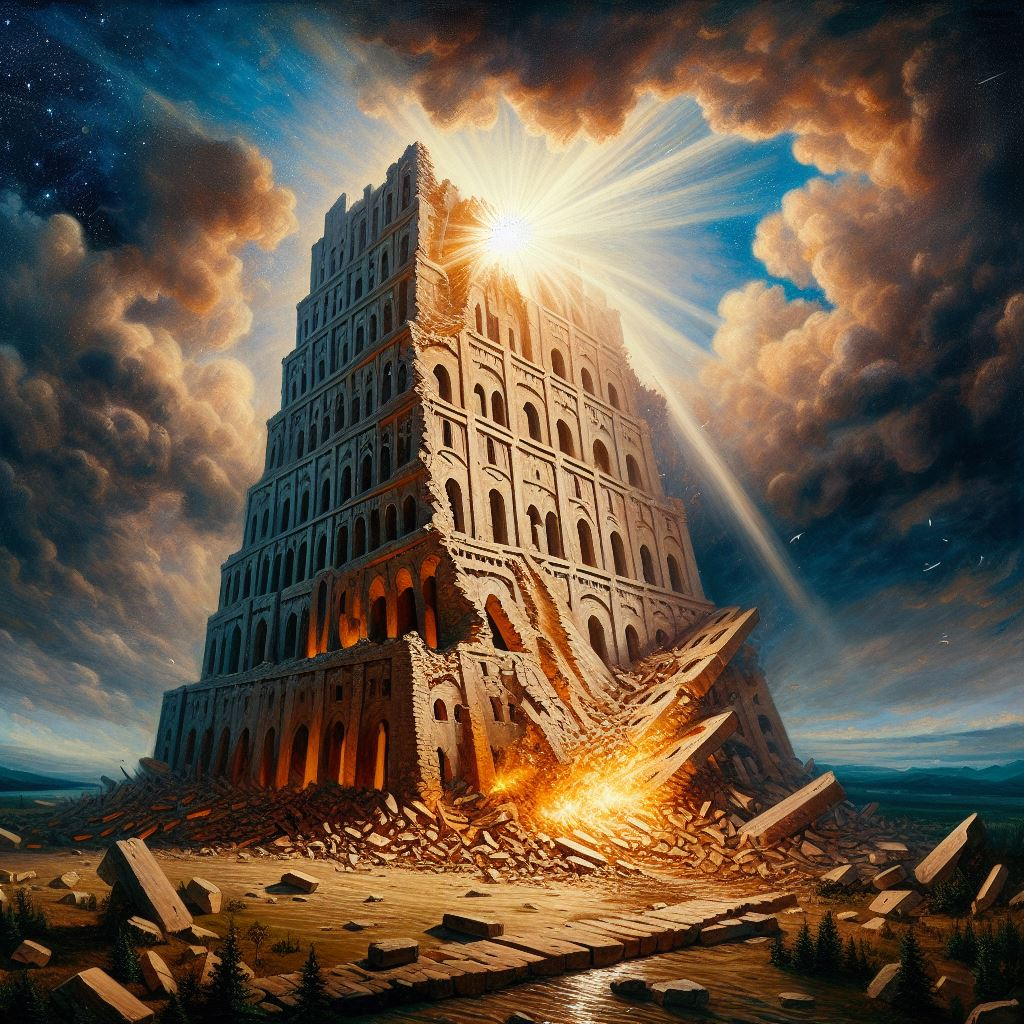
I am reminded of the story of the tower of Babel. In it, a nation of people decide to build a great tower, reaching all the way to heaven. Bold enough to make themselves gods, they toiled and labored on this great elevation of man until the whole thing toppled to the ground.

We do not know exactly how high they built their tower, only that it fell before they could achieve their aim. Their construction became destruction, their order became ruin, and the people were returned back to the level of the fallen earth.

This, of course, is a type for all manner of structures in the world today. And I don’t merely mean physical structures, either. Even more so it applies to structures of law, of government, of ideology, of any edifice constructed by the wisdom of man.

The Way of Things)

Every club, organization, corporation, and ideal is laid with ruin in its foundation. On the one hand, this might be because they are laid with carnal and earthly motivations, such as focus on profit or notoriety. Once making money is one of the organization’s pillars, then it is tied to the natural things of this earth, all of which decay, erode, and finally collapse. Through the years we have seen countless companies over-exploit their workers, consumers, and intellectual properties, killing the golden goose just to get a higher profit in the short term. We have seen countless governments siphon power and wealth to the highest class until they became too top-heavy and collapsed under their own weight. The compromises that were deemed necessary to make the enterprise possible eventually make its continued existence impossible.

But even without a foundation of earthly motivations, every structure of man is still doomed to fall due to our fundamentally flawed nature. Even our organizations that are built on ideal, and virtue, and purity of intention, gradually erode and eventually go wrong entirely. Even if a core principle is worthy, if it is taken slightly too far at the beginning, it will magnify and accelerate over time, eventually becoming a great evil. It is like stacking blocks to build a taller and taller tower, given enough time and distance every structure leans too far one way or the other. Given enough time and distance, every little flaw becomes a crushing error, and the whole thing will topple. So an organization founded with a focus on discipline will eventually become fascistic oppression, whereas a focus on liberty will eventually become gross hedonism. We sow the death even in the birth, it is simply our nature.

Even God’s church, once entrusted to earthly stewards, is tended toward ruin. The world was in a state of apostasy in the time of Noah, and in the time of Abraham, and in the time of Jesus. God has to refresh His word among His people repeatedly, not because His word has deteriorated, but because we people just keep losing our grasp of it. We know that even the believers today will once again be on the brink of ruin when God will have to refresh everything with the second coming.

What Lasts)

Ironically, what truly lasts is what seems most transient. Though man’s works are doomed to fail, along the way they house occasional sparks of something pure and genuine. There can be a nugget of God in the midst of all the stone. And though that nugget seems momentary and transient, it is only because we are perceiving it through a shifting lens. In actuality, each of those nuggets is anchored in something realer and truer than the structure it was found within.

There is an entity behind all those sparks, a constant certainty beneath every brief wonder. By fastening ourselves to these pearls, and following their threads to deeper things, we tie ourselves to the only thing that is actually eternal.

The man-made program I once loved may be gone, but the experiences I found within it have not. Those experiences introduced me to the One who hasn’t changed at all, and never will. In reality, I haven’t lost a thing.

Scriptural Analysis- Exodus 19:20-25

20 And the Lord came down upon mount Sinai, on the top of the mount: and the Lord called Moses up to the atop of the mount; and Moses went up.

21 And the Lord said unto Moses, Go down, charge the people, lest they break through unto the Lord to gaze, and many of them perish.

22 And let the priests also, which come near to the Lord, sanctify themselves, lest the Lord break forth upon them.

23 And Moses said unto the Lord, The people cannot come up to mount Sinai: for thou chargedst us, saying, Set bounds about the mount, and sanctify it.

24 And the Lord said unto him, Away, get thee down, and thou shalt come up, thou, and Aaron with thee: but let not the priests and the people break through to come up unto the Lord, lest he break forth upon them.

25 So Moses went down unto the people, and spake unto them.

This is a very unusual set of verses. Moses had already ascended into the mountain, but the Lord told him to go back down and tell the people not to come up or they would perish. Moses replied that he had already told the people not to come up, as God had already communicated that requirement in the first place. God insisted, though, “Away, get thee down,” and so Moses went down to repeat the instructions to the people.

What was the point of this back-and-forth? Was God not aware that Moses has already given those instructions to the Israelites? Was there going to be a breach of protocol in spite of the original instructions, and God knew it, but Moses wasn’t expecting it? Was God simply making a point through repetition? Why weren’t Moses and God already on the same page on this matter?

Quite frankly, we aren’t given a clear explanation. In the record that we have, God never makes clear why this repeated instruction was deemed necessary. One thing that might be worth considering, though, is that the next time Moses was called up into the mountain we are not told that he went back down to remind the Israelites of their commitments, and that is the time that they actively defy the Lord and construct the golden calf.

So perhaps the Lord sent Moses down to interrupt them before they could go astray this time, but after they had received His law and more fully committed themselves, He would not stop them if they kept tending towards future infractions. Having made their bed, He would allow them to lie in it.

Scriptural Analysis- Exodus 19:16-19

16 And it came to pass on the third day in the morning, that there were thunders and lightnings, and a thick cloud upon the mount, and the voice of the trumpet exceeding loud; so that all the people that was in the camp trembled.

17 And Moses brought forth the people out of the camp to meet with God; and they stood at the nether part of the mount.

18 And mount Sinai was altogether on a smoke, because the Lord descended upon it in fire: and the smoke thereof ascended as the smoke of a furnace, and the whole mount quaked greatly.

19 And when the voice of the trumpet sounded long, and waxed louder and louder, Moses spake, and God answered him by a voice.

All of Israel had been prepared, and now the miracle rolled down from heaven to the earth. Thunder, lightning, thick clouds, and the sounding of an unseen trumpet! Then, as the people gathered at the foot of the mountain, smoke, fire, quaking, an even louder trumpet. And finally, after all of that, the voice of God!

There is another passage of scripture that sounds very similar to this, which is when we are given the account of Elijah hearing the voice of the Lord in 1 Kings 19:11-12:

And a great and strong wind rent the mountains, and brake in pieces the rocks before the LORD; but the LORD was not in the wind: and after the wind an earthquake; but the LORD was not in the earthquake: And after the earthquake a fire; but the LORD was not in the fire: and after the fire a still small voice.

Wind, and earthquake, and fire, and finally a voice. However that later account is both similar and dissimilar to the one here in Exodus. While the 1 Kings account mentions a parade of dramatic forces of nature, it says God is not in any of them, while the elements presented here in Exodus seem to be directly heralding the Lord. Also, the account in 1 Kings describes a “still small voice,” whereas one would think the voice in Exodus was booming and loud, much like the trumpets that had sounded, so that all the camp would hear it.

I believe that both accounts give us half the picture of God. The fact that God lives in our hearts and is able to speak to us in a still, small voice does not mean He isn’t also the master of heaven and earth, appearing in great glory. There is both an outer manifestation and an inner manifestation of the Lord, but they are both one and the same God. Probably most of us are far more acquainted with the quiet, inner Lord who lives in our hearts, but we look forward to the day when we can meet (and survive!) an encounter with the outer Lord in all His majesty!

Scriptural Analysis- Exodus 19:14-15

14 And Moses went down from the mount unto the people, and sanctified the people; and they washed their clothes.

15 And he said unto the people, Be ready against the third day: come not at your wives.

Moses relates God’s instructions for the Israelites to prepare themselves to witness His presence and hear His voice. Specifically we are told that they are to wash their clothes, and to refrain from any sexual activity.

There has, of course, been a history of sexual shame in certain sects of Christianity. Not just immoral acts of sexuality outside of the marriage covenant, but even suggesting that every child is born in sin because of the act that brought them into existence. However, it is worth noting that this passage is not at all evidence that any such view is appropriate.

Let us consider the other imperative given to the Israelites: that they wash their clothes. Certainly we can all appreciate how nice and fresh it feels to be clean, and how we want to present our best to those we respect and admire, yet would we say that we are sinful if we come home dirty from a long day of manual labor? Certainly not. Could we not have the same nuanced view towards sexuality within the marriage covenant?

Also, the command for husbands and wives to keep their distance calls to mind the practice of fasting, whereby we forego food and/or drink for a period of time. No one thinks that we are sinful because we have to eat food, but we appreciate that a period of self-denial can help to cultivate the spirit within. Could it not be the same with sexuality within the marriage covenant?

Therefore it is logical to assume that the instruction given to the Israelites for temporary sexual abstinence between husbands and wives was one of preparing themselves spiritually, an act of self-denial that would focus their energy inwards. That is not at all the same as saying that any sexual activity, even in a committed marriage between a man and a woman, is sinful.

Scriptural Analysis- Exodus 19:12-13

12 And thou shalt set bounds unto the people round about, saying, Take heed to yourselves, that ye go not up into the mount, or touch the border of it: whosoever toucheth the mount shall be surely put to death:

13 There shall not an hand touch it, but he shall surely be stoned, or shot through; whether it be beast or man, it shall not live: when the trumpet soundeth long, they shall come up to the mount.

In addition to their steps of purification, the Israelites were instructed that they not come too close to the mountain when the glory of the Lord was upon it. They would be permitted to hear His voice, but that did not mean that they could abide touching His presence directly.

This is an interesting notion, one that is visited again later when Uzzah, the Israelite, reaches out to steady the ark and is immediately struck dead (2 Samuel 6:6-7). What is it about the Lord’s presence that people must not come too near, on pain of death?

I see in this a lesson that total godliness is too great for us to endure. It is too bright, it is too pure, it is too glorious, such that it condemns our perverse, fallen flesh. We are like particles of dust that immolate from the heat around the fire, even before we touch the flame. That buffer of disintegrating heat ensures that nothing impure ever touches that perfect light.

This is why each of us must be purified in our hearts before we meet the Father, why we must have our corruptible flesh replaced by an immortal body, why Moses had to be transfigured for his own up-close encounter with the Lord. We require a divine intermediary between us to interact with God, because His glory is literally too much for us to handle!