Scriptural Analysis- Exodus 17:1-4

1 And all the congregation of the children of Israel journeyed from the wilderness of Sin, after their journeys, according to the commandment of the Lord, and pitched in Rephidim: and there was no water for the people to drink.

2 Wherefore the people did chide with Moses, and said, Give us water that we may drink. And Moses said unto them, Why chide ye with me? wherefore do ye tempt the Lord?

3 And the people thirsted there for water; and the people murmured against Moses, and said, Wherefore is this that thou hast brought us up out of Egypt, to kill us and our children and our cattle with thirst?

4 And Moses cried unto the Lord, saying, What shall I do unto this people? they be almost ready to stone me.

Hardship in the wilderness had already been solved twice for the Israelites, but clearly it wasn’t in their past. They had thirsted and God had provided, but now they thirsted again. Enduring trials and being tested were going to be an ongoing part of their journey, though God would always intervene for them before it was too late.

Notice from verse 1 that they camped in Rephidim, a place where there was no water, “according to the commandment of the Lord.” God was commanding them to halt their progression in this place, commanding them to be stuck somewhere that could not sustain them, commanding them to be in an untenable situation. I believe that most of our hardships arise as a result of our own sins or simply as a natural result of living in a fallen world, but sometimes, such as this time, the hardship was part of God’s own design.

And how did the people respond to this test? Well, according to Moses, they were about ready to stone him! They once again proved to be a people who sang praises when God saved them, but breathed threats when He did not. Their one great desire was not to follow God, but to have their needs met. Not only their needs, either, but as in the case of the quail, their preferences and desires. God was to be praised only so far as He gave them what they wanted, but to be reviled when He did not. In short, they really hadn’t submitted themselves to God at all. The fact that they still failed this test is the reason why they needed to have it.

The Shackles We Choose

Something I have been noticing while doing my study of Exodus is that Israel hated their enslavement in Egypt…but they also preferred it to being free. Though initially euphoric when God destroyed their enemies in the Red Sea, they repeatedly afterwards claimed that things were better for them when they were in captivity than free in the wilderness.

It seemed a strange behavior, until I examined my own life and realized that the same is true for me. As much as I may not like feeling subject to my boss, I cannot fathom living without the security he provides me. I think of all the projects I wish devoted my spare time to, but I’m afraid to cut out the movies and video games that receive most of my spare hours instead. I see my cluttered house and want to set it in order, but focus instead on the mess of emails I’m subscribed to. I say that I’m ready to live a self-controlled and honorable life, then I obey the will of my temptations instead.

From my birth I was blessed with great opportunity and freedom, given to me by the goodness of God and the sacrifices of my ancestors. But I have taken that freedom and given it right back to other masters. There is no locked gate keeping me captive, most of the prisons I have checked myself into I could leave any time that I wanted, but I choose to bind myself to these places of my own volition. I remain a prisoner because I am not ready to be truly free.

My conscience urges me to forge out into the wild. My Savior freed my soul two millennia ago. My ancestors provided the security to let my ambitions soar. I pray I find the courage to live as free as I could, to have no Master but my God, the one who calls me into deeper waters.

Shutting God Out

Sometimes when I converse with God I hear the kindest, warmest, and most loving voice I have ever heard. At other times, He seems clinical and formal, still telling me good things, but without His usual warmth. As I have examined those different experiences I have come to realize that it is not God who changes His manner, but I who change what tone I am willing to receive.

When God feels direct and cold to me, it is because I am not open to receiving His love. Sometimes I am frustrated with myself, unwilling to love myself, and so I set up a wall to keep His love out also. He speaks to me as kindly as I allow Him.

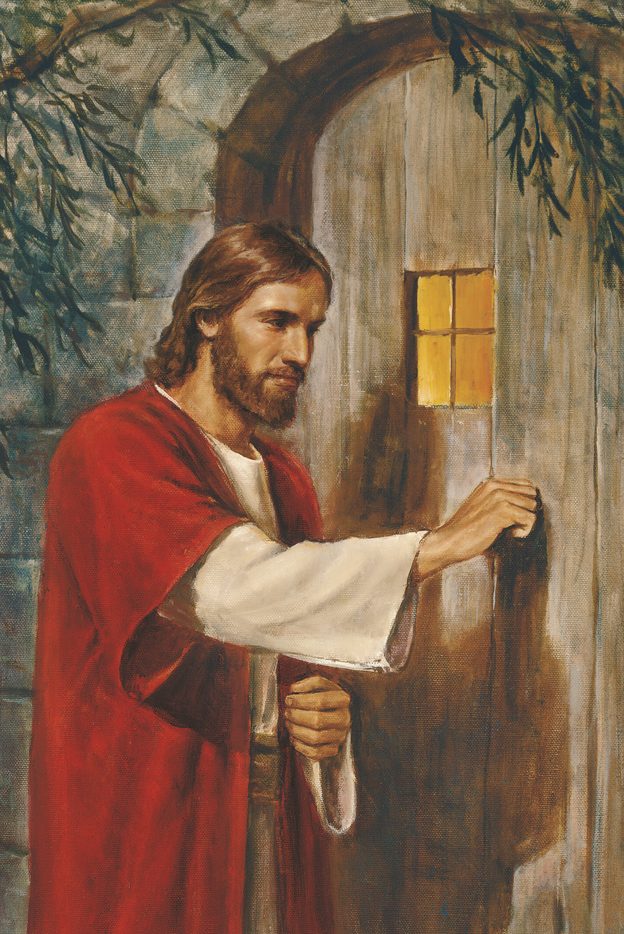
Sometimes He doesn’t just sound cold, though, sometimes I can’t even hear Him at all. But once again, it isn’t because He has abandoned me, but because I have gone and shut myself in a room without Him. Even then, though, “he stands at the door, and knocks: and if I will open the door, he will come in with me,” (Revelation 3:20).

And the fact that he will come in with me has been the most meaningful thing to me in those low moments. He doesn’t require me to break down my walls and come out into the open if I’m not yet willing to. He is content to come stay in the dark hovel with me. He will sit with me in the shadow, with only His presence for a light, until I’m finally ready to leave.

Scriptural Analysis- Exodus 16:35-36

35 And the children of Israel did eat manna forty years, until they came to a land inhabited; they did eat manna, until they came unto the borders of the land of Canaan.

36 Now an omer is the tenth part of an ephah.

Verse 35 pulls back from the linear narrative and provides commentary on the broader journey of Israel. We learn that the manna was not a temporary solution for the Israelites’ hunger, but that it would go on to sustain Israel through all their forty year sojourn in the wilderness.

Being in the wilderness represents a state of limbo for Israel. They had been evicted from Egypt’s womb, but they wouldn’t emerge fully reborn in the land of Canaan for decades. They were a people with a name, but without a home. This was therefore a time of great uncertainty and hardship, and the murmuring of the Israelites suggests that they saw this as an even lower low than their former captivity. How meaningful, then, that in this lowest of places God gave them a consistent, miraculous staple. The manna from heaven was a central pillar, supporting the people while they could not support themselves.

It is worth noting that after Israel leaves the wilderness we will never hear of the manna again. Today’s verse seems to confirm that the manna ceased just as soon as Israel came into fields where they could grow and harvest their own grain. God supported the people with just what they needed for as long as they needed it, then required them to let go of that crutch as soon as they were able to walk on their own.

Verse 36 is an interesting reminder that the books of Moses existed for many different audiences throughout history before us. It is assumed that it is a parenthetical statement meant to explain something to an ancient Israelite audience. The audience at that time presumably did not know what an “omer” was, as they had long since abandoned that unit of measurement, so the clerk explained that it was a tenth of an “ephah,” which was a more familiar unit of measurement at that time. It would be similar to me telling you that an “omer” was a little less than one US gallon.

Scriptural Analysis- Exodus 16:31-34

31 And the house of Israel called the name thereof Manna: and it was like coriander seed, white; and the taste of it was like wafers made with honey.

32 And Moses said, This is the thing which the Lord commandeth, Fill an omer of it to be kept for your generations; that they may see the bread wherewith I have fed you in the wilderness, when I brought you forth from the land of Egypt.

33 And Moses said unto Aaron, Take a pot, and put an omer full of manna therein, and lay it up before the Lord, to be kept for your generations.

34 As the Lord commanded Moses, so Aaron laid it up before the Testimony, to be kept.

Moses commands that a single portion of manna be gathered into a pot and preserved for future generations. It is interesting to note that the portion is an omer, exactly the amount that was meant for one person for one day. It almost seems as if it is being stored in anticipation of someone yet to come to receive it, much like how the Jewish people always leave one open seat for Elijah at their seder.

In time, the pot of manna would be placed within the ark of the covenant, but obviously that had not been constructed at this time. Sometimes God does not give His blessings in linear order. Sometimes we receive something that we do not fully understand, and only later receive the perfect place that it was meant to belong to. God giving His blessings in this way shows that it is all according to a plan, based on a perfect knowledge of what will be.

Verse 34 introduces us to a word that we have not yet encountered in the Bible. “Testimony,” as translated from “eduth” in the Hebrew, only appears 25 times in the Bible, all of them in the books of Moses, and almost all of them (21 of the 25 instances) in Exodus. In all 25 instances it is used exclusively as a reference to the laws and rituals that Moses delivered to the people. There are refences to the “tablets of the testimony,” the “ark of the testimony,” and the “tabernacle of the testimony.” These are the physical evidence of God’s blessings and commandments, a visual reminder of the Lord’s unseen spirit.

But “eduth” is not the only word that is translated to “testimony” in our English Bibles. There is also the Hebrew word “ed,” sometimes translated as “testimony” and sometimes as “witness.” Interestingly, these two Hebrew words are actually the same word, “ed” being the masculine form and “eduth” the feminine. This does raise the question why it is the feminine word for “testimony” that is used exclusively for the physical representations of God’s law. As mentioned before, the tablets, ark, and tabernacle of “testimony” were the material manifestation of the unseen God, which mirrors how a woman grows the unseen progeny into a material person in her womb. Another reason might be that these feminine testimonies all had to do with the law that was meant to nurture the newly-reborn Israelite people, cultivating them through their spiritual infancy, just as a mother nurtures and cultivates her child.

In any case, throughout the rest of Exodus we will see twenty more instances of the feminine “testimony,” always in reference to the physical tokens of God’s providence to His people.

Scriptural Analysis- Exodus 16:27-30

27 And it came to pass, that there went out some of the people on the seventh day for to gather, and they found none.

28 And the Lord said unto Moses, How long refuse ye to keep my commandments and my laws?

29 See, for that the Lord hath given you the sabbath, therefore he giveth you on the sixth day the bread of two days; abide ye every man in his place, let no man go out of his place on the seventh day.

30 So the people rested on the seventh day.

When God commanded the Israelites to only gather one omer per person each day, some of the Israelites had disobeyed and gathered extra. Then He had given them a specific exception: they could gather two omers on the morning before the sabbath, and some Israelites disobeyed yet again, trying to gather one portion on both days.

Some people sinned by relying on God too little and overexerting themselves against His will, and some sinned by relying on God too much and trying to do the minimal effort each day. Both approaches were wrong.

We are meant to have a nuanced relationship with God, relying on Him where He is meant to be relied on, and not where He is not. We are supposed to seek His will and do it, but also follow our own judgment where He has not expressed His will. Sometimes one of His laws supersedes or places a boundary on another of His laws, and we are meant to recognize when we cross that threshold and adjust our behavior accordingly.

The life of the disciple is meant to be active and observant. We are expected to actually pay attention and adapt to God’s movements, not just sit in the same place, applying the same rules to situations that are not applicable. We must also be careful not to carve out our own exceptions, pretending all the while that it is really God’s exception. We may fool others with such a claim, and maybe even our own selves, but there is one who will not be fooled, and He will require an answer of us sooner or later.

Scriptural Analysis- Exodus 16:22-26

22 And it came to pass, that on the sixth day they gathered twice as much bread, two omers for one man: and all the rulers of the congregation came and told Moses.

23 And he said unto them, This is that which the Lord hath said, To morrow is the rest of the holy sabbath unto the Lord: bake that which ye will bake to day, and seethe that ye will seethe; and that which remaineth over lay up for you to be kept until the morning.

24 And they laid it up till the morning, as Moses bade: and it did not stink, neither was there any worm therein.

25 And Moses said, Eat that to day; for to day is a sabbath unto the Lord: to day ye shall not find it in the field.

26 Six days ye shall gather it; but on the seventh day, which is the sabbath, in it there shall be none.

God had given two points of instruction thus far:

1. Every household was to gather one omer per person, which would be just the right amount for the day.

2. No one was to keep leftovers for the next day.

Certain Israelites had already tried defying the second rule, gathering extra rather than trusting the Lord to provide again in the morning, and all the extra had spoiled. It just wasn’t going to work for the people not to follow God’s directions in this matter, they needed to not make exceptions to His rules.

But then, as an interesting twist, God, Himself, presented a third rule that carved out an exception to his first two:

3. On the day before the sabbath they were permitted to gather two omers per person, one for the day before the sabbath and one for the sabbath.

The purpose of this rule being, of course, to keep the Israelites from having to labor on the sabbath. Thus, God was providing a valid way to do the exact thing that had been invalid when done by the disobedient Israelites just prior.

The lesson here is clear. When God gives us His commandments, He can also provide special limitations or exceptions to them, but we cannot. Some things are wrong inherently, and some things are wrong because they have been forbidden for that time. In either case, one is only right when applying the commandment of God that is relevant to that situation, and wrong when doing anything other than God’s commandment for that situation.

Some people may balk at the idea of God creating set times when a behavior is right and set times when it is wrong, but any collection of laws has this sort of nuance. For example, one may drive down the road at the posted speed limit, except at a red light they must stop until it turns green, except when that red light is flashing and they should treat it like a stop sign, except when there is a police officer directing traffic at that intersection. Are the rules ambiguous or arbitrary because they change what behavior is correct based on the circumstance? No. In each instance there is one right behavior, and there is a good reason for it. So it is with God’s laws.

Scriptural Analysis- Exodus 16:19-21

19 And Moses said, Let no man leave of it till the morning.

20 Notwithstanding they hearkened not unto Moses; but some of them left of it until the morning, and it bred worms, and stank: and Moses was wroth with them.

21 And they gathered it every morning, every man according to his eating: and when the sun waxed hot, it melted.

God gave a second piece of instruction, that the people were not to gather excess and store it for the next day. Every day a person would receive exactly what they needed, and no more, and the next day they would trust God to provide for them again. But some of the people did not listen. They did gather extra, they retained it through the night, and the next morning it was filled with worms and rotten.

Once again, the symbolism is clear. God had arranged this situation to teach a lesson that the people were to live by His grace alone. Going to bed every night and rising every morning would be an act of faith, trusting that there would be manna waiting for them each time. If there wasn’t…things would be very bad for them, but they would learn that they could count on God providing what they needed each day.

This, of course, goes directly against the instinct to provide for oneself. Rather than trust on the Lord tomorrow, some of the Israelites would rather have relied on their efforts the day before. They saw an opportunity to go beyond their mandate and build their own security. We also do this when we are distracted from God by our own strategies for happiness and security. The result for us, as it was for the Israelites, was rot and waste. All of our Godless goods became food for the worm. As a general rule for life, stale excess sooner or later summons the devourers.

Jesus spoke on this very matter in Luke 12. He warned against those who took too much thought for their gain when he recounted the parable of a rich man whose fields produced an excessive abundance, and who spent his time planning out the grand, new barns he would build to hold the surplus. Said the man, “And I will say to my soul, Soul, thou hast much goods laid up for many years; take thine ease, eat, drink, and be merry. But God said unto him, Thou fool, this night thy soul shall be required of thee: then whose shall those things be, which thou hast provided?” (Luke 12:19-20).

It is better to live moment-to-moment by God’s grace than to pave a road of our own design. For God’s grace cannot be thwarted, but all our designs will be.

Scriptural Analysis- Exodus 16:16-18

16 This is the thing which the Lord hath commanded, Gather of it every man according to his eating, an omer for every man, according to the number of your persons; take ye every man for them which are in his tents.

17 And the children of Israel did so, and gathered, some more, some less.

18 And when they did mete it with an omer, he that gathered much had nothing over, and he that gathered little had no lack; they gathered every man according to his eating.

Now the Lord gave very specific directions that every man was to gather a certain amount of food, related to the size of his household. If a man had ten people in his household, he would gather ten omers’ worth of manna, if he had two people he would gather two omers’ worth. An omer was an Old Testament measurement of volume, understood to be roughly equivalent to two quarts.

And, miraculously, this measurement turned out to be perfect for all people. There was neither excess nor want, so long as one adhered to the measurement given by God. This seems a miraculous thing, that men, women, and children of all different sizes and weights would be sustained by the same equal measure. Of course, the existence of the manna in the first place was an even greater miracle, so maybe that isn’t so surprising.

Once again, there is clear symbolism in this. God knows our needs perfectly, and He prescribes to us exactly what is right. He not only gives us the sustenance that our souls need, He gives just the right amount with no lack and no waste. I have personally seen little miracles in my life, always providing just the right help at just the right time. An unexpected one-time financial boost, a perfectly directed prompting to my spiritual leader, a window of time to get to know a dear friend before he passed away, I see all of these as miracles from heaven, each perfectly portioned to my need.

Scriptural Analysis- Exodus 16:13-15

13 And it came to pass, that at even the quails came up, and covered the camp: and in the morning the dew lay round about the host.

14 And when the dew that lay was gone up, behold, upon the face of the wilderness there lay a small round thing, as small as the hoar frost on the ground.

15 And when the children of Israel saw it, they said one to another, It is manna: for they wist not what it was. And Moses said unto them, This is the bread which the Lord hath given you to eat.

Quails came for the meat in the evening, and manna appeared in the morning for bread. However, the Israelites did not even recognize that the manna was the promised bread from God at first. Moses had to explain to them that that was what the small, round thing was for, that it could be processed as a food.

I see in this a symbolism for the manner in which God answers prayers. Sometimes He delivers exactly what we have asked for, but we do not recognize it as such. What we have received seems strange until someone points out to us that our problem has already been solved, we just haven’t recognized it yet.

In any case, now Israel understood how the Lord would provide for them, and Moses would go into greater detail about the rules they had to follow in relation to this food source.