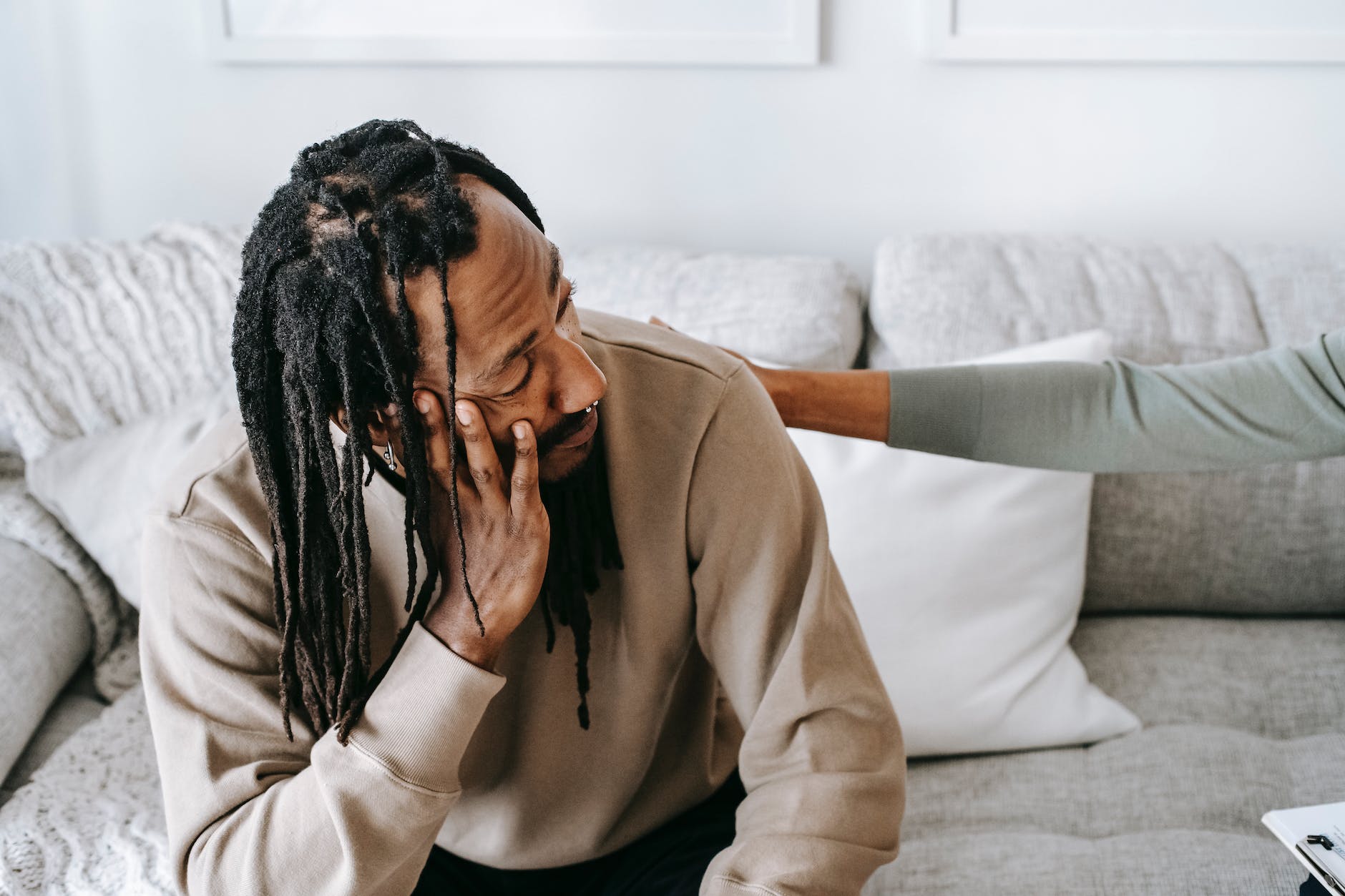
Addiction and the Angry Spouse: Part Two

What More Can I Say?)

Sometimes “sorry” isn’t enough. I discovered this fact when I started to face the wrongs that I had done in my addiction. I found that I could acknowledge how I had messed up, I could genuinely say that I was sorry, and I could offer to make amends however possible…but that still was not enough to fix things.

Don’t get me wrong, being able to do these things showed that I had made great progress in my journey. They were good things to be able to do, and I was proud to have finally made it that far, but my work was not yet done.

This fact particularly manifested itself in my interactions with my wife. Both of us had acknowledged how far I had come, but it was clear to us that there something was still missing. My wife was still hurting, and no amount of me being a new and improved version of myself changed that fact.

Admittedly at this point I felt helpless. What more could I say? I wished that she could just stop feeling the hurt, but that wasn’t a switch that she could flip on and off. And even if she could have done that, there was still this sense that I hadn’t really done all my part yet. There was still something I was holding back.

Leaning In)

The conversations that highlighted my reluctance were the ones where she tried to get me to understand just how much I had hurt her. From these discussions I came to understand that her entire world had been fractured, that she had trusted me unquestioning for years, only to find out that I had been lying the whole time. I came to understand that these experiences had shaken her entire paradigm. If she had been so convinced of what was true about me, and had been so wrong, then how much else in her life was a lie? Nothing could be trusted anymore. She was alone without anything or anyone.

And I had absolutely no idea what to say to all of that. How was I supposed to respond? She was right, of course, but what could I do about it? I was sorry, if I could take all it back I would, but I couldn’t. What was done was done, and now I was doing all in my power to be a different person moving forward. What else was there?

Honestly, I don’t know that I would have ever found out the answer to that question without the help of my recovery group counselor. It was he who helped us to understand the essential quality of empathy in healing. He made it clear that it wasn’t enough for me to merely understand what my wife was being put through, I had to start empathizing with it. I had to find a way to step into that pain, to get a sense of what it was really like for her. I had made great strides towards understanding her on a mental level, but now it had to get emotional.

And that was a lot easier said than done. At first it seemed impossible to feel the feelings of another person to that degree. I was hearing her say that she was sad and angry, and I was trying to make myself feel sad and angry, too, but that never came out as sincere. Eventually I realized that I needed to move a little further upstream. I needed to not replicate the emotions she was describing, but replicate the experience that had caused the emotions in the first place. I had to envision someone putting on me the same sorts of things I had put on my wife, and then the negative emotions would come naturally. I genuinely and authentically started to have a real taste of what she was going through. I still cannot claim that I fully went through the experience, but I started to feel at least some of it.

Building Empathy)

Being able to lean into this sort of empathy was definitely a process. I got better at it over time, though there had always been some resistance to doing it. Part of me really didn’t want to imagine what it was like to be on the receiving end of the stunts I had pulled, because that put me in a place of shame. I had to be brave and really let down my guard and let the empathy take me. When I finally was able to do that there were many tears and many epiphanies. Best of all, my wife expressed that she was really starting to feel heard and understood. And that, it turned out, had been the missing piece.

Now, I’ve given the highly abbreviated version of this process. There were a lot of missteps along the way, both for me and my wife, but I wanted to fast-track to where we finally got it right so that you could know the target to aim for. In the rest of this series, I’m going to take a step back to call out some of the common mistakes that get made along the way. Come back tomorrow as we start digging into those.

NOTE: Throughout this series I refer to the addict as “he” and the injured partner as his “wife.” This is merely a convenience for maintaining consistency. It is entirely possible for the addict to be a woman and the injured partner to be her husband. It is also entirely possible for the strained relationship to be between non-romantic partners, such as with a parent and a child.

Addiction and the Angry Spouse: Part One

A Precarious Situation)

I attended an addiction recovery clinic when I decided I really wanted to be done with lust and pornography. One of the things that was so helpful about that clinic was that they did two treatments at the same time, one for the addict, and one for the spouse or partner of the addict. Given the demographics of pornography addiction, the addicts were predominantly men, and thus the partners were their girlfriends and wives.

The partners, of course, were deeply hurt by our addiction, and this is true for most other types of addiction as well. Being so closely involved to a person with any sort of compulsive, destructive behavior will always result in extensive wounding. Thus, every addict is going to have to deal with this most intimate relationship at some point of his or her recovery journey. They are going to have to take ownership of their mistakes, empathize with their spouse’s pain, make amends however they can, and accept the consequences that follow their behaviors.

The spouse also has her own issues to come to terms with. Given the secretive nature of an addiction, most likely she is only learning about this whole secret life that was going on behind her back for the first time. She has to process the betrayal, the lies, the manipulation, and has to decide between rebuilding the relationship or moving on. What’s more, the spouse has to negotiate all these matters while being flooded by intense, negative emotions. Very often this makes for periods of deep depression and angry outbursts, both of which are difficult for the recovering addict to know how to deal with.

A Strange Disconnect)

If the addict is sincere in his recovery, then these first months of sobriety probably give him a confusing, dual perspective of himself. On the one hand, this is the most honest he has ever been in his life. This is the first time ever that he can sincerely say that he is giving it his all. He is heroically facing his inner demons and doing something he is genuinely proud of. His recovery group members are recognizing his sincerity and acknowledging his bravery. They are encouraging him by pointing out that he is one of the very few in life who has found the “straight and narrow path” and committed to following it.

But then, on the other hand, the addict feels that he is an absolute dirtbag. For the first time he is really acknowledging the harm he has caused. He has shameful memories that he has avoided his whole life, but now he must face them head-on. He has natural responses of self-disgust and revulsion. The voices inside tell him that he has done too much wrong, he is irredeemable, and that he doesn’t deserve to be loved. And in many cases, that very message is being echoed by the person that used to love him best.

It is only natural that the wife whose whole conception of life has been shattered would have anger bursting out at every turn. Many addicts discover a side of their spouse that they never knew before, full of shouting, insulting, and profanity. Some spouses start throwing objects and breaking things. Some start looking for ways to hurt their husband back, physically or otherwise. The addict is trying to manage his emotions and choose sobriety over quick relief, all while enduring a constant and passionate reminder of what terrible damage he has done.

In fact, since the addict knows that he really is guilty of this terrible damage, he might feel that he has no right to question his spouse’s behavior. He has given his spouse the ultimate trump card in any argument. Any frustration or disagreement that he might express towards his spouse is immediately overcome with “well at least I didn’t do what you did!”

It is easy for a couple in this situation to subconsciously assume a new rule in life. Anything that goes wrong for the wife, no matter how unrelated it is to his past wrongs, is still the fault of the addict. Even if his acting out didn’t directly cause the new trouble, the new trouble is more painful because it has landed on a heart that was already beaten and tender. The addiction didn’t make the spouse’s uncle die, for example, but it has deprived her of the trusted shoulder to cry on now when she needs it.

Moving Forward)

So, which is it to be? Must the addict accept that he is a terrible monster and always will be? That no matter of future sobriety can make up for the wrongs already committed? That he will be an addict, and he must daily self-flagellate because of that? Or is the wife supposed to just shut up about her pain? Does her anguish just not matter because the addict is suddenly a “new man?” Does the past not even matter?

Which of these two extremes is the right way forward? Well, of course, neither.

If the right way were so simplistic it would hardly require a blog series to unpack it. The real way forward is far more nuanced and intricate, and it absolutely requires full respect to be afforded to both sides of the matter. Throughout the next several days we will examine this issue from multiple angles, hopefully coming to a conclusion that resonates with all.

NOTE: Throughout this series I refer to the addict as “he” and the injured partner as his “wife.” This is merely a convenience for maintaining consistency. It is entirely possible for the addict to be a woman and the injured partner to be her husband. It is also entirely possible for the strained relationship to be between non-romantic partners, such as with a parent and a child.

Scriptural Analysis- Genesis 24:1-4

1 And Abraham was old, and well stricken in age: and the Lord had blessed Abraham in all things.

2 And Abraham said unto his eldest servant of his house, that ruled over all that he had, Put, I pray thee, thy hand under my thigh:

3 And I will make thee swear by the Lord, the God of heaven, and the God of the earth, that thou shalt not take a wife unto my son of the daughters of the Canaanites, among whom I dwell:

4 But thou shalt go unto my country, and to my kindred, and take a wife unto my son Isaac.

I mentioned in the previous chapter that the purchase of Sarah’s tomb would be the last duty that Abraham personally fulfilled. Here we see him concerned about whom his son will marry, but he is too old to handle the matter on his own. So he calls his eldest servant and solemnly charges him to find a worthy wife in Abraham’s place.

The land that Abraham instructed his servant to search was the one where his brother Nahor had lived. Nahor had not come to Canaan with Terah, Abraham, and Lot. He had parted ways with them many decades ago. But Abraham had received word that Nahor’s household had grown, with eight new sons and grandchildren. Grandchildren who had never met Abraham or seen the land of Canaan. Was there a daughter among them who would be willing to throw in with a people and a place that were entirely unknown to her?

Influence and Persuasion- Personal Example #1

Previously I spoke of the contention that arises when two egos strive together, versus the unity that arises when two hearts do. And I actually experienced a recent example of both sides of this.

The most difficult disagreements to navigate are the ones where each side feels a moral conviction. It is very easy to entangle pride and ego with your personal sense of right and wrong, and to feel insistent that your way is objectively correct.

The example I saw of this recently was when my wife and I were discussing the question of tithing. We’ve always subscribed to that practice, but there is definitely some room for interpretation within that law. Does that ten percent come before or after taxes? Does it come before or after benefits? If you realized you forgot to tithe a previous sum do you go back and cover that, or do you just let it go?

And generally I would say “do what your conscience tells you, and don’t worry if it is slightly different from someone else. So long as you are sincere in trying to follow the law, God will approve.”

And if my wife and I had separate incomes, I could tithe mine in the way that made sense to me, and she could tithe hers how it made sense to her. But we share an income, and when we received a sum that fell into that tithing-gray-area we each felt “right” about a different course of action to take.

And for the first while, each of us tried to convince the other of why we were right, and each of us felt a little ruffled about that. It did not become a very hostile situation, but there was definitely some friction in the moment. It was easy for each of us to feel unheard and judged.

Ego against ego. There was never going to be a mutual outcome from this.

Eventually we took a different approach, though. Instead of trying to “solve the problem,” we backed away and spoke about our stung feelings. We admitted to pride and frustration, to feeling unimportant and unprioritized.

We bypassed ego, and started taking heart-to-heart and spirit-to-spirit.

And then we didn’t feel like we were on two sides anymore, we felt like we were on one side together. It wasn’t important to me that we use my solution anymore, and it wasn’t important to her that we use hers. Neither of us had to be the one that won. Now, at last, we could kneel down together and ask God what to do about the matter.

And each of us came out of that prayer with a shared feeling, a warm assurance about the right thing to do.

And it wasn’t what either of us had been recommending. It wasn’t “my way” or “her way.” Nor would I say it was a compromise between our two extremes. It really felt like a third choice. A shared choice. Shared between me and she and He.