Scriptural Analysis- Exodus 26:36-37

36 And thou shalt make an hanging for the door of the tent, of blue, and purple, and scarlet, and fine twined linen, wrought with needlework.

37 And thou shalt make for the hanging five pillars of shittim wood, and overlay them with gold, and their hooks shall be of gold: and thou shalt cast five sockets of brass for them.

Yesterday we heard of the inner curtain, dividing the interior of the tabernacle into two rooms, now we hear about the outer curtain, which would divide the entire tabernacle from its surrounding courtyard. This door would follow the pattern of the inner curtain and the ceiling, made of fine-twined linen dyed blue, and purple, and scarlet. Thus, all the interior would be uniform.

This curtain would be hung from five pillars, as opposed to the four for the interior curtain. The odd number of pillars suggest that they were spaced evenly across the entrance, and not grouped together on either side with a single wide entryway in the middle. To me that suggests that the interior curtain was similarly broken up by each pillar. This would mean there would be four divisions to pass through the outer curtain, and three divisions to pass through the inner. Alternatively, some depictions assume the external curtain had two pillars grouped on each side, with one support pillar in the middle, creating two divisions, and no support pillar for the interior curtain, creating just one division there.

Another similarity between the exterior and interior curtains is that their pillars would be made of shittim wood overlaid with gold, with golden hooks to hold the curtains. The interior curtains, however, were said to have silver sockets at their base, just like the boards that made up the walls, whereas these external pillars are said to have sockets of brass. It’s a small change, but the use of less-valuable brass suggests that these pillars were to be seen as part of the outer courtyard, rather than part of the tabernacle. We will hear how brass was the chief metal used for the instruments and structures of the courtyard, which seems to correlate to that the place being less sanctified than the tabernacle.

Note: It can be difficult to visualize some of the structures described in these verses. Here is an excellent and extremely focused series of animations that show the visual form of the temple and its instruments, built up verse-by-verse from the Exodus record: https://youtube.com/playlist?list=PLpjohncRg94EZ55nJrbaKfi-lfeo3MFgl&si=6wm1J9Sdnu7LKYC_
Tended Towards Ruin

A Heavy Loss)

There was a project that I once loved very much. It was a program oriented towards connecting men with God, helping them to bring their hearts back into His light. It was small and local, humble and unpolished, but it did truly miraculous things in the lives of those who attended it. Lately, though, I’ve found myself struggling to recognize that same institution from what it has become today. At some point, after about ten years of operation, the institution became a for-profit organization, and changes started being made for the betterment of the bottom line, not for the betterment of the men it served. Several of the original founders quit, due to personal disagreement with this new direction.

This has been a heavy thing for me to come to grips with, but as I have reflected on it I’ve realized that it was always going to go something like this. The special spirit of the old program had to meet its end one way or another, because that’s just the nature of things.

Tale as Old as Time)

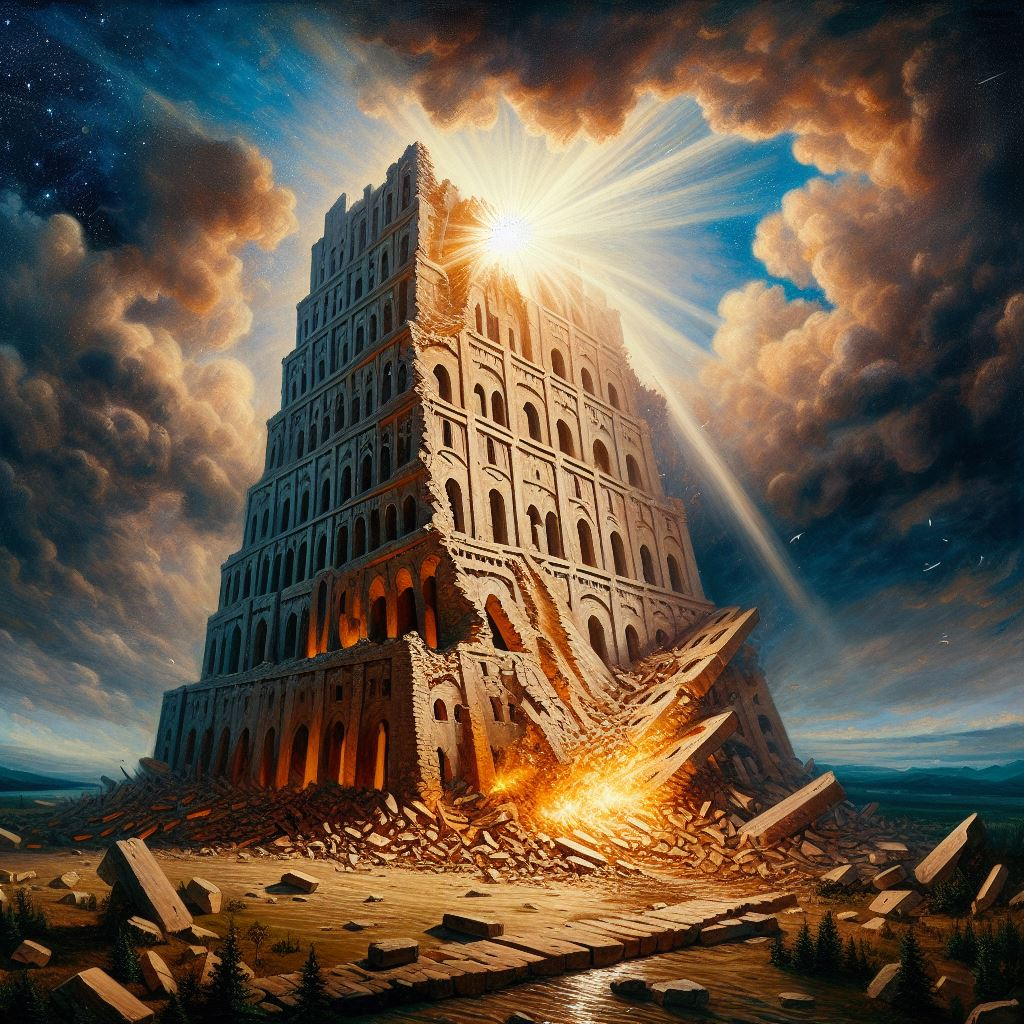
I am reminded of the story of the tower of Babel. In it, a nation of people decide to build a great tower, reaching all the way to heaven. Bold enough to make themselves gods, they toiled and labored on this great elevation of man until the whole thing toppled to the ground.

We do not know exactly how high they built their tower, only that it fell before they could achieve their aim. Their construction became destruction, their order became ruin, and the people were returned back to the level of the fallen earth.

This, of course, is a type for all manner of structures in the world today. And I don’t merely mean physical structures, either. Even more so it applies to structures of law, of government, of ideology, of any edifice constructed by the wisdom of man.

The Way of Things)

Every club, organization, corporation, and ideal is laid with ruin in its foundation. On the one hand, this might be because they are laid with carnal and earthly motivations, such as focus on profit or notoriety. Once making money is one of the organization’s pillars, then it is tied to the natural things of this earth, all of which decay, erode, and finally collapse. Through the years we have seen countless companies over-exploit their workers, consumers, and intellectual properties, killing the golden goose just to get a higher profit in the short term. We have seen countless governments siphon power and wealth to the highest class until they became too top-heavy and collapsed under their own weight. The compromises that were deemed necessary to make the enterprise possible eventually make its continued existence impossible.

But even without a foundation of earthly motivations, every structure of man is still doomed to fall due to our fundamentally flawed nature. Even our organizations that are built on ideal, and virtue, and purity of intention, gradually erode and eventually go wrong entirely. Even if a core principle is worthy, if it is taken slightly too far at the beginning, it will magnify and accelerate over time, eventually becoming a great evil. It is like stacking blocks to build a taller and taller tower, given enough time and distance every structure leans too far one way or the other. Given enough time and distance, every little flaw becomes a crushing error, and the whole thing will topple. So an organization founded with a focus on discipline will eventually become fascistic oppression, whereas a focus on liberty will eventually become gross hedonism. We sow the death even in the birth, it is simply our nature.

Even God’s church, once entrusted to earthly stewards, is tended toward ruin. The world was in a state of apostasy in the time of Noah, and in the time of Abraham, and in the time of Jesus. God has to refresh His word among His people repeatedly, not because His word has deteriorated, but because we people just keep losing our grasp of it. We know that even the believers today will once again be on the brink of ruin when God will have to refresh everything with the second coming.

What Lasts)

Ironically, what truly lasts is what seems most transient. Though man’s works are doomed to fail, along the way they house occasional sparks of something pure and genuine. There can be a nugget of God in the midst of all the stone. And though that nugget seems momentary and transient, it is only because we are perceiving it through a shifting lens. In actuality, each of those nuggets is anchored in something realer and truer than the structure it was found within.

There is an entity behind all those sparks, a constant certainty beneath every brief wonder. By fastening ourselves to these pearls, and following their threads to deeper things, we tie ourselves to the only thing that is actually eternal.

The man-made program I once loved may be gone, but the experiences I found within it have not. Those experiences introduced me to the One who hasn’t changed at all, and never will. In reality, I haven’t lost a thing.

The Need for Law- Question

At the end of my last study it came up how the Atonement of Jesus Christ was performed to fulfill the laws of our fallen world, while also enabling a new law, one of grace and salvation. The scriptures say a very great deal about law, and speak to a sense of system and procedure in divinity.

But at the same time, structured religion is becoming less and less popular today. People seek ways to be “spiritual not religious,” and refute the idea of a God who has terms and conditions. I do understand the reason for this, it is a very difficult thing (perhaps impossible) to not project all the limitations and flaws of our mortal laws and governments on the divine. Because we see how our attempts at structure are so flawed, we struggle to imagine what a perfect structure could be like.

But that does not mean that the perfect structure does not exist. Rather than trying to excuse ourselves from God’s law (because we cannot conceive of it properly) we should broaden our perspectives to better glimpse it. And the more we do glimpse it properly, the less hesitation we will have in being subject to it.

With this study I would like to consider what different laws are described in the scriptures and what their purposes are. I would like to consider why we need law, and why God uses this form for leading His children. Finally I would like to examine how the implementation of divine law does not preclude a divine Father being able to have a personal (and personalized) connection with each child.

I would be curious to hear how you have been able to resolve the rigidity of divine law with the warmth of paternal love. What differences are most significant to you between the Old Testament law and that of the New Testament? What reasons do you believe are behind those differences? What do you think perfect law looks like when perfectly understood?