For a society to function properly, its people must cooperate with one another. They must share a ruleset. They must have mutually beneficial expectations, and those expectations must be honored. All of this is necessary, because the world is too large and too complex for each of us to handle all aspects of it on our own. The advantage of a well-functioning society is that certain people can dedicate themselves to understanding one particular system and then disseminate to everyone else the essential information without them having to repeat the work. Shared rules also allow us to take complex interactions and reduce them to simple predetermined actions.
From what movies we watch, to how we navigate the road, to how we prioritize world affairs, “trusting the experts” and following predefined rules is the optimal strategy. I do not have enough time to watch every film, so I read reviews to only watch the best ones. I trust the rules of the road, so I can navigate complex group operations, like two lanes merging into one. I listen to news reports so that I know which issues I want to help my society overcome. I have not personally verified all of this information, but I trust in those that have, and assume my life will be optimal as result.
Trust Exploited)
But implicit trust is the most valuable commodity in the entire world, and the exploitation of it can be very lucrative.
What if a movie studio realizes that it can buy falsely positive reviews? The trust of the people will lead to increased ticket sales.
What if a driver realizes that he can hurriedly follow the car in front of him during a zipper merge to advance a space in traffic? He gets to his destination faster.
What if a news agency realize that they can sensationalize the news and fabricate outrage? Their ratings and ad revenue increase.
In each case, trust is turned into advantage, and one party is progressed beyond what could be achieved by honest means. Perhaps the short-term gain is justified by the assurance that one infraction is not going to break the whole system. The general populace will still benefit by trusting the institutions, and this one dishonest gain will amount to little more than a rounding error in the ledgers of society.
But when trust is exploited by one party, others will realize what has happened, and some will want to tip the scales in their favor also. Experience has proven that when the bond of trust has been broken once, and successfully profited from, a mass of other bad actors will soon follow.
Trust Broken)
And what happens when trust is broken repeatedly? It dies.
I watch a string of bad movies that came highly recommended, and I stop going to the movies altogether.
I get cut off in traffic repeatedly, and I start competing with every other driver on the road.
I realize the causes I supported made me a pawn in some party’s power grab, and I stop listening to the news media entirely.
I do not “trust the experts” anymore. I do not engage in the systems and rules as designed. And I am not the only one becoming cynical. Once enough of us are bitter and disillusioned, the movie industry collapses, violence becomes rampant on the roads, and conspiracy theories abound. The society stops being a society, and becomes instead a mass of angry individuals, all distrusting of one another. Divisions and public violence increase, and eventually the entire nation faces its demise. Perhaps strangest of all, there might even still be a majority of people who want to be honest and want to engage with the systems as intended, but the risk of trust outweighs its benefits, and so separating, not uniting, becomes the new norm.
When one is raised in a cohesive society, it is easy to take its trust systems for granted, but in truth, they must be guarded most carefully. For when they are broken, everything is lost. I do not know how far things can go and still be repaired, but at some point, the death of the nation must become inevitable.
I have explained the necessity of adhering to physical truths in the field of aviation. In order to overcome the forces of gravity and air resistance, great minds had to search out the realities of the physical world and build machines that would act in accordance with them. Today I’d like to consider another example of this in the world of logic. This time we won’t just consider the usefulness of truth, though, but also the chaos of untruth.
There is a concept in mathematics called propositional and predicate logic. In this system, propositions are statements of truth, such as George is Abe’s father, Steven is George’s father, and Marcus is not Abe’s brother. These are simple facts that contain a single piece of valid information. Then there are predicates, which are rules for how these propositions can be combined to reveal entirely new truths. For example, we might have a predicate that if A is the father of B, and B is the father of C, then A is the grandfather of C. Given our initial propositions, we can derive that George is Abe’s Grandfather, a fact that wasn’t in the original set of information.
This might not seem that useful, but once we expand our set of propositions and predicates to thousands of items there are literally millions of implied facts that a computer can derive from, something that our brains simply don’t have the capacity to process. Our modern-day databases are built upon this system of logic, allowing a large dataset to have its parts combined in a multitude of ways, revealing hidden patterns and trends, secrets and truths that were hiding in plain sight.
Let’s build expand on our example of a family tree to see this process more clearly. Suppose we have the following propositions and predicates (feel free to skim over these):
Propositions:
#1 George is Abe's Father
#2 Susan is George's wife
#3 Penny is Susan's daughter
#4 Penny is Abe's sibling
#5 Helen is George's sister
#6 Gabe is Marcus's father
#7 Steven is Marcus's maternal grandfather
#8 Agnes is Helen's mother
#9 Steven is Agnes's husband
#10 Howard is Susan's father
#11 Jill is Susan's mother

Predicates:
#1 If A is the father/mother of B, and B is the father of C, A is the grandfather of C
#2 If A is the father/mother of B, and B is the mother of C, A is the grandmother of C
#3 If B is a parent of A, and C is the husband/wife of B, then C is also a parent of A
#4 If A is the father/mother of B, and C is the other parent of B, then A is the mother/father
#5 If A is the father of B, and C is the mother of C, then A is B's husband and B is A's wife
#6 If A is the child of B, and C is the child of B, then A and C are siblings
#7 If A is the maternal grandfather of B, and B's mother is C, then A is the father of B
#8 If A is the sister of B, and B is the parent of C, A is the aunt of C
#9 If A is the child of B, and B is the aunt/uncle of C, A is C's cousin
#10 A cousin is not a sibling
#11 A mother is not a father
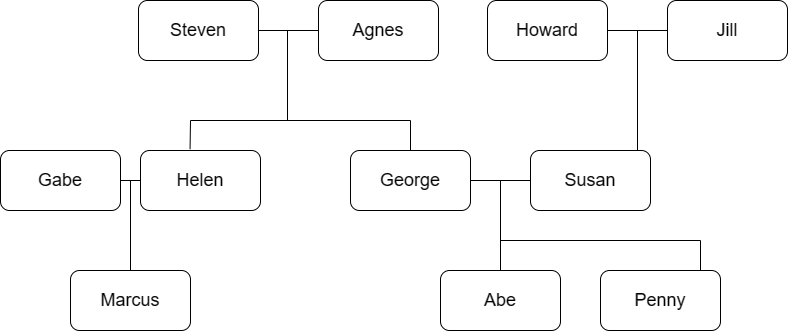
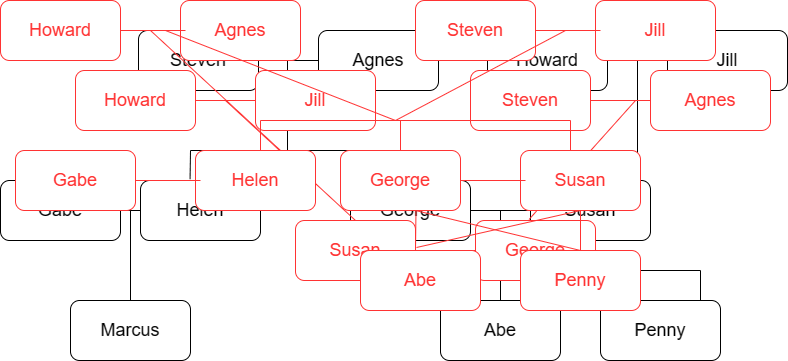
Given this setup, we could piece together the following family tree:
This tree is a visual representation of all the separate facts we get by combining all of our initial information. We can ask our system any number of questions, even ones that go beyond the scope of the original data set, and it can derive answers for them. It will answer yes, no, or uncertain, and so long as our propositions and predicates are all correct, then we can know that any derived answer is also correct. This data is a source of truth because it is based on logically sound principles.
A Twist)
But what if all of our propositions and predicates are all correct…except one? What if among all the truth facts and rules we include just one falsehood? It might occur to you that this would tarnish our confidence in the system, because there would always be a possibility that the answer it gave to us was that one lie. But actually, the effect is far, far worse. It has been proven that introducing just one logical falsehood into a system such as this will make any possible lie seem true. It won’t just be one lie that comes out of the system, it will be all lies. That might seem improbable, but allow me to illustrate.
To the system up above I will introduce one logical falsehood. Given the previously established rules, it is impossible for this to be the case, but I am going to enter it as a fact even so:
Susan is Abe's father
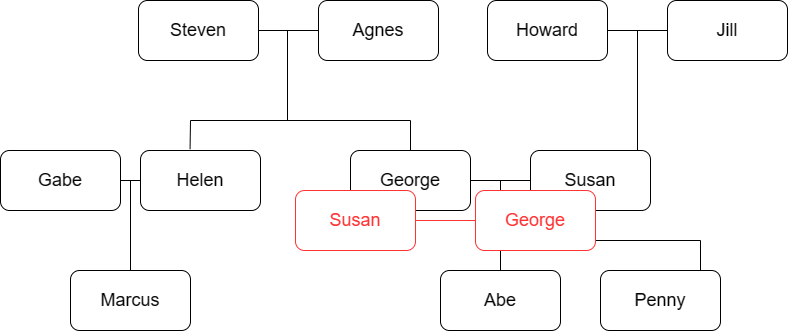
This statement is completely contrary to the logic of Predicate #11, but we add it to our system regardless. This creates a logical contradiction, and now let us look at all the new falsehoods we are able to infer from it. By Predicate #4 we can infer that since since Susan is Abe’s father, then Abe’s other parent, George, must be his mother.
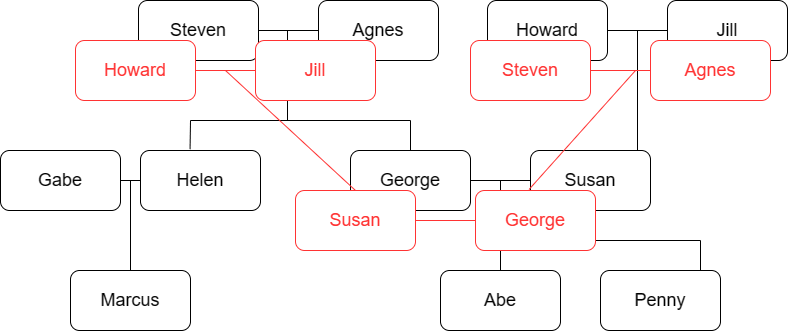
Of course, we previously had derived that Steven and Agnes were Abe’s paternal grandparents, because they are George’s parents. But now that we know that George is Abe’s mother, then they must also be his maternal grandparents. By the same token, Howard and Jill are now no longer only Abe’s maternal grandparents but also his paternal.
Of course, now that we know that Howard is Abe’s paternal grandfather we can combine that with the already-known fact that Agnes is his paternal grandmother, and we can now infer that they are married together, something we never knew before! And by the same token, Steven and Jill are now also married together. Thus all the grandparents are intermarried in some sort of free-love commune! This does have the unfortunate effect of making George and Susan, Abe’s parents, siblings to one another in addition to still being husband and wife! Furthermore, since Abe’s parents are also siblings, then his sister Penny is also his cousin because her mother is the sister of Abe’s father (and her father is the brother of Abe’s mother).
But we aren’t even really going yet! We still haven’t invoked the powers of NOT and ELIMINATION. First let’s consider the NOT. Predicate #10 stated that a cousin is NOT a sibling, and Predicate #11 that a mother is NOT a father. So, since we just proved that Penny is Abe’s cousin, then she is NOT his sibling. Of course, she also is his sibling, since Proposition #4 explicitly says so. Thus, she is his sibling, and she is not. These are both totally valid answers in the eyes of our data set. And Abe’s parents George is his father and Susan is his mother, but also, they are not. And his grandparents are his grandparents, but also, they are not.
And now that we’ve shown that we can prove that the exact same relationship can and cannot exist simultaneously, by ELIMATION we can also prove that every relationship can and cannot exist. So, from the initial data set we know that Abe has a sibling. But who is it? Well, we can go through each member of his family and prove that they are not that sibling. So, let’s do that for every family member except one, Steven, and now we know, by process of elimination, that Steven must be the one who is Abe’s sibling. And by the same process we can prove by process of elimination that it is Agnes, and Howard, and Gabe, and Helen, and George, and Susan, and Marcus. And by the same process they are all his father, and all his mother, and all his aunt, and all his uncle, and all his cousin, and all his grandfather, and all his grandmother.
I’m not going to try to show the family tree at this point, because it is simply all names connected to all other names in every possible way. But also…all names connected to none of the others. Every statement is true. Every statement is false.
Our data set was useful at one point. It was full of true statements, and it could be used to infer many other true statements. But now, after a single lie the entire thing has been corrupted. The only answer it has to provide are “yes, no, maybe, I don’t know…I guess it depends on how you look at it.” It has lost all confidence and isn’t useful for anything.
And sure, this is a rigorous and mathematical system, which is particularly prone to collapsing at the slightest instability. The system in our minds is far more nuanced, able to continue functioning with illogical assumptions and idiosyncrasies…but only to an extent. The same principle does apply to us to at least some degree. Adopt the wrong belief and suddenly every other concrete conviction starts to be undermined by it. People start going through logical acrobatics to try and make incompatible beliefs fit together, corrupting all that was once good and losing the certainty they once had. We cannot accept a lie without somewhat losing our grip on all truth.
Kurt Gödel was a logician and mathematician born in the early 20th century. He was a contemporary and friend of Albert Einstein’s, and as influential to the world of logic as Einstein was to the world of Physics.
Gödel’s most famous contribution were his Incompleteness Theorems, which proved that for any system there are truths which cannot be defined by the system itself. There are some things which are true, but which cannot be proven until you utilize outside sources.
Now this is a very crude example meant only as an illustration, but think of it this way: if we have a system called integer numbers (1, 2, 3, 4…) then there are patterns about those integers which do exist, but which we will never be able to discover with integers alone. We will have to add something else, perhaps fractions, in order to prove them. But now we have a new system, one of integers and fractions, and there are new patterns about this larger system which we will never be able to explain until we add something like irrational numbers, and so it goes on.
Now Gödel’s Incompleteness Theorem was related to logical and mathematical systems, but they raise a strong philosophical question as well. I have always been baffled that we humans are so arrogant as to believe that we could ever fully understand ourselves. It seems to me that we are much too close to the subject matter to ever find all of the objective truths locked within our souls. I find it far easier to accept that the only complete understanding of myself would have to come from a being that existed in a higher system than our own.
Thus when society decides that truth must be one thing, but God’s word declares that the truth is something else…it frankly is not difficult to for me to side with the unknowable omniscient. Indeed, the fact that God is unknowable gives his argument greater weight to me, not less. If God was comprehensible to me, then there’s no way He’d be great enough to comprehend all of me.
We use the word “logic” quite a good deal, it is something we strive to live in harmony with. In its original form, “logic” is simply the study of how to make correct inferences from known truths. If A is true, then so is B.
Logic has many different branches of study, including propositional calculus, predicate logic, and modal logic. It has applications to mathematics, computational problems, and even philosophy. Many of our technologies today, such as the modern database, are based upon its principles.
Another way to explain logic is that it is the study of relationships between truths. Take for example the statements “Adam is the father of Seth” and “Seth is the father of Enos.” By these two truths we may logically infer that “Adam is the grandfather of Enos.” In fact, by being given only a smattering of relationship facts, logic can be used to recompile entire family trees, defining numerous relationships between every member.
And all of this works…until a lie is introduced to the system. It has been proven that a single lie can totally break down any logical system. By process of elimination, one can prove or disprove anything. You could simultaneously prove that Adam is the father of Seth, that he is the mother of Seth, that he is no one to Seth, and that Seth is actually his father. And you can also disprove all of those statements, too. In a word, everything becomes “relative.” Where before you could go to a system of truth and find verifiable fact, now all that remains is a shrug of the shoulders and a “maybe.”
This happens to us in our lives as well. Each of us is born with a very simple model of truth. We inherently accept principles of love, faith, and goodness. It is a small core of truth, but it is sufficient. As we go through life we discover new facts, accepting those that seem to fit with our already-establish model, and rejecting those that do not.
However somewhere along the way, each of us will make a mistake. It is very easy to do. Perhaps a trusted authority figure gave us a notion that we accepted without a second thought. So we added a falsehood, but we believed it to be a truth. We may not realize that anything is amiss for a while, but over time, that lie will corrupt our previous associations. We’ll start to notice logical contradictions in our beliefs, and finally we’ll know that our system has become untenable.
Sadly, many will throw the entire thing out at this point. The work of pruning out the lies from the truth seems impossible. They will claim that there never really were any truths to begin with. It can be a hard thing to let go of a misconception about God without letting go of God entirely.
But that is not the only option. Sometimes evolving our beliefs is a matter of going back to basics. We realize that we went astray, so we return to what few facts we really do know: that we are a child of God, that He loves us, that there is such a thing as “good.” It might be a much smaller belief system, but it will be true again. Then, with utmost care, we add back in only the parts that fit with this core.
 Spiritual Wanderings