Why Did Peter Deny Jesus?

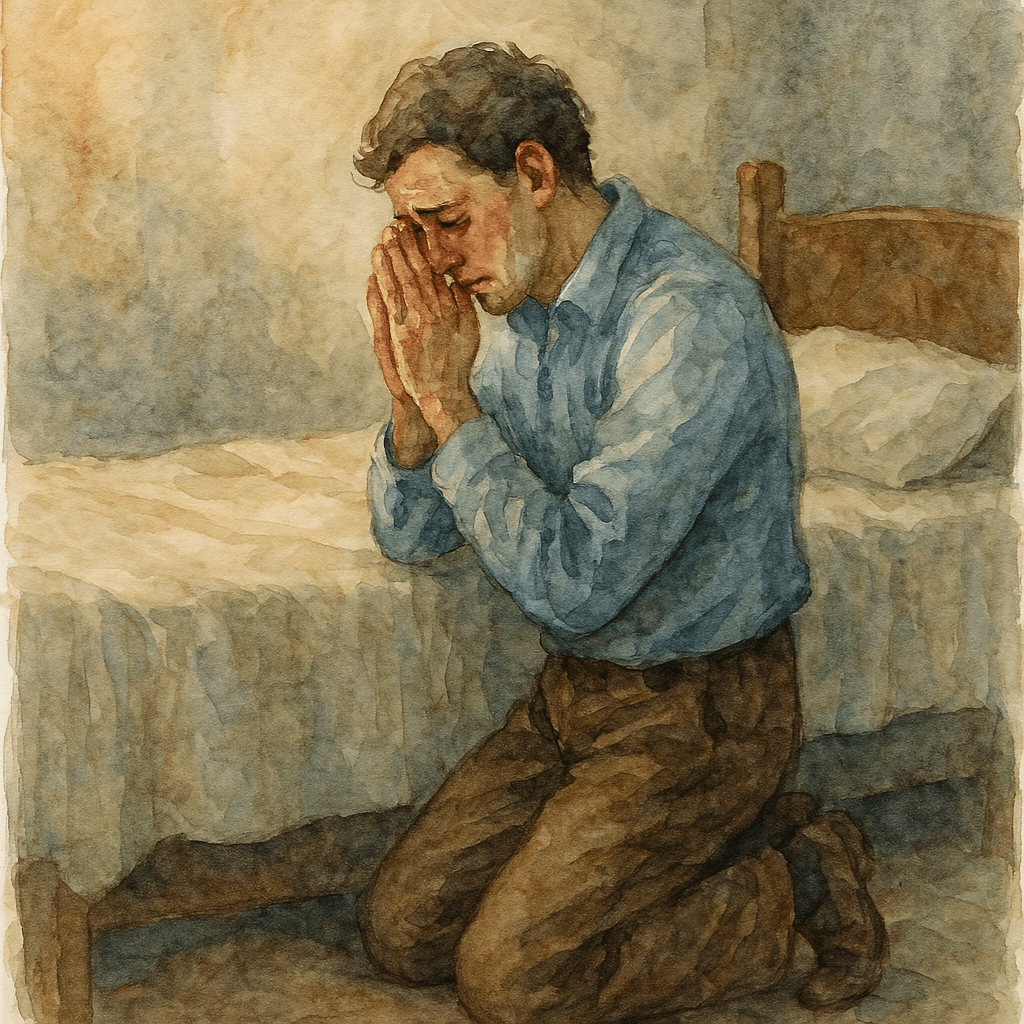
This Easter season I’ve been thinking about Jesus’s final week, culminating in his crucifixion and resurrection. One point that has stood out to me is Peter’s behavior on the night of Jesus’s arrest. Let us look at two moments from that evening:

  1. When Jesus’s captors arrive in the Garden of Gethsemane, Peter boldly leaps forward and cuts the ear off of one of them. He does this, even though Jesus and the disciples were almost certainly outnumbered and under-armed. It seems that if Jesus had not intervened, Peter’s actions would likely have gotten himself killed.
  2. After Jesus diffused the situation and surrendered to his arrest, Peter followed, waiting in the courtyard of where Jesus was being held. There he was recognized three times as one of Jesus’s followers, and each time denied it. It seems that he did this to preserve his life, to not get himself killed.

So why would Peter shrink from death in the latter case, but charge headlong toward it in the first?

I’ve always assumed that it was because Peter was acting in the heat of the moment in the first case. It may not have even crossed his mind that this could get him killed, he was just overcome with passion and acted without thinking. But during the arrest and the interrogation of Jesus, Peter had time for reality to set in, allowing him to truly feel the weight of the danger he was in, and his growing fear led him to lie.

That could certainly be the case, but as I’ve thought about it, I’ve realized that there could also be another explanation for his differing behaviors.

Another Theory)

Going back to the arrest at the Mount of Olives, what if Peter was actually fully aware that he was putting his life in jeopardy, and he was doing it deliberately? What if he was willing to sacrifice himself to give Jesus and the other disciples a chance to escape? If that were the case, then it must have been a great shock when Jesus instead rebuked him and peacefully submitted to the arrest. Jesus would have crushed the sacrifice he had been trying to make.

Now consider the second instance, where Peter lingered in the courtyard outside of Jesus’s interrogation and denied that he knew Jesus. In this case, there was no heroic rescue to be achieved by telling the truth. The only reason to admit that he was a follower of Jesus would be for the principle of the matter, to show that he would rather die than deny his master. Just because Peter might have been willing to die for some things, but not for others.

If this is the case, then Peter both proved great depth in his commitment, but also discovered even deeper depths that he was not yet ready for. He may have learned that his cause was not actually the same as Jesus’s, and that while he was prepared to die for his cause, he was not yet prepared to die for Jesus’s. He may have learned that it isn’t enough to be willing to give some sacrifice to the Lord, he needed to be willing to give the right sacrifice.

In either case, whether Peter’s initial fire cooled, or whether he was only willing to die for Jesus under certain circumstances, the tradition states that he did grow beyond his failing, that he did eventually die a martyr’s death, not on his own terms, but on the terms that were given him.

Forced to Fit- Part Two

Accepting God as He Is)

Yesterday I shared the observation that our culture raises us with certain preconceptions about what is good and ideal. When we then engage with the idea of God, we find aspects of His revealed character that do not comport with our preconceptions. Either we discard Him, try to make Him fit our own ideals, or sacrifice our own values to embrace His.

If we elect that third option, this will likely see us surrendering to a God that we don’t fully understand or agree with. Based on our unrecognized bias, we might think that God is sexist, or unmerciful, or discriminatory, or antiquated. But if we surrender to Him even so, living according to His word in spite of our uncertainty, in time we will see our secret prejudices for what they are, and be able to let them go.

A Dangerous Justification)

For those that elect the second option, to try and change God, they often justify it by saying that the ancient records of Him were biased by the culture of their time. The irony of this generational snobbery is obvious. If you accuse another person of misrepresenting God according to his bias, how do you know that you are not doing exactly the same?

Another justification might be that the description of God’s standards was appropriate for that time, but there is a precedent for it to be updated now. After all, we do not still perform animal sacrifices or abstain from eating pork, so why couldn’t God update His opinion on certain social constructs today?

However, this argument ignores the fact that all of the aforementioned changes were never instituted by popular vote, only by those who carried divine investiture from God, Himself. Jesus was God incarnate when he approved of his cousin John’s use of baptism, when he corrected the Israelite conception of the sabbath, and when he began the practice of the sacrament. The twelve apostles were divinely appointed by Jesus with his authority, and guided by revelation, when they changed the sabbath to Sunday, opened the gospel to the gentiles, called for an end to animal sacrifice, and approved the eating of previously unclean animals.

It is not the Christian view that we can change any of God’s commands or practices at will. We have not instituted the changes from Mosaic law to Christian values at random, or due to popular preference. Every change that we observe is founded in a heavenly mandate, not in popularity. In contrast, where is the divinely invested steward who declares God’s approval of our modern social ideals? Where is the heavenly vision that roots our “progressivism” in God and not the earth?

Rejection)

This leaves the final possible response to our personal ideals differing from God’s: rejection. We can say, “yes, the God of the Bible is that particular way, and I will never be okay with that, so I will reject Him.” This, at least, is a more honest response than trying to change the divine.

But to the person making this decision I would encourage them to consider the origin of your values. Are they not directly from the society around you? Are they not from the material, fallen world? Ideals based in the world are doomed to the same fate as all the rest of mortality. These ideals will go out of fashion, and those that lived by them will similarly perish and fade. It is the natural endpoint of every worldly path. If you reject the transcendent, transcendence will respect that decision and similarly abandon you. If you wish to have no more reality than materialism and popularity, then you will have no more than them, and you will die with them.

If, on the other hand, you wish to have a hope for life, and renewal, and the transcendent ideal, and ultimate truth, if you wish to belong to those things and be transfigured by them, you should only expect to do so by embracing a message and a perspective that transcends from on high. One that comes from an ancient God, whose long-standing ways you should naturally expect to contradict many of the messages in our modern, constantly changing world. If you reject that God, then you must realize you have rejected your only option for eternal life, and you must accept the nihilistic void in His place.

Forced to Fit- Part One

Prerequisites for the Divine)

We are a culture that approaches God by first establishing a foundation of worldly ideals that we believe in, and then trying to make Him fit them. We reject God or alter Him because He simply doesn’t match our modern presuppositions about what ultimate good is supposed to be.

Some require a God who isn’t patriarchal. Some require a God who doesn’t wage war on His enemies. Some require a God whose sovereignty doesn’t supersede our own authority. Some require a God who can be validated by scientific methods. Some require a God who is socially progressive.

In these cases, feminism or pacifism or individualism or materialism or progressivism are our first God, and for God to be God He must be in alignment with that first ideal, or He must not exist at all. He is forced to fit, or He is discarded.

This is, of course, an inversion of the proper order. When man recognizes that he has a different life philosophy than God he is supposed to change himself to conform with the Almighty, not change the Almighty to conform with him!

A Modern Lens)

Let us note that differences between God’s ideal and our own is inevitable. Even setting aside personal selfishness and flaws, our modern culture has been far removed from the Judeo-Christian ethic for a while now, and we have been immersed in that climate from before we had any understanding at all. Even if we were raised in a traditional, Christian home, it is certain that we have absorbed presuppositions that we are not even aware of, reasons why we feel that we cannot accept God entirely as He has been described to us.

I have never met the person who did not have some baked-in misunderstanding of the Lord, including myself. I have never met the person who did not struggle with some aspect of who God is declared to be. This is a common challenge that we all grapple with in one way or another. Indeed, we could make a case that most of our path of discipleship is simply us coming to terms with God as He is, surrendering our inclination to try and change Him, and choosing to change ourselves instead.

There is a little more that I wish to say on this subject, but I will save it for a second post tomorrow.

God is the Author and the Ink

Scriptures tell us that God is the Alpha and Omega, the beginning and the end. He is spoken of as being above us, but also within us:

Acts 7:49- Heaven is my throne, and earth is my footstool: what house will ye build me? saith the Lord: or what is the place of my rest?

John 17:23- I in them, and thou in me, that they may be made perfect in one; and that the world may know that thou hast sent me, and hast loved them, as thou hast loved me.

His work is simultaneously large and impressive, and quiet and invisible:

Exodus 19:18- 18 And mount Sinai was altogether on a smoke, because the Lord descended upon it in fire: and the smoke thereof ascended as the smoke of a furnace, and the whole mount quaked greatly.

1 Kings 19:11-12- And, behold, the Lord passed by, and a great and strong wind rent the mountains, and brake in pieces the rocks before the Lord; but the Lord was not in the wind: and after the wind an earthquake; but the Lord was not in the earthquake: And after the earthquake a fire; but the Lord was not in the fire: and after the fire a still small voice.

God is beyond and outside of mortality but also woven all throughout it. We find Him in the stars and galaxies and universe that we reside within, but also in the molecules and atoms and photons that reside within us.

Many have referred to God as the author of our existence. This is certainly true, but it only speaks to half of who He is to us. I would add that He is also the ink upon the page. He takes the empty void and provides the disparity that gives meaning. He forms each letter, each word, and each idea. He is woven through every character and every plot point in the ultimate tale of victory.

God is the author and God is the ink. We are not only written by Him from above, but of Him from below. He makes the story, and He is the story. And we, being characters in that story, are both a part of Him and Him a part of us.

Being on the Right Side

I always thought that there were just two sides, one of right, and one of wrong. I thought all the world was black-and-white.

My perception on that has shifted, but not to the cliché that it’s all just shades of gray. Rather, I now see it as black, and white, and black again. It isn’t just one side good and one side bad, it’s bad on this side and bad on that side, with one narrow strip of good down the middle.

This means you can’t just run full speed from the ledge on one side, because there’s soon a ledge on the other side as well. It truly is a “strait and narrow way,” with a steep slope on either side, and once you start down those slopes, gravity will make it very easy to roll all the way to the bottom.

Being aligned with good and with God is therefore a very careful and deliberate work. No one walks His line by accident. We have to constantly check ourselves and reevaluate our positions against revealed truth as we make our way forward.

Obedient Dust

One of the greatest sins in modern culture is to submit to another. We have to be tough and independent; we have to stubbornly maintain our autonomy always. We go so far as to resent the very idea of God, because we don’t want to obey even Him.

And then? Then we die, and then we return to the dust, and then we go wherever God blows us. All the world forgets us, and no one cares how independent we thought we were, and we dance to God’s every whim anyway.

Independence is an illusion, obedience is inevitable.

Fickle Popularity

I may not be very old, but I have already witnessed the way society can swing from one trend to another. I see the masses scramble onto today’s favored platform, only to be embarrassed when it becomes tomorrow’s laughingstock.

I believe that a key component of this is that too often we choose our stance more off of who else is standing there, and not by the merits of the platform itself. The fact is, there are values to be respected in most every position. Conservatism and liberalism, inclusivity and solidarity, faith and skepticism, individualism and collectivism, a solid case can be made for each of these, and it is my personal belief that the correct position comes by taking the good parts of each.

But balance is not the typical position of society. Typically, people go all in on one or another, believing that they do so because of their commitment to its underlying ideals, but more so because of the attractiveness of the community that is built upon it.

Whenever a platform becomes too popular, it starts to attract “all kinds.” Some of the meanest and least understanding jump onto it, and they bring out all the worst extremes of that particular ideal. The rest of society can see the growing ugliness in that position, and so they take up the opposition. In order to escape the depravity of the old platform’s worst tenets, people fully commit to its opposite, until it becomes the popular thing to do. As the masses invest in that side, then they also start to attract even the uglier parts of society to their platform and the cycle repeats, over and over again.

Playing this game is exhausting. Great effort is made, but any short-term progress is eventually undone by an over-correction in the other direction. It’s a pity, because I don’t think it has to be that way. I see the potential for mankind to balance one another out, to elevate the most powerful ideals in each platform, but to circumscribe them by the bounds of all the others. By this I believe we could continually progress towards greater and greater virtue, rather than rising only to fall as has been our historical pattern. I believe this unified progression is a vision of heaven, the society that we shall have when our Lord reigns supreme.

Evil in God’s World

A Common Argument)

I have frequently heard the argument that if we have an all-loving God, how are tragedies and disasters a part of this world? I have addressed this issue in part with previous posts, but today I wanted to point out a fundamental flaw in the argument itself.

Neil DeGrasse Tyson gave this argument in an interview where he said, “Every description of God that I’ve heard holds God to be all-powerful and all-good, and then I look around, and I see a tsunami that killed a quarter million people in Indonesia, an earthquake that killed a quarter million people in Haiti, and I see earthquakes, and tornadoes, and disease, childhood leukemia, and I see all of this and I say I do not see evidence of both of those being true simultaneously. If there is a God, the God is either not all-powerful or not all-good.”

I find it interesting that Tyson’s public persona is entirely based around having a scientific mind, yet his argument is entirely unscientific. He jumps to a conclusion that is not at all supported by the premises. Here are the premises that he establishes:

  1. God is all-powerful
  2. God is all-good
  3. ???
  4. There is great tragedy in this world

And from these he draws the conclusion that the last premise is incompatible with the first two. But as it stands, the statements of God’s character and the state of the world live in isolation from one another. There is a crucial premise missing, one that would establish what the relationship between God and the world even is!

This is the fundamental flaw in all of these criticisms. They speak of the nature of God, and the nature of the world, but never establish what one of those has to do with the other. It is quite a leap to say that if God is all-good that He is required to enforce only good things on the Earth of today. Where did that notion come from? Why can’t God be all-good and not puppeteering everything that plays out in humanity?

The Perfect Earth)

One thing that Tyson did not explicitly say, but which I believe is implied in his argument, is that the missing link between God’s goodness and the state of the earth is that God created the earth. If God is perfect, and the original author of our existence, then why isn’t that existence perfect also?

But even introducing this to the argument doesn’t make it any better. Because if one is going to question why a perfect God did not create a perfect world, the obvious answer is, “well, according to our records…He actually did.” In the first chapters of Genesis, we read that God created a world where everything was “good.” There was no death, no sickness, none of the great tragedies that so distress us today. Thus, the expectation actually fit the reality at the moment of creation. God did give us exactly the sort of world that we would have expected Him, too.

But states can change. And man, not God, chose to introduce sin into this world, corrupted its perfection, and gave birth to the fallen earth that we see all around us. This is all made clear in the first three chapters of the Christian canon, so it doesn’t make sense to state that the Christian conception of God does not account for the disparity between His goodness and the world’s evil.

If one does not believe in the biblical explanation, so be it, but don’t claim that there isn’t any explanation. Indeed, this is one of the unique and compelling aspects of Christianity, that it not only acknowledges the dual nature of our existence but also provides one of the clearest, most explicit explanations of that division’s origin.

Of course, one might still be troubled by the disparity between the professed perfection of the Christian God and the suffering in the world, and one might feel that if God really is all-powerful, then He ought to be able to reclaim that fallen world. And to that I say, brother, have I got some good news for you!