Scriptures tell us that God is the Alpha and Omega, the beginning and the end. He is spoken of as being above us, but also within us:
Acts 7:49- Heaven is my throne, and earth is my footstool: what house will ye build me? saith the Lord: or what is the place of my rest?

John 17:23- I in them, and thou in me, that they may be made perfect in one; and that the world may know that thou hast sent me, and hast loved them, as thou hast loved me.
His work is simultaneously large and impressive, and quiet and invisible:
Exodus 19:18- 18 And mount Sinai was altogether on a smoke, because the Lord descended upon it in fire: and the smoke thereof ascended as the smoke of a furnace, and the whole mount quaked greatly.

1 Kings 19:11-12- And, behold, the Lord passed by, and a great and strong wind rent the mountains, and brake in pieces the rocks before the Lord; but the Lord was not in the wind: and after the wind an earthquake; but the Lord was not in the earthquake: And after the earthquake a fire; but the Lord was not in the fire: and after the fire a still small voice.
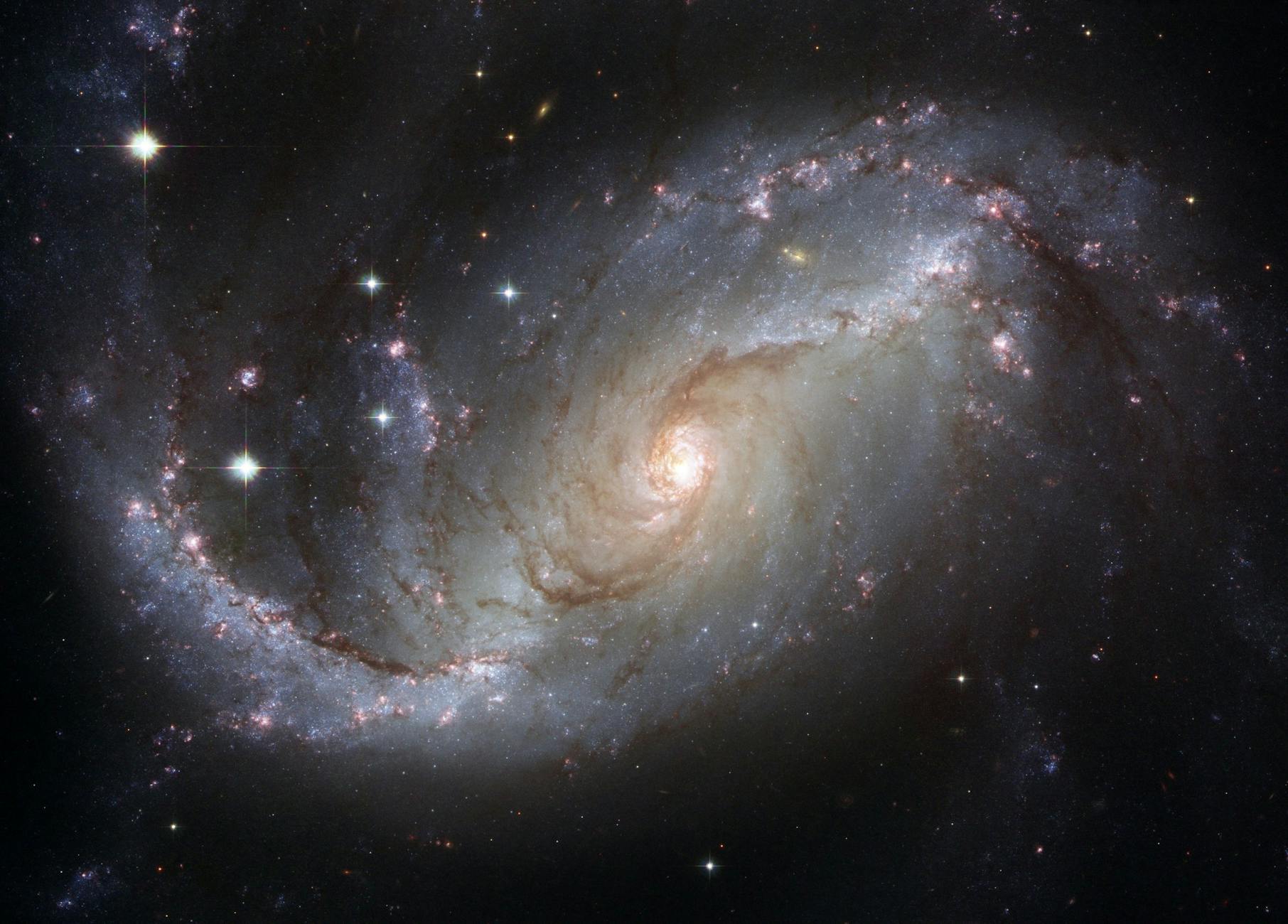
God is beyond and outside of mortality but also woven all throughout it. We find Him in the stars and galaxies and universe that we reside within, but also in the molecules and atoms and photons that reside within us.
Many have referred to God as the author of our existence. This is certainly true, but it only speaks to half of who He is to us. I would add that He is also the ink upon the page. He takes the empty void and provides the disparity that gives meaning. He forms each letter, each word, and each idea. He is woven through every character and every plot point in the ultimate tale of victory.
God is the author and God is the ink. We are not only written by Him from above, but of Him from below. He makes the story, and He is the story. And we, being characters in that story, are both a part of Him and Him a part of us.
I always thought that there were just two sides, one of right, and one of wrong. I thought all the world was black-and-white.
My perception on that has shifted, but not to the cliché that it’s all just shades of gray. Rather, I now see it as black, and white, and black again. It isn’t just one side good and one side bad, it’s bad on this side and bad on that side, with one narrow strip of good down the middle.
This means you can’t just run full speed from the ledge on one side, because there’s soon a ledge on the other side as well. It truly is a “strait and narrow way,” with a steep slope on either side, and once you start down those slopes, gravity will make it very easy to roll all the way to the bottom.
Being aligned with good and with God is therefore a very careful and deliberate work. No one walks His line by accident. We have to constantly check ourselves and reevaluate our positions against revealed truth as we make our way forward.
One of the greatest sins in modern culture is to submit to another. We have to be tough and independent; we have to stubbornly maintain our autonomy always. We go so far as to resent the very idea of God, because we don’t want to obey even Him.
And then? Then we die, and then we return to the dust, and then we go wherever God blows us. All the world forgets us, and no one cares how independent we thought we were, and we dance to God’s every whim anyway.
Independence is an illusion, obedience is inevitable.
I may not be very old, but I have already witnessed the way society can swing from one trend to another. I see the masses scramble onto today’s favored platform, only to be embarrassed when it becomes tomorrow’s laughingstock.
I believe that a key component of this is that too often we choose our stance more off of who else is standing there, and not by the merits of the platform itself. The fact is, there are values to be respected in most every position. Conservatism and liberalism, inclusivity and solidarity, faith and skepticism, individualism and collectivism, a solid case can be made for each of these, and it is my personal belief that the correct position comes by taking the good parts of each.
But balance is not the typical position of society. Typically, people go all in on one or another, believing that they do so because of their commitment to its underlying ideals, but more so because of the attractiveness of the community that is built upon it.
Whenever a platform becomes too popular, it starts to attract “all kinds.” Some of the meanest and least understanding jump onto it, and they bring out all the worst extremes of that particular ideal. The rest of society can see the growing ugliness in that position, and so they take up the opposition. In order to escape the depravity of the old platform’s worst tenets, people fully commit to its opposite, until it becomes the popular thing to do. As the masses invest in that side, then they also start to attract even the uglier parts of society to their platform and the cycle repeats, over and over again.
Playing this game is exhausting. Great effort is made, but any short-term progress is eventually undone by an over-correction in the other direction. It’s a pity, because I don’t think it has to be that way. I see the potential for mankind to balance one another out, to elevate the most powerful ideals in each platform, but to circumscribe them by the bounds of all the others. By this I believe we could continually progress towards greater and greater virtue, rather than rising only to fall as has been our historical pattern. I believe this unified progression is a vision of heaven, the society that we shall have when our Lord reigns supreme.
I have frequently heard the argument that if we have an all-loving God, how are tragedies and disasters a part of this world? I have addressed this issue in part with previous posts, but today I wanted to point out a fundamental flaw in the argument itself.
Neil DeGrasse Tyson gave this argument in an interview where he said, “Every description of God that I’ve heard holds God to be all-powerful and all-good, and then I look around, and I see a tsunami that killed a quarter million people in Indonesia, an earthquake that killed a quarter million people in Haiti, and I see earthquakes, and tornadoes, and disease, childhood leukemia, and I see all of this and I say I do not see evidence of both of those being true simultaneously. If there is a God, the God is either not all-powerful or not all-good.”
I find it interesting that Tyson’s public persona is entirely based around having a scientific mind, yet his argument is entirely unscientific. He jumps to a conclusion that is not at all supported by the premises. Here are the premises that he establishes:
God is all-powerful
God is all-good
???
There is great tragedy in this world
And from these he draws the conclusion that the last premise is incompatible with the first two. But as it stands, the statements of God’s character and the state of the world live in isolation from one another. There is a crucial premise missing, one that would establish what the relationship between God and the world even is!
This is the fundamental flaw in all of these criticisms. They speak of the nature of God, and the nature of the world, but never establish what one of those has to do with the other. It is quite a leap to say that if God is all-good that He is required to enforce only good things on the Earth of today. Where did that notion come from? Why can’t God be all-good and not puppeteering everything that plays out in humanity?
The Perfect Earth)
One thing that Tyson did not explicitly say, but which I believe is implied in his argument, is that the missing link between God’s goodness and the state of the earth is that God created the earth. If God is perfect, and the original author of our existence, then why isn’t that existence perfect also?
But even introducing this to the argument doesn’t make it any better. Because if one is going to question why a perfect God did not create a perfect world, the obvious answer is, “well, according to our records…He actually did.” In the first chapters of Genesis, we read that God created a world where everything was “good.” There was no death, no sickness, none of the great tragedies that so distress us today. Thus, the expectation actually fit the reality at the moment of creation. God did give us exactly the sort of world that we would have expected Him, too.
But states can change. And man, not God, chose to introduce sin into this world, corrupted its perfection, and gave birth to the fallen earth that we see all around us. This is all made clear in the first three chapters of the Christian canon, so it doesn’t make sense to state that the Christian conception of God does not account for the disparity between His goodness and the world’s evil.
If one does not believe in the biblical explanation, so be it, but don’t claim that there isn’t any explanation. Indeed, this is one of the unique and compelling aspects of Christianity, that it not only acknowledges the dual nature of our existence but also provides one of the clearest, most explicit explanations of that division’s origin.
Of course, one might still be troubled by the disparity between the professed perfection of the Christian God and the suffering in the world, and one might feel that if God really is all-powerful, then He ought to be able to reclaim that fallen world. And to that I say, brother, have I got some good news for you!
“Blessed are the meek,” Jesus taught, “for they shall inherit the earth.” I have heard several Christians discuss this passage, and they often take time to explain that meekness should not be associated with weakness, as the two mean different things.
It is true that the words have different meanings and shouldn’t be used as synonyms, but obviously there is a reason why the two are often associated with one another. Meekness, as well as other submissive qualities like humility and obedience, are indeed traits that are often found among the weak. Young children come to mind in particular. They are small and lacking in power, so they are required to be meek and submissive, because the will of the adults is imposed on them whether they want it or not.
Then, as they grow, children gain their own power. Resisting the will of others, and even of imposing their own, become viable options. Having gained this power, most people never want to go back to that state of being beholden to others.
However, just because we have enough power to make our own rules for ourselves, doesn’t mean that we should. Jesus called on us “to become as little children,” and showed an example of giving up his will for that of the Father. Jesus wasn’t calling on us to become weak again, though. It was a call to become submissive eventhough we have our own strength. Unlike a child, meekness, humility, obedience, and submission become a choice for us now, rather than the default way of being. We are not weak, but we place our strength upon the altar and become as though we were weak, complying with the Lord’s will even when it differs from our own.
Now I have been saying that when we become adults, we finally possess our own power, but that’s only relatively speaking. When we get to the other side, I’m sure we will recognize how truly insignificant and powerless we were even as adults in the broader scheme of things. God gives us the illusion of control now so that the quality of our character can be tested before we would be conferred with any real power in the hereafter. Meekness, even in strength, is essential to using our strength correctly.
After his baptism, Jesus was led into the wilderness, where he fasted for forty days and nights in preparation for his earthly ministry. It was in that vulnerable state that Satan met him and presented to Jesus a series of three temptations. First, Satan suggested that Jesus should turn rocks into bread to satiate his hunger, then to prove his divine sonship by leaping off a building so that angels might catch him, and finally to receive all the kingdoms of the world as a reward if he would worship Satan.
We say that these were the temptations of Jesus, but it isn’t specified whether he was actually tempted by any of them. In the records that we have, Jesus seems to dismiss each offer without any trouble.
At their core, each of these temptations has to do with worldly pleasure and glory. The pleasure of satiating one’s appetites, the glory of receiving the honor of others, the glory of dominating the world. Jesus was given temptations of glory, but these might have had little sway on him.
But temptations of glory are not the only foe that must be overcome. Satan also influences mankind by our fear of pain. Fear of being an outcast, of being punished, of even being killed. Jesus was subjected to these also when he bore the sins and pains of the world, was betrayed by his own people, and condemned to a torturous death. Here, Jesus actually did seem to have been tempted to turn from his calling.
At the point of embarking on that great sacrificial journey he prayed, “Father, if thou be willing, remove this cup from me” (Luke 22:42). Not only this, but near the end of his suffering he exclaimed, “My God, my God, why hast thou forsaken me?” (Matthew 27:46). Jesus had been impervious to glory, but clearly not to despair. This does not surprise me. I believe that fear has more power over all of us than offers of glory.
Of course, it is important to note that feelings of fear and despondency do not, in and of themselves, constitute a sin, though they can ruin us depending on our reaction to them. In both cases, we must note that Jesus prevailed. In the first, he followed his desire for the cup to be removed with, “nevertheless not my will, but thine, be done.” In the latter, even though he felt abandoned by his Father, still he showed continuing trust in Him with his final words: “Father, into thy hands I commend my spirit” (Luke 23:46). Perhaps Jesus feared, but ultimately, he remained faithful.
Each of us will face both of these challenges in life, and at one point or another succumb to them. We will compromise ourselves for the glory of others, or we will shrink from our responsibility because we are crippled by fear. Knowing that these are the strategies of Satan, we can prepare ourselves to weather them as best we can, and when at times we inevitably fail, we can turn for help to the one that never did.
There is no specific accolade or achievement in this life that the gospel of Jesus Christ guarantees for me. It does guarantee, however, that my life will be optimal. It will be the most fulfilling of all the possible lives that I might have led. Even if that means it was still fraught with hardship and pain, it will at least be a life that I will be proud to have lived.
That might not seem like much to the naive, but for those that have realized that the default life has no such assurances, that promise is everything.
Before we can be redeemed, we have to be condemned. Before we can be reborn, we have to have perished. Before we can be healed, we have to be broken.
And we have to be condemned, and perished, and broken, because we don’t recognize our natural fallen state until what little good we have is taken away. Though death is our certain end, we don’t feel the reality of it until we sin. Sin reveals to us the fallen nature we were always under and makes death itself more real to us. Sin brings upon us a sense of condemnation both for our guilt and our mortality.
Thus, we start in a state of innocent delusion, and we break that delusion by being awoken to our state of condemned mortality. But then we are reborn from that state of condemned mortality, not back into a state of delusion, but into the genuine article of eternal life. Though first we had to die, we are reborn into the reality of redemption.





 Spiritual Wanderings