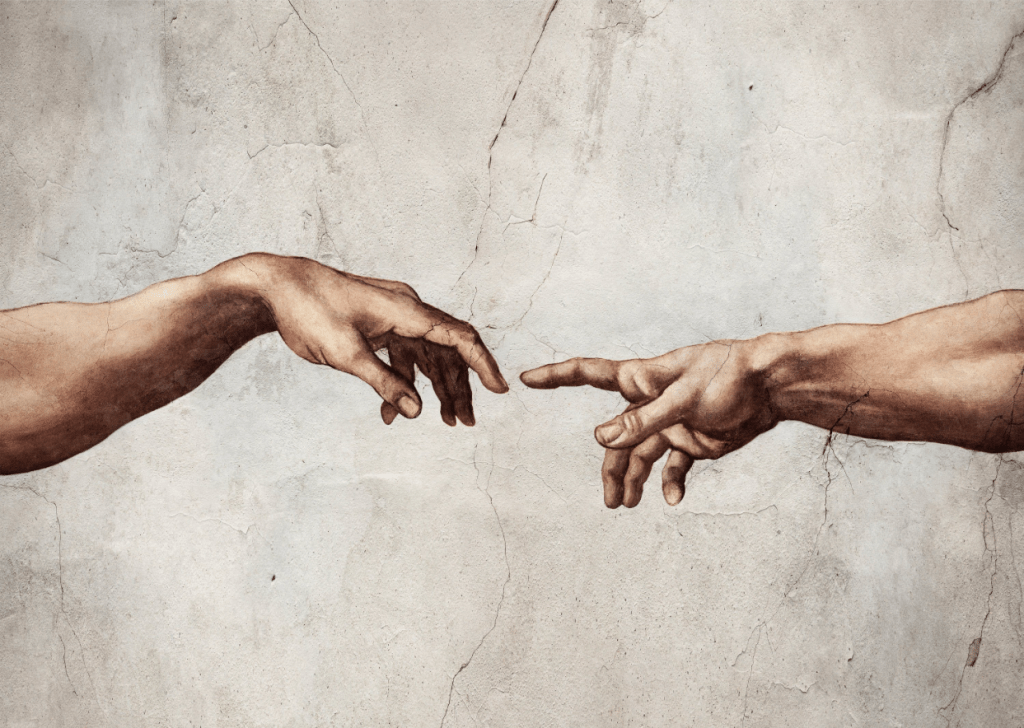
A Foundation Built on God- A Little Leaven

Time Equals Love)

As I have considered ways to make my life built more on the foundation of the Almighty, the simplest solution seems to simply be spending most of my waking time in direct communion with God. If I slept for 8 hours, strove with God for 9 hours, and took care of my personal affairs for 7 hours, who could argue that God wasn’t the most significant thing in my life?

As a general rule, we tend to give greatest value to the things we spend the most time with. Even if it’s not something we particularly enjoy, we still give it weight and meaning because we gave it so much of ourselves. Ask any man who worked a career he didn’t like for forty years to provide for his family whether there is substance and significance to the labor he did, and of course he’s going to say “yes.”

So, should we all become spiritual hermits or join the priesthood? Well, the body of Christ we are told is made of many different parts. We can’t all be hands, or all be feet, or all be eyes, or all be mouths. Some must work to build society, which typically consumes at least half of the waking day. Add in the time for family and personal affairs, and the window for exclusive focus on God becomes a small minority of the day.

A Small Foundation)

But maybe a minority of time can still have a majority of impact. As Paul taught, “A little leaven leaveneth the whole lump” (Galatians 5:9). Consider also the example of the foundation of a building. Typically, that part of the structure is only a small percentage of the building’s total height, yet it supports the entire thing. The Burj Khalifa for example 2,7117 feet tall, with a foundation of only 164 feet, about 6% of the entire structure.

The question then, is whether that relatively small amount of time with God is being laid at the foundation, or lost in the middle of everything else? Is it being allowed to spread its leaven through the whole, or is it isolated where it cannot activate any of the rest? I think it is possible to establish a life founded on God, even with a minority of time dedicated directly to Him, but the dedication of time must be of the right quality.

With this idea in mind, I will try to identify a way to achieve the right quality of time dedicated to God with tomorrow’s study.

A Foundation Built on God- Life Defined by Faith

Jesus foretold that, “Many will say to me in that day, Lord, Lord, have we not prophesied in thy name? and in thy name have cast out devils? and in thy name done many wonderful works? And then will I profess unto them, I never knew you: depart from me, ye that work iniquity,” (Matthew 7:23). This is a sobering warning to Christians everywhere that many who think they are in alignment with the Lord are actually offensive to Him.

There are multiple conceivable ways that Christians would find themselves on the left hand of the Lord. Perhaps they are hypocrites, professing Christ’s name but still harboring secret sin. Perhaps they treat Christianity as a political cudgel, using it to condemn those that they have no right to. Perhaps they are social Christians only, going to church and saying prayers, but more dedicated to the false churches of social trends.

I believe there are many in that last category. People that treat Christianity as a garnishment to the rest of their life, not the foundation and basis of the entire thing. It is, frankly, a way of being that I continually struggle with also. Most especially I lapse in my prayers because I am just too preoccupied with the distractions of the world, too concerned what I might miss out on if I make time “just” for connecting to God.

Obviously, I do perform a scriptural/spiritual study each weekday, and I do believe that that has helped a good deal in keeping God elevated in my mind, but I do crave more. With this short study I am going to try and identify for myself how I might do better in this aspect of daily prayer.

Perverted Frames of Mind

Any act of evil can be justified given a particular frame of mind.

Thus, the greatest safeguard is not against evil itself, but against the perverted frame of mind that would allow it.

The Mote in the Other Eye- Surrendering the Outcome

Distrust of Others)

In my previous post I talked about the popular trend of pinning all of the world’s problems on someone else and never taking accountability for one’s own side. I also admitted how I, too, have fallen into that trend many times, and how my conscience and Jesus’s words have always been there to convict me it is wrong to stay there.

At the end of the last post, I mentioned that when I recognize my folly and tell myself to focus on the beam in my own eye, there is a part of me that is worried about what might happen if I do so. That fear is based on a profound distrust of the “other side.” If I’m not there to keep them in check, who will be?

This is because our culture’s “us vs them” mentality leads us to shore up our own side even as we’re tearing down the other. In order to strengthen our arguments, we make ourselves blind to our own failings, excusing them as inaccurate or unimportant. So, now if I focus my energies on correcting myself instead, then that’s one less voice keeping the other side honest. Imagine if everyone on my side turned to self-introspection. We might take care of all the problems over here, but the other side’s problems will abound unfettered.

The Need for Surrender)

Well…yes, there is that potential outcome. There are other, more optimistic outcomes, but there is no guarantee of them. I do trust that good will ultimately prevail, but there is the possibility that if I focus on improving myself, the other side will run rampant in the meantime, and things will get worse for a while.

What this means, then, is that focusing on the beam in my own eye is not only an exercise in humility, but also a leap of faith. It means doing what is right in my own sphere with the hope, not the guarantee, that things will work out for the best because of it.

For this reason, I think an excellent companion to Jesus’s words on removing the beam from our own eyes is his later injunction that “if anyone would come after me, let him deny himself and take up his cross and follow me,” Matthew 16:24. Once again, he’s talking about picking up our own cross, denying our own self. And his use of the word “cross” makes clear that this is something hard, painful, and even dangerous.

Let’s take a moment to take these abstract concepts and personalize them. Just what would you call “your side,” and what would you call the “other side?” Conservatives? Liberals? The Patriarchy? Feminists? White supremacists? DEI peddlers? Colonizers? Immigrants? Whichever tribe you belong to, I’m sure that if you were honest there’s some house cleaning that is needed over there. Would you be willing to take up your cross and focus on the beam in your own eye? Would you be willing to stop hammering the other side as you set your gaze inward? It’s a lot to ask…but it is what is asked.

The Mote in the Other Eye- The Problem of Others

Who’s to Blame)

Everyone knows someone who is making the world worse. Everyone can identify popular ideals and propaganda that are harming society. Everyone knows who is to blame for things being the way that they are right now. Everyone knows how they’d like to change the world if they could. And people certainly make their opinions known. My news feeds and social media threads are constantly inundated with criticisms and accusations of “them.”

And I cannot claim to have never taken part in this pastime either. I could speak at great length about who I see as responsible for the greatest problems in the world today, and the deep resentment that I’ve harbored towards them.

But part of me has always felt guilty when my mind goes to that place. Part of me knows that at some point I crossed the line from “judging righteous judgment” to full-on condemning. Part of me knows that my desire to make everyone do what is right is not actually from God. It’s a sneaky misstep, because it’s oriented towards trying to establish ‘right,’ but its method of control is evil.

Focus Inward)

When I consider all of this, I am reminded of the words of Jesus: “How wilt thou say to thy brother, Let me pull out the mote out of thine eye; and, behold, a beam is in thine own eye?” Matthew 7:4. When I hear this, I realize that I’m not just wrong for letting my heart be filled with condemnation for another, but also because it has distracted me from focusing on the problems of my own side.

Of course, Jesus also suggested that after one had cleaned his own eye then he would see clearly enough to clean another’s. Honestly, I can’t speak to that, because I genuinely don’t feel that I am there yet. I suspect there are few who are. My focus for now is still on the first half of Jesus’s words.

The Reason for Reluctance)

I also want to make clear nowhere in Jesus’s injunction to focus on our own eye does he suggest that the other side doesn’t have problems. Even with my flawed judgment, I probably have identified some truly valid issues over on the other side. The idea that “they” need to change isn’t wrong, then, what’s wrong is thinking that I’m going to be the one to make them do it. I don’t have to stop my natural recognition of evil in the world, or condone any of it, but Christ is pointing out that everything would go much smoother if I acknowledged my own failings and worked on changing me, while “they” worked on changing “them.”

But what if I do work on me, and “they” don’t work on “them.” There is a real anxiety in this that manifests each time I try to pull myself back from policing the entire world. Tomorrow I will speak more at length on this fear, and how it can be remedied.

A Worthy Life

If it takes our whole life long just to find God, and to give Him our heart, and to regain our soul, it will have been worth it.

We Are Not Made for Peace

Made to War)

Many have envisioned a utopia where there is no more war and strife. Many have proposed by what method we could achieve such universal peace, though every attempt has failed. It is a strange paradox. Whether we have peace or not is obviously in our own hands, and it is hard to think of a more common goal, so why does it continually evade us? Why can’t we just stop fighting?

Because we are not made for peace.

We are a people that are designed to do battle. It is simply in our nature to fight. It is in our nature to draw a line and make war with whatever is on the other side of it. Yes, there is a part of us that craves calm and rest, but that part will always be overrun by our stronger, warrior nature. Battle is inevitable, and all of us are called to it. The need for war isn’t lessened by previous victories or having a rich life. The previous fathers’ wars do not satiate the hot blood of the rising generation.

This principle was found to be true in the shocking Universe 25 experiment with rats. The rodents were given a perfect Rat Utopia, with all the food, space, and sociality that they needed to thrive. And in every case, the rats eventually turned to self-destruction and brought about their own extinction. We may not be rats, but we carry that same fire within us.

A Divine Purpose)

But just because we are made to battle, does not mean that we have to use it for evil. Indeed, our warrior heart was given to us for a good purpose, and it is only when we twist it or suppress it that it bursts out in violence and hate.

God gave us warrior hearts so that we would have the motivation to battle our own inner demons. God made us restless in times of peace, because there is no end to the onslaught of temptation. God made us itch for a fight so that we wouldn’t be complacent about our flaws.

All of our lives are meant to be a struggle, though in the afterlife it may very well be different. Perhaps the part of us that yearns for peace looks to the afterlife, while the part of us that yearns for a fight looks to this life.

But one has to choose to wage war with the inner man. One can, instead, run from that fight, surrender to his worst impulses, and then his warlike nature has nowhere to go but outward. Even worse, because he gave control of his spirit up to the author of evil, his noble warrior heart becomes corrupted to one of cruelty.

Resolved to the Better Fight)

Trying to numb our desire to fight is misguided. That is trying to change our fundamental nature, which we cannot do.

Peace in this life will not be found by removing our desire to fight, but by each of us turning that fight inwards. Conflict never dies, but it can be transplanted. The global conflict can be internalized by the populace. We will only know peace in our society as we each accept that we will never know peace individually.

It may be a sobering reality: a lifetime of never-ending battle within the heart, but ironically, you can make peace with that war. You can accept it as a necessary component of life, something that you just have to do, and then it becomes easier. There are no easy answers, but there are at least answers.

Evidence in the Lack of Evidence

At key points in life, you must choose between that which is most beneficial to you and that which you know to be right. You will have to decide if you follow your conscience, even when there is no reason to assume a positive outcome for yourself.

It only stands to reason, however, that if you ever want to live in the hands of the supernatural, beyond the confines of mortal logic, that at some point you must make a choice just like this. Earthly outcomes follow choices based on earthly evidence. If you ever want a heavenly outcome, at some point you must leap with nothing earthly in view to catch you.

Thus, watch for these moments where there is no evidence that things will work out well, and in those moments take courage in the knowledge that the lack of evidence is the greatest evidence of all.

Reciprocity of Good

Every parent hopes that the world will be good to our children.

Certainly, we do what we can to shape the world in that direction, but there is only so much that we can do.

Far more effective, then, is to shape our children to be good to world, and then trust that reciprocity will see good reflected back to them.