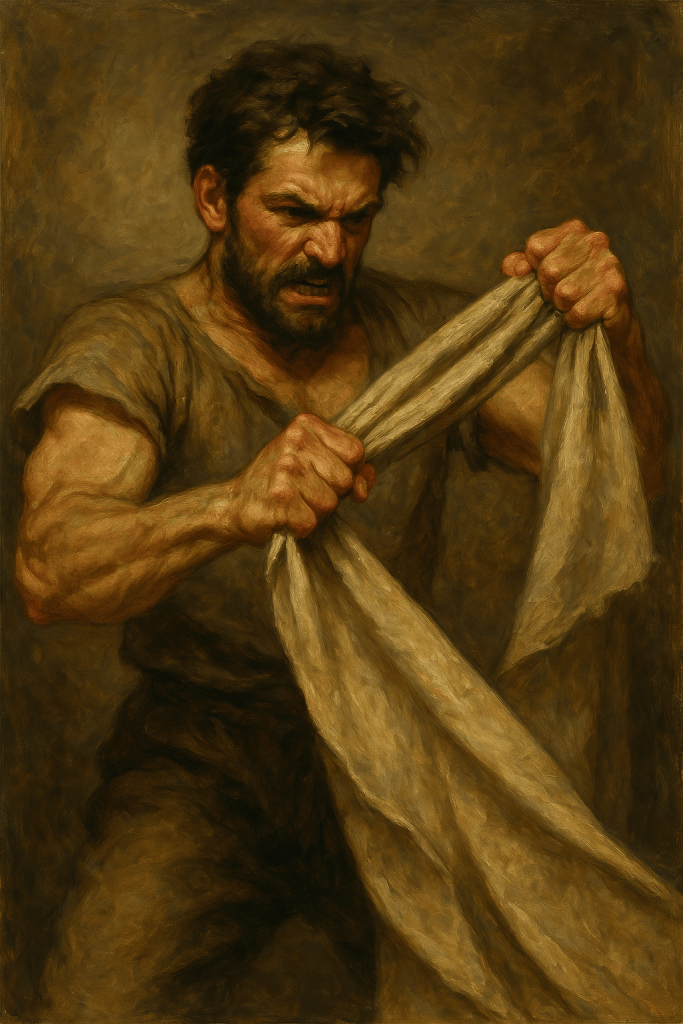
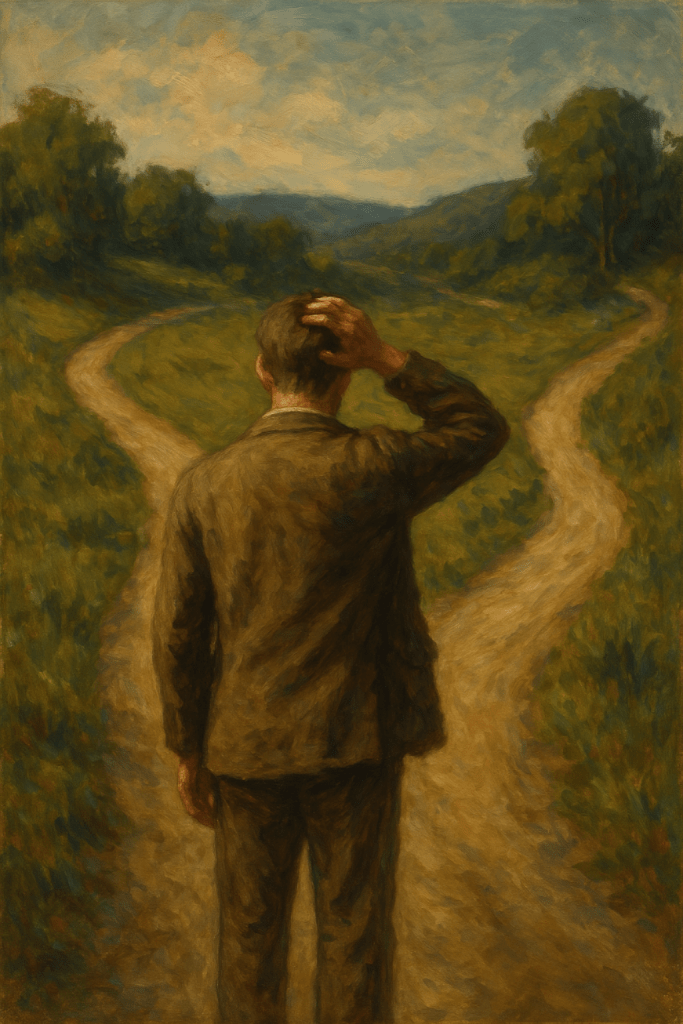
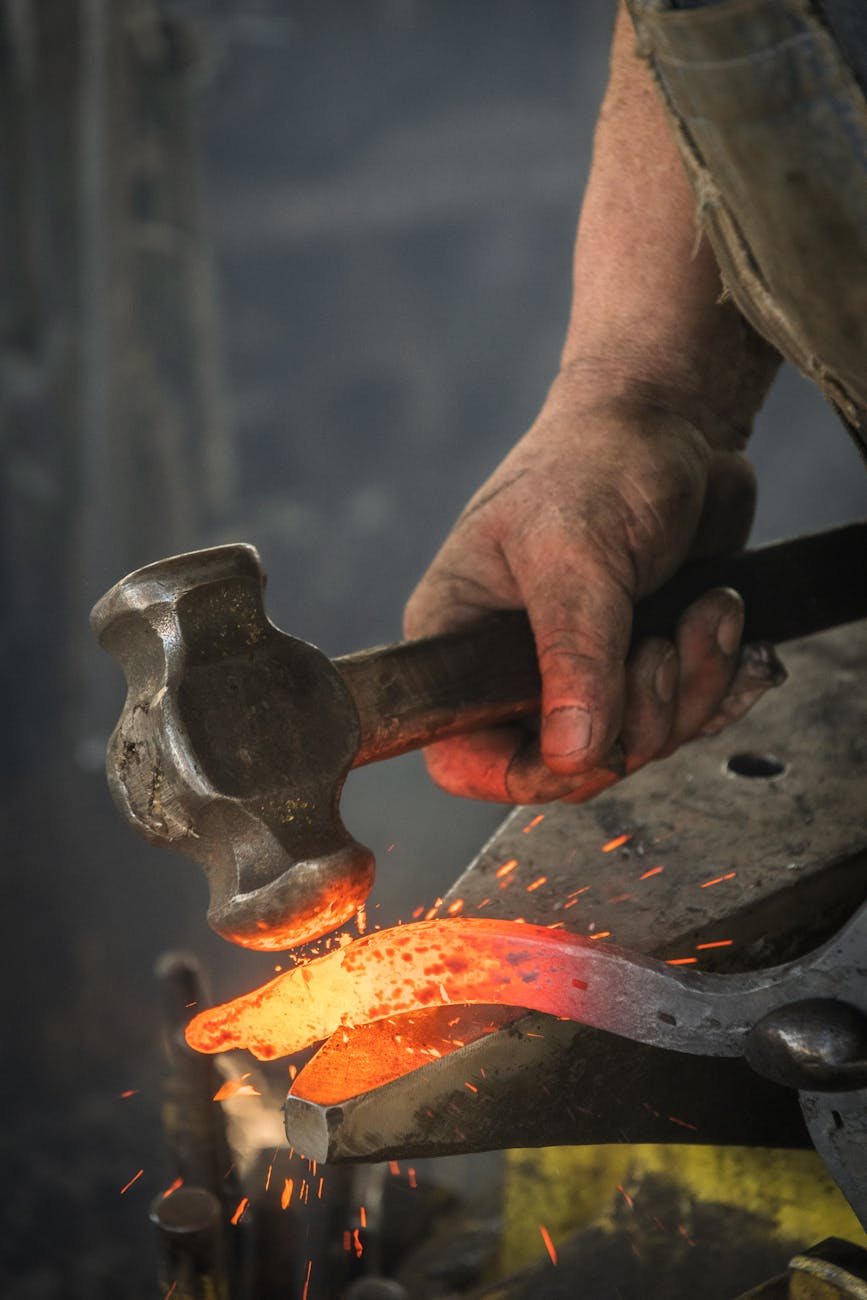
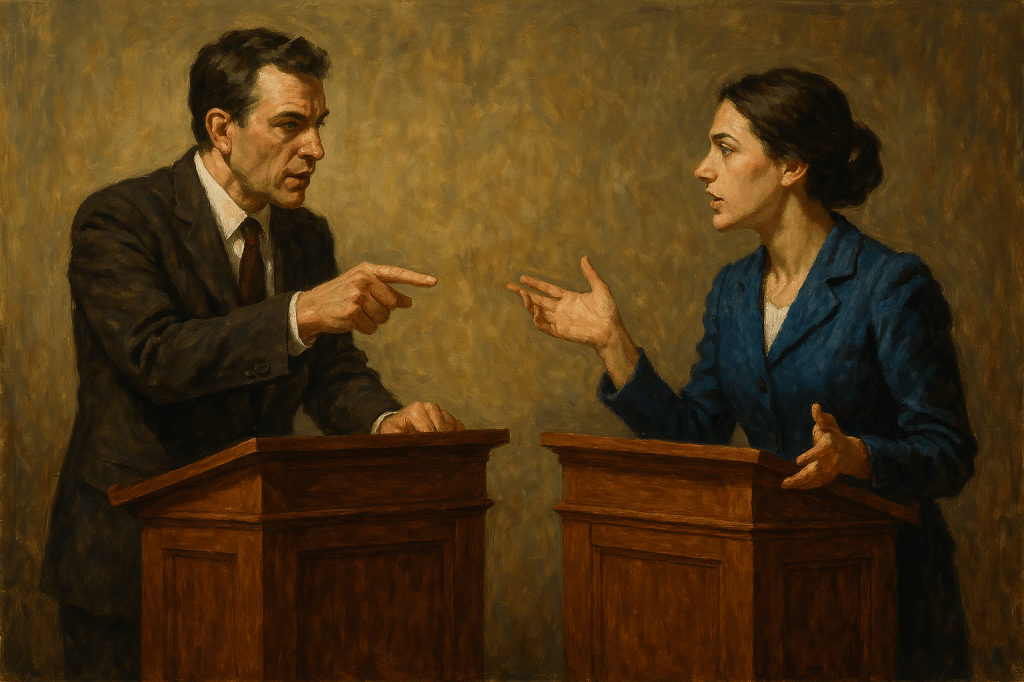
Any act of evil can be justified given a particular frame of mind.
Thus, the greatest safeguard is not against evil itself, but against the perverted frame of mind that would allow it.
Ambition Priority
Ambitions are good for life
But it is not good
If life is for the ambitions
The Mote in the Other Eye- Surrendering the Outcome
Distrust of Others)
In my previous post I talked about the popular trend of pinning all of the world’s problems on someone else and never taking accountability for one’s own side. I also admitted how I, too, have fallen into that trend many times, and how my conscience and Jesus’s words have always been there to convict me it is wrong to stay there.
At the end of the last post, I mentioned that when I recognize my folly and tell myself to focus on the beam in my own eye, there is a part of me that is worried about what might happen if I do so. That fear is based on a profound distrust of the “other side.” If I’m not there to keep them in check, who will be?
This is because our culture’s “us vs them” mentality leads us to shore up our own side even as we’re tearing down the other. In order to strengthen our arguments, we make ourselves blind to our own failings, excusing them as inaccurate or unimportant. So, now if I focus my energies on correcting myself instead, then that’s one less voice keeping the other side honest. Imagine if everyone on my side turned to self-introspection. We might take care of all the problems over here, but the other side’s problems will abound unfettered.
The Need for Surrender)
Well…yes, there is that potential outcome. There are other, more optimistic outcomes, but there is no guarantee of them. I do trust that good will ultimately prevail, but there is the possibility that if I focus on improving myself, the other side will run rampant in the meantime, and things will get worse for a while.
What this means, then, is that focusing on the beam in my own eye is not only an exercise in humility, but also a leap of faith. It means doing what is right in my own sphere with the hope, not the guarantee, that things will work out for the best because of it.
For this reason, I think an excellent companion to Jesus’s words on removing the beam from our own eyes is his later injunction that “if anyone would come after me, let him deny himself and take up his cross and follow me,” Matthew 16:24. Once again, he’s talking about picking up our own cross, denying our own self. And his use of the word “cross” makes clear that this is something hard, painful, and even dangerous.
Let’s take a moment to take these abstract concepts and personalize them. Just what would you call “your side,” and what would you call the “other side?” Conservatives? Liberals? The Patriarchy? Feminists? White supremacists? DEI peddlers? Colonizers? Immigrants? Whichever tribe you belong to, I’m sure that if you were honest there’s some house cleaning that is needed over there. Would you be willing to take up your cross and focus on the beam in your own eye? Would you be willing to stop hammering the other side as you set your gaze inward? It’s a lot to ask…but it is what is asked.
The Mote in the Other Eye- The Problem of Others
Who’s to Blame)
Everyone knows someone who is making the world worse. Everyone can identify popular ideals and propaganda that are harming society. Everyone knows who is to blame for things being the way that they are right now. Everyone knows how they’d like to change the world if they could. And people certainly make their opinions known. My news feeds and social media threads are constantly inundated with criticisms and accusations of “them.”
And I cannot claim to have never taken part in this pastime either. I could speak at great length about who I see as responsible for the greatest problems in the world today, and the deep resentment that I’ve harbored towards them.
But part of me has always felt guilty when my mind goes to that place. Part of me knows that at some point I crossed the line from “judging righteous judgment” to full-on condemning. Part of me knows that my desire to make everyone do what is right is not actually from God. It’s a sneaky misstep, because it’s oriented towards trying to establish ‘right,’ but its method of control is evil.
Focus Inward)
When I consider all of this, I am reminded of the words of Jesus: “How wilt thou say to thy brother, Let me pull out the mote out of thine eye; and, behold, a beam is in thine own eye?” Matthew 7:4. When I hear this, I realize that I’m not just wrong for letting my heart be filled with condemnation for another, but also because it has distracted me from focusing on the problems of my own side.
Of course, Jesus also suggested that after one had cleaned his own eye then he would see clearly enough to clean another’s. Honestly, I can’t speak to that, because I genuinely don’t feel that I am there yet. I suspect there are few who are. My focus for now is still on the first half of Jesus’s words.
The Reason for Reluctance)
I also want to make clear nowhere in Jesus’s injunction to focus on our own eye does he suggest that the other side doesn’t have problems. Even with my flawed judgment, I probably have identified some truly valid issues over on the other side. The idea that “they” need to change isn’t wrong, then, what’s wrong is thinking that I’m going to be the one to make them do it. I don’t have to stop my natural recognition of evil in the world, or condone any of it, but Christ is pointing out that everything would go much smoother if I acknowledged my own failings and worked on changing me, while “they” worked on changing “them.”
But what if I do work on me, and “they” don’t work on “them.” There is a real anxiety in this that manifests each time I try to pull myself back from policing the entire world. Tomorrow I will speak more at length on this fear, and how it can be remedied.
A Worthy Life

If it takes our whole life long just to find God, and to give Him our heart, and to regain our soul, it will have been worth it.
We Are Not Made for Peace

Made to War)
Many have envisioned a utopia where there is no more war and strife. Many have proposed by what method we could achieve such universal peace, though every attempt has failed. It is a strange paradox. Whether we have peace or not is obviously in our own hands, and it is hard to think of a more common goal, so why does it continually evade us? Why can’t we just stop fighting?
Because we are not made for peace.
We are a people that are designed to do battle. It is simply in our nature to fight. It is in our nature to draw a line and make war with whatever is on the other side of it. Yes, there is a part of us that craves calm and rest, but that part will always be overrun by our stronger, warrior nature. Battle is inevitable, and all of us are called to it. The need for war isn’t lessened by previous victories or having a rich life. The previous fathers’ wars do not satiate the hot blood of the rising generation.
This principle was found to be true in the shocking Universe 25 experiment with rats. The rodents were given a perfect Rat Utopia, with all the food, space, and sociality that they needed to thrive. And in every case, the rats eventually turned to self-destruction and brought about their own extinction. We may not be rats, but we carry that same fire within us.
A Divine Purpose)
But just because we are made to battle, does not mean that we have to use it for evil. Indeed, our warrior heart was given to us for a good purpose, and it is only when we twist it or suppress it that it bursts out in violence and hate.
God gave us warrior hearts so that we would have the motivation to battle our own inner demons. God made us restless in times of peace, because there is no end to the onslaught of temptation. God made us itch for a fight so that we wouldn’t be complacent about our flaws.
All of our lives are meant to be a struggle, though in the afterlife it may very well be different. Perhaps the part of us that yearns for peace looks to the afterlife, while the part of us that yearns for a fight looks to this life.
But one has to choose to wage war with the inner man. One can, instead, run from that fight, surrender to his worst impulses, and then his warlike nature has nowhere to go but outward. Even worse, because he gave control of his spirit up to the author of evil, his noble warrior heart becomes corrupted to one of cruelty.
Resolved to the Better Fight)
Trying to numb our desire to fight is misguided. That is trying to change our fundamental nature, which we cannot do.
Peace in this life will not be found by removing our desire to fight, but by each of us turning that fight inwards. Conflict never dies, but it can be transplanted. The global conflict can be internalized by the populace. We will only know peace in our society as we each accept that we will never know peace individually.
It may be a sobering reality: a lifetime of never-ending battle within the heart, but ironically, you can make peace with that war. You can accept it as a necessary component of life, something that you just have to do, and then it becomes easier. There are no easy answers, but there are at least answers.
Evidence in the Lack of Evidence
At key points in life, you must choose between that which is most beneficial to you and that which you know to be right. You will have to decide if you follow your conscience, even when there is no reason to assume a positive outcome for yourself.
It only stands to reason, however, that if you ever want to live in the hands of the supernatural, beyond the confines of mortal logic, that at some point you must make a choice just like this. Earthly outcomes follow choices based on earthly evidence. If you ever want a heavenly outcome, at some point you must leap with nothing earthly in view to catch you.
Thus, watch for these moments where there is no evidence that things will work out well, and in those moments take courage in the knowledge that the lack of evidence is the greatest evidence of all.
Reciprocity of Good
Every parent hopes that the world will be good to our children.
Certainly, we do what we can to shape the world in that direction, but there is only so much that we can do.
Far more effective, then, is to shape our children to be good to world, and then trust that reciprocity will see good reflected back to them.
The Richness of Scriptural Symbolism- The Final Symbol
Infinitely One)
Here at the end of this series I must acknowledge that I haven’t even scratched the surface of symbols in the Bible. There are so many different symbols, found in the parables, in the actions of everyday people, in the dreams, in the prophecies, in the patterns, and in the static images. I’ve known all along that this study would never be complete, that I could not cover all of the relevant material, that at some point I would just have to call it good enough and bring it to an end. It would be impossible to ever make a full assessment of what all the symbols are and what they stand for.
Yet for all this infinite variety of symbolism, it is at the same time entirely singular as well. Every basic symbol points to something higher, and every higher symbol points to something higher still. Together they form a great upward rising column, narrowing and converging as they ascend, until they point to the one: God, Himself. All of the symbolism in the Bible is meant to funnel our attention to Him.
As another book of scripture states:
The scriptures are laid before thee, yea, and all things denote there is a God; yea, even the earth, and all things that are upon the face of it, yea, and its motion, yea, and also all the planets which move in their regular form do witness that there is a Supreme Creator.
-Alma 30:44
Throughout this series I have been trying to identify the key qualities of good symbols in the scriptures. I have mentioned that they connect to something fundamental in the human experience, that they repeated play out in our collective lives, and that they can stand for multiple things at once, even polar opposites. All of these are good hallmarks, but the most important of them all is this quality that was identified just above: that they point us upwards, ultimately leading us back to the Creator. We know that we are recognizing a good symbol when it is bringing us to our Father.
One Last Symbol)
Now I would be remiss if I didn’t acknowledge one final great trick in all this symbolism. Remember what I said: that all of these infinite symbols point upward, ascending together as a column, combining in one that is God. Thus, God is the INFINITE…ONE. And once we start talking cosmic paradoxes like that, we should immediately realize that we are talking, once again, about a symbol.
God is Himself…a symbol.
He is the condensed, singular representation of the infinity that is also Him. He is the circle that is one, finite line, which circumscribes infinite angles. He is the recursive loop that is both self-terminating and also never-ending. He is the word that is used to define all other words and thus requires all other words to define itself.
It is God who shows us symbols, and those symbols are there to show us God, and that cyclical pattern is itself a symbol that God is showing us and that is also showing us God.
Symbols are much, much more than amusing, little mysteries. They are nuggets of eternity. They are part of a system that defies our capability to fully comprehend. We may extract from them what we can, and as we do, they in turn extract from us our spiritual transcendence.
The Richness of Scriptural Symbolism- Static Images
Throughout this series we have looked at symbols in their most complex forms and gradually introduced simpler and simpler forms. We started with lived-out moments that reenact something bigger, then moved on to carefully constructed parables, and most recently we looked at brief dream sequences which stripped away context and story to provide concentrated symbolic scenes.
There is, of course, an even simpler form of symbols and it is probably the first form that comes to mind when we heard the word. It is symbols as single, static images. These are things like the Christian Cross, the Star of David, or the Scales of Justice.
An argument could certainly be made that the more fundamental a symbol is, the more applications and representations it will hold. This would mean that these single static images will often have the most interpretations of all.
In today’s post we will take a look at two examples of this type of symbol and consider the sorts of things that they might stand for. I should first note, though, that while both of these symbols are religious, neither is divinely established in any religious text. There is no scripture that says that these specific symbols should be part of the iconography of the Jewish or Christian people, so let us not assume that these symbols are necessarily under God’s authorship.
The Star of David)

The first symbol we will consider is the Star of David. This six-pointed star has long been a symbol of the Jewish faith and is even the central element in the flag of Israel. Perhaps the first representation that we see in it is the fact that it is a star, or a sun, thus something that provides light and guidance, or which can be a marker to guide us along our way.
We also notice that there is one large hexagon in the middle, surrounded by six small triangles that extend from its sides. This could be seen as God in the center, with all other creations gathered in observation of Him. It even brings to mind Joseph’s dream of standing in the midst of his brethren as they bowed to him.
Of course, one can also see the shapes of two equilateral triangles, one upright and one inverted, offset and overlapping. With this view in mind, we can see one triangle as God descending downward and the other as mankind extending upward, the overlap being where the two come into union with one another. To the Jew, that place of union could be seen as the Law or the temple, while to the Christian it would be Christ.
The Christian Cross)

The Christian Cross must be one of the simplest symbols ever made: two lines crossing at right angles. Of course, it immediately invokes memories of the crucifixion of Jesus Christ. When considering that application, it becomes simultaneously a symbol of man’s greatest cruelty and God’s greatest mercy, an interesting paradox.
The vertical line of the cross can also be seen to stand for God, while the horizontal line stands for the earth, or the horizon. The point of juncture in the middle then has a similar meaning to the overlapping triangles in the Star of David: the place where heaven meets earth, meaning the church or Jesus.
With our modern system of world coordination, the crossing lines can also be seen as a longitude and a latitude, suggesting the ability to pinpoint where we stand spiritually, or suggesting a guided destination for where we need to go.
Summary)
We could go on quite a bit lot longer in our analysis of each symbol. Hopefully this has been enough to establish that their simplicity does not make their applications few. Rather, it is the inverse. Because they are such a basic representation of something so fundamental, their applications are virtually infinite. They are literal signs, pointing the way to much, much more