Commitment to the Ideal: A Richer Soil

A Difficult Requirement)

Yesterday I spoke of the trouble in having all of our relationships and commitments based purely on the attributes of the other person. If we only show love and devotion to those who love and are devoted to us, then we are not following Christ’s mandate to “bless them that curse you, do good to them that hate you, and pray for them which despitefully use you, and persecute you” (Matthew 5:44).

How do we offer such blessing, and good, and prayers, to those that are unpleasant to us. And how do we “give; not grudgingly, or of necessity: for God loveth a cheerful giver?” (2 Corinthians 9:7).

Love for the Ideal)

The answer that I have found is that we must have a love for the principle and ideal, one that is even more foundational to us than love for the individual. As I consider our society today, I see a great need for people who are not just devoted to their spouse, but to the very idea of marriage in-and-of-itself. We need people who are not just committed to taking care of their children, but who are committed to the role of fatherhood or motherhood itself. We need people who are not just supporters of their friends, but who are supporters of friendship itself.

If people loved marriage, loved parenthood, loved friendship, and loved neighborliness, then they could continue to act in those roles even when the other side of those relationships turned cold. If, instead, when companions turn from us, we abandon our relationship with them, we reveal that marriage, parenthood, friendship, and neighborliness never really meant anything to us at all. We just wanted to get, and if we couldn’t get, we wouldn’t be had.

Of course, I would advise anyone that they should marry someone that they genuinely love, and raise their kids to be people that they genuinely like, and build friendships with people that are genuinely good for them, and settle down in a neighborhood that is genuinely inviting. I believe it is right and wise to plant one’s relationships in promising ground, but sometimes the topsoil erodes, and roots must cling to something deeper if the relationship is to survive.

A Choice of Who to Be)

If one does not care whether the relationship survives after the initial excitement has worn off, then they hold a very shallow view of what it means to be a spouse, a parent, a friend, and a neighbor. They will never have a relationship of true depth and meaning. They will live petty and forgettable lives.

If, on the other hand, one remains committed to a marriage, a parent-child relationship, a friendship, and a community, through good times and bad, then that is a person whose bonds actually mean something. That is a person who is living a life of value.

At the end of the day, we are temporal, transient beings, and also the other people in our lives, so our commitment to them is naturally temporary and dynamic as well, ever shifting from moment to moment. We can, however, have a deep, abiding, and overriding commitment to an ideal. We can always believe in marriage, in fatherhood and motherhood, in friendship, and in neighborliness. We can be devoted to those ideals even when the relationship to the other person grows stale. We can continue giving of ourselves to those ideals with a passionate and cheerful heart, no matter how we feel about the person receiving on the other side. It is our commitment to the ideal that will see us through every drought and flood, every change of season, and every passing year.
Commitment to the Ideal: Transient Devotion

The Hardest Love)

One of the hardest instructions Jesus gave to his followers was that they were to love their enemies:

32 For if ye love them which love you, what thank have ye? for sinners also love those that love them.

33 And if ye do good to them which do good to you, what thank have ye? for sinners also do even the same.

35 But love ye your enemies, and do good, and lend, hoping for nothing again; and your reward shall be great, and ye shall be the children of the Highest: for he is kind unto the unthankful and to the evil.

Luke 6:32-33, 35

I cannot imagine a time or culture where this mandate wouldn’t go against the grain. I believe it is inherent in our humanity to value those that are good to us, and to despise those that are not.

How, then, are we meant to overcome this basic nature and live another way? It would be one thing if Jesus had said to “put up” with our enemies, or to “resentfully tolerate” them, but he didn’t. He said to love them, and that suggests having cultivated a state of mind and heart that is totally unnatural.

I could easily do an entire series that explores multiple answers to this question. For now, though, I will just take two posts to examine one way in which people fail this mandate, and one solution to that failing. The failure is this: commitment to the person, and the solution is this: commitment to the ideal.

The Failure)

I hear many times in our culture when a person expresses his love, commitment, and devotion to another person, and he gives as his reasons a positive attribute that applies to that person today. Consider these examples:

“I always listen to my wife because she believes in me when no one else does.”
“I need to be a good neighbor because they’ve always been good to me.”
“I’ll always give everything to my children because they bring me such joy.”
“I’ll always be there for my friends because they’re always there for me.”

I think statements like these are popular because they are flattering to the person in question, but they also establish a culture in which devotion is conditional. Implicit in all of these is that the speaker’s undying affection is dependent upon the other person continuing to show up in a way that is positive.

What if the wife stops believing in him? And the neighbors become indifferent? And the children make disagreeable choices? And the friends let him down in a time of need?

These statements of devotion are very transient and weak. They essentially communicate that “I will be dedicated to you, so long as you remain as someone that I like.” Unfortunately, and unsurprisingly, the behavior seems to follow the words. Even in our most sacred of mortal relationships, that of marriage, a man and a woman will separate themselves from one another for no other reason than, “we just don’t get along anymore.” Their commitment to one another was based on nothing more than personal delight, and once that delight is gone, so is their commitment.

In addition to being unhealthy for our society, this sort of transient devotion flies in the face of Jesus’s teaching. Our love, our commitment, our devotion was never meant to be dependent on the personal attributes of those we associate with. We were supposed to be able to love and be committed to the wellbeing of everyone, even our enemies.

Just how exactly can we foster this sort of unconditional love and devotion within us? I delve into my answer in my next post.

Tended Towards Ruin

A Heavy Loss)

There was a project that I once loved very much. It was a program oriented towards connecting men with God, helping them to bring their hearts back into His light. It was small and local, humble and unpolished, but it did truly miraculous things in the lives of those who attended it. Lately, though, I’ve found myself struggling to recognize that same institution from what it has become today. At some point, after about ten years of operation, the institution became a for-profit organization, and changes started being made for the betterment of the bottom line, not for the betterment of the men it served. Several of the original founders quit, due to personal disagreement with this new direction.

This has been a heavy thing for me to come to grips with, but as I have reflected on it I’ve realized that it was always going to go something like this. The special spirit of the old program had to meet its end one way or another, because that’s just the nature of things.

Tale as Old as Time)

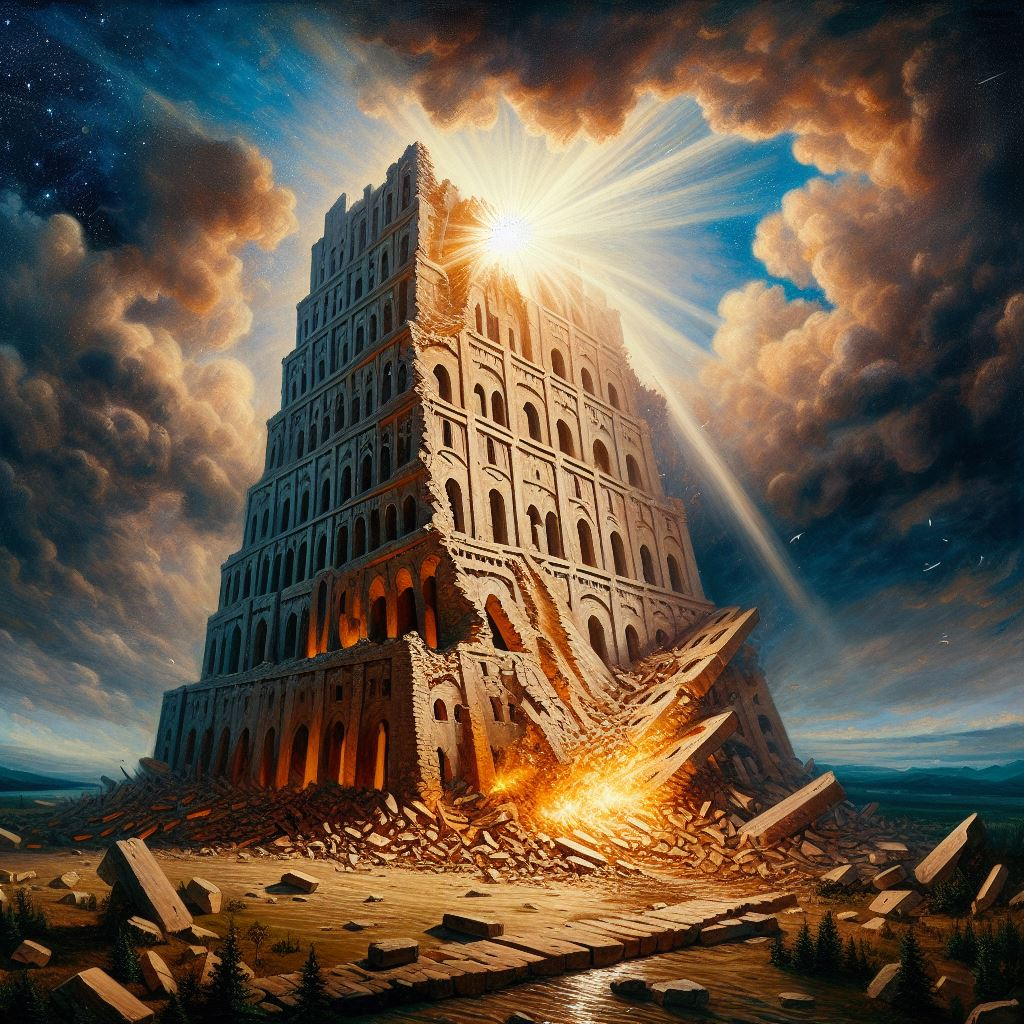
I am reminded of the story of the tower of Babel. In it, a nation of people decide to build a great tower, reaching all the way to heaven. Bold enough to make themselves gods, they toiled and labored on this great elevation of man until the whole thing toppled to the ground.

We do not know exactly how high they built their tower, only that it fell before they could achieve their aim. Their construction became destruction, their order became ruin, and the people were returned back to the level of the fallen earth.

This, of course, is a type for all manner of structures in the world today. And I don’t merely mean physical structures, either. Even more so it applies to structures of law, of government, of ideology, of any edifice constructed by the wisdom of man.

The Way of Things)

Every club, organization, corporation, and ideal is laid with ruin in its foundation. On the one hand, this might be because they are laid with carnal and earthly motivations, such as focus on profit or notoriety. Once making money is one of the organization’s pillars, then it is tied to the natural things of this earth, all of which decay, erode, and finally collapse. Through the years we have seen countless companies over-exploit their workers, consumers, and intellectual properties, killing the golden goose just to get a higher profit in the short term. We have seen countless governments siphon power and wealth to the highest class until they became too top-heavy and collapsed under their own weight. The compromises that were deemed necessary to make the enterprise possible eventually make its continued existence impossible.

But even without a foundation of earthly motivations, every structure of man is still doomed to fall due to our fundamentally flawed nature. Even our organizations that are built on ideal, and virtue, and purity of intention, gradually erode and eventually go wrong entirely. Even if a core principle is worthy, if it is taken slightly too far at the beginning, it will magnify and accelerate over time, eventually becoming a great evil. It is like stacking blocks to build a taller and taller tower, given enough time and distance every structure leans too far one way or the other. Given enough time and distance, every little flaw becomes a crushing error, and the whole thing will topple. So an organization founded with a focus on discipline will eventually become fascistic oppression, whereas a focus on liberty will eventually become gross hedonism. We sow the death even in the birth, it is simply our nature.

Even God’s church, once entrusted to earthly stewards, is tended toward ruin. The world was in a state of apostasy in the time of Noah, and in the time of Abraham, and in the time of Jesus. God has to refresh His word among His people repeatedly, not because His word has deteriorated, but because we people just keep losing our grasp of it. We know that even the believers today will once again be on the brink of ruin when God will have to refresh everything with the second coming.

What Lasts)

Ironically, what truly lasts is what seems most transient. Though man’s works are doomed to fail, along the way they house occasional sparks of something pure and genuine. There can be a nugget of God in the midst of all the stone. And though that nugget seems momentary and transient, it is only because we are perceiving it through a shifting lens. In actuality, each of those nuggets is anchored in something realer and truer than the structure it was found within.

There is an entity behind all those sparks, a constant certainty beneath every brief wonder. By fastening ourselves to these pearls, and following their threads to deeper things, we tie ourselves to the only thing that is actually eternal.

The man-made program I once loved may be gone, but the experiences I found within it have not. Those experiences introduced me to the One who hasn’t changed at all, and never will. In reality, I haven’t lost a thing.