Scriptural Analysis- Exodus 27:18-19

18 The length of the court shall be an hundred cubits, and the breadth fifty every where, and the height five cubits of fine twined linen, and their sockets of brass.

19 All the vessels of the tabernacle in all the service thereof, and all the pins thereof, and all the pins of the court, shall be of brass.

The dimensions of the entire courtyard are restated, and also we are told that the height of the curtain walls will be five cubits, the same as the width of each individual curtain. Five cubits is approximately 7.5 feet, so tall enough to conceal the interior courtyard from the outside view. However, it is only half of the height of the tabernacle walls which were ten cubits high, or 15 feet.

The effect of this would be that from a distance one would be able to see the wall, and then the top of the tabernacle floating above it. As one approached, and the angle to the top of the wall became steeper, the top of the building would descend out of view, but of course, after one passed through the outer gate, then they would be able to see the entire tabernacle, base to top.

Personally, that feels a lot like my own spiritual journey. I caught a glimpse of heaven from afar, and I start to move towards it, but then obstacles and doubts begin to cloud what I had previously witnessed. When I push on, though, even when I cannot hold the vision of heaven before me, I eventually press through the wall and it appears to me, fuller and truer than ever before.

Note: It can be difficult to visualize some of the structures described in these verses. Here is an excellent and extremely focused series of animations that show the visual form of the temple and its instruments, built up verse-by-verse from the Exodus record: https://youtube.com/playlist?list=PLpjohncRg94EZ55nJrbaKfi-lfeo3MFgl&si=6wm1J9Sdnu7LKYC_
Scriptural Analysis- Exodus 27:12-17

12 And for the breadth of the court on the west side shall be hangings of fifty cubits: their pillars ten, and their sockets ten.

13 And the breadth of the court on the east side eastward shall be fifty cubits.

14 The hangings of one side of the gate shall be fifteen cubits: their pillars three, and their sockets three.

15 And on the other side shall be hangings fifteen cubits: their pillars three, and their sockets three.

16 And for the gate of the court shall be an hanging of twenty cubits, of blue, and purple, and scarlet, and fine twined linen, wrought with needlework: and their pillars shall be four, and their sockets four.

17 All the pillars round about the court shall be filleted with silver; their hooks shall be of silver, and their sockets of brass.

Yesterday we heard of the north and south walls of the courtyard, which are the two long sides. Now we hear about the two shorter sides on the east and west. Each of these will be fifty cubits long, or 75 feet. Thus, the length of the courtyard is exactly double the width, and the width of the courtyard is about 4 times the width of the tabernacle that sits inside of it, once again allowing ample room to move around its perimeter.

As with the long sides, the short sides are to have 5-cubit long curtains, with pillars in between. On the east side, where one enters, there will be fifteen cubits of wall on each side of a twenty-cubit gate, divided into four portions, with four pillars in between. As mentioned yesterday, we are not explicitly told the color of the courtyard wall, but many assume that it was white. This gate, however, we are told will match with the curtains of the tabernacle: blue and purple and scarlet, decorated with fine needlework. Thus, the entry to the courtyard is marked with the design of the inner tabernacle.

This outer appearance of the interior pattern seems symbolic to me. Many the sinner has seen the pattern of God in his first steps back towards absolution. While the sinner may yet have a way to go to reach wholeness, he perceives that he is already on the road to paradise. This seems to be reflected in how one passes through a blue-purple-scarlet gate, even before having made their sacrifice, and even if they are not able to pass into the holy place, or the most holy place. They are still on the path that ultimately, through the end of this life and into the next, will allow them to pass into all of the Lord’s most holy places, and that truth is alluded to at the very first gate.

Note: It can be difficult to visualize some of the structures described in these verses. Here is an excellent and extremely focused series of animations that show the visual form of the temple and its instruments, built up verse-by-verse from the Exodus record: https://youtube.com/playlist?list=PLpjohncRg94EZ55nJrbaKfi-lfeo3MFgl&si=6wm1J9Sdnu7LKYC_

Scriptural Analysis- Exodus 27:9-11

9 And thou shalt make the court of the tabernacle: for the south side southward there shall be hangings for the court of fine twined linen of an hundred cubits long for one side:

10 And the twenty pillars thereof and their twenty sockets shall be of brass; the hooks of the pillars and their fillets shall be of silver.

11 And likewise for the north side in length there shall be hangings of an hundred cubits long, and his twenty pillars and their twenty sockets of brass; the hooks of the pillars and their fillets of silver.

The external wall around the court of the tabernacle would be a long stretch of linen, twenty sheets long, covering a distance of 150 feet. This means that the tabernacle itself would be less than a third of the courtyard’s full length. There would therefore be a great deal of room for gathering and performing sacrifices at the altar.

This outer linen wall is typically said to have been white, though I cannot find an official verification of that in the scriptures. Undyed linen is usually a white or off-white color, so perhaps the assumption is that it would have been that color by default. If so, it would have stood out brightly against the earthy tones of the wilderness and would have been an obvious symbol of purity. If it were white, that does raise the question of how the parts of the tabernacle were maintained, cleaned, and replaced. The bible account does not shine a light there, though.

The linen wall was not a single, unbroken sheet, but was interrupted twenty time by pillars. We are not told the interior material of the pillars, but one would assume shittim wood, as with every other component. Interestingly, we are also not told of any metal overlay upon the pillar. We are told that its sockets would be brass, to match the rest of the courtyard elements, and its hooks would be of silver, but it would seem that the body of the pillar was just bare wood. The transition from bare wood pillars to gold-overlaid pillars seems like a symbol of the change of the naked, natural man being clothed by God’s grace and atonement, just like Adam and Eve as they left the garden of Eden.

Note: It can be difficult to visualize some of the structures described in these verses. Here is an excellent and extremely focused series of animations that show the visual form of the temple and its instruments, built up verse-by-verse from the Exodus record: https://youtube.com/playlist?list=PLpjohncRg94EZ55nJrbaKfi-lfeo3MFgl&si=6wm1J9Sdnu7LKYC_

Scriptural Analysis- Exodus 26:26-30

26 And thou shalt make bars of shittim wood; five for the boards of the one side of the tabernacle,

27 And five bars for the boards of the other side of the tabernacle, and five bars for the boards of the side of the tabernacle, for the two sides westward.

28 And the middle bar in the midst of the boards shall reach from end to end.

29 And thou shalt overlay the boards with gold, and make their rings of gold for places for the bars: and thou shalt overlay the bars with gold.

30 And thou shalt rear up the tabernacle according to the fashion thereof which was shewed thee in the mount.

Yesterday we heard how the rear corners would have couplings to help hold the separate walls together as one. There would need to be greater support however, as thus far all 48 boards are freestanding one next to the other, with nothing to stop them tipping over and falling.

Today’s verses address that by describing how rings would be put in the boards, through which long bars would be inserted. Five bars would be run through for each side, holding each wall together as one. Thus fifteen bars in all, to support three different walls.

Verse 28 mentions that the central bar would reach from one end to another, presumably meaning that it would run the full length of the wall. It is unclear whether the other bars would also run the full length of their walls, but it seems like that would be the most sturdy design.

With this we reach the end of the description for the exterior walls of the tabernacle, and in verse 30 we are once again told that Moses was shown the design of it all in the mountain, in addition to receiving the written description. The combination of both word and picture is a very powerful combination. Words are able to be much more technical and precise, detailing exact measurements and dimensions, but it is easy to get lost in the words and lose all context of what any of them mean. An image, on the other hand, may lack the specific measurements, but it provides an abiding context that puts all of the words in their proper place. The two methods of instruction combined create the greatest understanding.

Note: It can be difficult to visualize some of the structures described in these verses. Here is an excellent and extremely focused series of animations that show the visual form of the temple and its instruments, built up verse-by-verse from the Exodus record: https://youtube.com/playlist?list=PLpjohncRg94EZ55nJrbaKfi-lfeo3MFgl&si=6wm1J9Sdnu7LKYC_

Shutting God Out

Sometimes when I converse with God I hear the kindest, warmest, and most loving voice I have ever heard. At other times, He seems clinical and formal, still telling me good things, but without His usual warmth. As I have examined those different experiences I have come to realize that it is not God who changes His manner, but I who change what tone I am willing to receive.

When God feels direct and cold to me, it is because I am not open to receiving His love. Sometimes I am frustrated with myself, unwilling to love myself, and so I set up a wall to keep His love out also. He speaks to me as kindly as I allow Him.

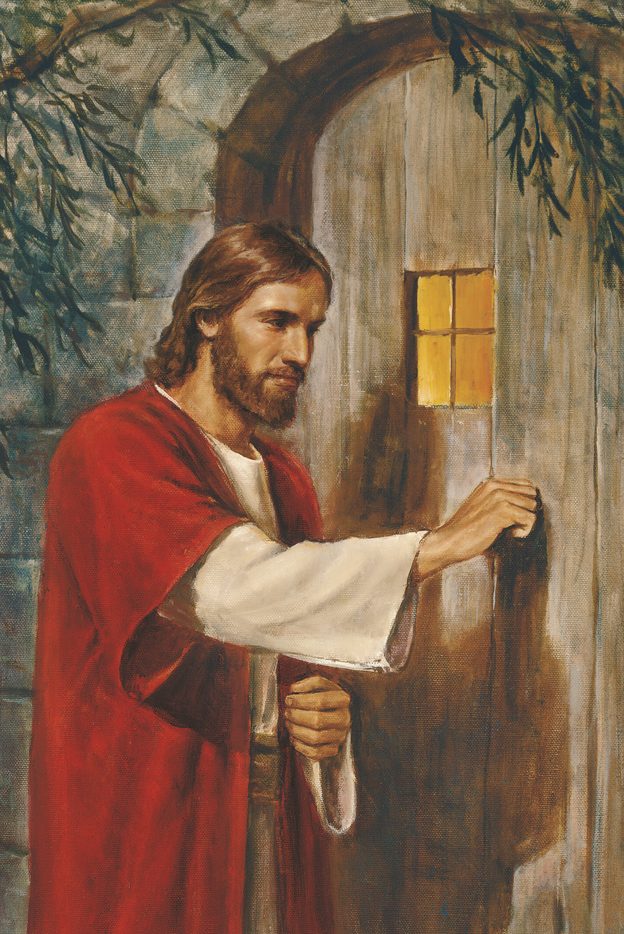
Sometimes He doesn’t just sound cold, though, sometimes I can’t even hear Him at all. But once again, it isn’t because He has abandoned me, but because I have gone and shut myself in a room without Him. Even then, though, “he stands at the door, and knocks: and if I will open the door, he will come in with me,” (Revelation 3:20).

And the fact that he will come in with me has been the most meaningful thing to me in those low moments. He doesn’t require me to break down my walls and come out into the open if I’m not yet willing to. He is content to come stay in the dark hovel with me. He will sit with me in the shadow, with only His presence for a light, until I’m finally ready to leave.